Real Austerity!
p. 17 · Read in the full issue
What American Lutherans Are Undergoing in N. Guinea
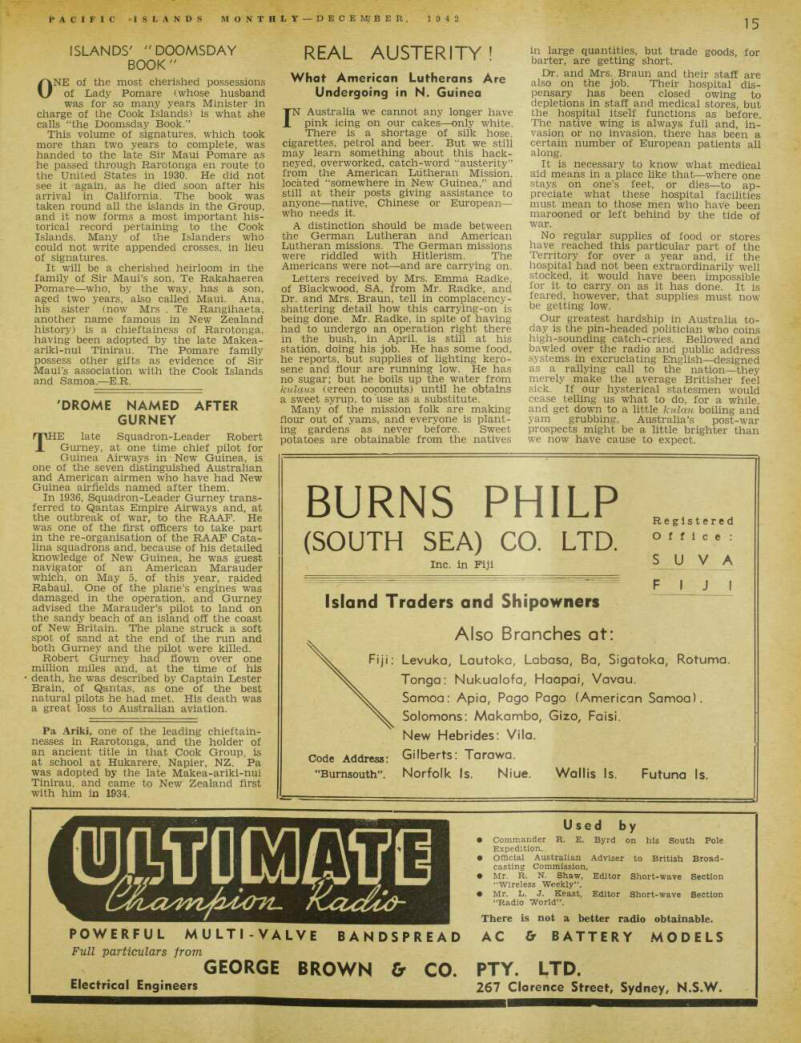
IN Australia we cannot any longer have pink icing on our cakes—only white.
There is a shortage of silk hose, cigarettes, petrol and beer. But we still may learn something about this hack neyed, overworked, catch-word “austerity” from the American Lutheran Mission, located “somewhere in New Guinea,” and still at their posts giving assistance to anyone—native, Chinese or European— who needs it.
A distinction should be made between the German Lutheran and American Lutheran missions. The German missions were riddled with Hitlerism. The Americans were not —and are carrying on.
Letters received by Mrs. Emma Radke. of Blackwood, SA, from Mr. Radke, and Dr. and Mrs. Braun, tell in complacency shattering detail how this carrying-on is being done. Mr. Radke, in spite of having had to undergo an operation right there in the bush, in April, is still at his station, doing his job. He has some food, he reports, but supplies of lighting kero sene and flour are running low. He has no sugar; but he boils up the water from kulaus (green coconuts) until he obtains a sweet syrup, to use as a substitute.
Many of the mission folk are making flour out of yams, and everyone is plant ing gardens as never before. Sweet potatoes are obtainable from the natives
in large quantities, but trade goods, for barter, are getting short.
Dr. and Mrs., Braun and their staff are also on the job. Their hospital dis pensary has been closed owing to depletions in staff and medical stores, but the hospital itself functions as before.
The native wing is always full and, in vasion or no invasion, there has been a certain number of European patients all along.
It is necessary to know what medical aid means in a place like that—where one stays on one’s feet, or dies—to ap preciate what these hospital facilities must mean to those men who have been marooned or left behind by the tide of war.
No regular supplies of food or stores have reached this particular part of the Territory for over a year and, if the hospital had not been extraordinarily well stocked, it would have been impossible for it to carry on as it has done. It is feared, however, that supplies must now be getting low.
Our greatest hardship in Australia to day is the pin-headed politician who coins high-sounding catch-cries. Bellowed and bawled over the radio and public address systems in excruciating English—designed as a rallying call to the nation—they merely make the average Britisher feel sick. If our hysterical statesmen would cease telling us what to do, for a while, and get down to a little kulau boiling and yam grubbing, Australia’s post-war prospects might be a little brighter than we now have cause to expect.