After The War?
p. 16 · Read in the full issue
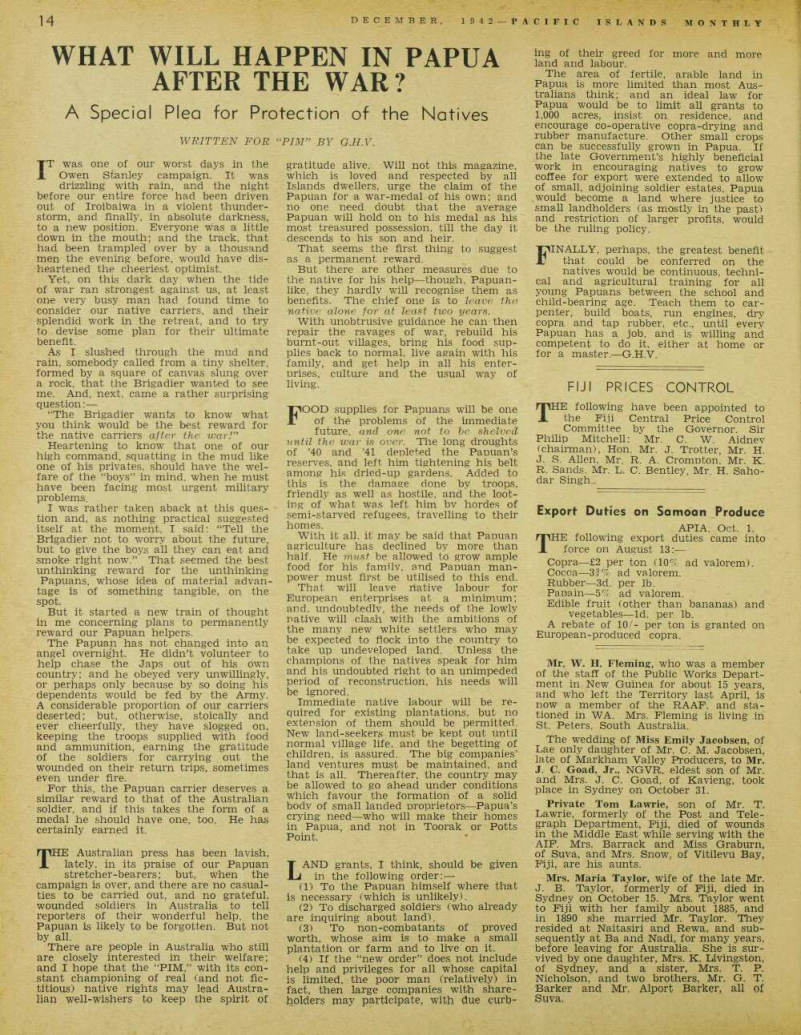
What Will Happen In Papua
A Special Plea for Protection of the Natives
Wkitten For “Pim” By G.H.V.
IT was one of our worst days in the Owen Stanley campaign. It was drizzling with rain, and the night before our entire force had been driven out of Iroibaiwa in a violent thunder storm, and finally, in absolute darkness, to a new position. Everyone was a little down in the mouth; and the track, that had been trampled over by a thousand men the evening before, would have dis heartened the cheeriest optimist.
Yet, on this dark day when the tide of war ran strongest against us, at least one very busy man had found time to consider our native carriers, and their splendid work in the retreat, and to try to devise some plan for their ultimate benefit.
As I slushed through the mud and rain, somebody called from a tiny shelter, formed by a square of canvas slung over a rock, that the Brigadier wanted to see me. And, next, came a rather surprising question:— “The Brigadier wants to know what you think would be the best reward for the native carriers after the war!”
Heartening to know that one of our high command, squatting in the mud like one of his privates, should have the wel fare of the “boys” in mind, when he must have been facing most urgent military problems.
I was rather taken aback at this ques tion and, as nothing practical suggested itself at the moment, I said: “Tell the Brigadier not to worry about the future, but to give the boys all they can eat and smoke right now.” That seemed the best unthinking reward for the unthinking Papuans, whose idea of material advan tage is of something tangible, on the spot.
But it started a new train of thought in me concerning plans to permanently reward our Papuan helpers.
The Papuan has not changed into an angel overnight. He didn’t volunteer to help chase the Japs out of his own country; and he obeyed very unwillingly, or perhaps only because by so doing his dependents would be fed by the Army.
A considerable proportion of our carriers deserted; but, otherwise, stoically and ever cheerfully, they have slogged on, keeping the troops supplied with food and ammunition, earning the gratitude of the soldiers for carrying out the wounded on their return trips, sometimes even under fire.
For this, the Papuan carrier deserves a similar reward to that of the Australian soldier, and if this takes the form of a medal he should have one, too. He has certainly earned it.
THE Australian press has been lavish, lately, in its praise of our Papuan stretcher-bearers; but, when the campaign is over, and there are no casual ties to be carried out, and no grateful, wounded soldiers in Australia to tell reporters of their wonderful help, the Papuan is likely to be forgotten. But not by all.
There are people in Australia who still are closely interested in their welfare; and I hope that the “PIM,” with its con stant championing of real (and not fic titious) native rights may lead Austra lian well-wishers to keep the spirit of
gratitude alive. Will not this magazine, which is loved and respected by all Islands dwellers, urge the claim of the Papuan for a war-medal of his own; and no one need doubt that the average Papuan will hold on to his medal as his most treasured possession, till the day it descends to his son and heir.
That seems the first thing to suggest as a permanent reward.
But there are other measures due to the native for his help—though, Papuan like, they hardly will recognise them as benefits. The chief one is to leave the native alone for at least two years.
With unobtrusive guidance he can then repair the ravages of war, rebuild his bumt-out villages, bring his food sup plies back to normal, live again with his family, and get help in all his enter prises, culture and the usual way of living.
FOOD supplies for Papuans will be one of the problems of the immediate future, and one not to he shelved until the war is over. The long droughts of ’4O and ’4l depleted the Papuan’s reserves, and left him tightening his belt among his dried-up gardens. Added to this is the damage done by troops, friendly as well as hostile, and the loot ing of what was left him bv hordes of semi-starved refugees, travelling to their homes.
With it all. it may be said that Papuan agriculture has declined by more than half. He must be allowed to grow ample food for his family, and Papuan man power must first be utilised to this end.
That will leave native labour for European enterprises at a minimum: and, undoubtedly, the needs of the lowly native will clash with the ambitions of the many new white settlers who may be expected to flock into the country to take up undeveloped land. Unless the champions of the natives speak for him and his undoubted right to an unimpeded period of reconstruction, his needs will be ignored.
Immediate native labour will be re quired for existing plantations, but no extension of them should be permitted.
New land-seekers must be kept out until normal village life, and the begetting of children, is assured. The big companies’ land ventures must be maintained, and that is all. Thereafter, the country may be allowed to go ahead under conditions which favour the formation of a solid body of small landed proprietors—Papua’s crying need —who will make their homes in Papua, and not in Toorak or Potts Point, LAND grants, I think, should be given in the following order:— (1) To the Papuan himself where that is necessary (which is unlikely). (2) To discharged soldiers (who already are inquiring about land). (3) To non-combatants of proved worth, whose aim is to make a small plantation or farm and to live on it. (4) If the “new order” does not include help and privileges for all whose capital is limited, the poor man (relatively) in fact, then large companies with share holders may participate, with due curb
ing of their greed for more and more land and labour.
The area of fertile, arable land in Papua is more limited than most Aus tralians think; and an ideal law for Papua would be to limit all grants to 1,000 acres, insist on residence, and encourage co-operative copra-drying and rubber manufacture. Other small crops can be successfully grown in Papua. If the late Government’s highly beneficial work in encouraging natives to grow coffee for export were extended to allow of small, adjoining soldier estates, Papua .would become a land where justice to small landholders (as mostly in the past) and restriction of larger profits, would be the ruling policy.
FINALLY, perhaps, the greatest benefit that could be conferred on the natives would be continuous, techni cal and agricultural training for all young Papuans between the school and child-bearing age. Teach them to car penter, build boats, run engines, dry copra and tap rubber, etc., until every Papuan has a job, and is willing and competent to do it. either at home or for a master. —G.H.V.