Malinowski
p. 20 · Read in the full issue
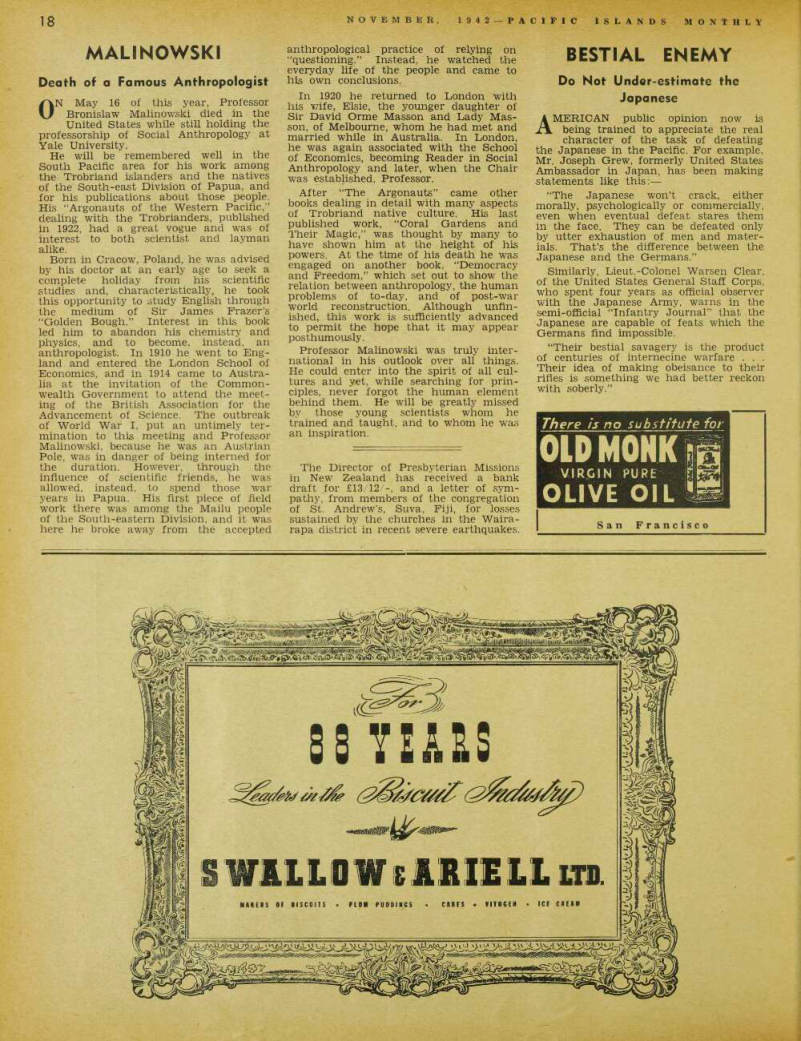
Death of a Famous Anthropologist
ON May 16 of this year, Professor Bronislaw Malinowski died in the United States while still holding the professorship of Social Anthropology at Yale University.
He will be remembered well in the South Pacific area for his work among the Trobriand islanders and the natives of the South-east Division of Papua, and for his publications about those people.
His “Argonauts of the Western Pacific,” dealing with the Trobrianders, published in 1922, had a great vogue and was of interest to both scientist and layman alike.
Born in Cracow, Poland, he was advised by his doctor at an early age to seek a complete holiday from his scientific studies and, characteristically, he took this opportunity to study English through the medium of Sir James Frazer’s “Golden Bough.” Interest in this book led him to abandon his chemistry and physics, and to become, instead, an anthropologist. In 1910 he went to Eng land and entered the London School of Economics, and in 1914 came to Austra lia at the invitation of the Common wealth Government to attend the meet ing of the British Association for the Advancement of Science. The outbreak of World War I, put an untimely ter mination to this meeting and Professor Malinowski, because he was an Austrian Pole, was in danger of being interned for the duration. However, through the influence of scientific friends, he was allowed, instead, to spend those war years in Papua. His first piece of field work there was among the Mailu people of the South-eastern Division, and it was here he broke away from the accepted
anthropological practice of relying on “questioning.” Instead, he watched the everyday life of the people and came to his own conclusions.
In 1920 he returned to London with his T »vife, Elsie, the younger daughter of Sir David Orme Masson and Lady Mas son, of Melbourne, whom he had met and married while in Australia. In London, he was again associated with the School of Economics, becoming Reader in Social Anthropology and later, when the Chair was established, Professor.
After “The Argonauts” came other books dealing in detail with many aspects of Trobriand native culture. His last published work, “Coral Gardens and Their Magic,” was thought by many to have shown him at the height of his powers. At the time of his death he was engaged on another book, “Democracy and Freedom,” which set out to show the relation between anthropology, the human problems of to-day, and of post-war world reconstruction. Although unfin ished, this work is sufficiently advanced to permit the hope that it may appear posthumously.
Professor Malinowski was truly inter national in his outlook over all things.
He could enter into the spirit of all cul tures and yet, while searching for prin ciples, never forgot the human element behind them. He will be greatly missed by those young scientists whom he trained and taught, and to whom he was an inspiration.
The Director of Presbyterian Missions in New Zealand has received a bank draft for £l3/12/-, and a letter of sym pathy, from members of the congregation of St. Andrew’s, Suva, Fiji, for losses sustained by the churches in the Waira rapa district in recent severe earthquakes.