Travels
p. 16 · Read in the full issue
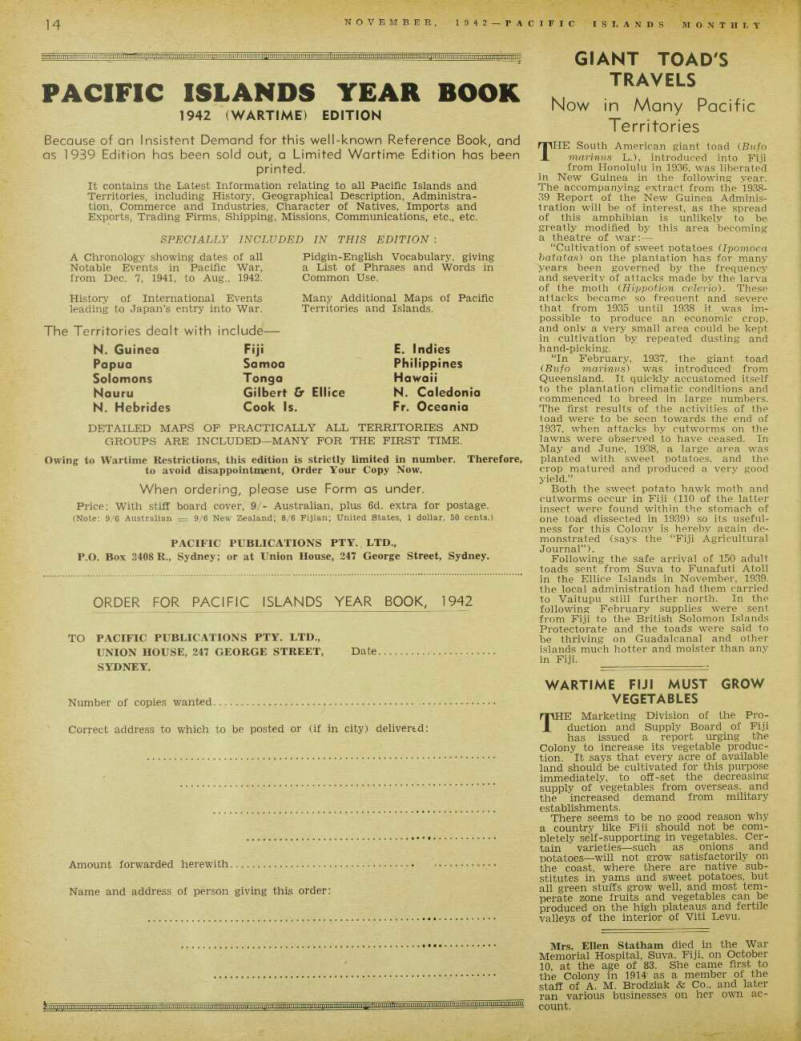
Giant Toad's
Now in Many Pacific Territories
THE South American giant toad (Bufo marinus L.), introduced into Fiji from Honolulu in 1936, was liberated in New Guinea in the following year.
The accompanying extract from the 1938- 39 Report of the New Guinea Adminis tration will be of interest, as the spread of this amphibian is unlikely to be greatly modified by this area becoming a theatre of war:— “Cultivation of sweet potatoes (Ipomoea batatas) on the plantation has for many years been governed by the frequency and severity of attacks made by the larva of the moth (Hippotion celerio). These attacks became so freouent and severe that from 1935 until 1938 it was im possible to produce an economic crop, and only a very small area could be kept in cultivation by repeated dusting and hand-picking.
“In February, 1937, the giant toad (Bufo marinus) was introduced from Queensland. It quickly accustomed itself to the plantation climatic conditions and commenced to breed in large numbers.
The first results of the activities of the toad were to be seen towards the end of 1937, when attacks by cutworms on the lawns were observed to have ceased. In May and June, 1938, a large area was planted with sweet potatoes, and the crop matured and produced a very good yield.”
Both the sweet potato hawk moth and cutworms occur in Fiji (110 of the latter insect were found within the stomach of one toad dissected in 1939) so its useful ness for this Colony is hereby again de monstrated (says the “Fiji Agricultural Journal”).
Following the safe arrival of 150 adult toads sent from Suva to Funafuti Atoll in the Ellice Islands in November, 1939. the local administration had them carried to Vaitupu still further north. In the following February supplies were sent from Fiji to the British Solomon Islands Protectorate and the toads were said to be thriving on Guadalcanal and other islands much hotter and moister than any in Fiji.