Centenary Of
pp. 14-15 · Read in the full issue
Tahiti
100 Years of French Rule
Prom Our Own Correspondent
Papeete, Sept. 30.
SEPTEMBER 9, 1942, was the centen ary of the establishment of the pro tectorate over Tahiti and dependen cies by Rear-Admiral A. du Petit- Thouars, in the name of Louis-Philippp, King of the French.
The official documents relative to the French occupation and the establishment of the protectorate, appear in the “Annuaire de Tahiti” of 1893.
The petition, addressed to Admiral du Petit-Thouars and signed by Queen Pomare IV and her principal chiefs, spe cifies the conditions under which the protectorate was instituted. Dated Sep tember 9, 1842, it reads as follows:
“Because we cannot continue to govern by ourselves, under the present condi tion of things, in a manner to conserve good relations with foreign governments, without exposing ourselves to the loss of our islands, our liberty and our authority, we the undersigned, the Queen and the High Chiefs of Tahiti, do by these pre sents solicit the King of the French to take us under his protection in accord ance with the following conditions:— “1. The sovereignty of the Queen and her authority and the authority of the principal chiefs over their people, are guaranteed.
“2. All regulations and laws shall be made in the name of the Queen, and signed by her.
“3. The possession of the lands of the Queen and of the people shall be guar anteed to them. These lands shall remain their property. AH disputes rela tive to the right of property or the own ers of lands shall be within the special jurisdiction of the tribunals of the realm.
“4. Each person shall be free in the exercise of his cult or of his religion.
“5. The churches actually existing shall continue in being and the English mis sionaries shall continue their functions without molestation; it shall be the same for all other cults: no one shall be molested or thwarted in his faith.
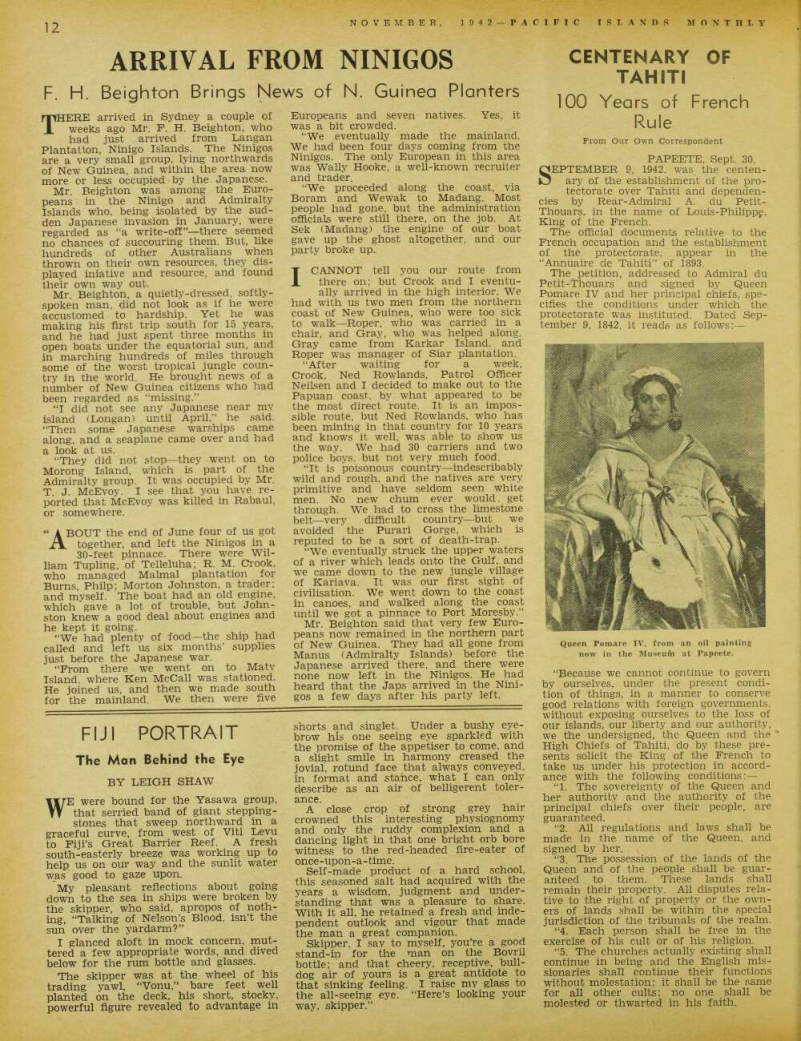
Queen Pomare IV, from an oil painting now in the Museum at Papeete.
“Subject to these conditions, the Queen Pomare and her high chiefs ask the pro tection of the King of the French, leav ing between his hands, and to the care of the French Government, or to the person nominated by him, and with the approbation of the Queen Pomare, the direction of all affairs with foreign gov ernments, as well as all which may con cern foreign residents, the port regula tions, etc., etc., and of taking such mea sures as he shall deem useful for the conservation of harmony and peace. (Signed) Pomare.
“Paraita (Regent), Utami, Hitoti, Tati.”
The provisional acceptance of the pro tectorate by Admiral du Petit-Thouars, bears the same date —September 9, 1842.
The ratification of du Petit-Thouars’ acceptance of the protectorate: “Given in our palace, des Tuileries” and signed, Louis Philippe, is dated March 25, 1843.
To explain why harmony and peace did not come to the kingdom until 1847, would require a volume of many pages.
The Queen was, however, eventually appeased and, on the day of her return from self-imposed exile, wrote this final paragraph in her diary: “February 9, 1847. This is the day Pomare arrived at Papeete. This was a great day of decora tion; of soldiers; of officials; of French and British warships, together with all the smaller craft; of the houses of foreigners and of those of all Tahitians as well. The bands, on board the ships and ashore, played until 6 o’clock. That night the illumination of the European houses was the splen dour of a comet.”
Qtieen Pomare IV reigned in peace and tranquility until 1877. The venerable survivors of her reign, whom this writer knew in the early years of this century, always spoke of that period as “the golden age of Tahiti.”