Fiji's Currency
Problem
Private Firms Issue Tokens
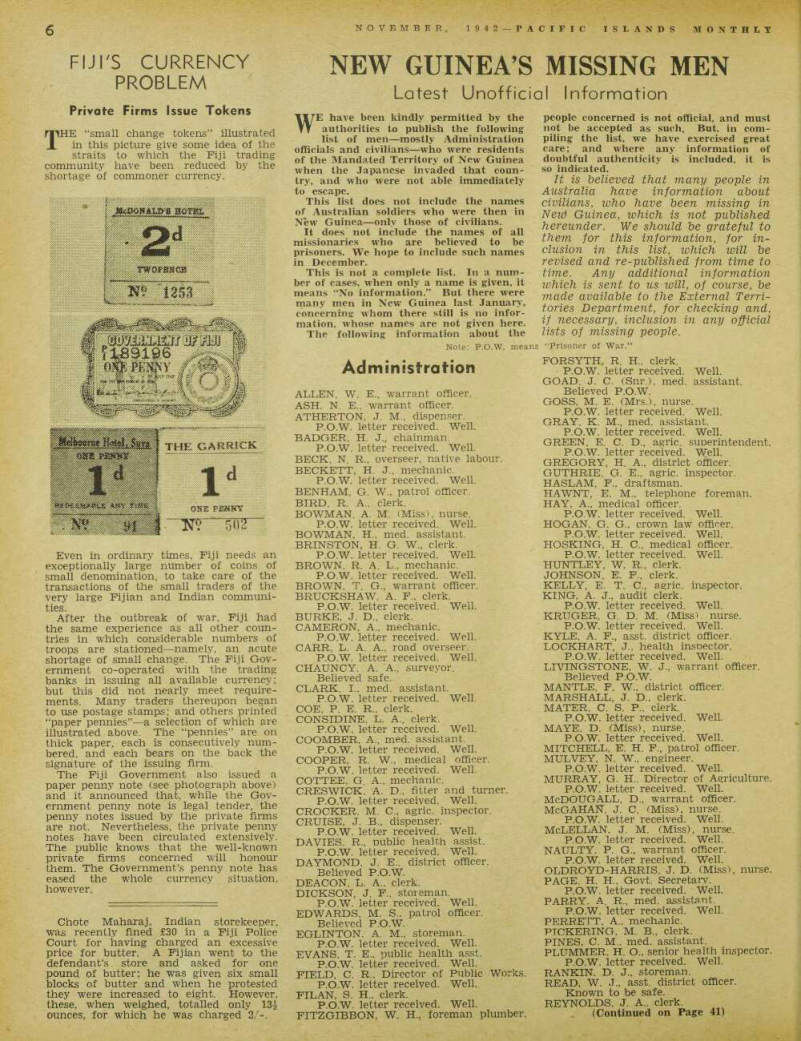
THE “small change tokens” illustrated in this picture give some idea of the straits to which the Fiji trading community have been reduced by the shortage of commoner currency.
Even in ordinary times, Fiji needs an exceptionally large number of coins of small denomination, to take care of the transactions of the small traders of the very large Fijian and Indian communi ties.
After the outbreak of war, Fiji had the same experience as all other coun tries in which considerable numbers of troops are stationed —namely, an acute shortage of small change. The Fiji Gov ernment co-operated with the trading banks in issuing all available currency; but this did not nearly meet require ments. Many traders thereupon began to use postage stamps; and others printed “paper pennies”—a selection of which are illustrated above. The “pennies” are on thick paper, each is consecutively num bered, and each bears on the back the signature of the issuing firm.
The Fiji Government also issued a paper penny note (see photograph above) and it announced that, while the Gov ernment penny note is legal tender, the penny notes issued by the private firms are not. Nevertheless, the private penny notes have been circulated extensively.
The public knows that the well-known private firms concerned will honour them. The Government’s penny note has eased the whole currency situation, however.
Chote Maharaj, Indian storekeeper, was recently fined £3O in a Fiji Police Court for having charged an excessive price for butter. A Fijian went to the defendant’s store and asked for one pound of butter; he was given six small blocks of butter and when he protested they were increased to eight. However, these, when weighed, totalled only 13£ ounces, for which he was charged 2/-.