Scots In The South
pp. 46-47 · Read in the full issue
Seas
A Trader's Bitter Tale, by "Tukapa Koko"
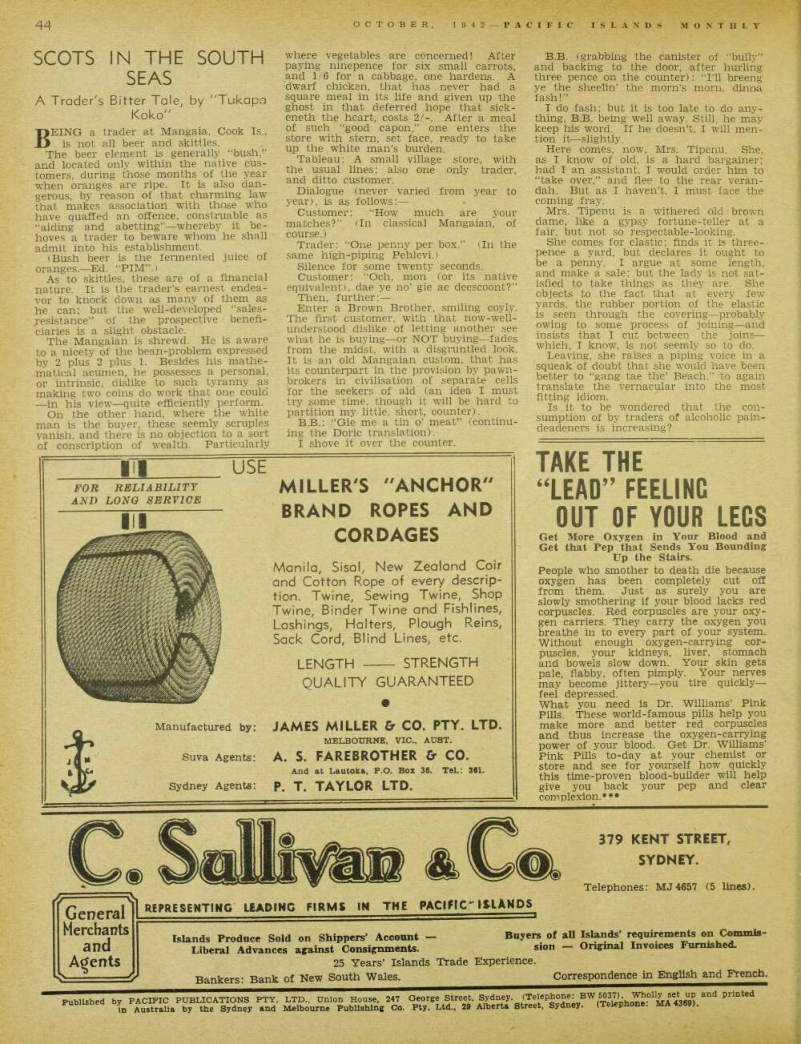
BEING a trader at Mangaia, Cook Is., is not all beer and skittles.
The beer element is generally “bush,” and located only within the native cus tomers, during those months of the year when oranges are ripe. It is also dan gerous, by reason of that charming law that makes association with those who have quaffed an offence, construable as “aiding and abetting”—whereby it be hoves a trader to beware whom he shall admit into his establishment. (Bush beer is the fermented juice of oranges.—Ed. “PIM”.) As to skittles, these are of a financial nature. It is the trader’s earnest endea vor to knock down as many of them as he can; but the well-developed “sales jesistance” of the prospective benefi ciaries is a slight obstacle.
The Mangaian is shrewd. He is aware to a nicety of the bean-problem expressed by 2 plus 2 plus 1. Besides his mathe matical acumen, he possesses a personal, or intrinsic, dislike to such tyranny as making two coins do work that one could —in his view—quite efficiently perform.
On the other hand, where the white man is the buyer, these seemly scruples vanish, and there is no objection to a sort of conscription of wealth. Particularly
where vegetables are concerned! After paying ninepence for six small carrots, and 1 6 for a cabbage, one hardens. A dwarf chicken, that has never had a square meal in its life and given up the ghost in that deferred hope that sick eneth the heart, costs 2/-. After a meal of such “good capon,” one enters the store with stem, set face, ready to take up the white man’s burden.
Tableau: A small village store, with the usual lines; also one only trader, and ditto customer.
Dialogue (never varied from year to year), is as follows: — Customer; “How much are your matches?” (In classical Mangaian, of course.) Trader: “One penny per box.” (In the same high-piping Pehlevi.) Silence for some twenty seconds.
Customer: “Och, mon (or its native equivalent), dae ye no’ gie ae deescoont?”
Then, further: — Enter a Brown Brother, smiling coyly.
The first customer, with that now-well understood dislike of letting another see what he is buying—or NOT buying—fades from the midst, with a disgruntled look.
It is an old Mangaian custom, that has its counterpart in the provision by pawn brokers in civilisation of separate cells for the seekers of aid (an idea I must try some time, though it will be hard to partition my little, short, counter).
B.B.: “Gie me a tin o’ meat” (continu ing the Doric translation).
I shove it over the counter.
8.8. (grabbing the canister of “bully” and backing to the door, after hurling three pence on the counter): “I’ll breeng ye the sheelin’ the morn’s morn, dinna fash!”
I do fash: but it is too late to do any thing, 88. being well away. Still, he may keep his word. If he doesn’t, I will men tion it —slightly.
Here comes, now, Mrs. Tipenu. She, as I know of old, is a hard bargainer; had I an assistant. I would order him to “take over,” and flee to the rear veran dah. But as I haven’t, I must face the coming fray.
Mrs. Tipenu is a withered old brown dame, like a gypsy fortune-teller at a fair, but not so respectable-looking.
She comes for elastic; finds it is three pence a yard, but declares it ought to be a penny. I argue at some length, and make a sale; but the lady is not sat isfied to take things as they are. She objects to the fact that at every few yards, the rubber portion of the elastic is seen through the covering—probably owing to some process of joining—and insists that I cut between the joins— which, I know, is not seemly so to do.
Leaving, she raises a piping voice in a squeak of doubt that she would have been better to “gang tae the’ Beach.” to again translate the vernacular into the most fitting idiom.
Is it to be wondered that the con sumption of by traders of alcoholic pain deadeners is increasing?