Unique Value in Maintaining Supply Lines
pp. 42-43 · Read in the full issue
Overdue Praise For New Guinea "Boys"
By Judy Tudor
WARM tribute has been paid of late by war correspondents, in the New Guinea area, to the work of the natives there.
This has not caused much surprise amongst those who know these people.
When the full story of the Papuan cam paign is written, it probably will be found that the part played by the natives in transporting food, equipment and muni tions, and in bringing out the sick and wounded, had an important bearing on the result.
In the days of peace, anthropologists made ftew Guinea their happy hunting ground. They pored over the native’s habits and customs and, psychologically, took him to pieces in order to see what
made him tick; and often they came to conclusions that were at variance with those of the plain planter, trader, miner or official, who had no scientific know ledge, but knew his native.
It was the accepted New Guinea fashion to pretend no love, nor even affection, for the people who alone made the country tenable for whites; and it was as easy to persuade the average Ter ritorian to admit that he ate babies or murdered grandmothers, as it was to get his acknowledgment that he “liked natives.”
This was' mostly (as the Americans have taught us to say) an “act.” A “per sonal boy,” for instance, was a matter of great personal pride—his qualities loudly deprecated in public but the retention of his services a private matter of much importance.
However, the personal-boy problem, with all its un-written and written laws, will not likely bother the Australian sol dier of the front line. Their contact with New Guinea natives will be mostly through the great numbers of carriers who have been gathered together to supply—as always in that part of the world —the country’s lines of communi cation and transport. rESE Melanesian people are not beautiful. If man wishes to dally on the fictional South Seas isle, with a South Seas maiden, he would not choose New Guinea. Neither have they any of the social ideals or standards that we have established over the centuries.
Yet, in his own way, this so-called savage can be a gentleman. A cranky, inexplic able, unexpected gentleman certainly, but a gentleman, nevertheless.
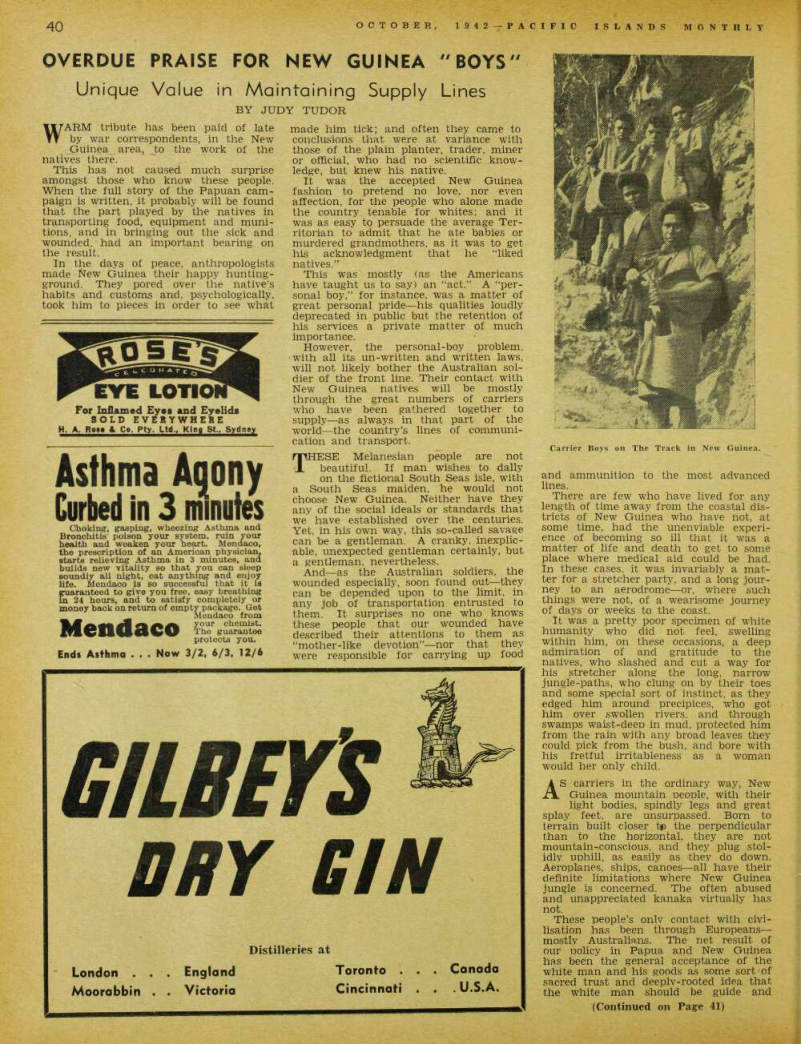
And —as the Australian soldiers, the wounded especially, soon found out—they can be depended upon to the limit, in any job of transportation entrusted to them. It surprises no one who knows these people that our wounded have described their attentions to them as “mother-like devotion” —nor that they were responsible for carrying up food
and ammunition to the most advanced lines.
There are few who have lived for any length of time away from the coastal dis tricts of New Guinea who have not, at some time, had the unenviable experi ence of becoming so ill that it was a matter of life and death to get to some place where medical aid could be had.
In these cases, it was invariably a mat ter for a stretcher party, and a long jour ney to an aerodrome —or, where such things were not, of a wearisome journey of days or weeks to the coast.
It was a pretty poor specimen of white humanity who did not feel, swelling within him, on these occasions, a deep admiration of and gratitude to the natives, who slashed and cut a way for his stretcher along the long, narrow jungle-paths, who clung on by their toes and some special sort of instinct, as they edged him around precipices, who got him over swollen rivers, and through swamps waist-deen in mud, protected him from the rain with any broad leaves they could pick from the bush, and bore with his fretful irritableness as a woman would her only child.
AS carriers in the ordinary way, New Guinea mountain people, with their light bodies, spindly legs and great splay feet, are unsurpassed. Bom to terrain built closer tf> the perpendicular than to the horizontal, they are not mountain-.conscious. and they plug stol idly uphill, as easily as they do down.
Aeroplanes, ships, canoes—all have their definite limitations where New Guinea jungle is concerned. The often abused and unappreciated kanaka virtually has not.
These people’s onlv contact with civi lisation has been through Europeans— mostly Australians. The net result of our policy in Papua and New Guinea has been the general acceptance of the white man and his goods as some sort of sacred trust and deeplv-rooted idea that the white man should be guide and
(Continued on Page 41)
Carrier Boys on The Track in New Guinea.
philosopher to the native when occasion demanded. There have been individual lapses from grace on both sides; but, broadly, it has worked very well.
OUR own standards of ethics and behaviour, and our moral values, mean literally nothing to the kan aka —with one exception. As one man, they admire strength—mental, physical or any other variety. A master who "savvies fight,” who can shoot, or who can walk or run or climb better than any other "master” around the district, or one who can impose his strength of mind and purpose upon those about him, has their whole-hearted admiration and hero-worship.
It can be easily imagined, therefore, that those Australian soldiers of ours, whose chief purpose in life at the pre sent moment is to fight, and kill, and pit their strength against an enemy for whom the natives had no love in the first place, are coming in for a good deal of this hero-worship.