Tahiti's Earliest Aviators
p. 24 · Read in the full issue
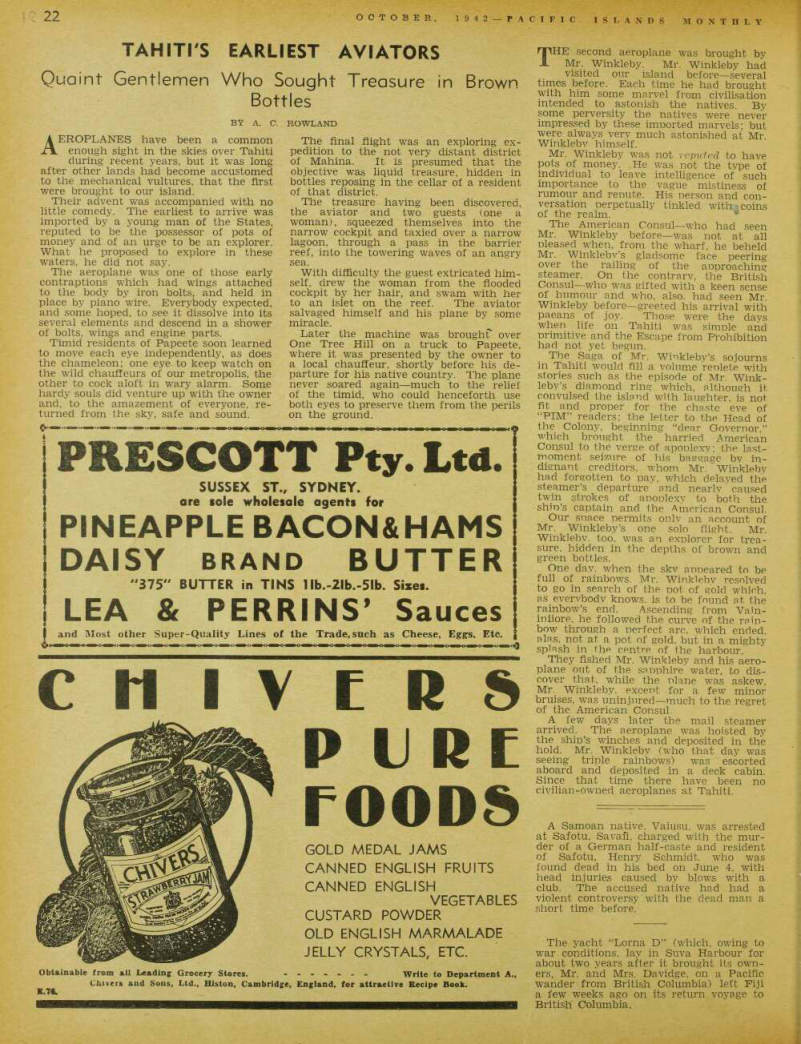
Quaint Gentlemen Who Sought Treasure in Brown Bottles
By A. C. Rowland
AEROPLANES have been a common enough sight in the skies over Tahiti during recent years, but it was long after other lands had become accustomed to the mechanical vultures, that the first were brought to our island.
Their advent was accompanied with no little comedy. The earliest to arrive was imported by a young man of the States, reputed to be the possessor of pots of money and of an urge to be an explorer.
What he proposed to explore in these waters, he did not say.
The aeroplane was one of those early contraptions which had wings attached to the body by iron bolts, and held in place by piano wire. Everybody expected, and some hoped, to see it dissolve into its several elements and descend in a shower of bolts, wings and engine parts.
Timid residents of Papeete soon learned to move each eye independently, as does the chameleon; one eye to keep watch on the wild chauffeurs of our metropolis, the other to cock aloft in wary alarm. Some hardy souls did venture up with the owner and, to the amazement of everyone, re turned from the sky, safe and sound.
The final flight was an exploring ex pedition to the not very distant district of Mahina. It is presumed that the objective was liquid treasure, hidden in bottles reposing in the cellar of a resident of that district.
The treasure having been discovered, the aviator and two guests (one a woman), squeezed themselves into the narrow cockpit and taxied over a narrow lagoon, through a pass in the barrier reef, into the towering waves of an angry sea.
With difficulty the guest extricated him self, drew the woman from the flooded cockpit by her hair, and swam with her to an islet on the reef. The aviator salvaged himself and his plane by some miracle.
Later the machine was brought over One Tree Hill on a truck to Papeete, where it was presented by the owner to a local chauffeur, shortly before his de parture for his native country. The plane never soared again—much to the relief of the timid, who could henceforth use both eyes to preserve them from the perils on the ground.
THE second aeroplane was brought by Mr. Winkleby. Mr. Winkleby had visited our island before—several times before. Each time he had brought with him some marvel from civilisation intended to astonish the natives. By some perversity the natives were never impressed by these imnorted marvels; but were always very much astonished at Mr Winklebv himself.
Mr. Winkleby was not reputed to have pots of money. He was not the type of individual to leave intelligence of such importance to the vague mistiness of rumour and renute. His nerson and con versation perpetually tinkled with • coins of the realm. * The American Consul—who had seen Mr. Winkleby before—was not at all pleased when, from the wharf, he beheld Mr. Winklebv’s gladsome face peering over the railing of the approaching steamer. On the contrary, the British Consul—who was gifted with a keen sense of humour and who, also, had seen Mr.
Winkleby before—greeted his arrival with paeans of joy. Those were the days when life on Tahiti was simple and primitive and the Escape from Prohibition had not yet begun.
The Saga of Mr. Wiukleby’s sojourns in Tahiti would fill a volume replete with stories such as the episode of Mr. Wink leby’s diamond ring which, although it convulsed the island with laughter, is not fit and proper for the chaste eve of “PIM” readers; the letter to the Head of the Colony, beginning “dear Governor,” which brought the harried American Consul to the verge of apoplexy; the last moment seizure of his baa-gage by in dignant creditors, whom Mr. Winkleby had forgotten to pay, which delayed the steamer’s departure and nearly caused twin strokes of apoplexy to both the ship’s captain and the American Consul.
Our space permits onlv an account of Mr. Winkleby’s one solo flight. Mr.
Winklebv. too, was an explorer for trea sure, hidden in the depths of brown and green bottles.
One day. when the skv appeared to be full of rainbows. Mr. Winklebv resolved to go in search of the not of gold which, as everybody knows, is to be found at the rainbow’s end. Ascending from Vain iniiore. he followed the curve of the rain bow through a perfect arc, which ended, alas, not at a pot of gold, but in a mighty splash in the centre of the harbour.
They fished Mr. Winkleby and his aero plane out of the sapphire water, to dis cover that, while the Plane was askew, Mr. Winkleby. except for a few minor bruises, was uninjured—much to the regret of the American Consul.
A few days later the mail steamer arrived. The aeroplane was hoisted by the ship’s winches and deposited in the hold. Mr. Winkleby (who that day was seeing triple rainbows) was escorted aboard and deposited in a deck cabin.
Since that time there have been no civilian-owned aeroplanes at Tahiti.
A Samoan native, Vaiusu. was arrested at Safotu, Savafi, charged with the mur der of a German half-caste and resident of Safotu, Henry Schmidt, who was found dead in his bed on June 4, with head injuries caused by blows with a club. The accused native had had a violent controversy with the dead man a short time before.
The yacht “Lorna D” (which, owing to war conditions, lay in Suva Harbour for about two years after it brought its own ers, Mr. and Mrs. Davidge, on a Pacific wander from British Columbia) left Fiji a few weeks ago on its return voyage to British Columbia.