Tahiti's New Supply
p. 19 · Read in the full issue
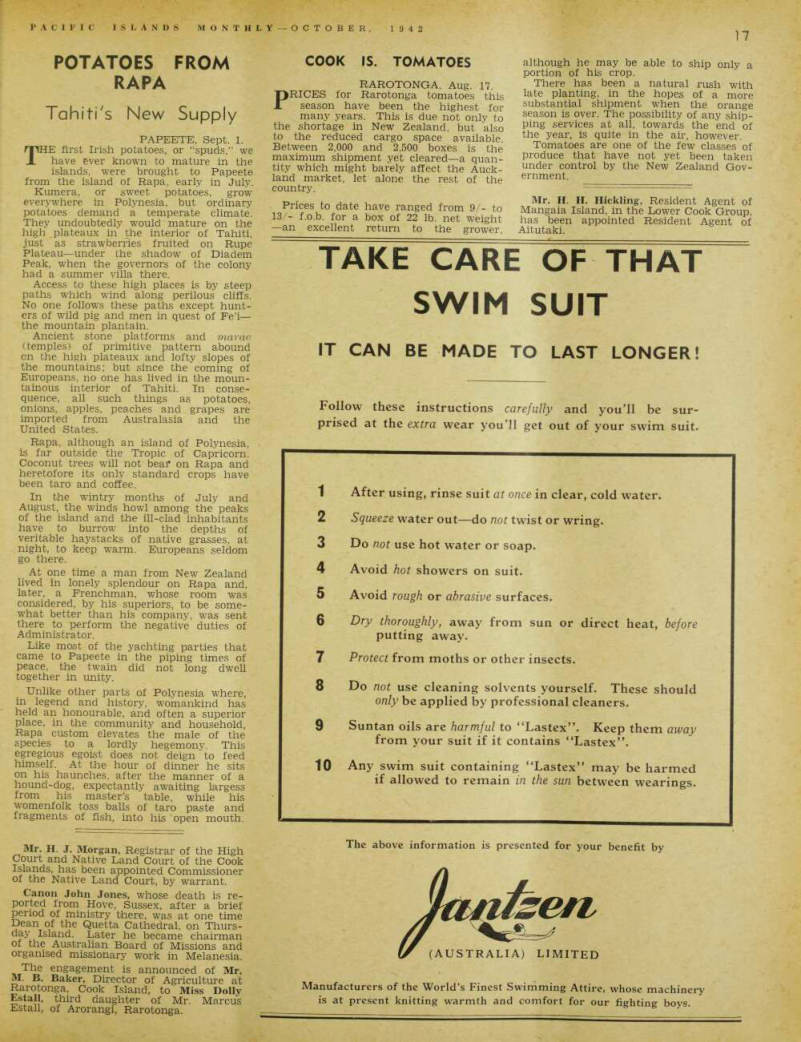
Potatoes From
Rapa
Papeete, Sept. 1.
THE first Irish potatoes, or “spuds,” we have ever known to mature in the islands, were brought to Papeete from the island of Rapa, early in July.
Kumera, or sweet potatoes, grow everywhere in Polynesia, but ordinary potatoes demand a temperate climate.
They undoubtedly would mature on the high plateaux in the interior of Tahiti, just as strawberries fruited on Rupe Plateau—under the shadow of Diadem Peak, when the governors of the colony had a summer villa there.
Access to these high places is by steep paths which wind along perilous cliffs.
No one follows these paths except hunt ers of wild pig and men in quest of Pel— the mountain plantain.
Ancient stone platforms and marae (temples) of primitive pattern abound on the high plateaux and lofty slopes of the mountains: but since the coming of Europeans, no one has lived in the moun tainous interior of Tahiti. In conse quence, all such things as potatoes, onions, apples, peaches and grapes are imported from Australasia and the United States.
Rapa, although an island of Polynesia, is far outside the Tropic of Capricorn.
Coconut trees will not bear on Rapa and heretofore its only standard crops have been taro and coffee.
In the wintry months of July and August, the winds howl among the peaks of the island and the ill-clad inhabitants have to burrow into the depths of veritable haystacks of native grasses, at night, to keep warm. Europeans seldom go there.
At one time a man from New Zealand lived in lonely splendour on Rapa and, later, a Frenchman, whose room was considered, by his superiors, to be some what better than his company, was sent there to perform the negative duties of Administrator.
Like most of the yachting parties that came to Papeete in the piping times of peace, the twain did not long dwell together in unity.
Unlike other parts of Polynesia where, in legend and history, womankind has held an honourable, and often a superior place, in the community and household, Rapa custom elevates the male of the species to a lordly hegemony. This egregious egoist does not deign to feed himself. At the hour of dinner he sits on his haunches, after the manner of a hound-dog, expectantly awaiting largess from his master’s table, while his womenfolk toss balls of taro paste and fragments of fish, into his open mouth.
Mr. H. J. Morgan, Registrar of the High Court and Native Land Court of the Cook Islands, has been appointed Commissioner of the Native Land Court, by warrant.
Canon John Jones, whose death is re ported from Hove, Sussex, after a brief period of ministry there, was at one time Dean of the Quetta Cathedral, on Thurs day Island. Later he became chairman of the Australian Board of Missions and organised missionary work in Melanesia.
The engagement is announced of Mr.
M. B. Baker, Director of Agriculture at Rarotonga, Cook Island, to Miss Dolly Estall, third daughter of Mr. Marcus Estall, of Arorangi, Rarotonga.