Solomon Islands Battle
pp. 14-15 · Read in the full issue
How Americans and Australians Recovered Tulagi Area From Japs
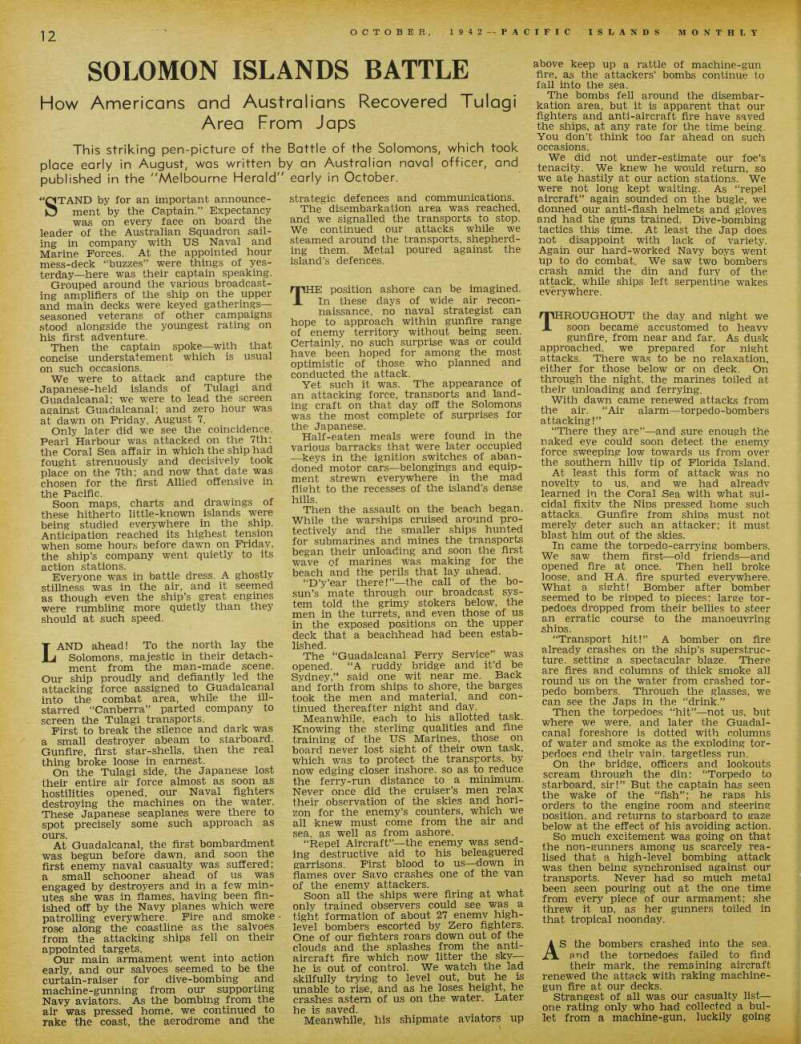
This striking pen-picture of the Battle of the Solomons, which took place early in August, was written by an Australian naval officer, and published in the "Melbourne Herald" early in October.
“CITAND by for an important announce ment by the Captain.” Expectancy was on every face on board the leader of the Australian Squadron sail ing in company with US Naval and Marine Forces. At the appointed hour mess-deck “buzzes” were things of yes terday—here was their captain speaking.
Grouped around the various broadcast ing amplifiers of the ship on the upper and main decks were keyed gatherings— seasoned veterans of other campaigns stood alongside the youngest rating on his first adventure.
Then the captain spoke—with that concise understatement which is usual on such occasions.
We were to attack and capture the Japanese-held islands of Tulagi and Guadalcanal: we were to lead the screen against Guadalcanal: and zero hour was at dawn on Friday, August 7.
Only later did we see the coincidence.
Pearl Harbour was attacked on the 7th; the Coral Sea affair in which the ship had fought strenuously and decisively took place on the 7th; and now that date was chosen for the first Allied offensive in tliG Pacific Soon maps, charts and drawings of these hitherto little-known islands were being studied everywhere in the ship.
Anticipation reached its highest tension when some hours before dawn on Friday, the ship’s company went quietly to its action stations.
Everyone was in battle dress. A ghostly stillness was in the air, and it seemed as though even the ship’s great engines were rumbling more quietly than they should at such speed.
LAND ahead! To the north lay the Solomons, majestic in their detach ment from the man-made scene.
Our ship proudly and defiantly led the attacking force assigned to Guadalcanal into the combat area, while the ill starred “Canberra” parted company to screen the Tulagi transports.
First to break the silence and dark was a small destroyer abeam to starboard.
Gunfire, first star-shells, then the real thing broke loose in earnest.
On the Tulagi side, the Japanese lost their entire air force almost as soon as hostilities opened, our Naval fighters destroying the machines on the water.
These Japanese seaplanes were there to spot precisely some such approach as ours.
At Guadalcanal, the first bombardment was begun before dawn, and soon the first enemy naval casualty was suffered; a small schooner ahead of us was engaged by destroyers and in a few min utes she was in flames, having been fin ished off by the Navy planes which were patrolling everywhere. Fire and smoke ■ rose along the coastline as the salvoes from the attacking ships fell on their appointed targets.
Our main armament went into action early, and our salvoes seemed to be the curtain-raiser for dive-bombing and machine-gunning from our supporting Navy aviators. As the bombing from the air was pressed home, we continued to rake the coast, the aerodrome and the
strategic defences and communications.
The disembarkation area was reached, and we signalled the transports to stop, We continued our attacks while we steamed around the transports, shepherd ing them. Metal poured against the island’s defences, ... h rnn bp imagined TV the™ days of wide air. rlco^ naissance, no naval strategist can toM Certainly, no such surprise was or could have been hoped tor among the most Wtamshc Wh ° planned and Yet suclTft “ The appearance of an attacking force, transports and land ing craft on that day off the Solomons was the most complete of surprises for Hal Sen meals were found in the various barracks that were later occupied —keys in the ignition switches of aban doned motor cars-belongings and eqmp- SSm to thl recesses of tee Sand’s dSSe ““hen the assault on the beach began, While the warships cruised around pro and 3 " theSra^orte
w?vT o^ma^wL"maktog ?or the
be ach and the penis that lay ahead. sun’? y Se th t^ougS th o e ur C froa 0 £
fuen awjfss EM
in the exposed positions on the upper deck that a beachhead had been estab fished.
The “Guadalcanal Ferry Service” was opened. “A ruddy bridge and it’d be Sydney,” said one wit near me. Back and forth from ships to shore, the barges took the men and material, and con tinned thereafter night and day.
Meanwhile, each to his allotted task.
Knowing the sterling qualities and fine training of the US Marines, those on board never lost sight of their own task, which was to protect the transports, by now edging closer inshore, so as to reduce the ferry-run distance to a minimum, Never once did the cruiser’s men relax their observation of the skies and hori zon for the enemy’s counters, which we all knew must come from the air and sea, as well as from ashore.
“Repel Aircraft”—the enemy was send ing destructive aid to his beleaguered garrisons. First blood to us—down in flames over Savo crashes one of the van of the enemy attackers, Soon all the ships were firing at what only trained observers could see was a tight formation of about 27 enemv high level bombers escorted by Zero fighters, One of our fighters roars down out of the clouds and the splashes from the anti aircraft fire which now fitter the sky he is out of control. We watch the lad skilfully trying to level out, but he is unable to rise, and as he loses height, he crashes astern of us on the water. Later he is saved.
Meanwhile, his shipmate aviators up
above keep up a rattle of machine-gun fire, as the attackers’ bombs continue to fall into the sea.
The bombs fell around the disembar kation area, but it is apparent that our fighters and anti-aircraft fire have saved the ships, at any rate for the time being.
You don’t think too far ahead on such occasions.
We did not under-estimate our foe’s tenacity. We knew he would return, so we ate hastily at our action stations. We were not long kept waiting. As “repel aircraft” again sounded on the bugle, we donned our anti-flash helmets and gloves and had the guns trained. Dive-bombing tactics this time. At least the Jap does not disappoint with lack of variety.
Again our hard-worked Navy boys went up to do combat. We saw two bombers crash amid the din and fury of the attack, while ships left serpentine wakes everywhere. fpHROUGHOUT the day and night we JL soon became accustomed to heavy gunfire, from near and far. As dusk approached, we prepared for night attacks. There was to be no relaxation, either for those below or on deck. On through the night, the marines toiled at their unloading and ferrying.
With dawn came renewed attacks from the air. “Air alarm —torpedo-bombers attacking!”
“There they are”—and sure enough the naked eye could soon detect the enemy force sweeping low towards us from over the southern hillv tip of Florida Island.
At least this form of attack was no novelty to us. and we had already learned in the Coral Sea with what sui cidal fixity the Nips pressed home such attacks. Gunfire from ships must not merely deter such an attacker; it must blast him out of the skies.
In came the torpedo-carrying bombers.
We saw them first—old friends—and opened fire at once. Then hell broke loose, and HA. fire spurted everywhere.
What a sight! Bomber after bomber seemed to be ripped to pieces; large tor pedoes dropped from their bellies to steer an erratic course to the manoeuvring ships.
“Transport hit!” A bomber on fire already crashes on the ship’s superstruc ture. setting a spectacular blaze. There are fires and columns of thick smoke all round us on the water from crashed tor pedo bombers. Through the glasses, we can see the Japs in the “drink.”
Then the torpedoes “hit” —not us, but where we were, and later the Guadal canal foreshore is dotted with columns of water and smoke as the exploding tor pedoes end their vain, targetless run.
On the bridge, officers and lookouts scream through the din: “Torpedo to starboard, sir!” But the captain has seen the wake of the “fish”; he raps his orders to the engine room and steering position, and returns to starboard to gaze below at the effect of his avoiding action.
So much excitement was going on that the non-gunners among us scarcely rea lised that a high-level bombing attack was then being synchronised against our transports. Never had so much metal been seen pouring out at the one time from every piece of our armament; she threw it up, as her gunners toiled in that tropical noonday.
AS the bombers crashed into the sea. and the tornedoes failed to find their mark, the remaining aircraft renewed the attack with raking machine gun fire at our decks.
Strangest of all was our casualty list— one rating only who had collected a bul let from a machine-gun, luckily going
straight through his upper arm.
Last of all before the barrage ceased were the underwater explosions of some of the torpedoes. Then comparative silence, and the debris of Nippon’s hopes floated by on the tide.
Fanaticism was illustrated when one of our destroyers later attempted to rescue a couple of the Japanese airmen who had managed to scramble on to an inflated raft. As the destroyer steamed close by, they drew pistols and attempted to slay their rescuers. They then shot them selves. Perhaps they expected death at our hands. Prisoners whom the marines later captured ashore said that they fully expected to be killed, and were astounded at the humane treatment they got in an Allied port.
Life aboard the ship during these days was far from easy. Men toiled and sweated in humidity and heat below, and the thick air caused by the ship being secured for action produced a soporific fatigue on all who worked between decks, which includes the greater part of the ship’s complement.
No man left his action station—we fed, slept and some even bathed where they worked. Officers and men shared the same food and conditions. It was no uncommon sight to see a hefty gunner scrubbing his torso in between “events,” in a kerosene tin by his gun.
AFTER that the canteen was opened, and “Zam” (as well known to the RAN as the Gunnery Pocket Book) mixed “goffers” for thirsty men. Officers filtered into the Wardroom to recount experiences to the doctors who had remained there in the improvised action casualty ward ready to attend, to the casualties that, happily, never occurred.
The news of the loss of “Canberra” stunned us all. Only a short time ago, we had been in company of her men ashore and aboard. With feelings of gratitude we learned of the fine rescue work undertaken by nearby American destroyers.
Soon the mess decks were busy col lecting clothing and money to help the survivors. Most of them, when we later saw them, looked like doughboys, thanks to our American shipmates’ generosity.
When Guadalcanal was finally cap tured the marines began mopping up operations ashore, assisted by their Naval pilot “buddies” who ceaselessly skimmed the hills of the hinterland, riddling enemy positions with machine-gun fire or attacking Japanese stragglers in their combing operations.
Finally, we completed our screen of the Guadalcanal victors, and steered a course towards Tulagi. where heavy gunfire was continuous, telling us that heavy night and day resistance was still being encountered. Here we joined forces with the Tulagi detachment. It was later that the capture of Tulagi and Gavutu was completed.
THE job done, we retired from the Solomons, and in the comparative respite, were able to piece together our experiences of those stirring days.
The tension over, the reaction set in, and we began to understand the power of the mind over physical fatigue, especially when the spirit is offensive.
The fortunate ones had souvenirs of the show —pieces of flak, bullets, shrap nel, and of the battle-frayed ensign which had defiantly streamed from our foremast throughout.
The adventure ended on the note of understatement with which it began. As we silently came to anchor, the shrill bo’sun’s mate’s pipe sounded off. and— “D’y’ear there? It is now permitted to state in your letters as follows: T have taken part in the operations in the Solo mons, of which you have probably heard or read.’ ”
Vale to “Canberra’s” dead, to our naval airmen and marines whom we left behind.
“Does not the gravestone on such bones sit light?
Posterity applauds: from such a spright, From such a tomb, from ashes blessed so Shall there not violets in cartloads grow?”
We dreamed wistfully of leave, but everywhere was manifest the desire to hit the enemy again. We knew that the offensive begun on that grey August mom was the turning-point in the Pacific war.