Buna-Kokoda Region
p. 10 · Read in the full issue
Scene of Recent Operations Described by Old Resident
By G. M. Rio
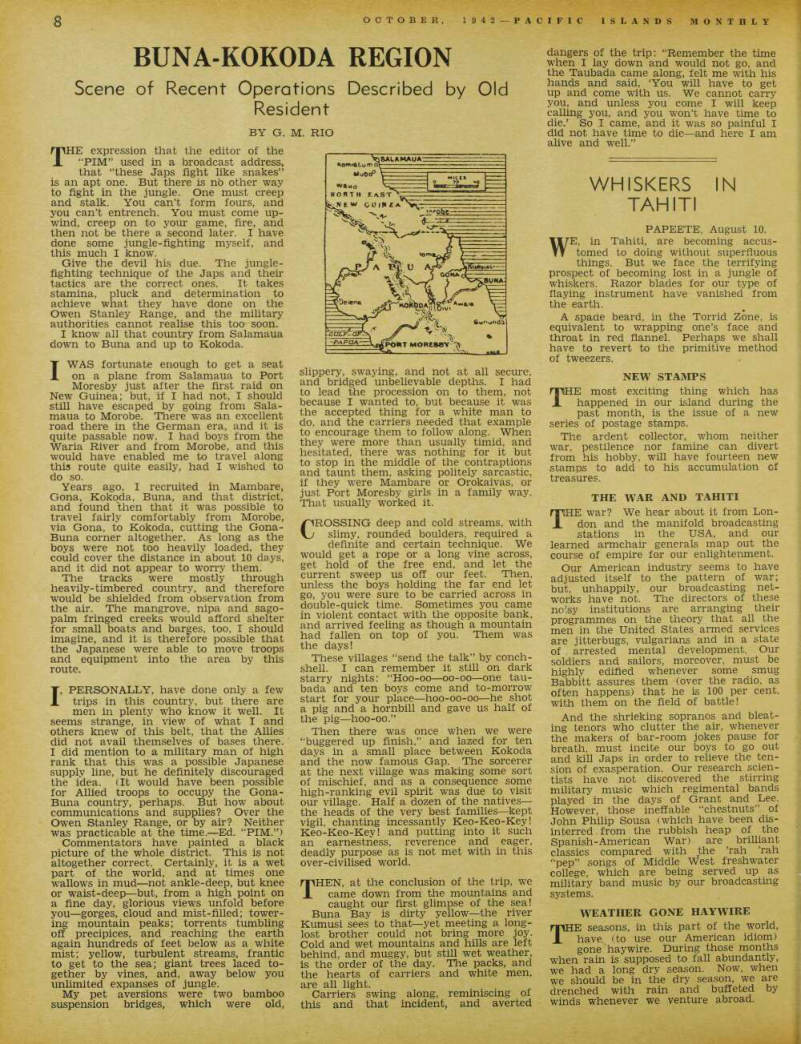
THE expression that the editor of the “PIM” used in a broadcast address, that “these Japs fight like snakes” is an apt one. But there is no other way to fight in the jungle. One must creep and stalk. You can’t form fours, and you can’t entrench. You must come up wind, creep on to your game, fire, and then not be there a second later. I have done some jungle-fighting myself, and this much I know.
Give the devil his due. The jungle fighting technique of the Japs and then tactics are the correct ones. It takes stamina, pluck and determination to achieve what they have done on the Owen Stanley Range, and the military authorities cannot realise this too soon.
I know all that country from Salamaua down to Buna and up to Kokoda.
IWAS fortunate enough to get a seat on a plane from Salamaua to Port Moresby just after the first raid on New Guinea: but, if I had not, I should still have escaped by going from Sala maua to Morobe. There was an excellent road there in the German era, and it is quite passable now. I had boys from the Waria River and from Morobe, and this would have enabled me to travel along this route quite easily, had I wished to do so.
Years ago, I recruited in Mambare, Gona, Kokoda, Buna, and that district, and found 'then that it was possible to travel fairly comfortably from Morobe, via Gona, to Kokoda, cutting the Gona- Buna corner altogether. As long as the boys were not too heavily loaded, they could cover the distance in about 10 days, and it did not appear to worry them.
The tracks were mostly through heavily-timbered country, and therefore would be shielded from observation from the air. The mangrove, nipa and sago palm fringed creeks would afford shelter for small boats and barges, too. I should imagine, and it is therefore possible that the Japanese were able to move troops and equipment into the area by this route. 1, PERSONALLY, have done only a few trips in this country, but there are men in plenty who know it well. It seems strange, in view of what I and others knew of this belt, that the Allies did not avail themselves of bases there.
I did mention to a military man of high rank that this was a possible Japanese supply line, but he definitely discouraged the idea. (It would have been possible for Allied troops to occupy the Gona- Buna country, perhaps. But how about communications and supplies? Over the Owen Stanley Range, or by air? Neither was practicable at the time. —Ed. “PIM.”) Commentators have painted a black picture of the whole district. This is not altogether correct. Certainly, it is a wet part of the world, and at times one wallows in mud—not ankle-deep, but knee or waist-deep—but, from a high point on a fine day, glorious views unfold before you—gorges, cloud and mist-filled; tower ing mountain peaks; torrents tumbling off precipices, and reaching the earth again hundreds of feet below as a white mist; yellow, turbulent streams, frantic to get to the sea; giant trees laced to gether by vines, and, away below you unlimited expanses of jungle.
My pet aversions were two bamboo suspension bridges, which were old,
slippery, swaying, and not at all secure, and bridged unbelievable depths. I had to lead the procession on to them, not because I wanted to, but because it was the accepted thing for a white man to do, and the carriers needed that example to encourage them to follow along. When they were more than usually timid, and hesitated, there was nothing for it but to stop in the middle of the contraptions and taunt them, asking politely sarcastic, if they were Mambare or Orokaivas, or just Port Moresby girls in a family way.
That usually worked it.
CROSSING deep and cold streams, with slimy, rounded boulders, required a definite and certain technique. We would get a rope or a long vine across, get hold of the free end, and let the current sweep us off our feet. Then, unless the boys holding the far end let go, you were sure to be carried across in double-quick time. Sometimes you came in violent contact with the opposite bank, and arrived feeling as though a mountain had fallen on top of you. Them was the days!
These villages “send the talk” by conch shell. I can remember it still on dark starry nights: “Hoo-oo—oo-oo —one tau bada and ten boys come and to-morrow start for your place—hoo-00-oo—he shot a pig and a hornbill and gave us half of the pig—hoo-oo.”
Then there was once when we were “buggered up finish,” and lazed for ten days in a small place between Kokoda and the now famous Gap. The sorcerer at the next village was making some sort of mischief, and as a consequence some high-ranking evil spirit was due to visit our village. Half a dozen of the natives— the heads of the very best families—kept vigil, chanting incessantly Keo-Keo-Key!
Keo-Keo-Key! and putting into it such an earnestness, reverence and eager, deadly purpose as is not met with in this over-civilised world.
THEN, at the conclusion of the trip, we came down from the mountains and caught our first glimpse of the sea!
Buna Bay is dirty yellow—the river Kumusi sees to that —yet meeting a long lost brother could not bring more joy.
Cold and wet mountains and hills are left behind, and muggy, but still wet weather, is the order of the day. The packs, and the hearts of carriers and white men, are all light.
Carriers swing along, reminiscing of this and that incident, and averted
dangers of the trip: “Remember the time when I lay down and would not go, and the Taubada came along, felt me with his hands and said, ‘You will have to get up and come with us. We cannot carry you, and unless you come I will keep calling you, and you won’t have time to die.’ So I came, and it was so painful I did not have time to die —and here I am alive and well.”