the hithprtn^inrbnL h I J ndo ;9 hlna :
pp. 5-7 · Read in the full issue
JAPAN IS OUT ON THE END OF A BOUGH
months have passed since the A Japanese reached the farthest limit of their territorial gains—Tulagi, on May 4, and Western Burma, about May 14—and we of the Pacific are inclined to believe that a “turningpoint” has been reached. Some expect to see the growing forces of the United Nations very soon driving the Japs back out of the equatorial islands, as a first step in their policy of “Japan for the Japanese.”
That is foolish, wishful thinking, see i? aS r before exodus Ja P an ? se now of thp ai ßrnf<fn f + ll P° s ? essiol J Honekonff Maifv! Rur territories of Islands g ßn^npn ya, Nmli n ?- a ’ . Andama 4 nart nf thP G^ a L a ? d the FrP7nph 6 ? r d^ Gl /^ ertS; the hithprtn^inrbnL h I J ndo ;9 hlna : Siam- thp AmpHnS?? 11 ? ? a i 10 r? ° f monwealth the huge, valuable Dutch territory of Netherlands Indies. And among the many Western ideas adopted by Japan is that first expressed in London in the phrase “What we have we hold.”
We may not forget the history of Japan’s occupation of the Marshall and Caroline Islands, after World War I. Japan, with a cynical grin, accepted from the League of Nations an open Mandate to govern the Carolmes, Marianas and Marshalls.
But the Japanese immediately took such complete possession of the three groups that no Europeans were
allowed to enter any except the main port; and the policy of rooting out every trace of Europeans was carried to such a limit that even Euronesian families (descendants of Germans who had married Marshall and Caro line women) were driven out—most of them to the British Gilberts.
Within a few years, Japan had left the League of Nations, and the Man date farce ended. The Marshall, Caroline and Mariana Islands became the closest possible preserve of Japan.
One may see the same spirit and principle in the history of Japanese “colonisation” in Korea and Man churia. Having once got in, the little men hang on with tooth and claw.
Only a large club applied to the honourable head, or a larger bomb placed near the even more honour able tail, will separate the Jap from his territorial booty.
FIVE months have passed, and the only apparent changes on the Asia-Pacific front appear to be in our favour—the important naval defeats inflicted on the Japanese in the Coral Sea, at Midway Island and in the Solomons, and comparatively un important land operations on the mainland of New Guinea.
But, beneath the surface in this Pacific area, there are terrific move ment and preparation. We have some idea of what our United Nations are doing. We may be perfectly cer tain that the enemy is similarly busy.
Let us remember what happened in the Solomons.
The 'Japs occupied Tulagi on May 4. When the Americans, in August, threw the enemy out of the Tulagi area, we were startled to find out how much he had accomplished in three months. All the headlands and little islands around Tulagi had been fortified; accommodation and sup plies had been provided for large numbers of troops; a seaplane base had been established, and a naval base (for which a surprising amount of equipment had been brought for ward) was well advanced; a new landing-field for planes had been hewn out of the coastal jungle of primitive Guadalcanal.
If the Japanese could do all this so quickly, at the extreme end of their dangerously long lines of communi cation, imagine what is happening in all the occupied countries nearer to Japan—especially in territories like Malaya, Singapore, Philippines, Bor neo, East Indies, and Indo-China and Burma, where the invaders can en slave unlimited local labour, and use enormous quantities of material abandoned by the Allies. We may be certain that every territory is not only being stripped of all its available wealth by swarms of Jap organisers and technicians, but also that all the energy and skill of Japan’s armed forces are being directed to creating, in each territory, a defence calculated to break the heart of any attack.
'T'HESE recent weeks have repre- JL sented, in a sense, a turning point in the Pacific war; but not a
point at which the Japanese turn back. They represent, rather, a change in the character of the war.
The Japanese have ceased their out wards thrust. They show no dis position to throw their forces against Che defences_created by the United Nations in India and Ceylon, China and Australia, the South Seas Islands and Hawaii.
The Japs are, instead, getting ready to defend their territorial gains, with every device of modern war. They have grabbed, with much success; now they must hold what they have grabbed. The hyena is digging in his claws for a firm grip on the bodies of his victims, and his snarl indicates that he will fight, with ruthlessness and fanaticism, so that he may retain at least a portion of his evil booty.
Japan, in the matter of territorial gains—“counters with which to bar gain”—appears to be in a position of some advantage. But let us not sup pose that Japan is either happy or confident. The headache that is be ing suffered by Mr. Tojo of Tokio is comparable only with that which furrows the noble brow of Mr. Hitler of Berlin.
Because, prior to December 7, we held Japan coo cheaply; and because, after December 7, we beheld with dismay the success of a new technique designed for jungle-sneaking and islands-hopping, and perfected in long, secret years of intensive train ing, at which we had not even guessed . . . because of these things, we are inclined now to credit the Japanese with initiative, aggressive ness and omniscience which they do not possess. If one listened long to the quacking of some arm-chair strategists, one v/ould suppose that all military genius is concentrated in Berlin and Tokio, and that the men who directed magnificent peacetime organisations from London, New York and Moscow are incapable of switch ing over to the direction of a great war.
WHEN the Atlantic Charter was signed, and when the United States, Great Britain, Russia and China went to war as the United Nations, the United Nations’ leaders began to plan for a victory that would be a certainty, and not a com promise. They started a long way back, and they began to dig deep.
Seeing them at work, one is some how reminded of the way that an Anglo-American concern, Bulolo Gold Dredging, Limited, began operations in New Guinea. There was a valley, in Central New Guinea, thick with gold, but cut off from the sea and civilisation by impenetrable moun tains (the same kind of mountains which have baffled the Japs). Many people called it a hopeless proposi tion. BGD, making the fullest use of commercial genius and technical ex perts, dealing with conditions entirely unique, prepared a deliberate, long distance plan.
Great, freight-carrying planes were bought in Europe, wherewith to carry over the mountains the necessary men and supplies; dredges, with
which to dig the gold, were fabricated in America and Australia, in such a manner that every bit could be carried in aeroplanes; hydro-electric plant was designed and built and flown in to specially selected places among the mountain streams, so that hydroelectric power was available to drive the dredges, light the little towns which sprang up, run the cinemas and do the cooking in the modern bungalows provided for the staff.
There had to be far-reaching as well as long-distance planning—expert aviators, and groundsmen for the aeroplanes, gardens to provide fresh foodstuffs, sawmillers and roadmakers and school teachers. The plan extended over several years; and everything clicked into place as if it were a piece of beautifully-turned machinerv. BGD started with a remote, tropical valley and an idea; ten years later, eight modern dredges were operating, four towns buzzed, and New Guinea was getting the benefit of a gold production worth over two millions per annum.
That is exactly what the United Nations are doing in relation to this global war: precise, calculated, long-distance planning, that admits of no failure. Everything is clicking into place. The growing power of the United Nations is as irresistible as their spirit is unquenchable. This war will be won; and a shrewd observer, if he can get these worldwide events into focus, should be able to say when it will be won.
These things are better known to
our enemy than to us. The troubled brows of Tokio’s war-lords, if we could but see them, would indicate their anxiety, very plainly. Then, one naturally asks, why did Japan go to war? Did she expect to gain more than she has gained? Did she not work to a clear-cut plan, and did she not expect the democracies to fight back?
The answer is that Japan’s great plan of Asiatic-Pacific conquest did go most seriously awry, and Japan’s leaders now are anxiously preparing for a long and bitter war.
THE plan upon which Japan launched herself on December 7 envisaged the seizure and occupation of all the countries which she has seized and over-run. But Japan knew that, if she were to hold her gains, she must render a successful counter attack from the United States and Britain unlikely. Vital parts of her plan were:— The destruction of the Pe*arl Harbour base and the crippling of American naval power in the Pacific; The destruction of British naval power in the Far East, so that Singa pore and the East Indies could be made useless, and India raised against Britain; The over-running and crippling of China; The occupation of Australia, New Zealand and the South Pacific Islands, so as to deny the democracies a possible base for operations from the south.
Only one of those plans succeeded.
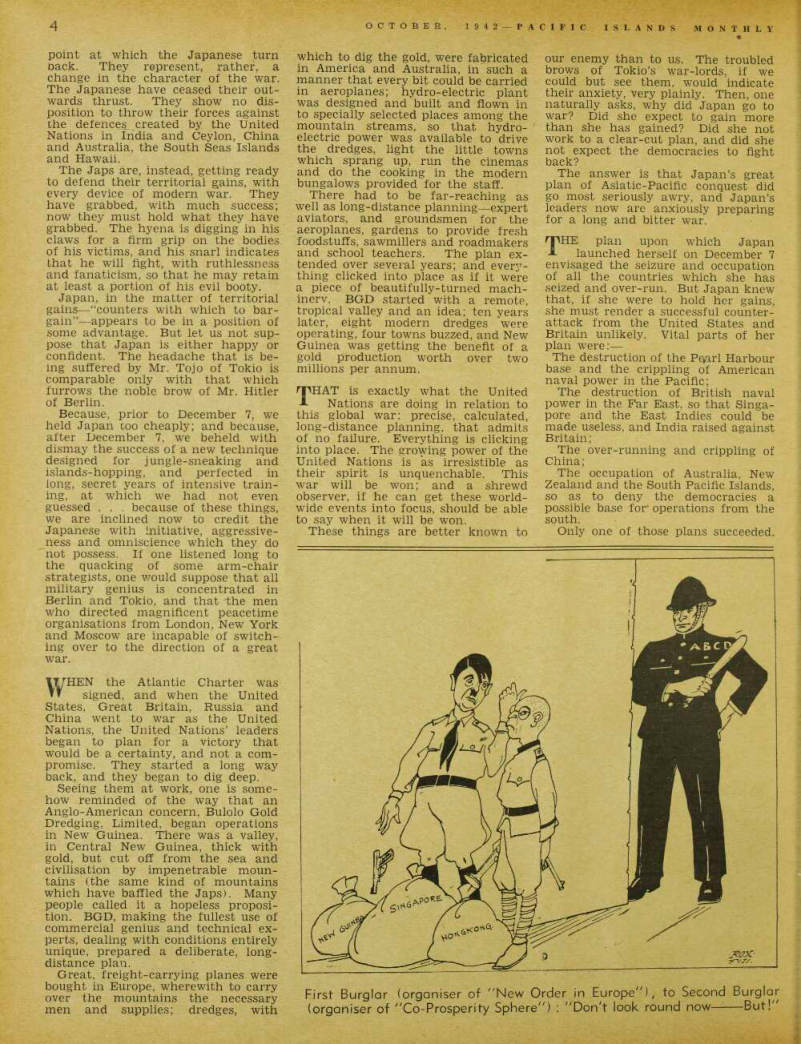
First Burglar (organiser of "New Order in Europe"), to Second Burglar (organiser of "Co-Prosperity Sphere"): "Don't look round now-But!"
How nearly all succeeded, we shall not know until after the war. The things which actually saved us in the Pacific and laid the foundation of Japan’s ultimate defeat were Japan’s failure to destroy Pearl Harbour; the long-continued resistance in the Philippines, which immobilised for months the Japanese forces intended for Australia; the rapidity with which the Americans recovered from the Pearl Harbour disaster and sent powerful forces to protect Australia and the South Pacific territories; and Germany’s failure to destroy Russia in 1942, and send armies through the Caucasus and Egypt to meet the Japanese in Central Asia.
The Japanese, when working to a plan which is developing successfully, are dangerous opponents. But when their plans go awry, and they must rapidly improvise and re-arrange to meet unexpected conditions, they are semi-helpless.
Japanese plans in the Asia-Pacific region are out of gear. Instead of a new empire and broken enemies, Japan has a new empire ringed around with enemies and potential enemies who not only are not broken, but clearly are gaining daily in strength—and especially in air strength, which is the one arm in which Japan is weakest.
SO far as one can see at present, Japan is turning desperately to the only strategy likely to be of use to her in the situation, which un expectedly confronts her—namely, a strategy of ruthless defence, of dying to the last man and thus forcing heavy losses upon her enemy.
Her plan now is to make every island a fortress, and every territory a bloody battleground. But here, again, her plans may go awry.
If the United Nations were depend ing only on naval and military forces, they might try to employ against Japan the technique of islands hopping and jungle-sneaking which Japan demonstrated so successfully in the December-May period, when the United Nations were unorganised and unready. But the United Nations’ strongest arm is their great growing
air force. Why waste precious months in island-hopping and jungle sneaking when—as recently proved on the north-eastern coast of Papua—a superior air force can gain domina tion over enemy forces and enemy occupied territory in a few hours?
MR. TOJO of Tokio has an enormous army, and a very powerful and efficient fleet, and a really vast agglomeration of tropical and sub tropical territories; but he can do nothing with any of them unless he has, and maintains, a superior air force. Without a superior air force, he is doomed.
And it is no use his gazing be seechingly Europe-wards. His partner in international rape, Mr. Hitler of Berlin, once had a very good air force; but it has been sadly chewed up lately by the incredibly-unbeaten Russians, and Mr. Hitler has none to spare for the Pacific.
All Mr. Hitler’s many planes will be needed, soon, to meet the attacks to come from what Mr. Hitler once sarcastically described as “an aircraft carrier off the coast of Europe.” The “aircraft-carrier,” commanded by one, Winston Churchill, is about to send along, not only 1,000-bomber raids from the RAF, but also some very numerous and fantastically big visitors with American markings, which may persuade Mr. Hitler of Berlin to forget all about Mr. Tojo of Tokio. * * ♦ The Americans have a delightful expression. When a man gets him self into trouble, and is completely exposed to the slings and arrows of unkind enemies, he is described as being “out on the end of a bough.”
We may be wrong: but, as we visualise the Pacific situation at present, we seem to see a long bough, swaying in a cold breeze, and, swinging danger ously out there, we perceive Mr. Tojo of Tokio. We think he will swing there for some time, while Mr. Hitler of Berlin is brought to a proper frame of mind, and while a really represen tative committee is formed to receive Mr. Tojo when the bough breaks — or is cut down.
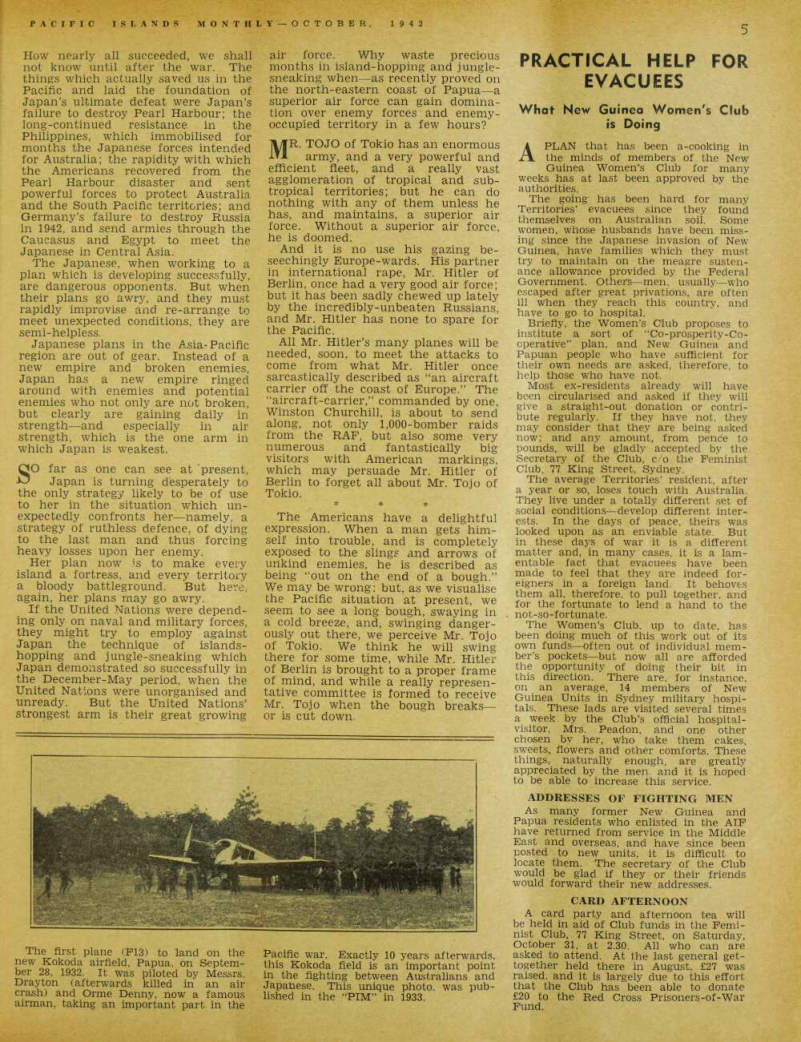
The first plane (Fl 3) to land on the new Kokoda airfield, Papua, on Septem ber 28, 1932. It was piloted by Messrs.
Drayton (afterwards killed in an air crash) and Orme Denny, now a famous airman, taking an important part in the
Pacific war. Exactly 10 years afterwards, this Kokoda field is an important point in the fighting between Australians and Japanese. This unique photo, was pub lished in the "PIM” in 1933.