Battle At Milne Bay
pp. 35-39 · Read in the full issue
"Whole Position in New Guinea is Better"
T ONG months ago, the “PIM” pointed out that the Japanese could not hope to take Port Moresby unless they came through China Strait, past Samarai, and attacked along the southern coast. It was no use their basing land operations on Lae, or Salamaua, or Gona—they could not get through the central moun tains. Sooner or later, we argued, they would find that out.
But Australian calamity-howlers—and especially pin-headed newspaper folk with no real knowledge of the country— insisted that Port Moresby was “menaced by Japanese jungle-fighters infiltrating through the jungles and the mountains.”
We were sure that the Japanese, sooner or later, would try to get com mand of China Strait; and it was great reassurance to us to learn that the High Command had made a shrewd appraisal of the situation, and was on the job.
It was difficult to know how that Aus tralian force was kept hidden in Milne Bay, away from Japanese reconnaissance.
But hidden it was. When, eventually, the Japanese came into the Bay, on August 26, their behaviour suggested that they were unaware of the presence of so many Australians. Or perhaps they were so “cocky” that they thought they had only to march in and take possession. In any event, they were sharply undeceived.
Among a welter of correspondents’ fragmentary reports it has been difficult to follow this Milne Bay operation.
However, the story was cleverly and effectively reconstructed, from available information, by Sir Keith Murdoch. Sir Keith is now head of the Melbourne “Herald” group of newspapers, and sel dom writes. But in 1914-18 he was by far the best Australian war correspondent in Europe, and he seems to have lost none of his skill.
A modern war correspondent seldom really sees a battle. If he is to tell an effective and truthful story, he must reconstruct it from the bits and pieces made available by observers and partici pants from all parts of the wide area concerned—and no man can do that unless he has imagination, logical rea soning and remarkable powers of deduc tion.
Here is the account of the Milne Bay Battle, as described by Sir Keith Mur doch, in the Melbourne “Herald” of September 2.
THE Milne Bay episode was satisfac tory and heartening. It could have been better only if we had had on the spot at the right time the dive bombers and torpedo-bombers needed so badly to blast the Japanese ships from the sea as they approached our bases.
Milne Bay is a long, deep-water har bour some seven miles wide; humid jungle reaches into the sea waters through swamps and marshes. Japanese pearl luggers used it until recently, and no doubt their captains took ample
soundings.
FOR some time we have had an air field on the southern side. We have called it Samarai, because the pomt is mostly known by that name.
The Japanese knew of the airfield and other works. What they did not know was the strength with which we were prepared to defend them.
Part of the Japanese expedition loomed up on Tuesday morning (August 25) from the south-west. It sent out some barges toward an island position. This was probably a feint. Our aeroplanes destroyed the barges, and thereafter were active whenever the heavy clouds and storms gave them a chance.
Other classes of bombers would have been infinitely more effective; our best weapons proved to be the fighter planes with heavy machine-guns.
On Tuesday night more Japanese arrived. Two cruisers, some destroyers, two transports, mine-sweepers and barges steamed to the middle of Milne Bay, and sent ashore troops, tanks, mortars and stores.
The ships got away in the morning, but not before one transport had been set on fire.
The troops set out for Koebul, one of the half-dozen mission stations in the area. Estimates of their tanks vary from two to five, and of their men from 500 to 2,000.
This will soon be cleared up. What is certain is that it was a well-found expe dition, intended to seize the airfield.
These Japanese light tanks are some thing of a mystery. They are about five tons in weight and they take a lot of landing. They have been used in the Philippines, Malaya and Java. They are so light as to be easy victims of anti tank guns, but even on jungle tracks they have a big value if the other side has none. In this case the tanks suc ceeded in disturbing our posts, but our men soon got their measure.
The Japanese belonged to the class of troops used so much in China, in the Philippines and in Malaya to effect landings on defended coasts. These were a jungle variety, wearing light jungle green uniforms. On their dead were found the insignia of the special corps.
They followed the Malayan formula.
When they found frontal opnosition— which they did much sooner than they expected—-they scattered into the iungle and began to squirm, climb and hew their way to their objectives.
For three days difficult and intensive fighting prevailed.
We had some of the finest men pro duced by Australia, hardened, fit, and trained for some months in tropical war fare, in well-placed posts, defending all the approaches to the aerodrome.
Our New Guinea air force had been mustered with great effect. The Japan ese land positions were heavily bombed and machine-gunned. Some of the finest Australian pilots, with European experi ence, wore in these attacks. One was a prominent leader. The fighters came low and attacked tanks and troops, and sprayed the tops of trees, which Japan ese junglemen use with skill.
The Japanese support by air was sur prisingly weak. It may have been because Ki ttyhawks had settled 13 Zero fighters on the ground at Buna in two surprise attacks.
How far the Japanese got around the Bay is not yet clear, but they appear at stage to have had a hold upon the Gin Gih plantation and the wharf. Some
(Continued on Page 38)
infiltrated to the edges of the aerodrome.
The jungle is so thick that men can pass unseen within a few yards.
Cruisers and destroyers came into the Bay during Thursday night, and landed more troops, departing at daybreak for some sheltered cove.
THE struggle on land covered a wide area, something like ten miles, but I doubt if the local commanders were ever really anxious. We had sub stantial numbers of good troops, and by air and by land were punishing the invaders heavily.
But when during Saturday night a Japanese cruiser and eight destroyers were spotted approaching the Bay, it was expected that reinforcements were coming to the enemy.
The main Australian counter-attack was to come on the Sunday. When our men struggled through the swamps and undergrowth they found some of the Japanese had gone.
The Japanese left some scores of dead.
This in itself proves they went in haste and disorder. They go to great pains always in carrying away their dead and wounded.
The Japanese have had nothing to boast about—although boasting they have done in plenty—since we all got our second wind in the Pacific. Coral Sea. Midway Island, Solomons, and Milne Bay—all have been defeats, and they have no victories to set against them.
It is true that they hold Gona and Buna, but while they have complete sea control to the north of New Guinea, and we lacked the right type of bombers on
the spot at the right moment in ade quate numbers to keep their ships from the New Guinea coast, they could go where they wanted about those parts.
The whole position in New Guinea is better. It is not so many months —certainly not further back than the time of Java’s conquest—when a quick move by Japan would have thrown us out of Port Moresby. We had made inadequate pro visions.
Now the picture is entirely different.
There are new aerodromes, roads, defence works in plenty; many troops and much aggressive activity. Morale is high; patrols go far inland; sections are main tained, as the communiques now show, as far inland as at Lae and Salamaua.
To-day we are fighting close to the back doors of these northern New Guinea coastal settlements, and at Kokoda, also
on the Japanese side of the mountains, we are denying our enemy the use of the airfield which would bring his fighters so close to Port Moresby.
The position is difficult, because of the Japanese capacity to pour in strength; but it is hardening all the time in our favour.
The destruction of Zeros from Darwin and from north-western bases lately has been one of the happiest and most signi ficant of events,
Descripfion of Milne Bay
MILNE Bay really is a beautiful place.
Not exotically so, as many tropical settings are, but just plain lovely.
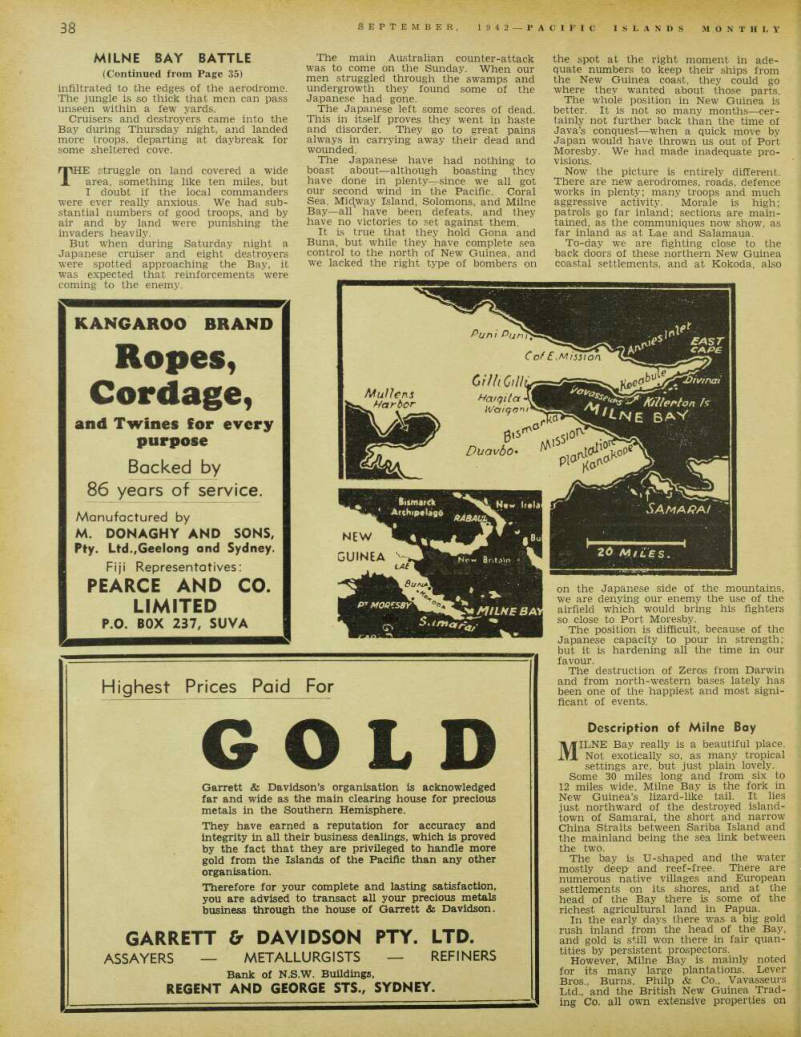
Some 30 miles long and from six to 12 miles wide, Milne Bay is the fork in New Guinea’s lizard-like tail. It lies just northward of the destroyed island town of Samarai, the short and narrow China Straits between Sariba Island and the mainland being the sea link between the two.
The bay is U-shaped and the water mostly deep- and reef-free. There are numerous native villages and European settlements on its shores, and at the head of the Bay there is some of the richest agricultural land in Papua.
In the early days there was a big gold rush inland from the head of the Bay, and gold is still won there in fair quan tities by persistent prospectors.
However, Milne Bay is mainly noted for its many large plantations. Lever Bros., Burns. Philp & Co., Vavasseurs Ltd., and the British New Guinea Trad ing Co. all own extensive properties on
the shores of the Bay.
Lever’s “Gili Gili” and Vavasseurs’
“Ahioma” estates were used exclusively for the manufacture of desiccated coco nut and their factories employed many hundreds of native workers.
Also in the Bay are many stations of the Kwato Industrial Mission, which has done splendid work for the Papuan natives. The headquarters of this mis sion were at Kwato Island near Samarai, and the mission specialised in teaching the natives useful trades such as car pentry and boat-building.
Two members of this mission, Mr. Cecil Abel, son of the mission’s founder, the late Mr. Charles Abel, and Mr. Geoffrey Baskett, remained behind at the time of the general evacuation, to carry on their work among the natives.
The northern side of Milne Bay is joined by a long and narrow peninsula, the eastern point of which is East Cape, the easternmost tip of New Guinea.
Some 200 odd miles to the north-east from this cape is Buna, where the Jap anese made their first sortie on Papuan soil.
Eastward from Milne Bay begin the string of islands that form the Louisiades Archipelago. At least one of these islands—Pana Pom Pom in the De Boyne group—has already been occupied by the Japanese, and 400 miles further east ward, of course, are the Solomons.
A dozen miles northward from Milne Bay is Normanby Island, of the D’Entre casteaux group, a rugged and mountain ous cluster of islands with many fine harbours—one of which, Sewa Bay, is among the finest of the world, capable of sheltering all Japan’s Navy. The channel between Normanby Island and East Cape is known as the Goschen Straits.
Sixty miles north of the D’Entrecas teaux group are the Trobriand Islands, and somewhere between these two groups the invading Japanese convoy was sighted and bombed.
The death was announced, on August 5, of Mrs. J. P. Watt. She was the widow of the late Rev. W. Watt and a link with the older tradition of New Hebridean mission work. She was a fund of infor mation on the Group, and retained her interest in this field to the last.
Mr. H. Robinson, who was a missionary with the Methodist Mission in Papua, is now a Warrant Officer in the New Guinea Forces. He writes that he was able to visit Dobu, and made contact with a number of Papuan and other Island teachers.