Panoramic Photograph Of Central Part Of The Scene Of The Solomon Island Battle
pp. 24-25 · Read in the full issue
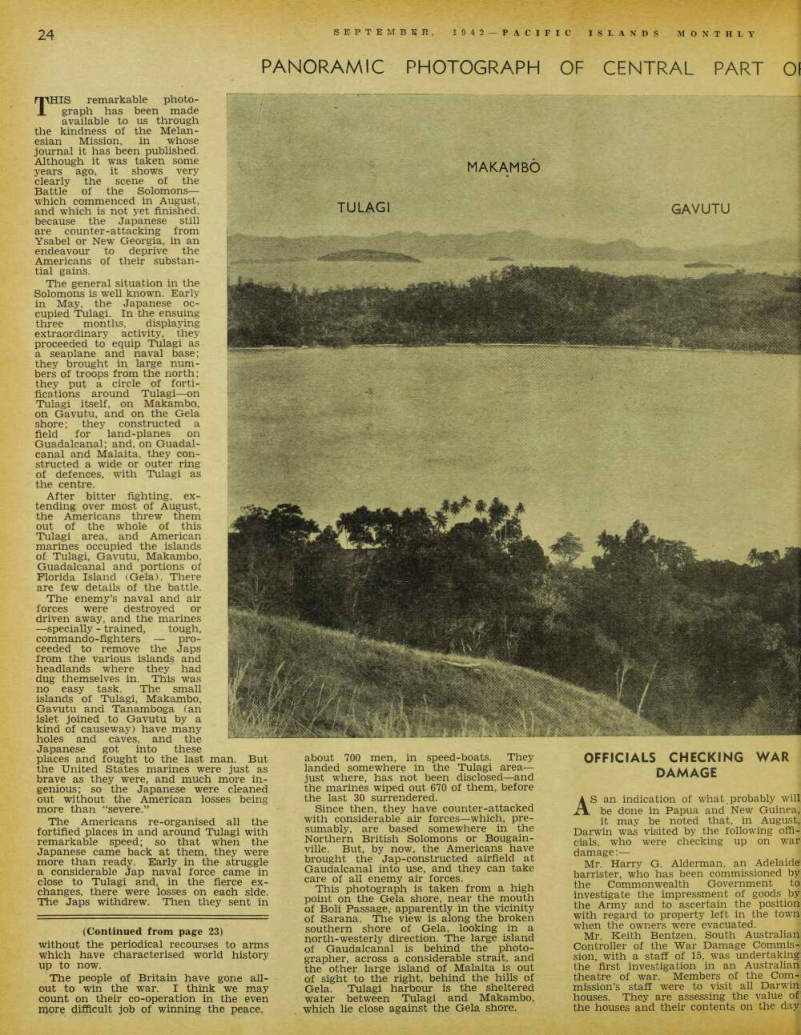
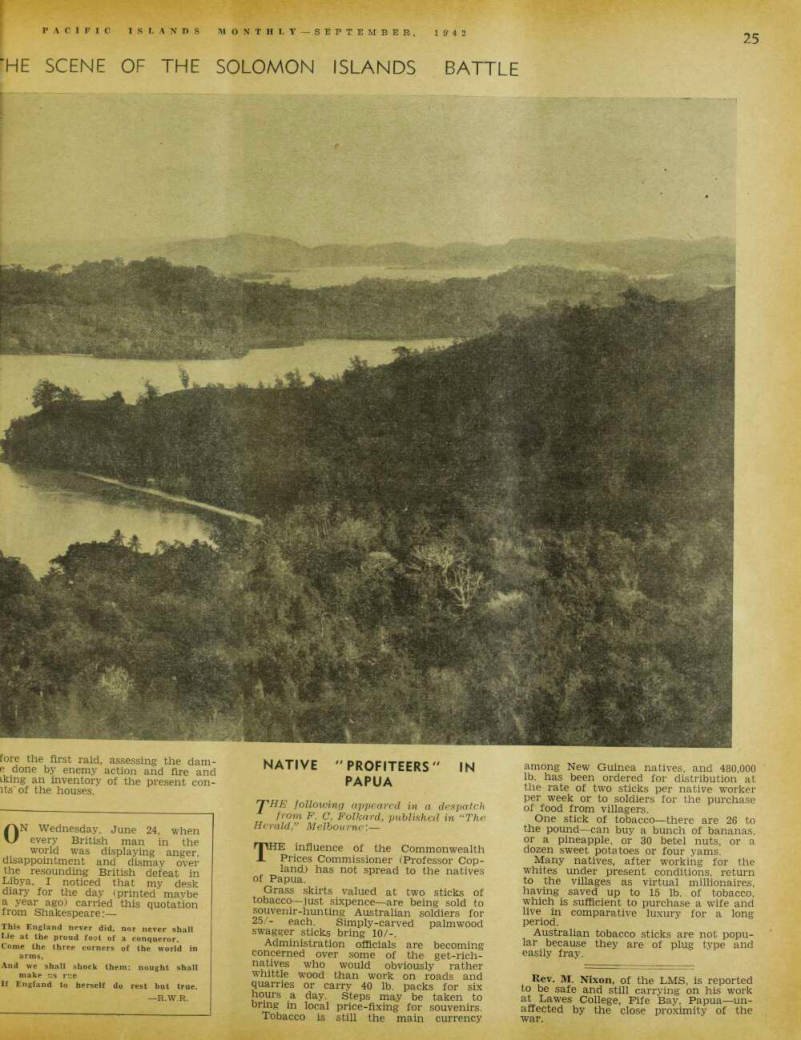
THIS remarkable photo graph has been made available to us through the kindness of the Melan esian Mission, in whose journal it has been published.
Although it was taken some years ago, it shows very clearly the scene of the Battle of the Solomons — which commenced in August, and which is not yet finished, because the Japanese still are counter-attacking from Ysabel or New Georgia, in an endeavour to deprive the Americans of their substan tial gains.
The general situation in the Solomons is well known. Early in May, the Japanese oc cupied Tulagi. In the ensuing three months, displaying extraordinary activity, they proceeded to equip Tulagi as a seaplane and naval base; they brought in large num bers of troops from the north; they put a circle of forti fications around Tulagi—on Tulagi itself, on Makambo, on Gavutu, and on the Gela shore; they constructed a field for land-planes on Guadalcanal; and, on Guadal canal and Malaita, they con structed a wide or outer ring of defences, with Tulagi as the centre.
After bitter fighting, ex tending over most of August, the Americans threw them out of the whole of this Tulagi area, and American marines occupied the islands of Tulagi, Gavutu, Makambo, Guadalcanal and portions of Florida Island (Gela). There are few details of the battle.
The enemy’s naval and air forces were destroyed or driven away, and the marines —specially - trained, tough, commando-fighters pro ceeded to remove the Japs from the various islands and headlands where they had dug themselves in. This was no easy task. The small islands of Tulagi, Makambo, Gavutu and Tanamboga (an islet joined to Gavutu by a kind of causeway) have many holes and caves, and the Japanese got into these
places and fought to the last man. But the United States marines were just as brave as they were, and much more in genious; so the Japanese were cleaned out without the American losses being more than “severe.”
The Americans re-organised all the fortified places in and around Tulagi with remarkable speed; so that when the Japanese came back at them, they were more than ready. Early in the struggle a considerable Jap naval force came in close to Tulagi and, in the fierce ex changes, there were losses on each side.
The Japs withdrew. Then they sent in
about 700 men, in speed-boats. They landed somewhere in the Tulagi area— just where, has not been disclosed —and the marines wiped out 670 of them, before the last 30 surrendered.
Since then, they have counter-attacked with considerable air forces —which, pre sumably, are based somewhere in the Northern British Solomons or Bougain ville. But, by now, the Americans have brought the Jap-constructed airfield at Gaudalcanal into use, and they can take care of all enemy air forces.
This photograph is taken from a high point on the Gela shore, near the mouth of Boli Passage, apparently in the vicinity of Sarana. The view is along the broken southern shore of Gela, looking in a north-westerly direction. The large island of Gaudalcanal is behind the photo grapher, across a considerable strait, and the other large island of Malaita is out of sight to the right, behind the hills of Gela. Tulagi harbour is the sheltered water between Tulagi and Makambo, which lie close against the Gela shore.
Officials Checking War
Damage
AS an indication of what, probably will be done in Papua and New Guinea, it may be noted that, in August, Darwin was visited by the following offi cials, who were checking up on war damage:— Mr. Harry G. Alderman, an Adelaide barrister, who has been commissioned by the Commonwealth Government to investigate the impressment of goods by the Army and to ascertain the position with regard to property left in the town when the owners were evacuated.
Mr. Keith Bentzen, South Australian.
Controller of the War Damage Commis sion, with a staff of 15, was undertaking' the first investigation in an Australian, theatre of war. Members of the Com mission’s staff were to visit all Darwin houses. They are assessing the value of the houses and their contents on the day
fore the first raid, assessing the dam e done by enemy action and fire and iking an inventory of the present con its'of the houses.
ON Wednesday, June 24, when every British man in the world was displaying anger, disappointment and dismay over the resounding British defeat in Libya, I noticed that my desk diary for the day (printed mavbe a year ago) carried this quotation from Shakespeare:— This England never did, nor never shall Lie at the proud foot of a conqueror.
Come the three corners of the world in arms.
And we shall shock them: nought shall make ns rue If England to herself do rest but true.
R.W.R.
Native "Profiteers" In
Papua
J 1 HE following appeared in a despatch from F. C. Folkard, published in “The Herald,” Melbourne :— THE influence of the Commonwealth Prices Commissioner (Professor Cop land) has not spread to the natives of Papua.
Grass skirts valued at two sticks of tobacco—just sixpence—are being sold to souvenir-hunting Australian soldiers for 25/- each. Simply-carved palmwood swagger sticks bring 10/-.
Administration officials are becoming concerned over some of the get-rich natives who would obviously rather whittle wood than work on roads and quarries or carry 40 lb. packs for six hours a day. Steps may be taken to bring in local price-fixing for souvenirs.
Tobacco is still the main currency
among New Guinea natives, and 480,000 lb. has been ordered for distribution at the rate of two sticks per native worker per week or to soldiers for the purchase of food from villagers.
One stick of tobacco—there are 26 to the pound—can buy a bunch of bananas, or a pineapple, or 30 betel nuts, or a dozen sweet potatoes or four yams.
Many natives, after working for the whites under present conditions, return to the villages as virtual millionaires, having saved up to 15 lb. of tobacco, which is sufficient to purchase a wife and live in comparative luxury for a long period.
Australian tobacco sticks are not popu lar because they are of plug type and easily fray.
Rev. M. Nixon, of the LMS, is reported to be safe and still carrying on his work at Lawes College, Fife Bay, Papua—un affected by the close proximity of the war.