Battle Of Owen Stanley Range
pp. 8-41 · Read in the full issue
Japs Make Extraordinary Effort to Attack P. Moresby in Rear
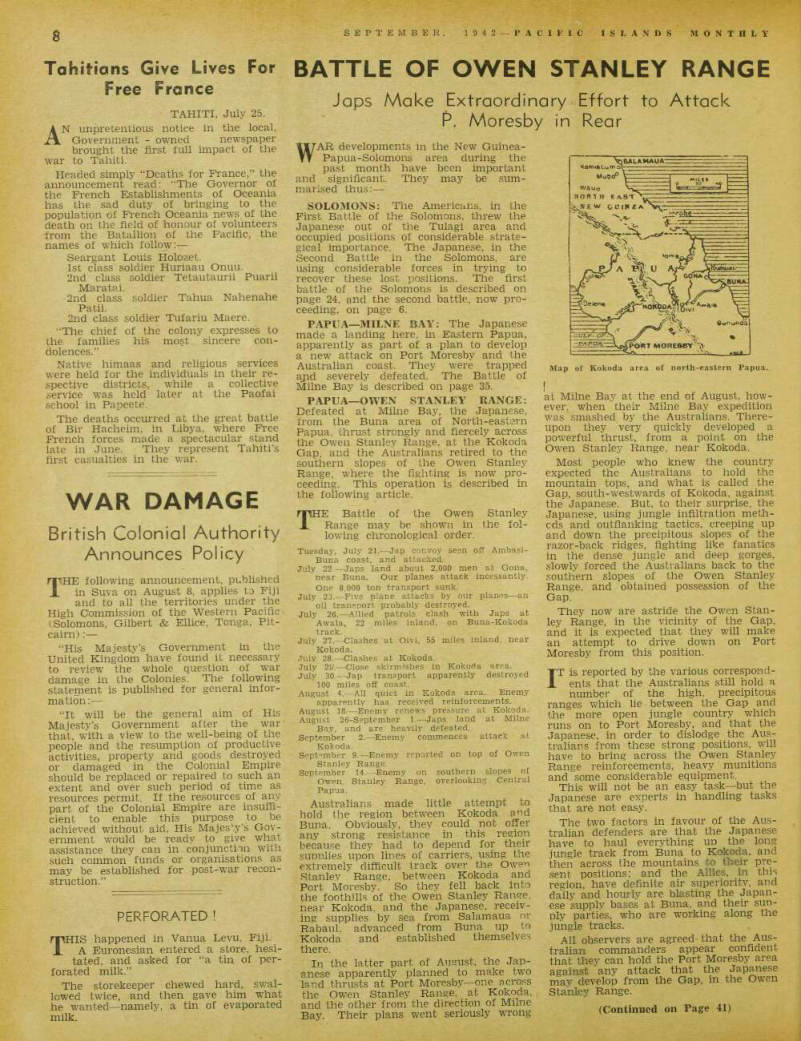
WAR developments in the New Guinea- Papua-Solomons area during the past month have been important and significant. They may be sum marised thus:— SOLOMONS: The Americans, in the First Battle of the Solomons, threw the Japanese out of the Tulagi area and occupied positions of considerable strate gical importance. The Japanese, in the Second Battle in the Solomons, are using considerable forces in trying to recover these lost positions. The first battle of the Solomons is described on page 24, and the second battle, now pro ceeding, on page 6.
PAPUA—MILNE BAY: The Japanese made a landing here, in Eastern Papua, apparently as part of a plan to develop a new attack on Port Moresby and the Australian coast. They trapped and severely defeated. The Battle of Milne Bay is described on page 35.
Papua—Owen Stanley Range:
Defeated at Milne Bay, the Japanese, from the Buna area of North-eastern Papua, thrust strongly and fiercely across the Owen Stanley Range, at the Kokoda Gap, and the Australians retired to the southern slopes of the Owen Stanley Range, where the fighting is now pro ceeding. This operation is described in the following article. rE Battle of the Owen Stanley Range may be shown in the fol lowing chronological order.
Tuesday, July 21. —Jap convoy seen off Ambasi- Buna coast, and attacked.
July 22—Japs land about 2,000 men at Gona, near Buna. Our planes attack incessantly.
One 8.000 ton transport sunk.
July 23.—Five plane attacks by our planes—an oil transport probably destroyed.
July 26. —Allied patrols clash with Japs at Awala,. 22 miles inland, on Buna-Kokoda track.
July 27.—Clashes at Oivi, 55 miles inland, near Kokoda.
July 28.—Clashes at Kokoda.
July 29'.—Close skirmishes in Kokoda area.
July 30.—Jap transport apparently destroyed 100 miles off coast.
August 4. —All quiet in Kokoda area. Enemy apparently has received reinforcements.
August 18.—Enemy renews pressure at Kokoda.
August 26-September I.—Japs land at Milne Bay, and are heavily defeated.
September 2.—Enemy commences attack at Kokoda.
September 9.—Enemy reported on top of Owen Stanley Range.
September 14.—Enemy on southern slopes of Owen Stanley Range, overlooking Central Papua.
Australians made little attempt to hold the region between Kokoda and Buna. Obviously, they could not offer any strong resistance in this region because they had to depend for their sunnlies upon lines of carriers, using the extremely difficult track over the Owe-n Stanlev Range, between Kokoda and Port Moresby. So they fell back into the foothills of the Owen Stanley Range, near Kokoda. and the Japanese, receiv ing supplies by sea from Salamaua or Rabaul, advanced from Buna up to Kokoda and established themselves there.
In the latter part of August, the Jap anese apparently planned to make two land thrusts at Port Moresby—one across the Owen Stanley Range, at Kokoda, and the other from the direction of Milne Bay. Their plans went seriously wrong
at Milne Bay at the end of August, how ever, when their Milne Bay expedition was smashed by the Australians. There upon they very quickly developed a powerful thrust, from a point on the Owen Stanley Range, near Kokoda.
Most people who knew the country expected the Australians to hold the mountain tops, and what is called the Gap, south-westwards of Kokoda, against the Japanese. But, to their surprise, the Japanese, using jungle infiltration meth ods and outflanking tactics, creeping up and down the precipitous slopes of the razor-back ridges, fighting like fanatics in the dense jungle and deep gorges, slowly forced the Australians back to the southern slopes of the Owen Stanley Range, and obtained possession of the Gap.
They now are astride the Owen Stan ley Range, in the vicinity of the Gap, and it is expected that they will make an attempt to drive down on Port Moresby from this position.
IT is reported by the various correspond ents that the Australians still hold a number of the high, precipitous ranges which lie between the Gap and the more open jungle country which runs on to Port Moresby, and that the Japanese, in order to dislodge the Aus tralians from these strong positions, will have to bring across the Owen Stanley Range reinforcements, heavy munitions and some considerable equipment.
This will not be an easy task—but the Japanese are experts in handling tasks that are not easy.
The two factors in favour of the Aus tralian defenders are that the Japanese have to haul everything up the long jungle track from Buna to Kokoda, and then across the mountains to their pre sent positions; and the Allies, in this region, have definite air superiority, and daily and hourly are blasting the Japan ese supply bases at Buna, and their sun ply parties, who are working along the jungle tracks.
All observers are agreed that the Aus tralian commanders appear confident that they can hold the Port Moresby area against any attack that the Japanese may develop from the Gap, in the Ow T en Stanley Range.
(Continued on Page 41)
Map of Kokoda area of north-eastern Papua.
AS all Territories residents know, the rainy season is now approaching in New Guinea —and the rainy season will very definitely handicap jungle fighters and air-fighters in this great island.
Many questions have been asked as to when the rainy season actually com mences.
Actually, it covers different periods in different parts of the mainland. Along the north-eastern slopes of the Owen Stanley Range, in the country now occu pied by the Japs between Buna and Salamaua, the rains piobably already have commenced. It is quite likely that the Japanese there are suffering extremes of inconvenience and discomfort on their track from Buna right up to their pre sent lines overlooking the Port Moresby country. But, on the southern side of the range, in the region of Port Moresby, the rains probably will not really com mence until December. The Australian commanders knew this, and there may have been shrewd design in their with drawal from the Kokoda area to their present positions.
Nevertheless, many people are asking why the Australians were so quickly and unexpectedly withdrawn from the Kokoda district to the southern slopes of the mountains.
WE cannot do better than quote from a despatch from F. C. Folkard, cor respondent of Melbourne ■'Herald” and Sydney “Sun,” published on Sep tember 14.
When Mr. Folkard first went to Port Moresby, many months ago, he caused Territories residents great irritation by writing too confidently about conditions that he obviously did not understand.
But, of all the correspondents who went to that front, he has learned most quickly, and secured so good an under standing of a confusing and confused situation that his despatches are most enlightening and valuable. His com ments follow; THE Australian soldier cannot be blamed for letting the Japanese across the range. It was not his fault.
He was asked to fight an enemy numerically superior and at the same time trained to the utmost in every method of cover-fighting. Visible and vulnerable himself—because of an insuffi cient development of camouflage—he had to fight an unseen enemy, a “phantom army” in the true sense of the term.
Seen by the Japanese because his uni form did not blend well enough with the background, the Australian soldier had to fight blind when attacked. He fired at noises, not at sight, saw Japanese snipers tumble from treetops, found others dead when he advanced. For him it was a nightmare war, a joust with shadows, a battle of the senses . . .
Most of the lessons learned in Malaya had been expounded to our men, many of our old fighting faults exposed. They were told that they were fighting men of high calibre, men tough enough to throw back a German advance.
But they found this war was different.
It was so eerie, so full of unseen menace that their desire “to get at the enemy and annihilate him” was checkmated by the jungle itself.
From that picture I think that these questions are permissible:— Knowing that we would have to fight the Japanese in the jungle, did we sufficiently train our men for the job?
(2) With the object-lessons of the amazingly clever Japanese camouflage, did we dress our men so that they, too, would merge as closely with the jungle background? (3) Did we place too much confidence in our physical superiority and not enough in the development of cunning and tactics that would outmatch the Japanese at his game of infiltration? (4) Did we overload our soldiers with equipment so that he could not move so freely through the jungle as the Japan ese? (5) Did we develop to the full the essential merit of small counter-infiltrat ing parties?
To-day’s history is answering those questions. If some are in the negative, I have sufficient faith in our military leaders in New Guinea to know that they will be rectified.
Lieut.-General Rowell is one of the most qualified and most adaptable lead ers. Under him are young, keen, clever officers from the Middle East.
The deficit is not in leadership. It is not in cur men. If anywhere, it is in our almost nationally characteristic re fusal to prepare fully for a coming event.
We have now to adapt ourselves to con ditions which we should have understood all along.
Pessimistic as the news may seem, there is no need to lose faith nor to call for heads. Unfortunately, among some of our leaders there has been a marked tendency to cry down demands for an Army completely Commando-trained . . .
In the meantime, I feel confident that Port Moresby will be able to withstand and defeat any Japanese attack from the rear.
But the time will come when we must throw the Jap out of his jungle posses sions and this can only happen when we have troops who are better than he in every conceivable phase of this strangest of all modern warfare.
The answer, I am convinced, lies not in isolated bands of Commandos but in a Commando army where every man knows the counter to every Japanese trick and manoeuvre.
Although we learned much from Malaya and Indies, we did not learn enough. We trained our troops in jungle warfare, but did not develop our tactics
sufficiently to out-manoeuvre, outfight,
and match with better cunning the ingenuity of the enemy.
Australia still has lessons to learn in the art of jungle fighting. The battle for New Guinea is far from lost—in fact, it has only just started, and the familiar cry, “Too little, too late,” can find no echo.
Miss Elsie Edgar, who was formerly with the Presbyterian Mission in the New Hebrides, is at present doing district nursing work in Adelaide.