New Governor
Of Fiji
Application to Wartime Task
ON assuming duty in Suva as Governor of Fiji and High Commissioner for the Western Pacific, Major-General Sir Philip Mitchell, KCMG, sent the fol lowing message to Admiral Nimitz, USN, Commander-in-Chief of the Allied Navy in the Pacific:— “I have assumed duty as Governor of Fiji and High Commissioner for the Western Pacific. I take this opportunity to assure you of the whole-hearted co operation in the prosecution of the war of the people and Government of the Colony and High Commission.—Mitchell.”
The following reply was received from Admiral Nimitz:— “Extend you a hearty welcome and best wishes for success as Governor of Fiji and High Commissioner for the Western Pacific. Your assurance of co operation is appreciated and reciprocated It may rightly be said that we stand shoulder to shoulder against the enemy —Nimitz.”
ALL reports from the Central Pacific agree that Sir Philip Mitchell has created a favourable impression
there. The personality of the man who fills this high post always is a matter of public interest. He exercises almost dic tatorial powers, and his wisdom, no less than his temper, is a matter of vital concern to a large body of public ser vants, as well as to the various non- Pacific and Pacific communities over whom he rules.
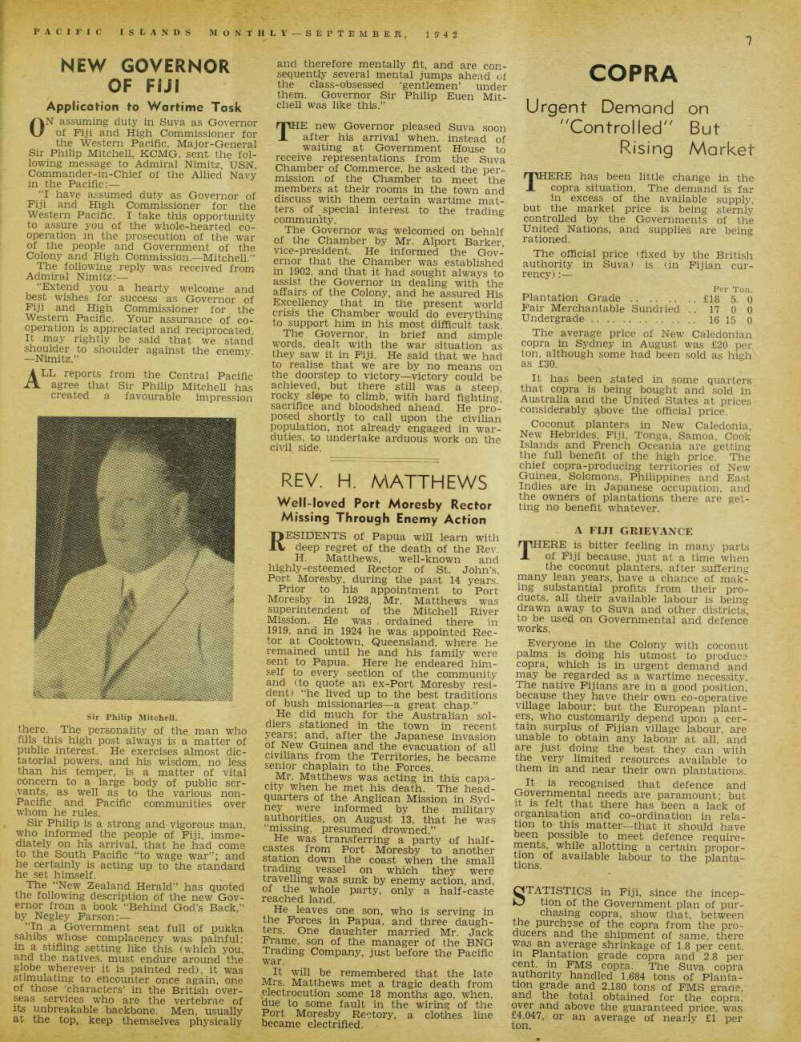
Sir Philip is a strong and vigorous man, who informed the people of Fiji, imme diately on his arrival, that he had come to the South Pacific “to wage war”; and he certainly is acting up to the standard he set himself.
The “New Zealand Herald” has quoted the following description of the new Gov ernor from a book “Behind God’s Back,” by Negley Farson:— “In a Government seat full of pukka sahibs whose complacency was painful; in a stifling setting like this (which you, and the natives, must endure around the globe wherever it is painted red), it was stimulating to encounter once again, one of those ‘characters’ in the British over seas services who are the vertebrae of its unbreakable backbone. Men, usually at the top, keep themselves physically
and therefore mentally fit, and are con sequently several mental jumps ahead ol the class-obsessed ‘gentlemen’ under them. Governor Sir Philip Euen Mit chell was like this.”
THE new Governor pleased Suva soon after his arrival when, instead of waiting at Government House to receive representations from the Suva Chamber of Commerce, he asked the per mission of the Chamber to meet the members at their rooms in the town and discuss with them certain wartime mat ters of special interest to the trading community.
The Governor was welcomed on behalf of the Chamber by Mr. Alport Barker, vice-president. He informed the Gov ernor that the Chamber was established in 1902, and that it had sought always to assist the Governor in dealing with the affairs of the Colony, and he assured His Excellency that in the present world crisis the Chamber would do everything to support him in his most difficult task.
The Governor, in brief and simple words, dealt with the war situation as they saw it in Fiji. He said that we had to realise that we are by no means on the doorstep to victory—victory could be achieved, but there still was a steep rocky stepe to climb, with hard fighting sacrifice and bloodshed ahead. He pro posed shortly to call upon the civilian population, not already engaged in war duties, to undertake arduous work on the civil side.
Sir Philip Mitchell.