Prospect
pp. 5-6 · Read in the full issue
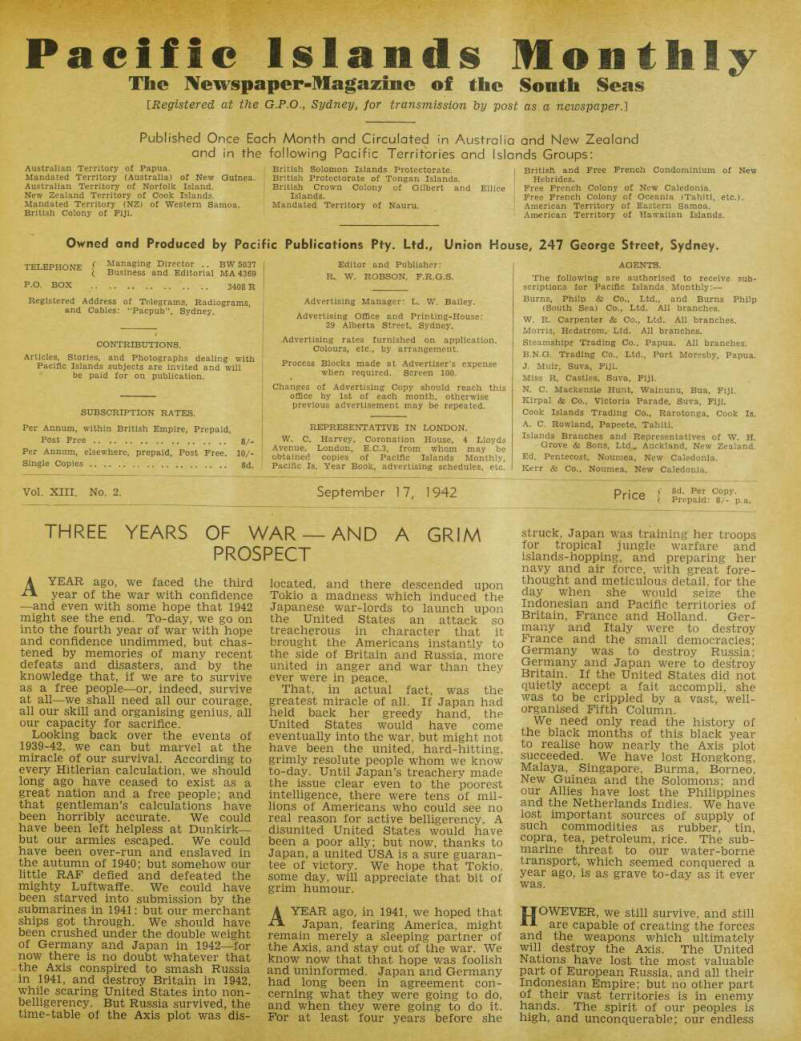
THREE YEARS OF WAR — AND A GRIM
A YEAR ago, we faced the third year of the war with confidence —and even with some hope that 1942 might see the end. To-day, we go on into the fourth year of war with hope and confidence undimmed, but chas tened by memories of many recent defeats and disasters, and by the knowledge that, if we are to survive as a free people—or, indeed, survive at all—we shall need all our courage, all our skill and organising genius, all our capacity for sacrifice.
Looking back over the events of 1939-42, we can but marvel at the miracle of our survival. According to every Hitlerian calculation, we should long ago have ceased to exist as a great nation and a free people; and that gentleman’s calculations have been horribly accurate. We could have been left helpless at Dunkirk— but our armies escaped. We could have been over-run and enslaved in the autumn of 1940; but somehow our little RAF defied and defeated the mighty Luftwaffe. We could have been starved into submission by the submarines in 1941: but our merchant ships got through. We should have been crushed under the double weight of Germany and Japan in 1942—f0r now there is no doubt whatever that the Axis conspired to smash Russia in 1941, and destroy Britain in 1942, while scaring United States into non belligerency. But Russia survived, the time-table of the Axis plot was dis
located, and there descended upon Tokio a madness which induced the Japanese war-lords to launch upon the United States an attack so treacherous in character that it brought the Americans instantly to the side of Britain and Russia, more united in anger and war than they ever were in peace.
That, in actual fact, was the greatest miracle of all. If Japan had held back her greedy hand, the United States would have come eventually into the war, but might not have been the united, hard-hitting, grimly resolute people whom we know to-day. Until Japan’s treachery made the issue clear even to the poorest intelligence, there were tens of mil lions of Americans who could see no real reason for active belligerency. A disunited United States would have been a poor ally; but now, thanks to Japan, a united USA is a sure guaran tee of victory. We hope that Tokio, some day, will appreciate that bit of grim humour.
A YEAR ago, in 1941, we hoped that Japan, fearing America, might remain merely a sleeping partner of the Axis, and stay out of the war. We know now that that hope was foolish and uninformed. Japan and Germany had long been in agreement con cerning what they were going to do, and when they were going to do it.
For at least four years before she
struck, Japan was training her troops for tropical jungle warfare and islands-hopping, and preparing her navy and air force, with great fore thought and meticulous detail, for the day when she would seize the Indonesian and Pacific territories of Britain, France and Holland. Ger many and Italy were to destroy France and the small democracies; Germany was to destroy Russia; Germany and Japan were to destroy Britain. If the United States did not quietly accept a fait accompli, she was to be crippled by a vast, well organised Fifth Column.
We need only read the history of the black months of this black year to realise how nearly the Axis plot succeeded. We have lost Hongkong, Malaya, Singapore, Burma, Borneo, New Guinea and the Solomons; and our Allies have lost the Philippines and the Netherlands Indies. We have lost important sources of supply of such commodities as rubber, tin, copra, tea, petroleum, rice. The sub marine threat to our water-borne transport, which seemed conquered a year ago, is as grave to-day as it ever was.
TTOWEVER, we still survive, and still -■-A are capable of creating the forces and the weapons which ultimately will destroy the Axis. The United Nations have lost the most valuable part of European Russia, and all their Indonesian Empire; but no other part of their vast territories is in enemy hands. The spirit of our peoples is high, and unconquerable; our endless
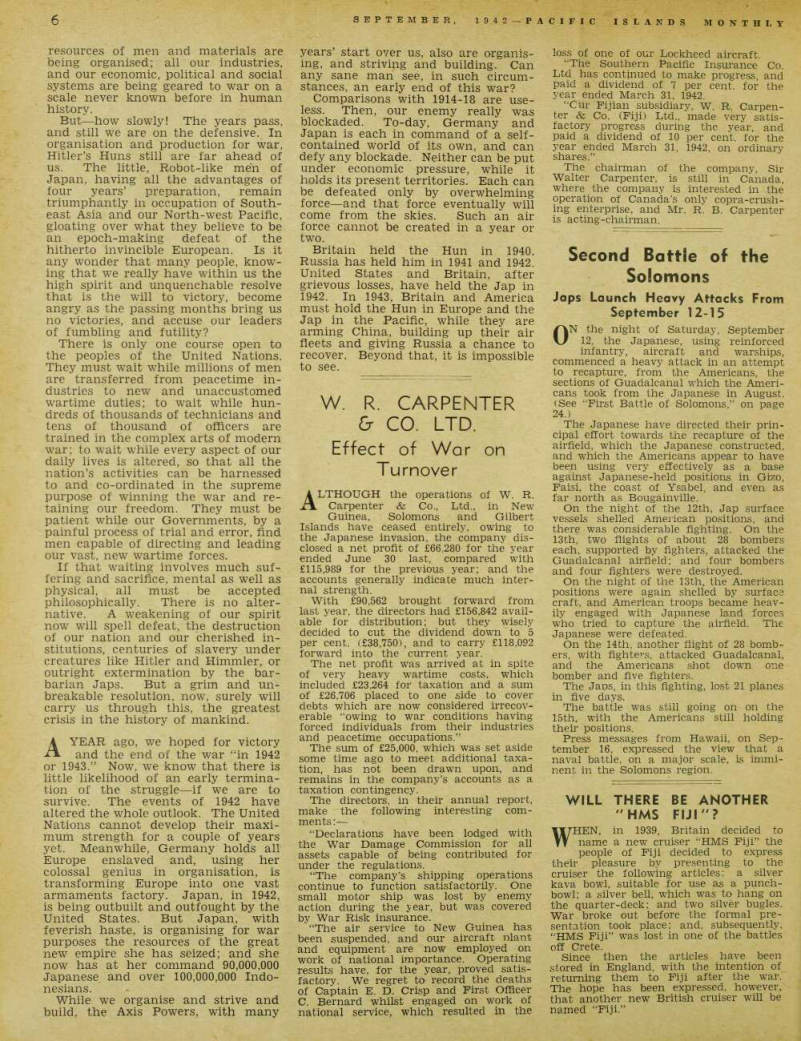
resources of men and materials are being organised; all our industries, and our economic, political and social systems are being geared to war on a scale never known before in human history.
But—how slowly! The years pass, and still we are on the defensive. In organisation and production for war.
Hitler’s Huns still are far ahead of us. The little, Robot-like men of Japan, having all the advantages of four years’ preparation, remain triumphantly in occupation of South east Asia and our North-west Pacific, gloating over what they believe to be an epoch-making defeat of the hitherto invincible European. Is it any wonder that many people, know ing that we really have within us the high spirit and unquenchable resolve that is the will to victory, become angry as the passing months bring us no victories, and accuse our leaders of fumbling and futility?
There is only one course open to the peoples of the United Nations.
They must wait while millions of men are transferred from peacetime in dustries to new and unaccustomed wartime duties; to wait while hun dreds of thousands of technicians and tens of thousand of officers are trained in the complex arts of modern war; to wait while every aspect of our daily lives is altered, so that all the nation’s activities can be harnessed to and co-ordinated in the supreme purpose of winning the war and re taining our freedom. They must be patient while our Governments, by a painful process of trial and error, find men capable of directing and leading our vast, new wartime forces.
If that waiting involves much suf fering and sacrifice, mental as well as physical, all must be accepted philosophically. There is no alter native. A weakening of our spirit now will spell defeat, the destruction of our nation and our cherished in stitutions, centuries of slavery under creatures like Hitler and Himmler, or outright extermination by the bar barian Japs. But a grim and un breakable resolution, now, surely will carry us through this, the greatest crisis in the history of mankind.
A YEAR ago, we hoped for victory and the end of the war “in 1942 or 1943.” Now, we know that there is little likelihood of an early termina tion of the struggle—if we are to survive. The events of 1942 have altered the whole outlook. The United Nations cannot develop their maxi mum strength for a couple of years yet. Meanwhile, Germany holds all Europe enslaved and, using her colossal genius in organisation, is transforming Europe into one vast armaments factory. Japan, in 1942, is being outbuilt and outfought by the United States. But Japan, with feverish haste, is organising for war purposes the resources of the great new empire she has seized; and she now has at her command 90,000,000 Japanese and over 100,000,000 Indo nesians.
While we organise and strive and build, the Axis Powers, with many
years’ start over us, also are organis ing, and striving and building. Can any sane man see, in such circum stances, an early end of this war?
Comparisons with 1914-18 are use less. Then, our enemy really was blockaded. To-day, Germany and Japan is each in command of a self contained world of its own, and can defy any blockade. Neither can be put under economic pressure, while it holds its present territories. Each can be defeated only by overwhelming force—and that force eventually will come from the skies. Such an air force cannot be created in a year or two.
Britain held the Hun in 1940.
Russia has held him in 1941 and 1942.
United States and Britain, after grievous losses, have held the Jap in 1942. In 1943, Britain and America must hold the Hun in Europe and the Jap in the Pacific, while they are arming China, building up their air fleets and giving Russia a chance to recover. Beyond that, it is impossible to see.