Matavai, which
p. 16 · Read in the full issue
LIGHT ON HALF-FORGOTTEN INCIDENT OF EARLY TAHITI
For the following interesting and half forgotten chapter in the history of pioneer London Missionary Society work in Tahiti we are indebted to Mr. W. W. Bolton, MA, a resident of Papeete, who, as a hobby, has carried out much historical re search in Tahiti. When the first LMS mis sionaries came to Tahiti in 1797, they were made a grant of land by the Tahitians.
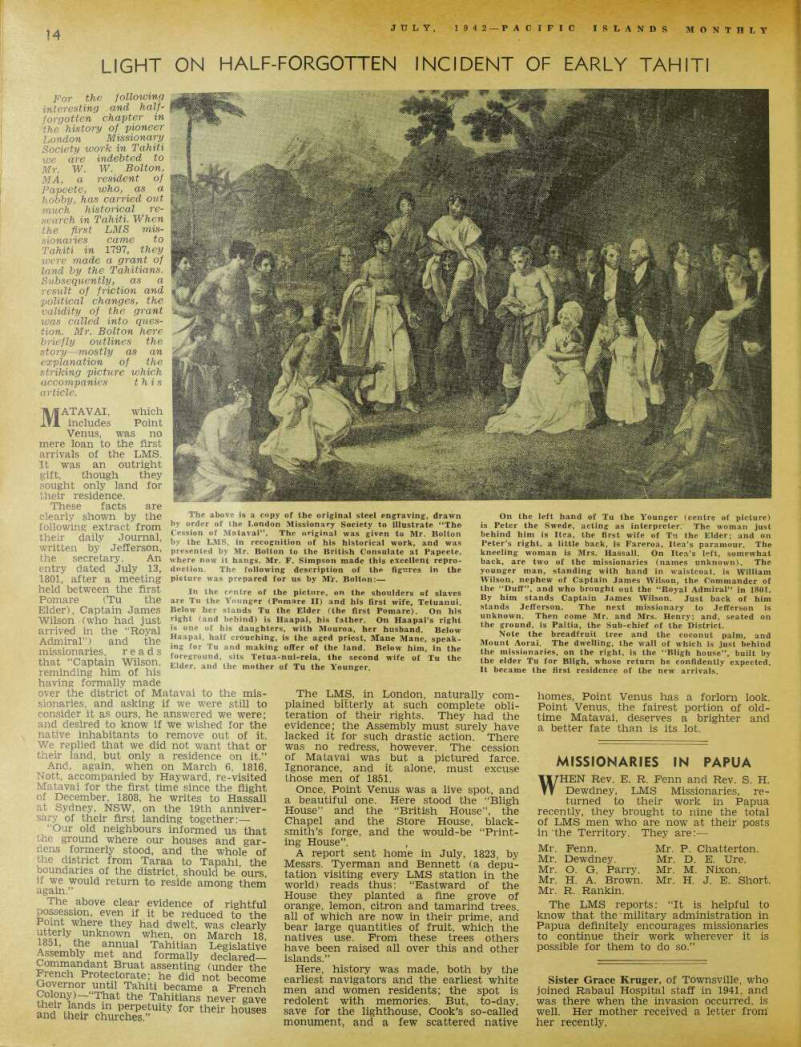
Subsequently, as a result of friction and political changes, the validity of the grant was called into ques tion. Mr. Bolton here briefly outlines the story—mostly as an explanation of the striking picture which accompanies this article.
Matavai, which
includes Point Venus, was no mere loan to the first arrivals of the LMS.
It was an outright gift, though they sought only land for their residence.
These facts are clearly shown by the following extract from their daily Journal, written by Jefferson, the secretary. An entry dated July 13, 1801, after a meeting held between the first Pomare (Tu the Elder), Captain James Wilson (who had just arrived in the “Royal Admiral”) and the missionaries, reads that “Captain Wilson, reminding him of his having formally made
over the district of Matavai to the mis sionaries, and asking if we were still to consider it as ours, he answered we were; and desired to know if we wished for the native inhabitants to remove out of it.
We replied that we did not want that or their land, but only a residence on it.”
And, again, when on March 6, 1816, Nott, accompanied by Hayward, re-visited Matavai for the first time since the flight of December, 1808, he writes to Hassall at Sydney, NSW, on the 19th anniver sary of their first landing together:— “Our old neighbours informed us that the ground where our houses and gar dens formerly stood, and the whole of the district from Taraa to Tapahi, the boundaries of the district, should be ours, if we would return to reside among them again.”
The above clear evidence of rightful possession, even if it be reduced to the Point where they had dwelt, was clearly VoS rly^unknown when - on March 18, 1851, the annual Tahitian Legislative Assembly met and formally declared commandant Bruat assenting (under the French Protectorate; he did not become Governor until Tahiti became a French Colony)-“That the Tahitians never gave their lands m perpetuity for their houses and their churches.”
The above is a copy of the original steel engraving, drawn by order of the London Missionary Society to illustrate “The Cession of Matavai”. The original was given to Mr. Bolton by the LMS, in recognition of his historical work, and was presented by Mr. Bolton to the British Consulate at Papeete, where now it hangs. Mr. F. Simpson made this excellent repro duction. The following description of the figures in the picture was prepared for us by ML Bolton: In the centre of the picture, on the shoulders of slaves are Tu the Younger (Pomare II) and his first wife, Tetuanui.
Below her stands Tu the Elder (the first Pomare). On his right (and behind) is Haapai, his father. On Haapai’s right is one of his daughters, with Mouroa, her husband. Below Haapai, half crouching, is the aged priest, Mane Mane, speak ing for Tu and making offer of the land. Below him. in the foreground, sits Tetua-nui-reia, the second wife of Tu the Elder, and the mother of Tu the Younger.
On the left hand of Tu the Younger (centre of picture) is Peter the Swede, acting as interpreter. The woman just behind him is Itea, the first wife of Tu the Elder; and on Peter’s right, a little back, is Fareroa, Itea’s paramour. The kneeling woman is Mrs. Hassall. On Itea’s left, somewhat back, are two of the missionaries (names unknown). The younger man, standing with hand in waistcoat, is William Wilson, nephew of Captain James Wilson, the Commander of the • Duff”, and who brought out the “Royal Admiral” in 1801.
By him stands Captain James Wilson. Just back of him stands Jefferson. Th.e next missionary to Jefferson is unknown. Then come Mr. and Mrs. Henry; and, seated on the ground, is Paitia, the Sub-chief of the District.
Note the breadfruit tree and the coconut palm, and Mount Aorai. The dwelling, the wall of which is just behind the missionaries, on the right, is the “Bligh house”, built by the elder Tu for Bligh, whose return he confidently expected.
It became the first residence of the new arrivals.
The LMS, in London, naturally com plained bitterly at such complete obli teration of their rights. They had the evidence; the Assembly must surely have lacked it for such drastic action. There was no redress, however. The cession of Matavai was but a pictured farce.
Ignorance, and it alone, must excuse those men of 1851.
Once, Point Venus was a live spot, and a beautiful one. Here stood the “Bligh House” and the “British House”, the Chapel and the Store House, black smith’s forge, and the would-be “Print ing House”. , A report sent home in July, 1823, by Messrs. Tyerman and Bennett (a depu tation visiting every LMS station in the world) reads thus: “Eastward of the House they planted a fine grove of orange, lemon, citron and tamarind trees, all of which are now in their prime, and bear large quantities of fruit, which the natives use. From these trees others have been raised all over this and other islands.”
Here, history was made, both by the earliest navigators and the earliest white men and women residents; the spot is redolent with memories. But, to-day, save for the lighthouse, Cook’s so-called monument, and a few scattered native
homes, Point Venus has a forlorn look.
Point Venus, the fairest portion of old time Matavai, deserves a brighter and a better fate than is its lot.