Pitcairn
p. 15 · Read in the full issue
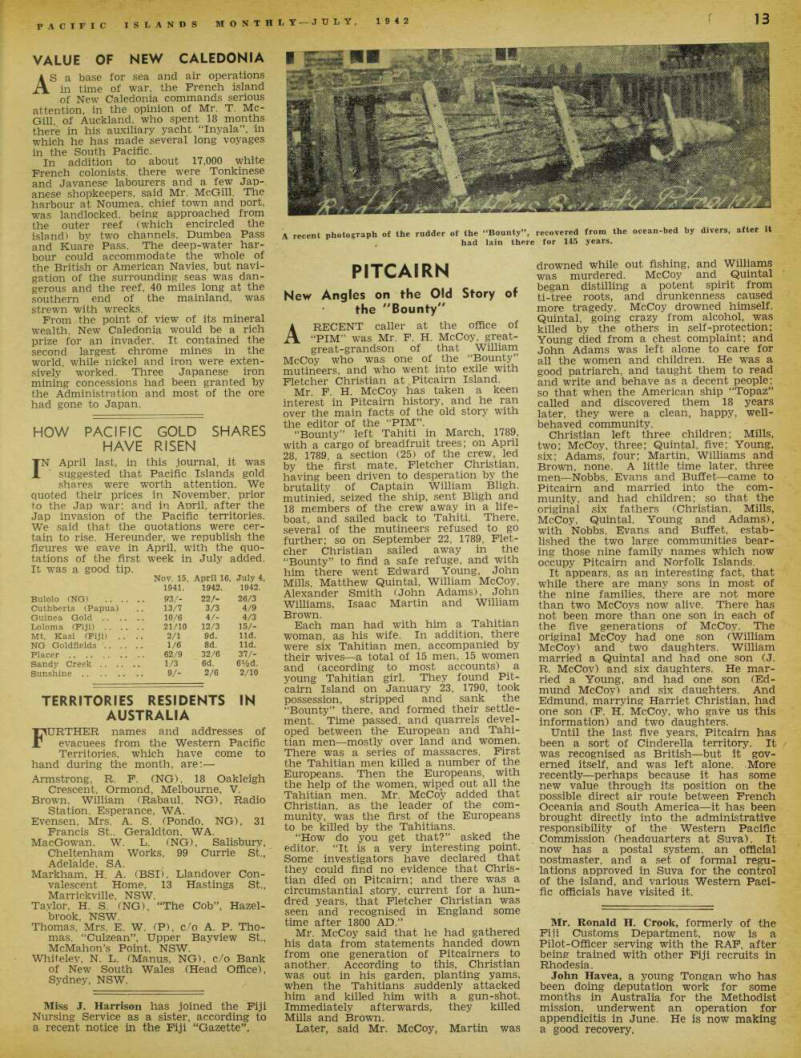
New Angles on the Old Story of the "Bounty"
A RECENT caller at the office of “PIM" was Mr. F. H. McCoy, great great-grandson of that William McCoy who was one of the “Bounty” mutineers, and who went into exile with Fletcher Christian at Pitcairn Island.
Mr. F. H. McCoy has taken a keen interest in Pitcairn history, and he ran over the main facts of the old story with the editor of the “PIM”.
“Bounty” left Tahiti in March, 1789, with a cargo of breadfruit trees; on April 28, 1789, a section (25) of the crew, led by the first mate, Fletcher Christian, having been driven to desperation by the brutality of Captain William Bligh, mutinied, seized the ship, sent Bligh and 18 members of the crew away in a life boat, and sailed back to Tahiti. There, several of the mutineers refused to go further: so on September 22, 1789, Flet cher Christian sailed away in the “Bounty” to find a safe refuge, and with him there went Edward Young, John Mills, Matthew Quintal, William McCoy, Alexander Smith (John Adams), John Williams, Isaac Martin and William Brown.
Each man had with him a Tahitian woman, as his wife. In addition, there were six Tahitian men, accompanied by their wives—a total of 15 men, 15 women and (according to most accounts) a young Tahitian girl. They found Pit cairn Island on January 23, 1790, took possession, stripped and sank the “Bounty” there, and formed their settle ment. Time passed, and quarrels devel oped between the European and Tahi tian men—mostly over land and women.
There was a series of massacres. First the Tahitian men killed a number of the Europeans. Then the Europeans, with the help of the women, wiped out all the Tahitian men. Mr. McCoy added that Christian, as the leader of the com munity, was the first of the Europeans to be killed by the Tahitians.
“How do you get that?” asked the editor. “It is a very interesting point.
Some investigators have declared that they could find no evidence that Chris tian died on Pitcairn; and there was a circumstantial story, current for a hun dred years, that Fletcher Christian was seen and recognised in England some time after 1800 AD.”
Mr. McCoy said that he had gathered his data from statements handed down from one generation of Pitcairners to another. According to this, Christian was out in his garden, planting yams, when the Tahitians suddenly attacked him and killed him with a gun-shot.
Immediately afterwards, they killed Mills and Brown.
Later, said Mr. McCoy, Martin was
drowned while out fishing, and Williams was murdered. McCoy and Quintal began distilling a potent spirit from ti-tree roots, and drunkenness caused more tragedy. McCoy drowned himself.
Quintal, going crazy from alcohol, was killed by the others in self-protection; Young died from a chest complaint; and John Adams was left alone to care for all the women and children. He was a good patriarch, and taught them to read and write and behave as a decent people; so that when the American ship “Topaz” called and discovered them 18 years later, they were a clean, happy, well behaved community.
Christian left three children; Mills, two; McCoy, three; Quintal, five; Young, six; Adams, four; Martin, Williams and Brown, none. A little time later, three men—Nobbs, Evans and Buffet —came to Pitcairn and married into the com munity. and had children; so that the original six fathers (Christian, Mills, McCoy, Quintal, Young and Adams), with Nobbs, Evans and Buffet, estab lished the two large communities bear ing those nine family names which now occupy Pitcairn and Norfolk Islands.
It appears, as an interesting fact, that while there are many sons in most of the nine families, there are not more than two McCoys now alive. There has not been more than one son in each of the five generations of McCoy. The original McCoy had one son (William McCoy) and two daughters. William married a Quintal and had one son (J.
R. McCoy) and six daughters. He mar ried a Young, and had one son (Ed mund McCoy) and six daughters. And Edmund, marrying Harriet Christian, had one son (F. H. McCoy, who gave us this information) and two daughters.
Until the last five years, Pitcairn has been a sort of Cinderella territory. It was recognised as British—but it gov erned itself, and was left alone. More recently—perhaps because it has some new value through its position on the possible direct air route between French Oceania and South America—it has been brought directly into the administrative responsibility of the Western Pacific Commission (headauarters at Suva). It now has a postal system, an official nostmaster, and a set of formal regu lations approved in Suva for the control of the island, and various Western Paci fic officials have visited it.
Mr. Ronald H. Crook, formerly of the Fiji Customs Department, now is a Pilot-Officer serving with the RAF, after being trained with other Fiji recruits in Rhodesia.
John Havea, a young Tongan who has been doing deputation work for some months in Australia for the Methodist mission, underwent an operation for appendicitis in June. He is now making a good recovery.