New Appointment Apparently Connected With
pp. 10-11 · Read in the full issue
Sir Harry Luke Retires
New Appointment Apparently Connected With South Pacific War Sitation
THE following announcement by the
British Colonial Office, published in Australian newspapers about June
17, caused surprise:—
The Secretary of the State for the Colonies (Lord Cranborne) has been in consultation with Sir Harry Luke, the Governor of Fiji and High Commissioner for the Western Pacific, regarding the new situation that has arisen in that area. With great public spirit, Sir Harry Luke has consented to place his resignation in His Majesty’s hands in order to facilitate the appointment of a younger man to the position. Sir Harry Luke, who is 57 and has had long distin guished colonial service, became Governor of Fiji in 1938.
Until then, there had been no indica tion (outside of Fiji, at any rate) that any such change was contemplated.
Those who know Fiji suspected that there
was more behind the announcement than appeared on the surface.
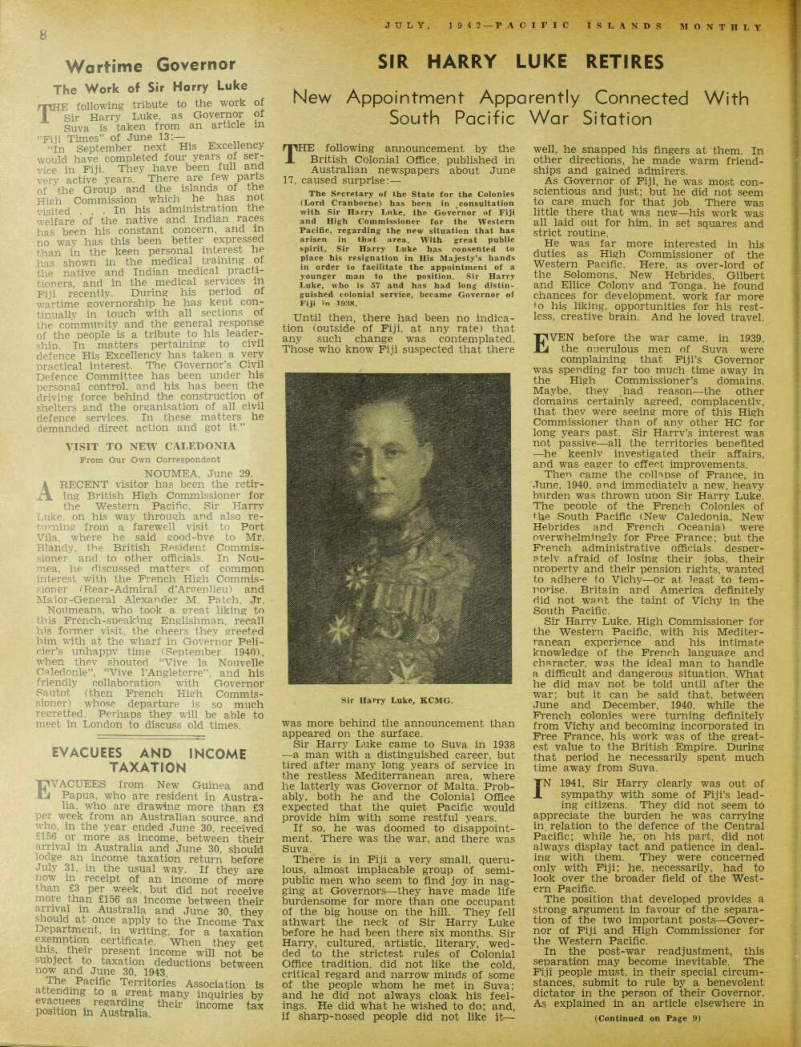
Sir Harry Luke came to Suva in 1938 —a man with a distinguished career, but tired after many long years of service in the restless Mediterranean area, where he latterly was Governor of Malta. Prob ably, both he and the Colonial Office expected that the quiet Pacific would provide him with some restful years.
If so, he was doomed to disappoint ment, There was the war, and there was Suva.
There is in Fiji a very small, queru lous, almost implacable group of semi public men who seem to find joy in nag ging at Governors —they have made life burdensome for more than one occupant of the big house on the hill. They fell athwart the neck of Sir Harry Luke before he had been there six months. Sir Harry, cultured, artistic, literary, wed ded to the strictest rules of Colonial Office tradition, did not like the cold, critical regard and narrow minds of some of the people whom he met in Suva; and he did not always cloak his feel ings. He did what he wished to do; and, if sharp-nosed people did not like it—
well, he snapped his fingers at them. In other directions, he made warm friend ships and gained admirers.
As Governor of Fiji, he was most con scientious and just; but he did not seem to care much for that job. There was little there that was new—his work was all laid out for him, in set squares and strict routine.
He was far more interested in his duties as High Commissioner of the Western Pacific. Here, as over-lord of the Solomons, New Hebrides, Gilbert and Ellice Colonv and Tonga, he found chances for development, work far more fo his liking, opportunities for his rest less, creative brain. And he loved travel.
EVEN before the war came, in 1939, the cmerulous men of Suva were complaining that Fiji’s Governor was spending far too much time away in the High Commissioner’s domains.
Maybe, they had reason—the other domains certainly agreed, complacently, that they were seeing more of this High Commissioner than of any other HC for long years past. Sir Harry’s interest was not passive—all the territories benefited —he keenly investigated their affairs, and was eager to effect improvements.
Then came the collapse of France, in June. 1940. and immediately a new, heavy burden was thrown unon Sir Harry Luke.
The peonle of the French Colonies of the South Pacific (New Caledonia, New Hebrides and French Oceania) were overwhelmingly for Free France; but the French administrative officials, desper ately afraid of losing their jobs, their property and their pension rights, wanted to adhere to Vichy—or at least to tem porise. Britain and America definitely did not want the taint of Vichy in the South Pacific.
Sir Harry Luke. High Commissioner for the Western Pacific, with his Mediter ranean experience and his intimate knowledge of the French language and character, was the ideal man to handle a difficult and dangerous situation. What he did mav not be told until after the war; but it can be said that, between June and December, 1940, while the French colonies were turning definitely from Vichy and becoming incorporated in Free France, his work was of the great est value to the British Empire. During that period he necessarily spent much time away from Suva.
IN 1941, Sir Harry clearly was out of sympathy with some of Fiji’s lead ing citizens. They did not seem to appreciate the burden he was carrying in. relation to the defence of the Central Pacific: while he, on his part, did not always display tact and patience in deal ing with them. They were concerned only with Fiji; he, necessarily, had to look over the broader field of the West ern Pacific.
The position that developed provides a strong argument in favour of the separa tion of the two important posts—Gover nor of Fiji and High Commissioner for the Western Pacific.
In the post-war readjustment, this separation may become inevitable. The Fiji people must, in their special circum stances, submit to rule by a benevolent dictator in the person of their Governor, As explained in an article elsewhere in
(Continued on Page 9)
Sir Harry Luke, KCMG.
this issue, they cannot expect represen tative government. Therefore, they want all the time and thought their Governor can give them.
If their Governor is preoccupied with Fiji, the territories of the Western Paci fic feel themselves neglected, and howl accordingly. If the man at Suva gives over-much attention to the affairs of the Western Pacific Commission, as Sir Harry Luke has done, the people of Suva are aggrieved, and complain to White hall.
Some such complaint to the British Colonial Office was formulated in Fiji early in 1942—a petition, it was called, although not numerously signed—but we are not sure that it actually was sent to London. It is probable that at least some echoes of it reached Whitehall.
BUT, probably, the circumstances
which rendered Sir Harry Luke’s position so difficult, as indicated by the British Colonial Office announce ment quoted above, arose out of the Pacific war.
Prior to December. 1941, defence mea sures in the South Pacific were of such a character that they easily could be controlled by the civil and military authorities, acting in concert. The entry of Japan altered all that.
At once (and up until the present) the problem of defence overtopped all others, civil or military; and, as the months passed, more and more authority was passed over to the heads of the fighting services. Inevitably, conflict (not neces sarily unfriendly) developed between civil administrator and service commanders — just as happened in Papua and New Caledonia —and, of necessity, the civil authority had to step aside.
In April, a leading New Zealand newspaper directed attention to the diffi culty of Sir Harry Luke’s position, in relation to New Zealand military author ity, British naval authority, and, now, the increasing appearance in the Pacific of the sea, land and air forces of the United States.
It was obvious that, as the Allies in the Pacific pass from the defensive to the offensive, the position of the civil head of the territories of Fiji, Solomons, Tonga, New Hebrides and Gilbert and Ellice Colony will become more and more difficult.
It is clear from Whitehall’s announce ment, and from the character of the new appointment (Major-General Sir Philip Mitchell, lately Political Officer attached to the staff of General Sir Archibald Wavell) that these latter considerations have weighed heavily in London.
It may be taken as certain that the new Governor and High Commissioner
for the Western Pacific will be more concerned with defensive and offensive operations, for the period of the war, than with civil administration. It may be expected, also, that a gentleman of Sir Philip Mitchell’s experience will not hesitate to lay a heavy hand upon Suva’s querulous minority—that is, if the lat ter are short-sighted enough to imagine that their petty grievances are to occupy much official attention in wartime.
Meanwhile, Sir Harry Luke departs gracefully, and his many friends in the South Pacific —especially the men of the public services, who accorded him always their esteem and regard—will hope that, before he_ enters “the retireful sixties’’, he will have opportunities of rendering more Imperial service, as valuable as that which he gave in the South Seas.
Major-General Sir Philip Mitchell
THERE is not much information avail able here about the new Governor and' High Commissioner, Major- General Sir Philip Euen Mitchell, KCMG, MC. The reference books show that he was born on May 1, 1890, and therefore is just 52 years old. He is married, and without children. He is a graduate of Oxford, and he entered the Colonial Ser vice as Assistant-Resident, Nyasaland, in 1912. He served in the King’s African Rifles in the First Great War, and fin ished with a captaincy and the Military Cross. He went back to Nyasaland as ADC and private secretary to the Gov ernor, and went to Tanganyika Territory as Political Officer in 1919. He remained several years in the Territory, filling various important posts, and by 1934 he was Chief Secretary. In 1935 he was appointed Governor and Commander-in- Chief in Uganda, and he became KCMG in 1937.
After the commencement of the cam paign in East Africa (late in 1940) he was appointed Chief Political Officer on the staff of the General Officer Com manding-in-Chief; and, subsequently, as Chief Political Officer, he was closely associated with General Wavell —although it is not clear whether he went with General Wavell to India, Singapore and the East Indies. If he did, it is easy to see a connection between his experience there and his present appointment.
One wandering writer who met Sir Philip Mitchell in Uganda before 1939 gives a description of him which would indicate that he is a vigorous man of strong personality, who is not much con cerned with “fuss and flummery”—who quickly knows what he wants, and pro ceeds quickly to get it.
Mrs. Patience E. Waters, formerly a well-known resident of Suva, Fiji, died at Rotorua, NZ, recently, at the age of 86.
Rev. H. M. Bell, Presbyterian mission ary of Paama, New Hebrides, was in Sydney last month awaiting steamer connection for Vila. It is understood that Mrs. Bell is remaining in Australia.
Pilot-Officer E. E. Nicholls, RAF, who was given his “wings” and commission in May, after being trained in Southern Rhodesia, is a son of Mr. and Mrs. H.
Warne Nicholls, of Nadroga, Fiji.
Mr. C. R. F. Workman, CBE, who was in charge of the Australian expedition which took possession of Nauru in the last war, died in London on July 3. Mr.
Workman qualified as a barrister in 1900.
He was appointed Administrator in Nauru in 1914, Resident Commissioner in the Solomon Islands in 1917, and was Colonial Secretary of Gambia (West Africa) from 1921 to 1931.