Early Settlers In New
pp. 44-47 · Read in the full issue
Caledonia
Romantic Career of Captain Paddon
By H. E. L. Friday
THE origins of a country, like those of a family, are always of interest.
And New Caledonia, though a French Colony, in its early days was for the most part settled, not by colonists who came direct from the mother coun try, but by men who came from and had spent some time in Australia. Land hun ger, and the itch for adventure, brought them out from Europe and then urged them further afield, to this remote island.
Surrounded by hostile savages, aiding each other, fighting the same difficulties, suffering the same privations and shar ing the same simple joys, this handful of men of various nationalities lived together like members of one family. It is pleasant to pay this tribute to their memory, particularly as many lie in for gotten graves outside Noumea or scat tered up and down the reef-sheltered coast.
Noumea’s progress, in the beginning, was painfully slow —much slower, for example, than even that of early Perth and Fremantle. It is on record that at the end of 1856, three years after the French took possession, the population of Port-de-France—which was Noumea’s original name—was only 129, including garrison and 16 colonial settlers. When an expedition set out to punish the blacks for certain massacres, only 40 people remained.
The township looked liked being wiped out in January, 1857, when chief Kun dio with many hundred natives schemed to surprise the place. But Captain Pad don, greatest of old Caledonians, warned the authorities just in time.
The same month, thirteen white set tlers, led by Monsieur Berard, and a score of hjs New Hebridean workers, were massacred, and their settlement on Mont Dore, behind Noumea, razed to the ground. On this occasion a Tahitian chief, named Tariirii, and his men, helped to punish the offending tribe, this being the start of Tahitian-Cale donian co-operation.
Progress, later, was more rapid. By 1868, besides French troops and officials, there were 500 whites in the town.
BUT, for national and religious rea sons, officialdom was suspicious of British influence among the natives.
In 1859, fifty foreigners were expelled from the Colony.
In September of that year, two Brit
ishers and an American—their names were Fred Williams, William Smith and Samuel Baily—were summarily shot by French soldiers on the beach at Hieng hene, east coast. Nothing definite was proved against them, and the matter, although included in the records of the time, was hushed up for fear of inter national complications. What had hap pened was that the French had had a brush with a truculent local tribe, and a marine infantry captain named Tricot had been killed with ammunition which these men were suspected of having sup plied to the natives.
At 10 p.m. on April 23, 1856, the first white child was born in Noumea. He was an English boy named Oliver, and the Christian names given him were William Benjamin Felix. His father, a Noumea port pilot, was eventually buried on an islet in the great wild Bay of Prony, in the south. This islet is still known as Pilot’s Island. The maiden name of the boy’s mother was Jane Ann Richards.
Two years later a second white boy was born, and named Theodore Lac haume, his father French and his mother an Englishwoman named Rabone.
In the following month of March arrived the first white girl, Rose Catherine Durand, whose descendants are still in the Colony. Her mother was an Irish woman named Hurley.
The oldest Caledonian-born white woman alive to-day is Miss Le Clerc, a Sister of Mercy at La Conception Mis sion village, not far from Noumea. She is well over 80.
LIKE all young colonies, New Cale donia suffered from a serious short age of womenfolk. Thinking to overcome this lack, the Sisters of Saint- Joseph came to an arrangement with the Assistance Publique in Paris, and brought out foundling girls whom they lodged in a building in the bay since known as the Orphelinat, which lies on the cor niche road to Anse Vata beach. To-day, this is Noumea’s most agreeable residen tial suburb.
The first convoy of ten girls arrived in September, 1863. The men of the Colony donned collars and ties, curled their lavish beards, and rode down to the wharf to welcome them. By the end the year all ten girls were married, some to quite well-to-do settlers.
A second batch of thirty girls followed
in February, 1864. Of these, twelve im mediately found husbands and the rest were placed in employment while await ing suitable marriage offers. rE hero, the legendary personage of Caledonian history, is the Captain Paddon already referred to, mar iner whaler, trader, hailing from Ports mouth, in England. Every contemporary, French priest Montrouzier as much as English Admiral Erskine, praises this extraordinary man.
He emerges, trafficking along the coast, in 1841; also in the New Hebrides, where he had his first big station, with small posts scattered throughout outlymg islands and among Caledonian tribes where his representative—usually an English sailorman —would be the only white within scores of miles.
He made a fortune, and his reputa tion for generosity and fair dealing is proverbial. As Admiral Erskine remarks, if other white traders had been as he, there would have been fewer massacres and fewer disgraceful incidents in the South Seas. , , , , Yet he thrived on danger and had to suffer for the bad faith of others. Once, at Mare, in the Loyalty group (now a Caledonian dependency) seventeen of his men were slaughtered by angry natives in revenge for the disreputable doings of another vessel. Even here Paddon emerged from the situation with honour.
AFTER the French occupation in 1853 it was Captain Paddon, from his great trading establishment at He Noii, in Noumea harbour, who directed the ’industrial, commercial and agricul tural life of the baby Colony.
He had a fleet of ships; he organised the vital postal service with Sydney; he was the first to raise cattle, the first successfully to introduce immigrants, the
first to found a bush township, the pretty village of Paita.
He saved Noumea, as I have said, but on one occasion he fell foul of the French Governor (possiblv for selling guns to the natives) and found it prudent, with a kanaka crew, to escape to Sydney in an open whale-boat. He brought the boat back, too, and for years, his sur viving daughter (now over 80) tells me, it lay beached at Paddon Bay.
“Look at the boat papa escaped to Sydney in,” the children used to say to one another.
A great man in every sense, Paddon’s sudden death at the age of 49 was a calamity—the Colony would have pros pered more had he lived longer. Hand some were the eulogies uttered over his first grave in Noumea’s first cemetery and recorded in the “Moniteur Imperial” of the time; and handsome those a few years later when . his remains were removed to the village of Paita, there to be placed in an impressive mausoleum. A great man, his history should some day be written.
Among the families he introduced to his estate at Paita were his relatives, the Martins, from England; and from Australia, Britain or Germany, the Lynches, Sleaths, and Ambroses, the Abels, Ohlens, Gaertners, Metzgers and Yeomans. These settlers had to send their produce to Noumea by boat, for no real road was yet available.
From a trip Paddon made to China with sandalwood —once a most import ant article of trade, but now cut right out—he brought back another well known settler. This was the Chinaman, Jimmy Song, a thorough gentleman, to whom nobody ever went in vain for a meal or a night’s lodging—in fact, he hated to see his guests leave him. It was Jimmy’s hobby to cross sheep and
to” ay* sCTvtag o 'with the
They^eft°Noumet with'"the* first Cale
(lonian contingent on May 5 1941. .
The tallest man in Caledoman his tory was . t ’ in eventually be:ame an art master^^^ Sydney, where he before he went into don’s chief clerk he went into business on his own account—-a hairless individual, but brave and intelligent. He
used to carry a triggerless revolver, solely for effect, and the natives were super stitiously afraid of him. And well they might be, for he was seven feet tall.
It was he, with a companion named Pannetrat, who made the first crossing from Kanala, on the east coast, across the Chaine Centrale, to the west coast.
Descending the mountainside, he ran into a hideously painted tribe on the warpath, but frightened them into
respect by feigning madness, sitting down and talking and grimacing to himself.
THE state of mind of the natives of the time may be gauged from the name . of. on e of their chiefs, Picanini- Kai-Kai (Eater of Children).
The Colony’s first bush postman was a native who used to carry letters to set tlers slung over his shoulder in a tin box. Unfortunately, the tribes he passed
through blamed the white man’s magic in the box for an epidemic that broke out among them, so they waylaid and murdered him.
It was Paddon who gave his first job in the Colony to Higginson, who it is said was first put on the job of wheel ing stones in a barrow from quay to store. Higginson was another extraor dinary man. A former Australian jockey, born at Hitchin, in England, he even tually became New Caledonia’s flam boyant financial genius, feted in Paris— the man who introduced Rothschild money to build the nickel industry. Later, he did all in his power to make the French supreme in the New Hebrides.
He was a shortish, dapper man, lively, and not afraid of running up debts, who customarily wore frock coat and top hat and incessantly smoked a cigar. For his services he Was decorated by the French.
Capom, another settler, came to Nou mea in 1857 on a three weeks’ visit to Paddon, whom he had met in Sydney, but stayed on for 35 years.
ANOTHER character not to be forgot ten is Captain Donald McLeod, Heb ridean pioneer and uncle of the brothers Kerr, Islands traders of to-day.
The captain finally rests ashore, in the cemetery at Noumea’s Fourth Kilometre; living, he preferred to sleep aboard his schooner.
In early days, there were 400 traders along these coasts; but many went out of business and left the Colony when a law was introduced—a law harmful to local' interests—refusing a licence to foreign traders.
However, by this time there were set tled in the north sailorfolk and others— the Williams, the Winchesters, the Henrys, Henwoods and Fords. Once, when the Henry homestead was attacked,
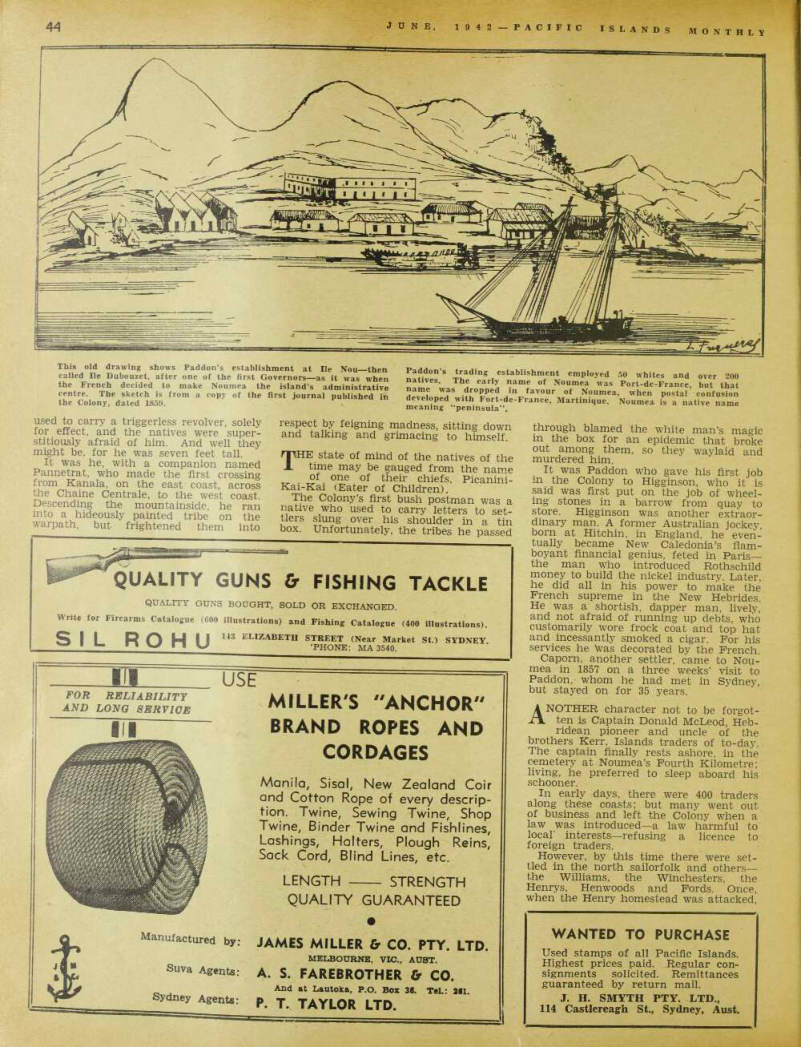
This old drawing shows Paddon’s establishment at He Nou then called He Dubouzet, after one of the first Governors—as it was when the French decided to make Noumea the island’s administrative centre. The sketch is from a copy of the first journal published in the Colony, dated 1859.
Paddon's trading establishment employed 50 whites and over 200 natives. The early name of Noumea was Port-de-France, but that Was i n favour of Noumea, when postal confusion developed with Fort-de-France, Martinique. Noumea is a native name meaning “peninsula”.
the mother hid the younger children in a clothes-press, while the elder boy, who was wounded, helped repel the attackers.
Lynn, a big Dane, ruled over the isle of Pott. It was he who discovered the Walpole Island guano deposits, of im portance to New Zealand agriculture.
Three bachelor brothers of a well-known South Australian family who for a time made their home in the Colony were William. Frank and Jack Morgan. Jack ran a Noumea flour-mill.
Cheval, a restauranteur from Sydney, took up land at Saint-Vincent, west coast, and introduced some families, not ably the O’Donoghues and the Dalys.
Nearby, Bouloupari—place meaning Red Earth—became a regular cattle-raising centre, full of Britons. There were Tom Lewis, Bobby Henderson, Peter Walker, Charlie and Joe Bull, a London-Italian named Panorma, and an Anglo-Indian named Atkinson, whose son, James Jas per, became a “Sydney Bulletin” artist.
OTHER early settlements were less successful. Australians named Brown and Byrne took up a big concession on the same lines as Cheval, but lost their contract for not fulfilling their bargain to introduce settlers.
Another failure was a French com munity experiment known as the Pha lanstere, at Yate, on the south coast somewhat on the lines of William Lane’s Australian Utopian scheme in Paraguay in the ’nineties.
But, successful or unsuccessful, the men of the first hour, who contributed to the making of white New Caledonia should not be forgotten.
Mr. H. A. Markham, of Marovo Lagoon, Solomon Islands, who underwent an operation in Sydney Hospital last month, spent some weeks in a convales cent home. The first operation was complicated by malaria, and another operation has to be undergone in June.
Mr. James Boyer, of Suva, Fiji, mar ried Miss Rosemary Collins, second daughter of Mr. and Mrs. L. Collins, late of Suva, at the Sacred Heart Cathedral, Suva, in May.
Mr. Roy Gorringe, of Huhurangi Plan tation, Ysabel, British Solomon Islands, and Mr. Charles Bignell, of Marovo Lagoon, BSI, got away from the Solo mons together in April, just one hop ahead of the Japanese, on Mr. Bignell’s schooner. Mr. Gorringe, who arrived in Sydney in May, reports that most of the Europeans had left the Group before the Japanese arrived —some going to New Hebrides and some to Fiji. A few who remained have gone into the interior of the big islands, well out of harm’s way.
Mr. Bignell remained in Port Vila (New Hebrides). A number of missionaries refused to leave the Solomons.