Come to Mangaia
p. 37 · Read in the full issue
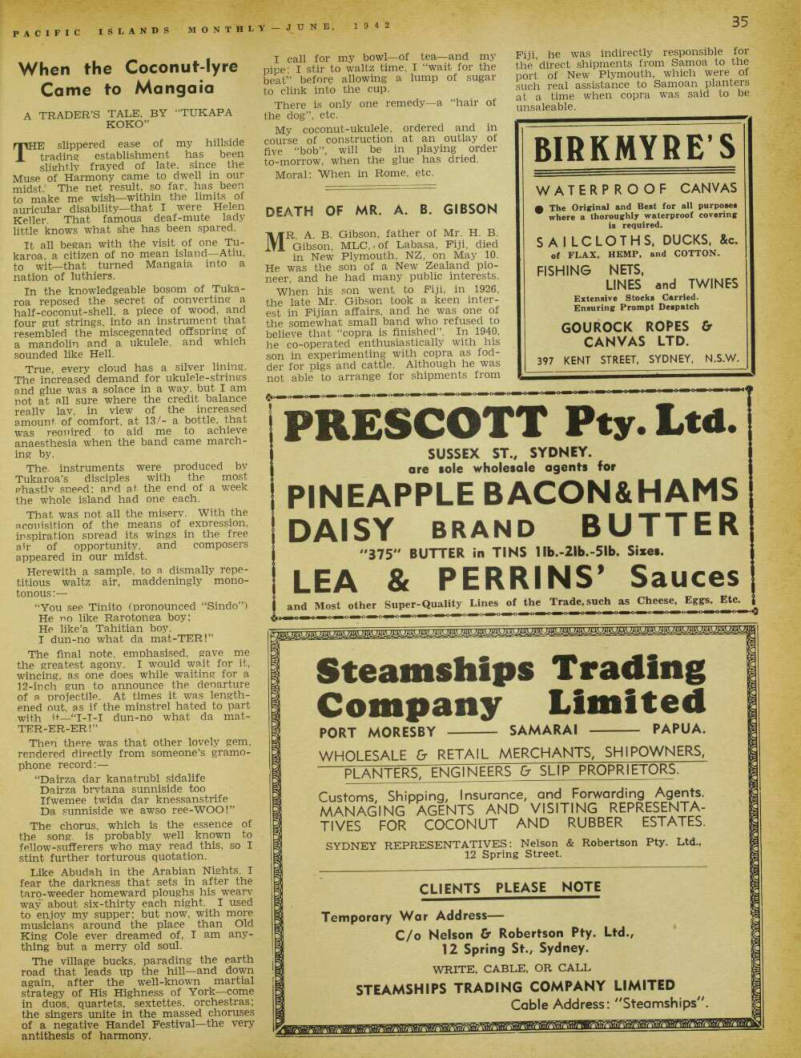
When the Coconut-lyre Come to Mangaia
A Trader’S Tale, By “Tukapa
Koko”
rE slippered ease of my hillside trading establishment has been sliehtly frayed of late, since the Muse of Harmony came to dwell in our midst. The net result, so far, has been to make me wish—within the limits of auricular disability—that I were Helen Keller. That famous deaf-mute lady little knows what she has been spared.
It all began with the visit of one Tu karoa. a citizen of no mean island—Atm, to wit—that turned Mangaia into a nation of luthiers.
In the knowledgeable bosom of Tuka roa reposed the secret of converting a half-coconut-shell, a piece of wood, and four gut strings, into an instrument that resembled the miscegenated offspring of a mandolin and a ukulele, and which sounded like Hell.
True, every cloud has a silver lining.
The increased demand for ukulele-strings and glue was a solace in a way, but I am not at all sure where the credit balance really lay. in view of the increased amount of comfort, at 13/- a bottle, that was reouired to aid me to achieve anaesthesia when the band came march ing by.
The. instruments were produced by Tukaroa’s disciples with the most p-hastlv sneed; and at the end of a week the whole island had one each.
That was not all the misery. With the acouisition of the means of expression, inspiration spread its wings in the free air of opportunity, and composers appeared in our midst.
Herewith a sample, to a dismally repe titious waltz air, maddeningly mono tonous: — “You see Tinito (pronounced “Sindo”) He no like Rarotonga boy; He like’a Tahitian boy.
I dun-no what da mat-TER!”
The final note, emphasised, gave me the greatest agony. I would wait for it, wincing, as one does while waiting for a 12-inch gun to announce the departure of a projectile. At times it was length ened out, as if the minstrel hated to part w it,h it—“i-I-I dun-no what da mat-
Ter-Er-Er!”
Then there was that other lovely gem. rendered directly from someone’s gramo phone record: — “Dairza dar kanatrubl sidalife Dairza brytana sunniside too Tfwemee twida dar knessanstrife Da sunniside we awso ree-WOO!”
The chorus, which is the essence of the song, is probably well known to fellow-sufferers who may read this, so I stint further torturous quotation.
Like Abudah in the Arabian Nights. I fear the darkness that sets in after the taro-weeder homeward ploughs his weary way about six-thirty each night I used to enjoy my supper; but now, with more musicians around the place than Old King Cole ever dreamed of, I am any thing but a merry old soul.
The village bucks, parading the earth road that leads up the hill —and down again, after the well-known martial strategy of His Highness of York —come in duos, quartets, sextettes, orchestras; the singers unite in the massed choruses of a negative Handel Festival —the very antithesis of harmony.
I call for my bowl —of tea —and my pipe- I stir to waltz time, I “wait for the beat'’ before allowing a lump of sugar to clink into the cup.
There is only one remedy—a “hair of the dog”, etc.
My coconut-ukulele, ordered and in course of construction at an outlay of five “bob”, will be in playing order to-morrow, when the glue has dried.
Moral: When in Rome, etc.