Strange Political Events In
pp. 26-30 · Read in the full issue
French Colonies
De Gaulle Interference Causes Muddle in Pacific
rpHERE is political trouble in New A Caledonia, blame for which must be laid at the door of the Free French Administration, in London. The lat ter’s well-meaning interference with the administration of the Free French colonies in the South Pacific has caused an explosion, of which repeated warnings were given in this journal.
The following Australian Associated Press message was published in “Sydney Morning Herald” on May 22: The Washington correspondent of the “New York Times” says that a conflict between the two Free French Governors of New Caledonia
has produced a serious “state of demoralisation”, and that the United States has appealed to General de Gaulle to iron out the affair for the sake of the common cause.
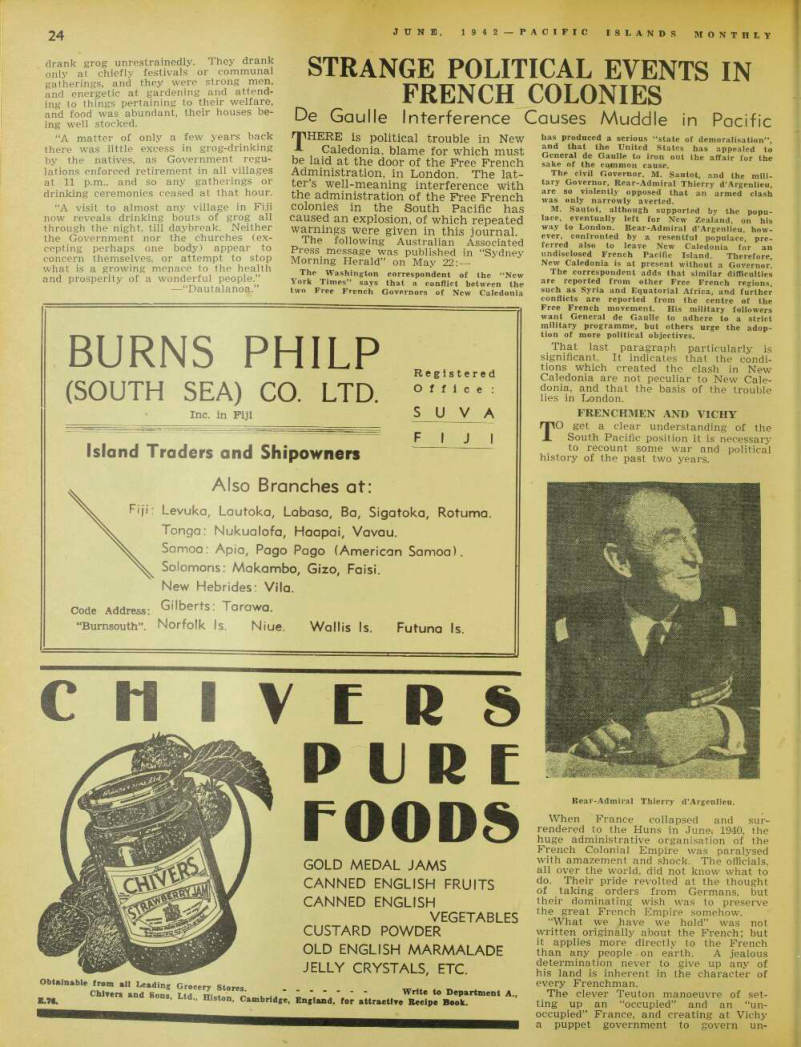
The civil Governor. M. Sautot. and the mili tary Governor, Rear-Admiral Thierry d’Argenlieu, are so violently opposed that an armed clash was only narrowly averted.
M. Sautot, although supported by the popu lace, eventually left for New Zealand, on his way to London. Rear-Admiral d’Argenlieu, how ever, confronted by a resentful populace, pre ferred also to leave New Caledonia for an undisclosed French Pacific Island. Therefore, New Caledonia is at present without a Governor.
The correspondent adds that similar difficulties are reported from other Free French regions, such as Syria and Equatorial Africa, and further conflicts are reported from the centre of the Free French movement. His military followers want General de Gaulle to adhere to a strict military programme, but others urge the adop tion of more political objectives.
That last paragraph particularly is significant. It indicates that the condi tions which created the clash in New Caledonia are not peculiar to New Cale donia, and that the basis of the trouble lies in London.
Frenchmen And Vichy
TO get a clear understanding of the South Pacific position it is necessary to recount some war and political history of the past two years.
When France collapsed and sur rendered to the Huns in June, 1940, the huge administrative organisation of the French Colonial Empire was paralysed with amazement and shock. The officials, all over the world, did not know what to do. Their pride revolted at the thought of taking orders from Germans, but their dominating wish was to preserve the great French Empire somehow.
“What we have we hold” was not written originally about the French; but it applies more directly to the French than any people on earth. A jealous determination never to give up any of his land is inherent in the character of every Frenchman.
The clever Teuton manoeuvre of set ting up an “occupied” and an “un occupied” France, and creating at Vichy a puppet government to govern un
Rear-Admiral Thierry d’Argenlieu.
occupied France and the French colonies may have been seen through by most intelligent Frenchmen. But the promise given by the Germans that the French Colonial Empire would be preserved in tact if Vichy collaborated with Germany in creating “a new Order in Europe” (in other words, in defeating Britain) was sufficient to gain eventually for Vichy
and the aged Fascist, Marshal Petain, the adherence of most French colonial officials.
This did not happen at once. The first impulse of colonial Frenchmen generally was to defy the Boche and continue the fight beside Britain. But Germany, using as her tools the cunning and utterly unscrupulous Laval gang, distributed through Vichy some effective propaganda. It was built around the ap parent fact that Britain, terribly bat tered and completely isolated, could not possibly continue to resist the Nazis.
The most important French territories (North Africa, Indo-China, Madagascar, Syria, French West Indies) declared for Vichy; others made no move. The ap peals of General de Gaulle for a Free France found absolutely no response in the French colonies during late June and most of July, 1940.
Frenchmen could not believe that Britain could survive, while France col lapsed. To them, it clearly was a case of “Sauve qui peut”.
The Voice Of Henri Sautot
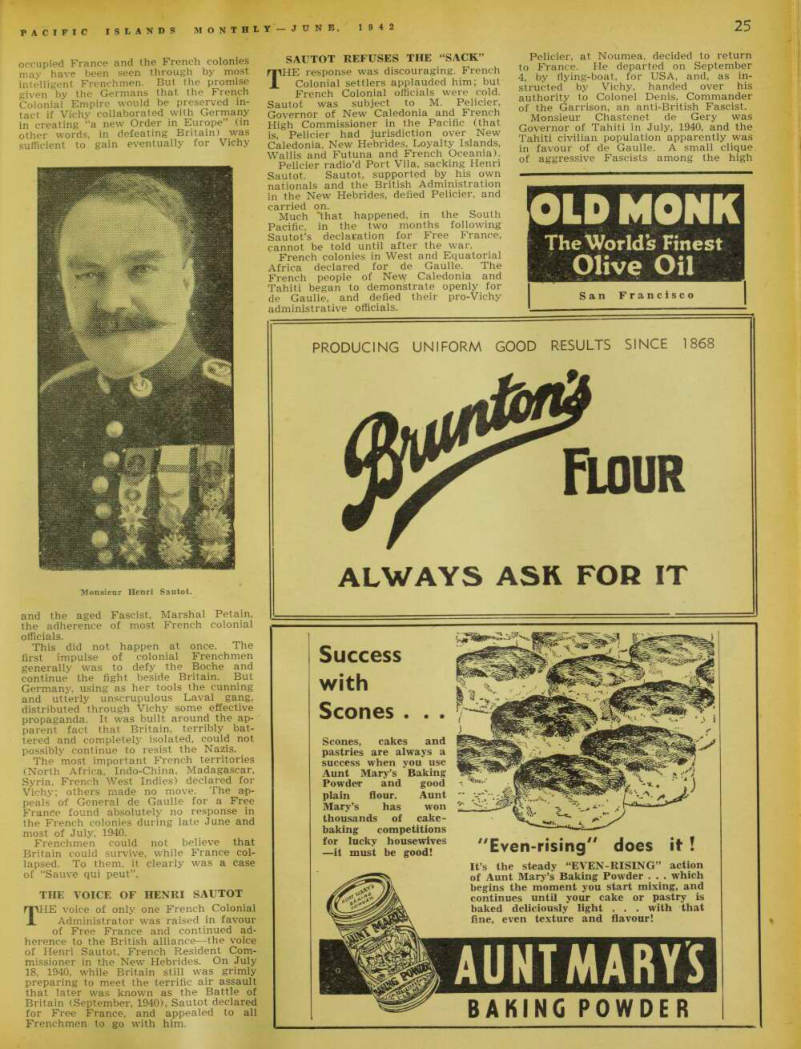
THE voice of only one French Colonial Administrator was raised in favour of Free France and continued ad herence to the British alliance —the voice of Henri Sautot, French Resident Com missioner in the New Hebrides. On July 18, 1940, while Britain still was grimly preparing to meet the terrific air assault that later was known as the Battle of Britain (September, 1940), Sautot declared for Free France, and appealed to all Frenchmen to go with him.
Sautot Refuses The “Sack”
THE response was discouraging. French Colonial settlers applauded him; but French Colonial officials were cold.
Sautot was subject to M. Pelicier, Governor of New Caledonia and French High Commissioner in the Pacific (that is, Pelicier had jurisdiction over New Caledonia, New Hebrides, Loyalty Islands, Wallis and Futuna and French Oceania).
Pelicier radio’d Port Vila, sacking Henri Sautot. Sautot, supported by his own nationals and the British Administration in the New Hebrides, defied Pelicier, and carried on.
Much That happened, in the South Pacific, in the two months following Sautot’s declaration for Free France, cannot be told until after the war.
French colonies in West and Equatorial Africa declared for de Gaulle. The French people of New Caledonia and Tahiti began to demonstrate openly for de Gaulle, and defied their pro-Vichy administrative officials.
Pelicier, at Noumea, decided to return to ra SJ? n de f P®rtu|AonandPtir*in
vlchf handed ove? his
au thority to Colonel Denis, Commander of the Garrison, an anti-British Fascist.
Monsieur Chastenet de Gery was Governor of Tahiti in July, 1940, and the Tahiti civilian population apparently was - n f avour 0 f de Gaulle. A small clique ° £ aggressive Fascists among the high
Monsieur Henri Sautot.
French officials, however, fought hard to keep Tahiti for Vichy France. Finally, in mid-August, a plebiscite' of the people was taken, and the result was: For General de Gaulle, 5,564; for Vichy France, 18. ' .
Thereupon Governor de Gery resigned and departed, and three members nf the Privy Council, in accordance with a re quest from General de Gaulle on Sep tember 7, temporarily carried on the Government.
Sautot’S Coup D’Etat
AT Noumea, Governor Denis was less tactful, and bloodshed was narrowly averted. But the colonists were organised; and when Henri Sautot sud denly appeared in Noumea on September 19, 1940, they were strong enough to defy Denis’s military and naval forces, depose Denis, and install Sautot as Governor of New Caledonia and French High Com missioner in the Pacific.
At about the same time, Edmond Mansard, an old comrade-in-arms of de Gaulle and now a resident of Tahiti, was installed there as Free French Governor.
All known and declared supporters of Vichy among French officials in New Caledonia, Tahiti (French Oceania) and New Hebrides were gathered together and shipped away to French Indo-China —where by now the pro-Vichy Adminis tration was “developing a cordial re lationship” with the stealthily-approach ing Japanese. Within a few months, Indo-China was completely occupied by the Sons of Heaven, and the officials who refused Free French rule in the South Pacific, now had to accept Japanese rule.
That was the position at the end of September, 1940; Free Frenchmen of de clared loyalty were entirely in command of the French colonies in the South
Pacific; the United States and the British Dominions were giving them all the trading facilities possible, so that they could create a new economy to take the place of that destroyed when France col lapsed; and French Pacific colonials generally were quite happy in their association with the democratic nations.
There seemed no reason why this condition should not continue indefinitely.
Ex-Governor’S Black Eye
BUT much political unrest developed—partly due to the underground in trigues of a very small number of pro-Vichy, pro-Fascist officials, and partly to aimless, petty interference by the de Gaulle organisation in London.
Mansard did not remain Governor of Tahiti for more than a few weeks. In November, 1940, on the nomination of M.
Mansard, Dr. de Curton was appointed Governor.
There were indications in October and November that a Fascist clique was very busy in Tahiti. Citizens formed a “Com mittee of Free France” and the Fascists were cleaned up in no uncertain fashion, and some were deported. Early in 1941, some reports from Tahiti indicated quiet and harmony under Governor de Curton.
Other reports hinted at bitter, under ground, anti-British propaganda.
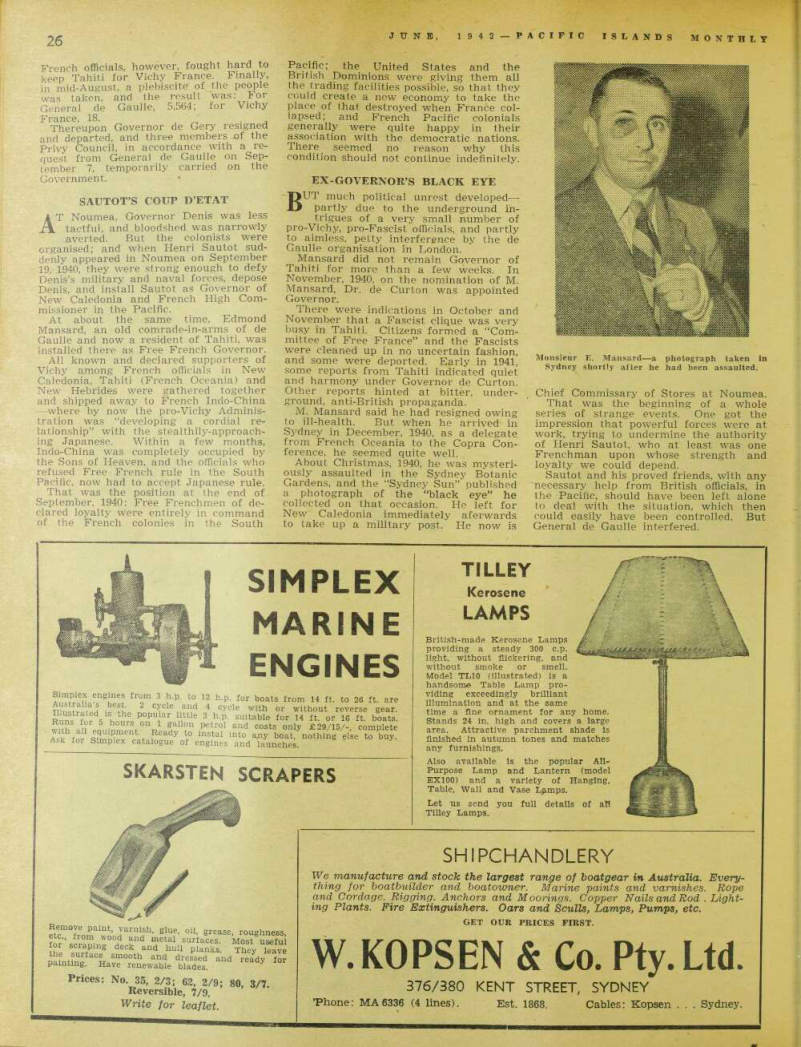
M. Mansard said he had resigned owing to ill-health. But when he arrived in Sydney in December, 1940, as a delegate from French Oceania to the Copra Con ference, he seemed quite well.
About Christmas, 1940, he was mysteri ously assaulted in the Sydney Botanic Gardens, and the “Sydney Sun” published a photograph of the “black eye” he collected on that occasion. He left for New Caledonia immediately aferwards to take up a military post. He now is
Chief Commissary of Stores at Noumea.
That was the beginning of a whole series of strange events. One got the impression that powerful forces were at work, trying to undermine the authority of Henri Sautot, who at least was one Frenchman upon whose strength and loyalty we could depend.
Sautot and his proved friends, with any necessary help from British officials, in the Pacific, should have been left alone to deal with the situation, which then could easily have been controlled. But General de Gaulle interfered.
Monsieur E. Mansard—a photograph taken in Sydney shortly after he had been assaulted.
Enter Commandant Brunot
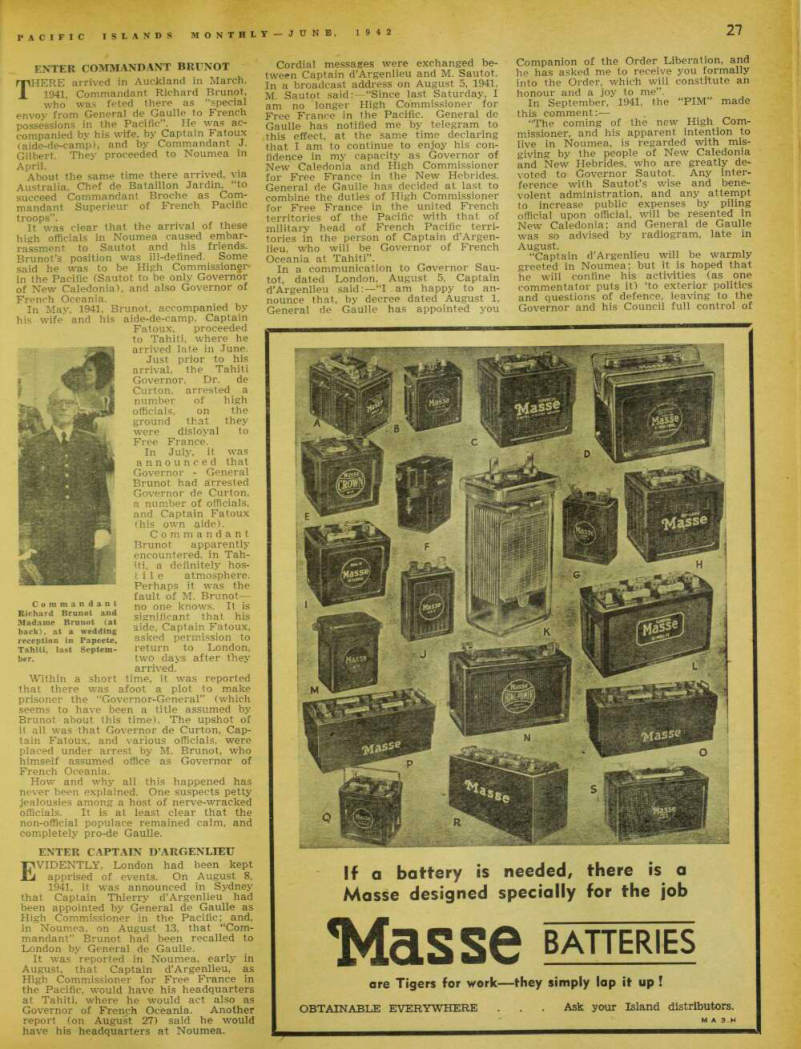
THERE arrived in Auckland in March, 1941, Commandant Richard Brunot, who was feted there as “special envoy from General de Gaulle to French possessions in the Pacific”. He was ac companied by his wife, by Captain Fatoux (aide-de-camp), and by Commandant J.
Gilbert. They proceeded to Noumea in April.
About the same time there arrived, via Australia, Chef de Bataillon Jardin, “to succeed Commandant Broche as Com mandant Superieur of French Pacific troops”. . , . „ It was clear that the arrival of these high officials in Noumea caused embar rassment to Sautot and his friends.
Brunot’s position was ill-defined. Some said he was to be High Commissioner in the Pacific (Sautot to be only Governor of New Caledonia), and also Governor of French Oceania.
In May, 1941, Brunot, accompanied by his wife and his aide-de-camp, Captain
Fatoux, proceeded to Tahiti, where he arrived late in June.
Just prior to his arrival, the Tahiti Governor, Dr. de Curton, arrested a number of high officials, on the ground that they were disloyal to Free France.
In July, it was announced that Governor - General Brunot had arrested Governor de Curton, a number of officials, and Captain Fatoux (his own aide).
Commandant Brunot apparently encountered, in Tah iti, a definitely hos c i 1 e atmosphere.
Perhaps it was the fault of M. Brunot— no one knows. It is significant that his aide, Captain Fatoux, asked permission to return to London, two days after they arrived.
Within a short time, it was reported that there was afoot a plot to make prisoner the “Governor-General” (which seems to have been a title assumed by Brunot about this time). The upshot of it all was that Governor de Curton, Cap tain Fatoux, and various officials, were placed under arrest by M. Brunot, who himself assumed office as Governor of French Oceania.
How and why all this happened has never been explained. One suspects petty jealousies among a host of nerve-wracked officials. It is at least clear that the non-official populace remained calm, and completely pro-de Gaulle.
Enter Captain D’Argenlieu
EVIDENTLY, London had been kept apprised of events. On August 8, 1941, it was announced in Sydney that Captain Thierry d’Argenlieu had been appointed by General de Gaulle as High Commissioner in the Pacific; and, in Noumea, on August 13, that “Com mandant” Brunot had been recalled to London by General de Gaulle.
It was reported in Noumea, early in August, that Captain d’Argenlieu, as High Commissioner for Free France in the Pacific, would have his headquarters at Tahiti, where he would act also as Governor of French Oceania. Another report (on August 27) said he would have his headouarters at Noumea.
Cordial messages were exchanged between Captain d’Argenlieu and M. Sautot.
In a broadcast address on August 5, 1941, M. Sautot said:—“Since last Saturday, I am no longer High Commissioner for Free France in the Pacific. General de Gaulle has notified me by telegram to this effect, at the same time declaring that I am to continue to enjoy his confidence in my capacity as Governor of New Caledonia and High Commissioner fer Free France in the New Hebrides.
General de Gaulle has decided at last to combine the duties of High Commissioner for Free France in the united French territories of the Pacific with that of military head of French Pacific territories in the person of Captain d’Argenlieu, who will be Governor of French Oceania at Tahiti”.
In a communication to Governor Sautot, dated London, August 5, Captain d’Argenlieu said:—“l .am happy to announce that, by decree dated August 1, General de Gaulle has appointed you
Companion of the Order Liberation, and he has asked me to receive you formally into the Order, which will constitute an honour and a joy to me .
In September, 1941, the PIM made this comment: — , “The coming of the new High Com missioner, and his apparent intention to live in Noumea, is regarded with mis giving by the people of New Caledonia and New Hebrides, who are greatly de voted to Governor Sautot. Any mter ference with Sautot’s wise and bene volent administration, and any attempt to increase public expenses by piling official upon official, will be resented m New Caledonia: and General de Gaulle was so advised by radiogram, late in August.
“Captain d'Argenlieu will be warmly greeted in Noumea; but it is hoped that he will confine his activities (as one commentator puts it) ‘to exterior politics and questions of defence, leaving to the Governor and his Council full control of
Commandant Richard Brunot and Madame Brunot (at back), at a wedding reception in Papeete, Tahiti, last Septem ber.
New Caledonia’s economic and adminis trative affairs.’ ”
As it proved, those fears were well founded.
Captain Thierry d’Argenlieu arrived in Tahiti in August, 1941, from United States, and officially took over, from Commandant Richard Brunot the duties of High Commissioner, and Governor of French Oceania. With him was Frigate- Captain Cabanier, who had been ap pointed “Commanding Officer of the De fence of the Free French Pacific Colonies”.
Commandant Brunot returned to London.
“You Lie, Darlan!”
MEANWHILE, in New Caledonia, Governor Henri Sautot was on good terms with his people, and he came into the news occasionally.
He spoke from Radio Noumea on June 18, 1941, and referred to the statement of Admiral Darlan, in Vichy, that “Britain has taken over the Free French colonies”.
“Monsieur Darlan, you are a liar” de clared Sautot. The colonies, he said, were completely free, under the French French administration.
In July, 1941, Darlan announced from Vichy that Sautot had been deprived of French nationality. Sautot retorted: “This is the greatest honour of my life.
It shows that Vichy recognises that I really am working for the liberation of France”. General de Gaulle telegraphed: “Congratulations on the honour done you by the Vichy Gestapo!”
D’Argenlieu And Sautot
CAPTAIN d’Argenlieu arrived in New Caledonia in September, 1941. He was received cordially, but cau tiously, by a community devoted to Sautot. His extraordinarily romantic career (he was a very courageous naval officer until 1918, then a Carmelite monk until August, 1939, then a French naval
officer, and finally a prominent executive of the de Gaulle Administration) gave him an assurance of respect. Not long after d’Argenlieu’s arrival in New Cale donia, General de Gaulle raised him to the rank of Rear-Admiral.
One heard echoes of what was hap pening in Noumea: but, at first, High Commissioner and Governor got along together very well. But it soon became apparent that d’Argenlieu was not go ing to be Governor in Tahiti, as had been expected—Lieut.-Colonel George Orselli, of the Free French Air Force was appointed Governor of French Oceania.
An explosion was bound to occur; and it came when New Caledonia was oc cupied by a defensive force of American troops, early in 1942.
The Americans did not wish to inter fere, in any way, with the civil adminis tration. But, when it came to clari fying the relationship between the Goyernment and the military organi sation, trouble inevitably developed be tween d’Argenlieu, who claimed re sponsibility for defence, and Sautot, who was responsible for New Caledonian government generally.
But there are no details—nothing be yond the above-quoted news despatch from Washington.
One Sydney newspaper, on April 30, said that General de Gaulle had recalled M. Sautot to London, and that he would be sent to another Free French colony; but this was not confirmed.
It can be understood that the dispute between d’Argenlieu and Sautot has caused the Americans much embarrass ment. They are not concerned with Free French politics—only with doing an ef ficient job as fighting men. The action of both d’Argenlieu and Sautot in de parting from the colony, under the present most difficult conditions, must have created a special headache for the American Commandant.
A Free French Problem
THE following, from the “Sydney Morning Herald” correspondent at General MacArthur’s headquarters in Australia, throws some light upon the situation:— “As Rear-Admiral Thierry d’Argenlieu is passionately loyal to the Free French cause, his clash with M. Sautot, who is on his way to London, does not suggest on either side a defection from the Allies. Indeed, it appears to be only a local manifestation of a universal prob lem for the Free French—whether the fight to free France should be confined to a military movement, leaving political problems until after the war, or whether the movement under General de Gaulle should branch out into civil as well as
military affairs.”