Battle-front
p. 18 · Read in the full issue
Line of the Pacific Battle-front
AS a matter of record and of general interest, it is worth noting that at this stage the battle-front in the War of the Pacific runs as follows, from west to east:— From the border between Burma and India, through the Bay of Bengal to the Andaman Islands; thence southerly and easterly to the north-west coast of Aus tralia. (All the East Indies region to the westward of that line is in enemy hands.) Thence we turn eastwards, through the waters immediately north of Austra lia. It is not clear that all of Dutch New Guinea is held by the Japs. We have heard of them along the north coast (in fact, the Dutch had admitted a colony of Japs there, to grow cotton, before the war), but not in the Aroe Islands (off the south-west coast of Dutch New Guinea) or at Merauke (administrative centre on the south coast). But we may be sure that then naval patrols have been thereabouts.
So the front runs eastward from Dar win, through Torres Strait, to Port Moresby, and thence continues eastward through the middle of Papua and the Louisiade Islands to the Solomons.
Between the known Jap bases in the East Indies and the northern part of the mainland of New Guinea, and the line just indicated, there is a wide and defi nite No-man’s-land. The Trobriands and the Woodlarks, for example, are in No-man’s-land. So are the Louisiades.
Jap seaplanes have been hanging about in the latter archipelago, but are being continually attacked.
Until May 30, the Solomons position was obscure, but a communique on that date indicates clearly that the enemy is in occupation of northern and central Solomons. So the dividing line, there fore, must be drawn from the Louisiades, westward of the Solomons chain, to the Southern Solomons.
From the Solomons, the front runs away north-east to the Gilberts. The Japs definitely are in the northern Gil berts, but the southern Gilberts and the Ellice Islands may be regarded as No man’s-land.
From the Gilberts, the line runs north to the Japanese territory of the Marshall Islands, and thence in a north-westerly direction towards Japan.
The only South Pacific Territories actually in Japanese occupation are the Mandated Territory of New Guinea (which includes the Northern Solomons), the British Solomon Islands and the Northern Gilberts.
Territories in No-man’s-land (that is, where civilian population has been evacuated by the Allies, but the areas are not occupied by the enemy) are Papua, Southern Gilberts, Ellice islands.
All the other Pacific Territories are carrying on as usual. They include (from west to east), New Hebrides, New Caledonia, Fiji, Tonga, East and West Samoa. Cook Islands, Tahiti and French Oceania and, of course, north of the equator, the large American Territory of Hawaii.
The Japs have the Philippines, Guam and Wake Island. The Americans hold Midway Island.
Mr. E. T. Frost, formerly a well-known engineer in Fiji, now is serving as a lieutenant with the British military forces in Bombay, India.
Among a group of fighter pilots of the RAAF Spitfire Squadron in England, who met Dr. H. V. Evatt, Australia’s Special Envoy to Britain, when he inspected a Royal Air Force operational station last month, was Pilot-Officer D. D. McLean, formerly of Rabaul, New Guinea.
If any recent arrivals from the New Britain section of New Guinea have any news concerning Rev. J. Barge and Rev.
B. Moore, who were members of the Melanesian Mission in New Britain when the Japanese invaded the Territory, such information would be gladly received by Major H. S. Robinson, secretary of the Melanesian Mission, London Assurance Building, 16 Bridge Street, Sydney.
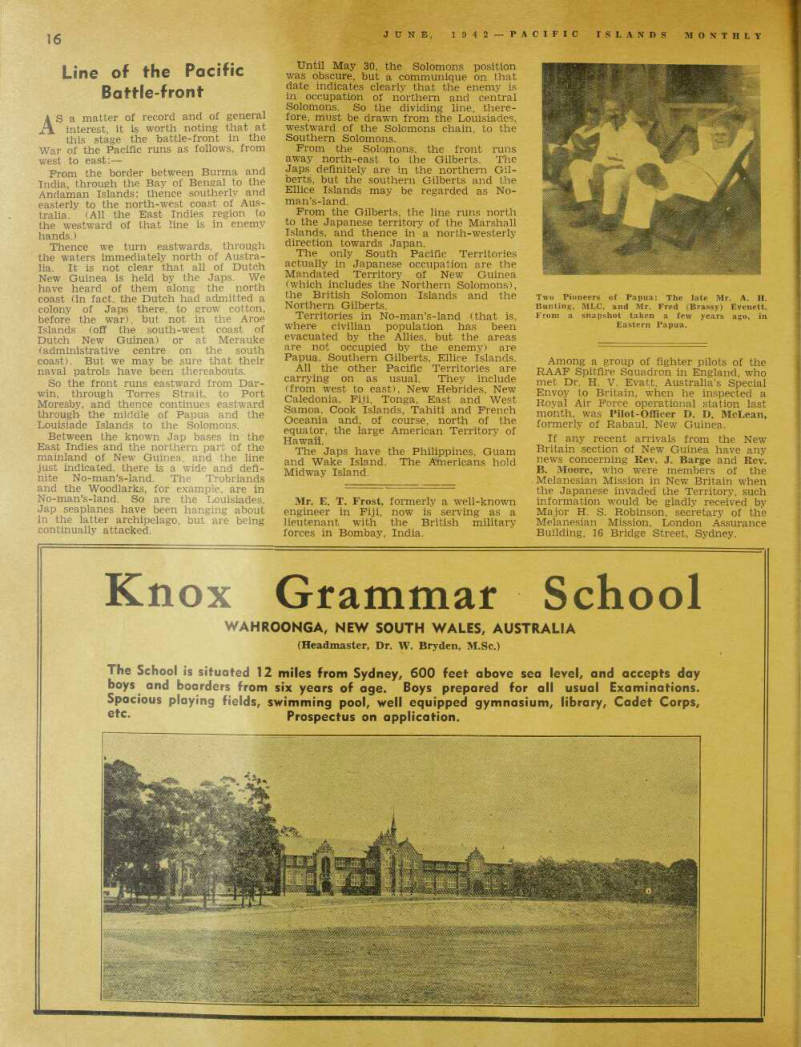
Two Pioneers of Papua: The late Mr. A. H.
Bunting, MLC, and Mr. Fred (Brassy) Evenett.
From a snapshot taken a few years ago, in Eastern Papua.