Guinea Airways Points the Way to Some Headaches
pp. 14-15 · Read in the full issue
New Guinea Invasion And A Company's
Assets
INDUSTRIAL operations in New Guinea were suspended in the third week of January, 1942, when the Japs came.
The cessation of Morobe goldfield activi ties occurred, as near as can be fixed, on January 21.
On that date, Guinea Airways estab lishment at Lae was smashed to pieces by enemy bombs, and the few planes that were saved were taken to Australia.
The financial year of Guinea Airways ends on February 28; so the 1941-42 year was complete except for five weeks; and the annual report shows that, in that year, the Co. made a profit of £13,945, which was £1,200 better than the previous year. Consequently, preference and ordinary dividends are unchanged, at 7 per cent.
As the Co.’s aerial transport business in New Guinea is “suspended for the duration”, it is worth while to glance over its interesting history.
In the early twenties, the “father of Bulolo”, the late Cecil J. Levien, planned something so unusual and unorthodox that no ordinary investor would look at it—gold-dredges in the inaccessible Bulolo Valley, in the interior of New Guinea, and air transport as the pioneer (and only) means of communication between the Bulolo Valley and the coast. Two old friends, C. V. T. Wells and W. P. A.
Lapthorne, had faith in his vision; they succeeded somehow in conveying their faith to an Adelaide syndicate; and so was born the money-spinning “Bulolo Group” of companies—Guinea Gold NL, Placer, Bulolo Gold Dredging, Ltd., and Guinea Airways, Ltd.
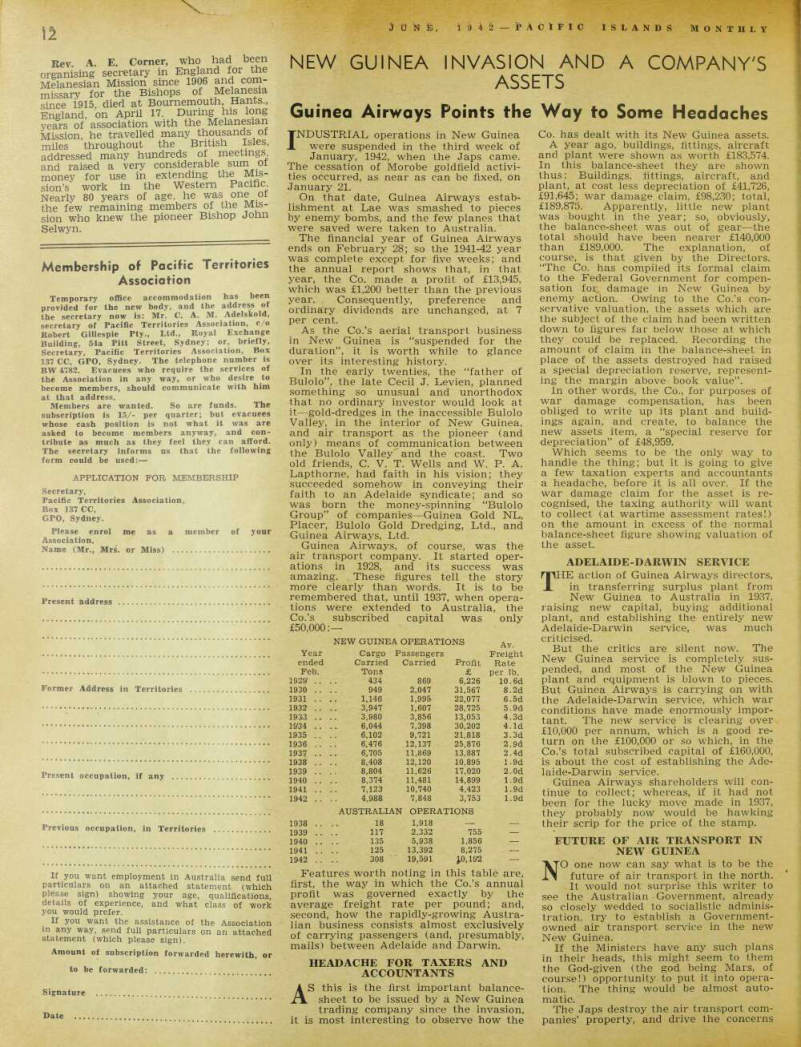
Guinea Airways, of course, was the air transport company. It started oper ations in 1928, and its success was amazing. These figures tell the story more clearly than words. It is to be remembered that, until 1937, when opera tions were extended to Australia, the Co.’s subscribed capital was only £50,000:—
Features worth noting in this table are, first, the way in which the Co.’s annual profit was governed exactly by the average freight rate per pound; and, second, how the rapidly-growing Austra lian business consists almost exclusively of carrying passengers (and, presumably, mails) between Adelaide and Darwin.
Headache For Taxers And
Accountants
AS this is the first important balance sheet to be issued by a New Guinea trading company since the invasion, it is most interesting to observe how the
Co. has dealt with its New Guinea assets.
A year ago, buildings, fittings, aircraft and plant were shown as worth £183,574.
In this balance-sheet they are shown thus: Buildings, fittings, aircraft, and plant, at cost less depreciation of £41,726, £91,645; war damage claim, £98,230; total, £189,875. Apparently, little new plant was bought in the year; so, obviously, the balance-sheet was out of gear—the total should have been nearer £140,000 than £189,000. The explanation, of course, is that given by the Directors.
“The Co. has compiled its formal claim to the Federal Government for compen sation for damage in New Guinea by enemy action. Owing to the Co.’s con servative valuation, the assets which are the subject of the claim had been written down to figures far below those at which they could be replaced. Recording the amount of claim in the balance-sheet in place of the assets destroyed had raised a special depreciation reserve, represent ing the margin above book value”.
In other words, the Co., for purposes of war damage compensation, has been obliged to write up its plant and build ings again, and create, to balance the new assets item, a “special reserve for depreciation” of £48,959.
Which seems to be the only way to handle the thing; but it is going to give a few taxation experts and accountants a headache, before it is all over. If the war damage claim for the asset is re cognised, the taxing authority will want to collect (at wartime assessment rates!) on the amount in excess of the normal balance-sheet figure showing valuation of the asset.
Adelaide-Darwin Service
THE action of Guinea Airways directors, in transferring surplus plant from New Guinea to Australia in 1937, raising new capital, buying additional plant, and establishing the entirely new Adelaide-Darwin service, was much criticised.
But the critics are silent now. The New Guinea service is completely sus pended, and most of the New Guinea plant and equipment is blown to pieces.
But Guinea Airways is carrying on with the Adelaide-Darwin service, which war conditions have made enormously impor tant. The new service is clearing over £10,000 per annum, which is a good return on the £100,000 or so which, in the Co.’s total subscribed capital of £160,000, is about the cost of establishing the Ade laide-Darwin service.
Guinea Airways shareholders will con tinue to collect; whereas, if it had not been for the lucky move made in 1937, they probably now would be hawking their scrip for the price of the stamp.
Future Of Air Transport In
New Guinea
NO one now can say what is to be the future of air transport in the north.
It would not surprise this writer to see the Australian Government, already so closely wedded to socialistic adminis tration, try to establish a Government owned air transport service in the new New Guinea.
If the Ministers have any such plans in their heads, this might seem to them the God-given (the god being Mars, of course!) opportunity to put it into opera tion. The thing would be almost auto matic.
The Japs destroy the air transport com panies’ property, and drive the concerns
New Guinea Operations
Av.
Year Cargo Passengers Freight ended Carried Carried Profit Rate Feb.
Tons £ per lb. 192ff .. 434 869 6,226 10.6d 1930 .. 949 2,047 31,567 8.2d 1931 .. 1,146 1,995 22,077 6.5d 1932 .. 3,947 1,607 28,725 5.9d 1933 .. 3,980 3,856 13,053 4.3d 1934 .. 6,044 7,398 30,202 4.Id 1935 .. 6,102 9,721 21,818 3.3d 1936 .. 6,476 12,137 25,876 2.9d 1937 .. 6,705 11,869 13,887 2.4d 1938 .. 8,408 12,120 10,895 1.9d 1939 .. 8,804 11,626 17,020 2.0d 1940 8,374 11,481 14,899 1.9d 1941 .. 7,123 10,740 4,423 1.9d 1942 4,988 7,848 3,753 1.9d
Australian Operations
1938 .. 18 1,918 — — 1939 .. 117 2,332 755 — 1940 .. 135 5,938 1,856 — 1941 .. 125 13,392 8,275 — 1942 . . 308 19,591 *0,192 —
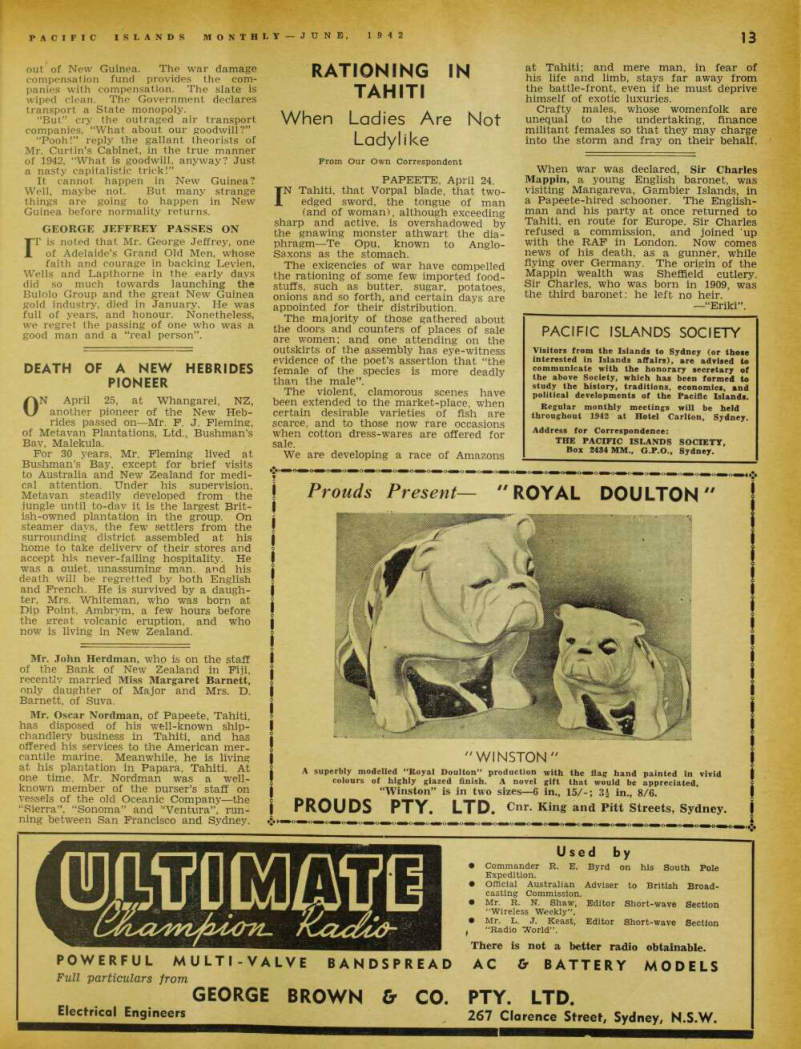
out of New Guinea. The war damage compensation fund provides the com panies with compensation. The slate is wiped clean. The Government declares transport a State monopoly.
“But” cry the outraged air transport companies, “What about our goodwill?”
“Pooh!” reply the gallant theorists of Mr. Curtin’s Cabinet, in the true manner of 1942, “What is goodwill, anyway? Just a nasty capitalistic trick!”
It cannot happen in New Guinea?
Well, maybe not. But many strange things are going to happen in New Guinea before normality returns.
George Jeffrey Passes On
IT is noted that Mr. George Jeffrey, one of Adelaide’s Grand Old Men, whose faith and courage in backing Levien, Wells and Lapthorne in the early days did so much towards launching the Bulolo Group and the great New Guinea gold industry, died in January. He was full of years, and honour. Nonetheless, we regret the passing of one who was a good man and a “real person”.