Solomons
pp. 7-8 · Read in the full issue
Japanese Now Occupy The
Allied Planes Repeatedly Raid Enemy Seaplane Base at Tulagi
(ADAPTED FROM RADIO BROADCAST BY R. W. ROBSON)
MANY of us, who had been trying to follow any southwards progress of the Japanese which might be indicated in the official communiques, learned with something of a shock on May 30 that the enemy has established a seaplane base at Tulagi, in the British Solomon Islands, and is apparently present in that area in some strength.
The following are the dates and exact phraseology of the various official communiques: T ,„ ’ , , r ™ , • /c. , , Issued Saturday, May 30: Tulagi (Solomons).— The enemy seaplane base was attacked on Friday night by our Air Force. Fires started and destroyed fuel dumps, wharves, and adjoining buildings, and were visible for so miles. An enemy flying-boat was destroyed and antiaircraft guns at Tanamboga and Gavutu were sllenced> (Gavutu and Tanamboga are little islands near Tulagi Island.) Issued Wednesday, June 3: Solomons.—Tulagi: Our Air Force bombed enemy installations. starting huge fires. One large warehouse was destroyed. All of our planes returned.
V. „ .
Issued Friday, June 5: Solomons.-Tulagi: An Allied reconnaissance aircraft machine-gunned an enemy float-plane on the water. „ J , Until May 30, nothing had been said of strong Japanese penetration of the Solomons. Enemy landings at Faisi and Gizo, up near the New Guinea Mandated Territory, and at Santa Cruz, in the extreme south of the group, had been reported—but, generally, such news as we had had indicated that the
enemy’s activities in this area had been mostly air reconnaissance, As is well known, the European women were evacuated from the Solomons in December and January; but it was assumed that some British Government officials still were at administrative head quarters in Tulagi, and that a few coco nut planters were hanging on in the other islands. We regarded the Solo m2!ls L as a No-Man’s-Land.
But now we know that the Japanese are at Gizo and Faisi, and that they u.,. 0 „I m,, r • . aVG a base at Tulagi, and are present there in sufficient strength to require the frequent attentions of our bombers. It is clear, therefore, that the Japanese, for the present, are virtually in occupation of the Solomons.
A Tokio message, published in Sydney 0 n June 2, claimed precisely that. Japan it said. now occup i es the Solomons.
Apart from strategical considerations this is not a Very serious item in the wnrlH-wnr rmtfprn Fmnomiooll,, worm-war pattern Economically the Solomons are of little value. But that is cold comfort for the planters and trad „„„ TTT i ilr „ •„ • „ , T . ? rS wl ™, like their fellows in New Guinea, have been forced to leave all their pos sessions and a lifetime of work, to Jap anese invaders and native looters mHE map does not give the impression X that the Solomdhs are unimportant There, one sees a double chain com prising six of the largest islands in the South Pacific—with an area of well over
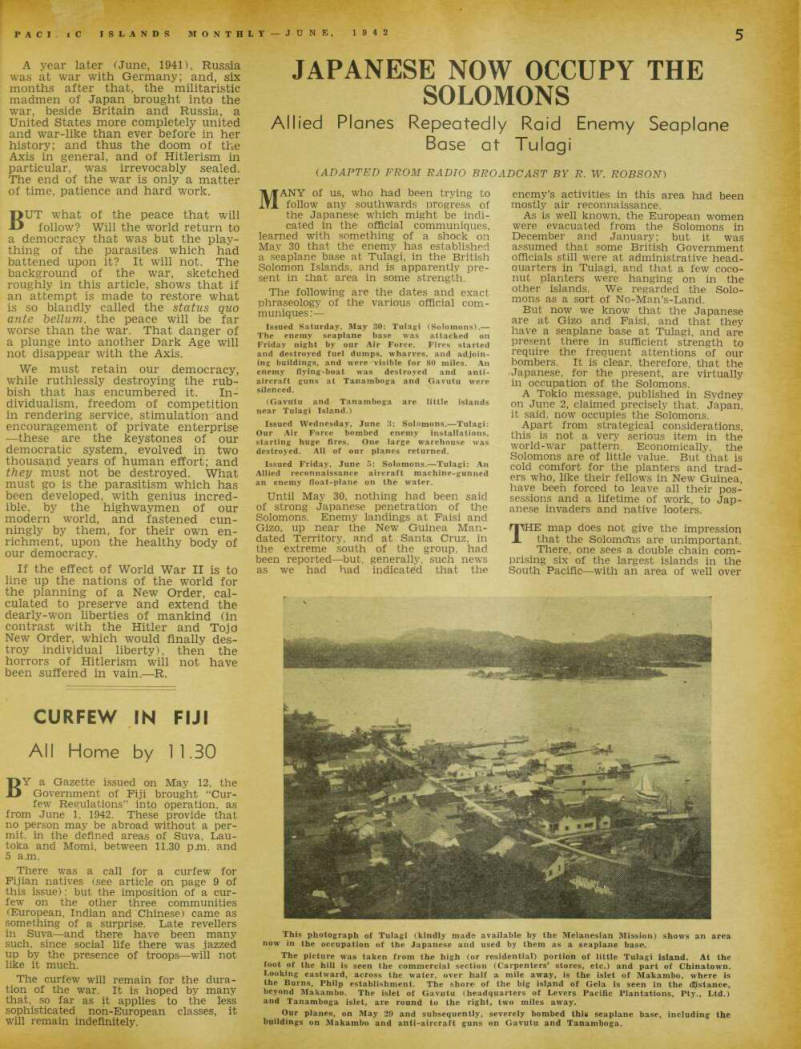
This photograph of Tulagi (kindly made available by the Melanesian Mission) shows an area now in the occupation of the Japanese and used by them as a seaplane base.
The picture was taken from the high (or residential) portion of little Tulagi island. At the foot of the hill is seen the commercial section (Carpenters’ stores, etc.) and part of Chinatown.
Looking eastward, across the water, over half a mile away, is the islet of Makambo, where is the Burns, Philp establishment. The shore of the big island of Gela is seen in the distance, beyond Makambo. The islet of Gavutu (headquarters of Levers Pacific Plantations, Pty., Ltd.) and Tanamboga islet, are round to the right, two miles away.
Our planes, on May 29 and subsequently, severely bombed this seaplane base, including the buildings on Makambo and anti-aircraft guns on Gavutu and Tanamboga.
14,000 square miles—twice the size of the Colony of Fiji, twice the size of the Hawaiian Islands, ten times the size of Samoa.
Yet, although it is a region of great mountains and dense jungles, large riv ers and broad plateaux, it is a very Cin derella among Pacific Territories. It is practically undeveloped.
In normal times, there are less than 500 Europeans there, and about 200 Chinese. Settlement and development are represented by a chain of copra producing properties owned by Levers Pacific Plantations Pty. Ltd.; by a few scores of coconut plantations; by the stores of Burns, Philp and Carpenters; by some scores of native trading stores owned by the Chinese; and by a num ber of Mission stations. There is noth ing else —the great territory produces nothing but copra.
But we cannot ignore the Solomons.
They are too close to Australia —so close that, although they are governed by Britain, all their trade is Australian, and Australian currency is used there.
The group lies diagonally across the map. north-west to south-east, in two parallel chains of large islands—Choiseul, Isabel and Malaita in one, and New Georgia, Guadalcanal and San Cristoval in the other. There are a lot of smaller islands, of course, but those two chains of three each comprise the big ones.
Between the two chains there is a narrow, sheltered sea, hundreds of miles long; and in the middle of this sea, snugly sheltered between Malaita and Guadalcanal, is the fairly large island of Gela —or, to give it its old name, Florida.
Close to the southern coast of Gela is the little island of Tulagi.
BETWEEN Tulagi, and the Gela shore there is a deep and narrow strait; and this sheltered water is the harbour of Tulagi.
Tulagi itself is in three sections. First, there are the government offices and residences, scattered over the higher parts of Tulagi island; second, the Car penter establishment, and Chinatown (a scattered place of stores and workshops) down on the shore of Tulagi island; and. third, there is the Burns, Philp establish ment, comprising stores, workshops, docks, etc., on the little islet of Makambo, lying about three-quarters of a mile from Tulagi beach, between Tulagi island and the shore of Gela.
Tulagi, as can be imagined, is a most picturesque and colourful place The panorama seen from the high parts of Tulagi island will not soon be forgotten.
A couple of miles to the eastward of Tulagi is another little island, hugging G Sf la u coast - This is Gavutu, and there has been established the Solomon Islands headquarters of Levers Pacific Plantations Pty. Ltd.
Nearly 40 years ago, the famous soap
making firm of Lever Broth ers, with extraordinary fore sight, set out to secure plan tations throughout the world, from which they might derive ample supplies of one of their most important raw materials —namely, vegetable oil. So, in 1905, their repre sentatives came to the Solo mons, and purchased there 20,000 acres of land, for growing coconuts. They es tablished many plantations,, and Gavutu became their headquarters, and in recent years they have been export ing (mostly to their Sydney soapworks) some 20,000 tons of copra per annum.
Little did the pious men of the ori ginal Lever firm dream that, in 1942, Gavutu would be occupied by Japanese— for, according to recent communiques, Gavutu was one of the three places— Tulagi, Gavutu and Tanamboga—which we have bombed. It is apparent that the Japs have made their seaplane base in the sheltered water between Tulagi and Makambo, and have put anti-aircraft guns out on the nearby islands of Gav utu and Tanamboga.
Although practically all European offi cials, planters and traders were with drawn, a few Missionaries, who refused to leave the natives, and most of the Chinese, appear to have remained.
There are about 90,000 natives in the Solomons, mostly on Malaita. They are the same type of people as one finds in New Guinea, and are a virile, warlike race. A percentage have been brought under Mission influence, and given some education—but the great majority still are primitives—living as their fathers did, and uninfluenced by European life— except that they no longer attack Euro peans on sight.
In that respect, there has been a great change in the Solomons in the last few decades. For half a century, the history of European contact with the Solomons was mostly a story of murders, massacres and reprisals.
THIS great territory of the Solomons, under vigorous colonisation, could be made highly productive, rich and populous. But I do not think that the new invaders will direct the new devel opment. I am one who believes strongly in the doctrine of Japan for the Japan ese.
I believe that the future development of the Solomons will be a responsibility of Australia—that one result of the Pacific war will be a recognition of the fact that all these Islands Territories in the South-west Pacific (New Guinea.
Papua, New Britain and New Ireland, Solomon Islands and perhaps part of the New Hebrides) are so clearly within Australia’s sphere of influence that Aus tralia must take care of them.
Mr. R. H. Garvey, lately Acting Resi dent Commissioner in the Gilbert and Ellice Islands Colony, accompanied by Mrs. Garvey and their children, arrived recently in Australia from Fiji, on their way to Nyasaland. Central Africa, where he will take up the position of District Officer. The departure of this most effi cient officer has been noted with regret throughout all the British Territories of the South Pacific—his kindness, courtesy and hospitality, no less than the charm and vivacity of his wife, won high esteem for the Garvey couple in all the Territories where they were located, especially Fiji, New Hebrides, Tonga and Ocean Island.
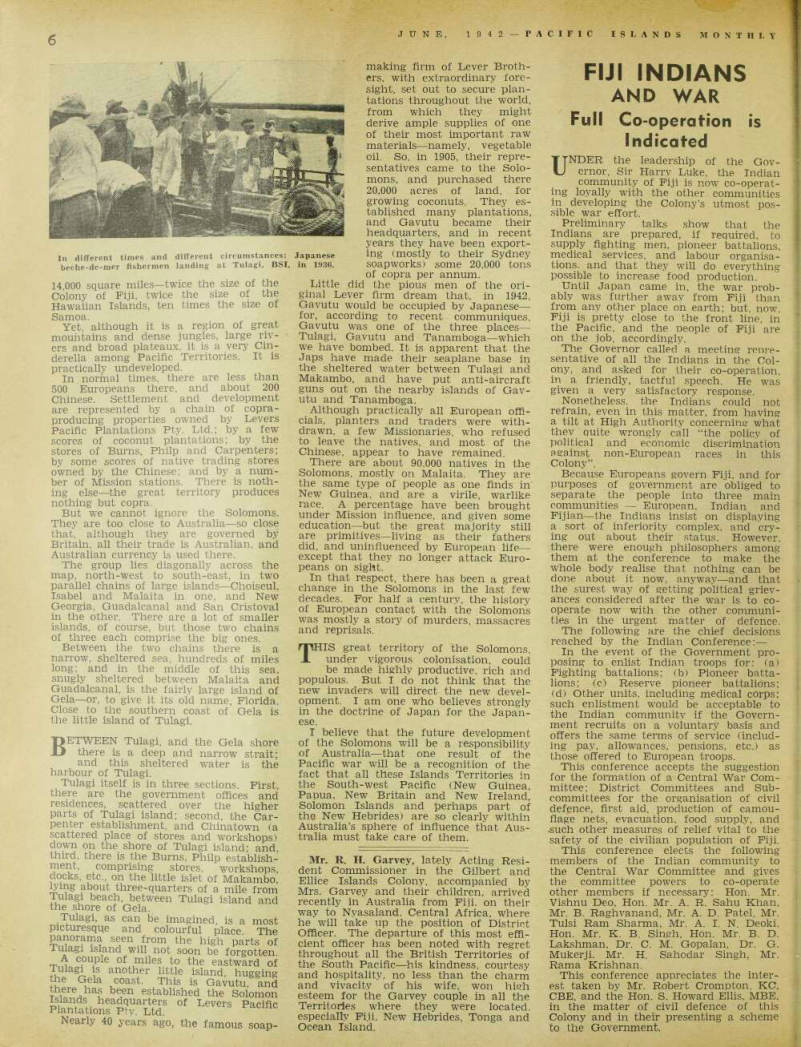
In different times and different circumstances: Japanese beche-de-mer fishermen landing at Tulagi, BSI, in 1936.