Samoa
pp. 26-27 · Read in the full issue
The Islands Of
A Valuable Publication
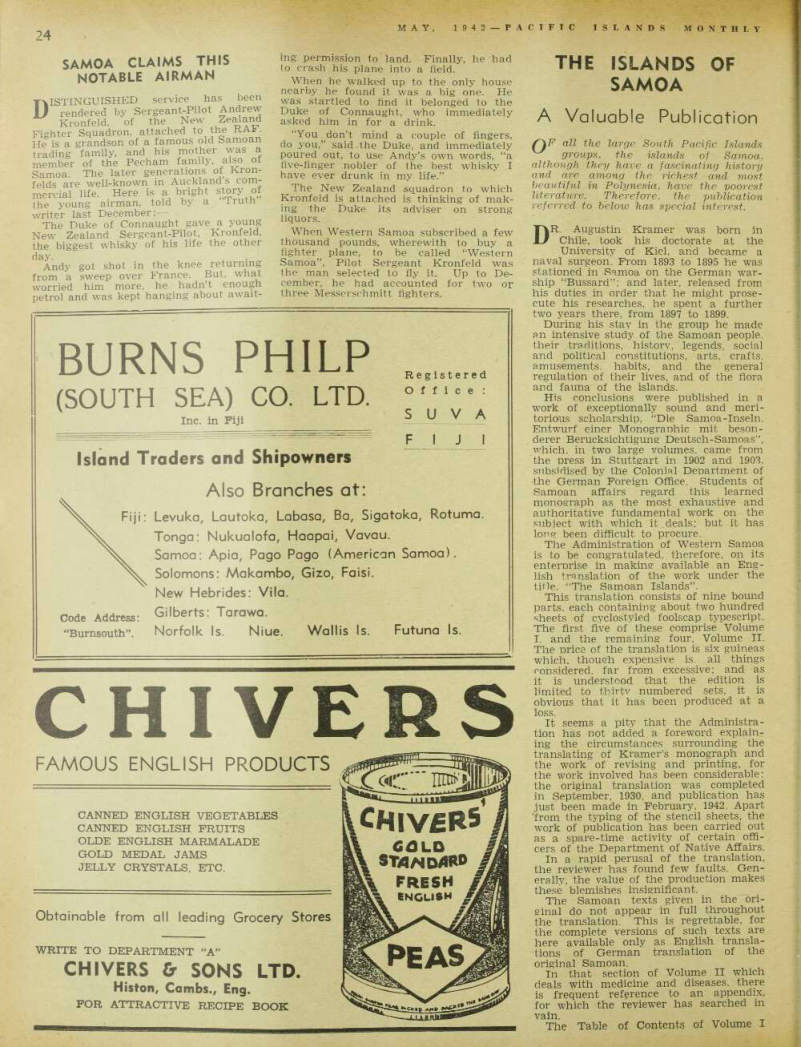
(~)F all the large South Pacific Islands groups, the islands of Samoa, although they have a fascinating history and are among the richest and most beautiful in Polynesia, have the poorest literature. Therefore, the publication referred to below has special interest.
DR. Augustin Kramer was born in Chile, took his doctorate at the University of Kiel, and became a naval surgeon. From 1893 to 1895 he was stationed in Samoa on the German war ship “Bussard”; and later, released from his duties in order that he might prose cute his researches, he spent a further two years there, from 1897 to 1899.
During his stay in the group he made an intensive study of the Samoan people, their traditions, history, legends, social and political constitutions, arts, crafts, amusements, habits, and the general regulation of their lives, and of the flora and fauna of the islands.
His conclusions were published in a work of exceptionally sound and meri torious scholarship, “Die Samoa-Inseln.
Entwurf einer Monogranhic mit beson derer Berucksichtigung Deutsch-Samoas”, which, in two large volumes, came from the press in Stuttgart in 1902 and 1903. subsidised by the Colonial Department of the German Foreign Office. Students of Samoan affairs regard this learned monograph as the most exhaustive and authoritative fundamental work on the subject with which it deals; but it has loner been difficult to procure.
The Administration of Western Samoa is to be congratulated, therefore, on its enternrise in making available an Eng lish translation of the work under the title. “The Samoan Islands”.
This translation consists of nine bound parts, each containing about two hundred sheets of cyclostyled foolscap typescript.
The first five of these comprise Volume I. and the remaining four. Volume 11.
The price of the translation is six guineas which, though expensive is. all things considered. far from excessive: and as it is understood that the edition is limited to thirtv numbered sets, it is obvious that it has been produced at a loss.
It seems a pity that the Administra tion has not added a foreword explain ing the circumstances surrounding the translating of Kramer’s monograph and the work of revising and printing, for the work involved has been considerable: the original translation was completed in September, 1930, and publication has just been made in February, 1942. Apart 'from the typing of the stencil sheets, the work of publication has been carried out as a spare-time activity of certain offi cers of the Department of Native Affairs.
In a rapid perusal of the translation, the reviewer has found few faults. Gen erally, the value of the production makes these blemishes insignificant.
The Samoan texts given in the ori ginal do not appear in full throughout the translation. This is regrettable, for the complete versions of such texts are here available only as English transla tions of German translation of the original Samoan.
In that section of Volume II which deals with medicine and diseases, there is frequent reference to an appendix, for which the reviewer has searched in vain.
The Table of Contents of Volume I
gives the original German page num bers. It is a pity that these were not converted to agree with the present pag ing. True, one can apply the excellent concordance supplied with the Index; but the conversion would have facilitated the finding of one’s way about the book.
No page numbers are given in the Table of Contents of Volume II; and it is as convenient to use as that of the first volume.
The Index of each volume is merely a transcript of the corresponding Index in the original, prefixed by a concordance, or “key”, with the aid of which the cor responding page in the translation can readily be found. This presents no diffi culty in Volume I, where the Index is a list of Samoan names; but with Volume II the position is different, for there the Index is largely composed of German words. Thus, if one wants to look up burial, the reference in the Index is Beerdigung; if one wants cuttle-fish, one must look for Tintenfisch; for the tooth billed pigeon (manumea), the Index gives Zahntaube, and so on. There should have been a translation or a con cordance of English and German words appended to this Index. Perhaps it is not too much to hope that one may be prepared and distributed to the pur chasers of the translation.
Page references in the text are given as blanks. This is the most serious and annoying defect in the whole translation.
If one wishes to consult such a reference, one must tread a wearisome path through the Index (which in Vol. II may be in German) and the concordance, in order to locate it; and in some cases it is not easy to find the proper reference in the Index. Had the original German page references been given, there would have been little difficulty, whereas the system adopted is often acutely exasperating.
The work deserves a much stronger binding than it has been given. Paper covers may be good enough for cheap novels, or even for parliamentary Blue Books, but reference books of the size and weight of the nine parts of the pre sent monograph require stiff boards. The cost would have been greater, but pur chasers would not have objected to pay ing for the more serviceable binding.
Unfortunately, it was not found pos sible to reproduce the illustrations. The cost would have been prohibitive.
There is nothing to show that this translation has been published by the Administration of Western Samoa; nor is the date of its publication given.
This information should have appeared on the title page. It is an unfortunate omission, for the Administration has every reason to take pride in so success fully completing the venture.
In the first instance, this exceedingly valuable monograph would never have been available at all but for the liberality of the old Imperial German Government, which not only granted Dr. Kramer the necessary leave from his duties so that he could complete his researches, but also paid a large share of the cost of publica tion. At this latter time, Western Samoa was a German Colonv; now it is man dated to the British Crown and is under the tutelage of the New Zealand Gov ernment.
The attitude of governments in gen eral to pure scientific research is notori ously apathetic; and it is pleasing to have such an opportunity as this of com plimenting the Administration of West ern Samoa on its wisdom, enterprise, and liberalitv in making available to English speaking people, in their own language, the valuable fruits of Dr.
Kramer’s investigations. Dr. Kramer’s work is as valuable to-dav as when it was written—especially to those who take
part in the shaping and administration of Government policy in Samoa, or who are interested in Samoan affairs, or who conduct missionary activities in the Ter ritory P. W. Glover, BSc., FRAS.
Apia, March 1, 1942.