Cleanly Tahiti
p. 28 · Read in the full issue
A Reply to Dr. Lambert
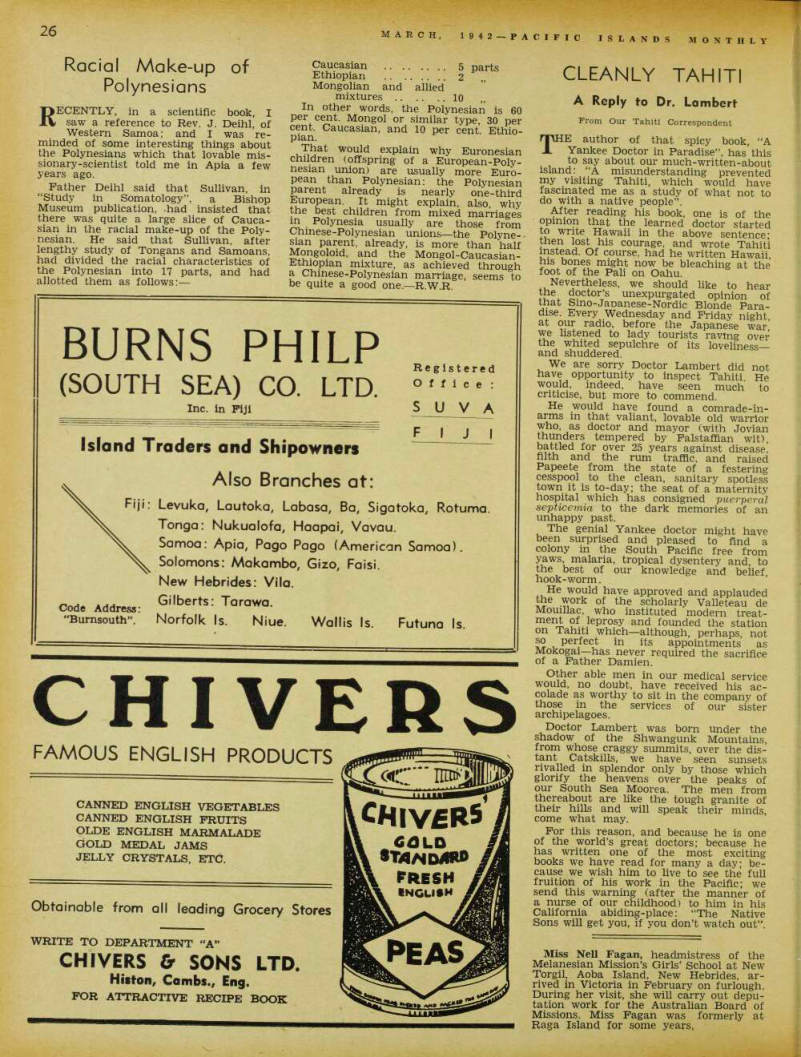
From Our Tahiti Correspondent T'HE author of that spicy book, “A JL Yankee Doctor in Paradise”, has this to say about our much-written-about island: “A misunderstanding prevented my visiting Tahiti, which would have fascinated me as a study of what not to do with a native people”.
After reading his book, one is of the opinion that the learned doctor started to write Hawaii in the above sentence; then lost his courage, and wrote Tahiti instead. Of course, had he written Hawaii his bones might now be bleaching at the foot of the Pali on Oahu.
Nevertheiess, we should like to hear the fetor’s unexpurgated opinion of that Smo-Japanese-Nordic Blonde Para dise. Every Wednesday and Friday night at our radio, before the Japanese war we listened to lady tourists raving over the whited sepulchre of its loveliness— and shuddered.
We are sorry Doctor Lambert did not have opportunity to inspect Tahiti. He would, indeed, have seen much to criticise, but more to commend.
He would have found a comrade-in arms in that valiant, lovable old warrior who, as doctor and mayor (with Jovian thunders tempered by Falstaffian wit), battled for over 25 years against disease, filth and the rum traffic, and raised Papeete from the state of a festering cesspool to the clean, sanitary spotless town it is to-day; the seat of a maternity hospital which has consigned puerperal septicemia to the dark memories of an unhappy past.
The genial Yankee doctor might have been surprised and pleased to find a colony in the South Pacific free from yaws, malaria, tropical dysentery and, to the best of our knowledge and belief, hook-worm.
He would have approved and applauded the work of the scholarly Valleteau de Mouillac, who instituted modern treat ment of leprosy and founded the station on Tahiti which—although, perhaps, not so perfect in its appointments as Mokogai—has never required the sacrifice of a Father Damien.
Other able men in our medical service would, no doubt, have received his ac colade as worthy to sit in the company of those in the services of our sister archipelagoes.
Doctor Lambert was born under the shadow of the Shwangunk Mountains, from whose craggy summits, over the dis tant Catskills, we have seen sunsets rivalled in splendor only by those which glorify the heavens over the peaks of our South Sea Moorea. The men from thereabout are like the tough granite of their hills and will speak their minds, come what may.
For this reason, and because he is one of the world’s great doctors; because he has written one of the most exciting books we have read for many a day; be cause we wish him to live to see the full fruition of his work in the Pacific; we send this warning (after the manner of a nurse of our childhood) to him in his California abiding-place: “The Native Sons will get you, if you don’t watch out”.
Miss Nell Fagan, headmistress of the Melanesian Mission’s Girls’ School at New Torgil, Aoba Island, New Hebrides, ar rived in Victoria in February on furlough.
During her visit, she will carry out depu tation work for the Australian Board of Missions. Miss Fagan was formerly at Raga Island for some years,