Islands
Pacific
Monthly
Vol. Xii. No. 8.
March 16, 1942
Established 1930
I Sydney. for transmission by post as a newspaper]
Qd
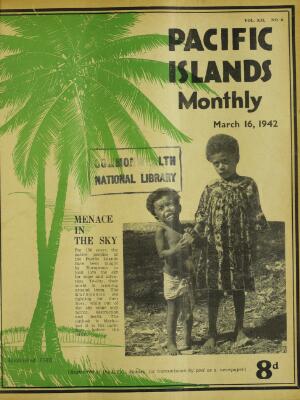
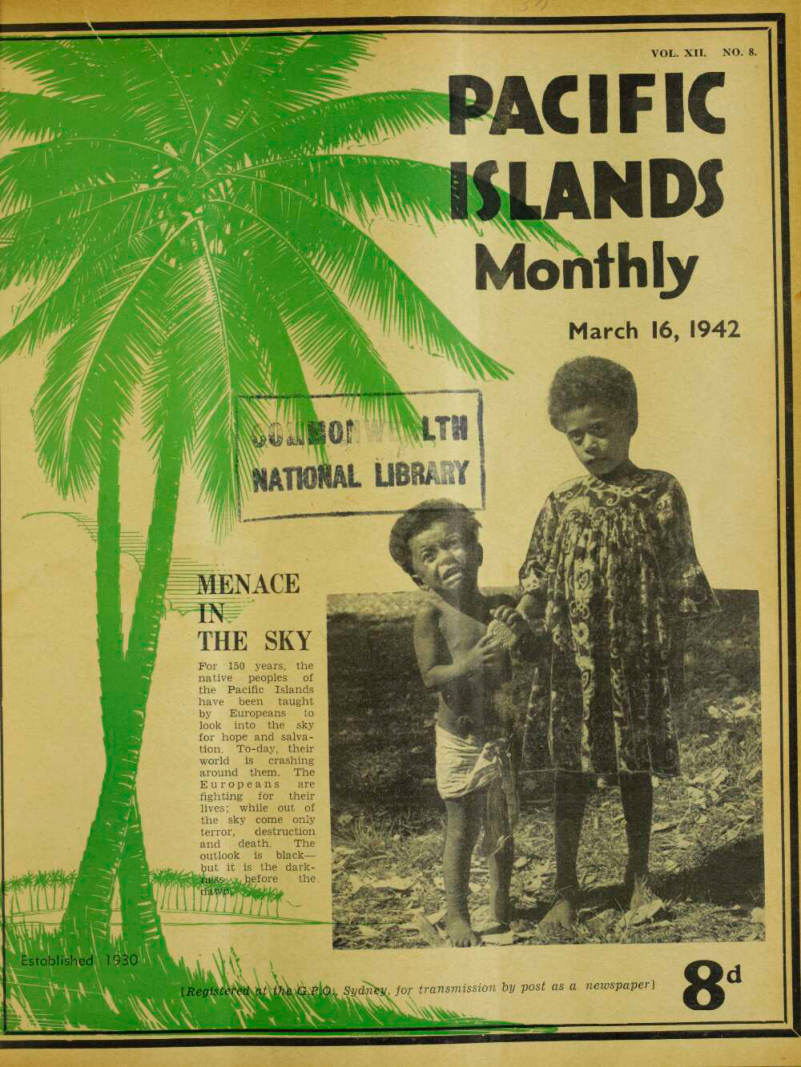
Menace
IN
The Sky
For 150 years, the native peoples of the Pacific Islands have been taught by Europeans to look into the sky for hope and salva tion. To-day, then world is crashing around them. The Europeans are fighting for their lives; while out of the sky come only terror, destruction and death. The outlook is black— but it is the dark before the.
Advertisements & other items, pp. 2-4 (2 items)
W. R. Carpenter & Co. Ltd
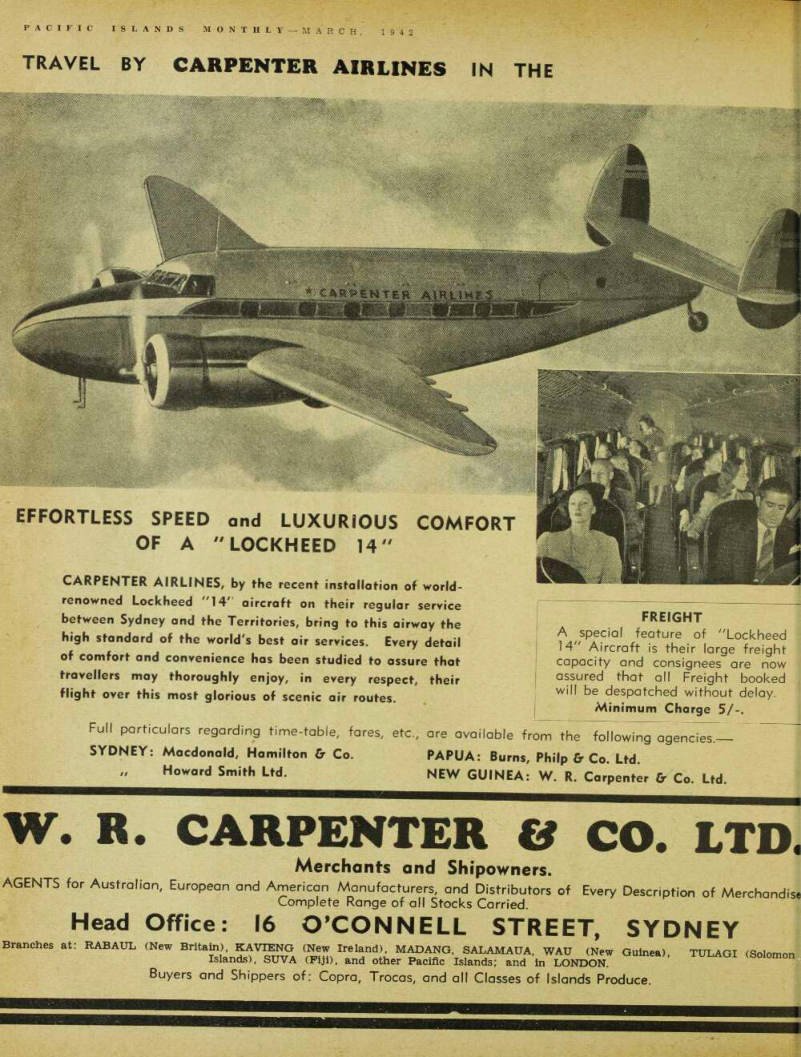
TRAVEL BY CARPENTER AIRLINES IN THE
. ■ paii H ::
ife
ii :* I si in « ■ ■ ■ HI
EFFORTLESS SPEED and LUXURIOUS COMFORT
OF A "LOCKHEED 14"
CARPENTER AIRLINES, by the recent installation of worldrenowned Lockheed "14' aircraft on their regular service between Sydney and the Territories, bring to this airway the high standard of the world's best air services. Every detail of comfort and convenience has been studied to assure that travellers may thoroughly enjoy, in every respect, their flight over this most glorious of scenic air routes.
Full particulars regarding time-table, fares, etc.
SYDNEY: Macdonald, Hamilton Cr Co. /, Howard Smith Ltd.
FREIGHT
A feature of "Lockheed 14" Aircraft is their large freight capacity and consignees are now assured that all Freight booked will be despatched without delay.
Minimum Charge 5/-. are available from the following agencies.— PAPUA: Burns, Philp Cr Co. Ltd.
NEW GUINEA: W. R. Carpenter Cr Co. Ltd.
W. R. CARPENTER & CO. LTD
Merchant's and Shipowners.
AGENTS for Australian, European and American Manufacturers, and Distributors of Complete Range of all Stocks Carried.
Head Office: 16 O’CONNELL STREET, SYDNEY
Every Description of Merchandi; Branches at: RABAUL (New Britain), KAVTENG (New Ireland), MADANG, SALAMAUA, WAU (New Guinea) Islands), SUVA (Fiji), and other Pacific Islands; and in LONDON.
Buyers ond Shippers of: Copra, Trocas, and all Classes of Islands Produce.
TULAGI (Solomor
SirSSSS i
PACIFIC NEWS-REVIEW
NOTES AND COMMENT ON
THE PROGRESS OF THE WAR
FROM FEB. 14 TO MAR. 15
r, l Id . -RHHsh newspapers are bitterly ss »<>—.
P °Aithmiffh there is much about the in-
SirSSSS i
very thick and, £ alt £ough r h ip S hurled
fordoing, aSETe-g
were limited by bad and the enemy s of were showdown Eighteen enemy were - Th * afrrraft fighters, and 6 naval aircrait.
Feb. 18: The Russian winter campaig is still in progress along the whole of the Russo-German front, and at a number o places, especially directly west of Moscow, the Russians have driven deep salients into the German line. The Germans are falling back slowly, fighting every inch of the way. . , imnn The Russians ea^le^ s toe chosen points, hope to aisorganise German plans for a spring offensivefhe 1 ’ Ge y rmans nB had 0 cho S en pt E -
many’ German that'thejf wiU
compel Hitler to throw in now, a large portion of the reserves which he has been assembling for the spring offensive.
Feb 20- A considerable re-organisation of the British War Cabinet is announced, Sir Stafford Cripps and Mr. Oliver Lyttleton have joined the Cabinet, and Lord Beaverbrook Mr. Greenwood, and Sir Kingsley Wood have left it.
Feb 23’ Considerable uneasiness is seen in British and American newspapers concerning the position in India.
The British forces have failed to hold the Japanese in Burma and Japanese armies are approaching the eastern frontiers of India. There are indications that Japanese propagandists are attempting to raise Indian public opinion against the British Large sections of India’s 3™ million people are not friendly to the British and they may listen to Japan’s urgent promises that if India now turns against the British, and assists the Japanese India will be allowed to join Japan fn the “Co-prosperity Sphere”, and. will have political liberty. The Chinese Generalissimo Chiang Kai Shek has urgentlv appealed to Britain to transfer nolitical power to India immediately.
P Feb 24- A new Lease-Lend Agreement hPtwPPn Britain and United States provides for the indefinite postponement of the final settlement of thecost of leaseoTh"w r mortals and aCC6SS t 0 eaCh In the noisfandContusion of the World
nof
mo\t S thoughtful commentators point out that it is epochal to that it now estabfishes Vhat P is virtually free trade betwpen the two great powers of toe Anglo- ?e a votation° rld a WOrld ' Wlde commercial The Russian attack all along the German front continues with un-
abated The, Russians havejn-
trapped the 16th German army 280 miles north-west of Moscow.
Feb. 28: It is understood that Russia is urging upon Britain and America the need for opening a second front in
Europe this spring as a counter-blow to
ssrffi;
where thousands of enslaved Frenchmen
arsas
mentators, however, say that there is no a f °Slr 9 : Thf President of the Indian Congress Party announced that nothing but Indian freedom would make any difference or move India’s millions to effective participation in the war. In dians would be indifferent to the struggle gQing on around them until they realised India had achieved freedom, where would fight to preserve £Pou t y Mar i 0: Tq upset G erm an preparations fQr a spring attack towards the Caucasus, the Russians have launched heavy as saults between Kharkov and the Black j^ ar 11; It officially announced in London that the Japanese have sub
jected the British men and wpmen, taken prisoners at Hongkong, to hideous mal treatment. British men, lying bound and helpless, were bayoneted; British women have been raped by Japanese soldiery; a Chinese district was declared a brothel district, and all the women therein were given over to the Japanese troops. The revelations have caused a wave of horror and revulsion throughout the world.
Mar. 13; Sir Stafford Cripps (now Brit ain’s most prominent Minister, next to Churchill) is to visit India to discuss a new constitution for India, agreed upon by the British Cabinet.
Mar. 15: The German 16th Army is still entrapped in the regions between Moscow and Smolensk; and, although the fighting in process all along the Russo - German front appears to make little progress, it is clear that the Germans are suffering heavy losses and that the initiative remains with the Russians.
Mar. 15: The RAF, with the fining of early spring, have renewed their smash ing blows, night and day, upon industrial cities in Western Germany. An attack which they made upon Essen was far worse than what the Germans did to Coventry. It is expected that these attacks will continue and increase in violence.
The World War in the Pacific
Feb. 17: The Japanese officially occu pied Singapore at 8 a.m. on Feb. 16.
The surrender of the British forces, totalling about 60,000 men, is regarded as a shameful termination of a weak and fumbling campaign, in which one only bright spot was the fine fighting spirit and high courage of the Australians.
Large numbers of vessels are arriving at Dutch East Indies ports carrying refu gees from Singapore. Meanwhile, the Japanese are rapidly occupying the island of Sumatra. They are in possession of the great oil-producing centre of Palem bang, which was destroyed by the Dutch prior to evacuation.
Feb. 18: The Japanese are immediately organising a large-scale attack upon Java.
The Dutch express confidence that they can hold the island —or, at any rate, the mountainous portions thereof.
Meanwhile, ever-increasing Japanese forces are pushing on in Eastern Burma.
The British have withdrawn to a new line on the west bank of the Dilin River and the great city and port of Rangoon is menaced.
Feb. 19: Seventy-two Japanese twin engine bombers attacked the Australian port of Darwin this morning, and another fleet of 21 similar craft attacked during the afternoon. The Australian defenders appear to have been caught unprepared. There was loss of life and considerable damage to property.
Two waves of Japanese bombers yes terday attacked the Dutch naval base at Sourabaya.
Feb. 20: A large Japanese expeditionary force is now attacking the East Indies island of Bali, and an enemy landing there is expected as a preliminary to the attack on Java. , Another Japanese force is making ings upon the Portuguese-Dutch island of Timor (occupied by Dutch and Aus tralian troops on Dec. 17).
Feb. 22: Heavy attacks by Allied war ships and aircraft were made upon the Japanese invasion fleet in the vicinity of Bali and along the eastern coast of Java. Extremely bitter fighting continued for some days. The Allied naval forces were gravely out-numbered. Some three
weeks later it was announced that in this battle the Allies lost 1 British cruiser, 1 Australian cruiser, 1 American cruiser, and 2 Dutch cruisers, and 4 British destroyers, 1 American destroyer, 1 Aus tralian sloop and 2 Dutch destroyers.
The Japanese lost, in addition to many transports, 3 cruisers and 4 destroyers.
The Allied warships fought heroically, but were heavily out-numbered, and the Japanese had the best of the battle, the result of which opened the way to their successful invasion of Java.
Feb. 24; It is claimed that the greater part of the Japanese invasion fleet was destroyed off Bali by Allied air and sea attacks.
Feb. 24: Australian bombers have started a series of attacks against the Japanese at Rabaul. Allied aircraft at tacked a concentration of Japanese ships in the Southern Celebes and sank two large transports.
Feb. 25: Japanese armies are now ap proaching Rangoon. Civilian population evacuated and a “scorched earth” policy applied. . , Feb. 26: A bitter struggle for aerial supremacy is proceeding around Java, the outcome of which will decide the fate of the island. The Netherlands Government says that “50 more aircraft would make a lot of difference”.
Mar. 2: During the week-end Japanese troops landed at three points on the north coast of Java and are rapidly penetrating inland. They are being re sisted by Dutch, British, Australian and United States troops. The enemy lost a few warships and several transports.
Mar. 2: There is much aerial liveliness north of Australia. The Australians are constantly attacking the Japanese in New Guinea, and the New Guinea Japanese are repeatedly raiding Port Moresby.
Mar. 3: Another Japanese invasion fleet is reported off the north coast of Java.
Japanese columns, already landed, have penetrated deeply into the island.
Mar. 3: Japanese aircraft this morning attacked Broome and Wyndham in the north-west of Western Australia.
Mar. 3: East Indies Government has been withdrawn from Batavia to Ban
doeng. General Sir Archibald Wavell has handed over his command of the South western Pacific to the Dutch, and re turned to his command in India. London announces that the dissolution of General Waveil’s command in Java does not mean that the Dutch are being aban doned or that resistance in Java is con sidered useless—but that, apparently, is precisely what it does mean.
Mar. 5: The Japanese are now close to Rangoon, which they probably will oc cupy shortly.
Mar. 5: Greatly out-numbered, and handicapped by air inferiority, Allied troops in Java cannot stem the invasion, and the total occupation of Java by the Japanese is only a matter of hours.
Mar. 6: Japanese occupied Batavia (capital of Java).
Mar. 7: The British have launched a tank attack upon the Japanese in Burma.
The Japanese have occupied Rangoon.
Mar. 8: The Java radio ceased trans mitting at 11.45 p.m. on March 7. The enemy has over-run Bandoeng, and all the principal towns, and the battle for Java is practically ended.
Mar. 10: Japanese to-day made a land ing at Finschhafen, in N. Guinea. This is apparently connected with the Jap anese landings at Salamaua and Lae, on the New Guinea mainland, on March 8.
Mar. 13: British armies are now with drawn into North-western Burma and the Japanese hold all the rest of Burma, including Rangoon. The British are making sharp attacks upon the enemy with newly-arrived tanks.
Mar. 15: United States and Australia have arrived at an agreement on a plan to combat the threatened Japanese in vasion of Australia. There is, as yet, no real indication of whether the Japanese propose to strike north-westward towards India, or south - eastward towards Australia.
Advertisers
“Arnott’s Biscuits . 25 “Ausoline” . . . .37 Baker Ltd., W. Jno. 32 Bank of N.S.W. cov. 3 Berger’s Paints . . 30 Broomfields Ltd. . 40 Brown & Co. Ltd., G n Brunton’s Flour . . 27 Burns’ Philp & Co.
Ltd 2 B.P. Magazine . . 46
B.P. (S.S.) Co. . . 26
Burns, Philp Trust Co. Ltd. . . ,39 Carlton & United Breweries Ltd. .21 Carpenter Ltd., W.
R cov. 2 Chivers & Sons Ltd. 26 Coleman Lamp & Stove Co. . . . 36 Colonial Wholesale Meat Co. ... 19 Coral Starch ... 25 “Cystex” ... 51
Dewar’s Whisky , . 38
Donaghy & Sons Ltd 42 Donald Ltd., A. B. 34 Dr. Williams Pink Pills 28 Dunlop Pedriau Rubber Co. Ltd. 28 Eaton Ltd., J. W. . 31 Edgell Products . . 44 Electrolux Refrigerators . . 20 Excelsior Supply Co.
Ltd 32 Export Soap Co. 33 “Flit” 41 Foster Clark Ltd. . 23 Garden Vale Pro ducts Ltd. ... 24 Garrett & Davidson 42 Gilbey’s Gin ... 18 Gillespie’s Flour . 44 Gourock Ropes & Canvas Ltd. . . 39
Grand Pacific Hotel 35 Grove & Sons, W.
H is Holbrook’s Ltd, . . 27 Horlicks Malted Milk 48 International Correspondence Schools ... 50 Ironised Yeast Laboratories . . 35 Kambala School for Girls 13 Knox Grammar School 13 Kodak (A/sia) Ltd. 12 Kolynos Dental Cream 14 Kopsen & Co. Ltd. 16 Lea & Perrins Sauce 44 Masse Batteries . . 29 Maxwell Porter Ltd. 31 “Mendaco” ... 46 Meriden School . . 34 Miller & Co, Pty.
Ltd 50 Nelson & Robertson Pty. Ltd. ... 16 Noyes Bros. Ltd. . 43 Old Monk Olive Oil . . 18, 24, 33, 49 Pacific Is. Society . 12 “Pinkettes” ... 52 Prescott Ltd. ... 24 Prouds Pty. Ltd. . 11 Ransome Sims & Jefferies Ltd. . . 51 Riverstone Meat Co.
Ltd 44 Rohu, Sil . . . .43 Rose’s Eye Lotion . 41 St. Ignatius’ College 15 Scott Ltd., J. . .40 Smyth Pty. Ltd., J.
H 50 Springwood Ladies’
College ... 47 Steamships Trading Co. Ltd 37
Sullivan & Co . .49 Swallow & Ariell . 22 Talkeries, The . . 46 Taylor & Co., A. . 42 “Tenax” Soap . . 47 Tillock & Co. Ltd. 49 Toohey’s Ltd. . .17 Tooth & Co. . cov. 4 Union Assurance Society Ltd. . . 15
“206” Private Hotel 17 Vincent’s A.P.C. . . 47 “Vi-stim” ... 41 West, Harry ... 40 Wills Ltd., W. D. & H. 0 34 Wright & Co. Ltd., E 31 Wunderlich Ltd. . 31
Contents
Pacific News - Review i This Squealing '' ‘’ '' 3 Effect of War on Fiji & Samoa !. !! 4 * Copra Price Rises Sharply ... 5 Fighting in New Guinea Jungles? .. 6 Midway Island Holds Out 6 Copra Grading in Fiji 7 World-War in the Pacific ..."" 7 European Men still on Tarawa ... 8 Papuan “Impressment’' Orders ... 9 Territories’ Offices Opened in Sydney 9 Compensation for War Damage ... 9 Captain W. Michie Killed by Jap Bombs 10 New Caledonia Is Ready 10 What War Has Done to South Pacific Territories n Filariasis in Tahiti 15 V. G. Smith in a New Job 16 The Secret Story of Hess 17 How Three G. & E. Officers Reached Suva 19 Beekeeping as an Islands Industry .. 21 Death of William Blacklock (Samoa) 25 How Territories’ People Escaped from the Japs 29 Genesis of the New Hebrides Condominium 39 Eat More Coconuts! 42 The Story of Honolulu 45 Territories’ Residents in Australia .. 47 Germany’s Part in Jap Attack on Pacific Territories 52
Advertisements & other items, p. 4 (1 item)
Burns, Philp
r
aKi
na m mm II u
III)
i:
iii
|||«~3C 111 ill HI ■ Head Office: 7 Bridge Street, Sydney—Australia Code Address: " Burphii"
BURNS, PHILP
& Co. Ltd.
GENERAL MERCHANTS
SHIPOWNERS
TOURIST AGENTS
TRAVEL BOOKING AGENTS
FOR
AIRWAYS, RAILWAYS AND STEAMSHIP LINES
Pacific Islands Monthly
The Newspaper-Magazine of the South Seas t ßegistered at the G.P.0., Sydney, for transmission by post as a newspaper .]
Published Once Each Month and Circulated in Australia and New Zealand and in the following Pacific Territories and Islands Groups:
Australian Territory of Papua.
Mandated Territory (Australia) of New Guinea.
Australian Territory of Norfolk Island.
New Zealand Territory of Cook Islands.
Mandated Territory (NZ) of Western Samoa.
British Colony of Fiji.
British Solomon Islands Protectorate.
British Protectorate of Tongan Islands.
British Crown Colony of Gilbert and Ellice Islands.
Mandated Territory of Nauru.
British and Free French Condominium of New Hebrides. „ , J Free French Colony of New Caledonia.
Free French Colony of Oceania (Tahiti, etc.).
American Territory of Eastern Samoa.
American Territory of Hawaiian Islands.
Owned and Produced by Pacific Publications Pty. Ltd., Union House, 247 George Street, Sydney.
( Managing Director .. BW 5037 TELEPHONE £ Business and Editorial MA 4369
P.O. Box 3408 R
Registered Address of Telegrams, Radiograms, and Cables: “Pacpub”, Sydney.
Contributions.
Articles, Stories, and Photographs dealing with Pacific Islands subjects are invited and will be paid for on publication.
Subscription Rates.
Per Annum, within British Empire, Prepaid, Post Free 8/- Per Annum, elsewhere, prepaid, Post Free. 10/- Single Copies Bd.
Editor and Publisher:
R. W. Robson, F.R.G.S.
Assisted by Selwyn Hughes.
Advertising Manager: L. W. Bailey.
Advertising Office and Printing-House; 29 Alberta Street, Sydney.
Advertising rates furnished on application.
Colours, etc., by arrangement.
Process Blocks made at Advertiser’s expense when required. Screen 100.
Changes of Advertising Copy should reach this office by Ist of each month, otherwise previous advertisement may be repeated.
Representative In London.
W. C, Harvey, Coronation House, 4 Lloyds Avenue, London, E.C.3, from whom may be obtained copies of Pacific Islands Monthly, Pacific Is. Year Book, advertising schedules, etc.
Agents.
The following are authorised to receive sub scriptions for Pacific Islands Monthly.
Burns, Philp & Co., Ltd., and Burns Philp (South Sea) Co., Ltd. All branches.
W. R. Carpenter & Co., Ltd. All branches.
Morris, Hedstrom, Ltd. All branches.
Steamships Trading Co., Papua. All branches.
B.N.G. Trading Co., Ltd., Port Moresby, Papua.
J. Muir, Suva. Fiji.
Miss R. Castles, Suva, Fiji.
N. C. Mackenzie Hunt, Wainunu, Bua, Fiji.
Kirpal & Co., Victoria Parade, Suva, Fiji.
Cook Islands Trading Co., Rarotonga, Cook Is.
A. C. Rowland, Papeete, Tahiti.
Islands Branches and Representatives of W. H.
Grove & Sons, Ltd., Auckland, New Zealand.
Ed. Pentecost, Noumea, New Caledonia.
Kerr & Co., Noumea, New Caledonia.
Vol. XII. No. 8.
March 16, 1942
Pr\r* ! 8d - Per Copy mce Prepaid: 8/- p.a.
This Squealing
A Review
By
R. W. Robson
THE British have been driven out of Hongkong, out of Singapore, out of Borneo, out of Burma—and driven out with some ignominy, beaten by a race of Asiatics, so that their prestige, for the moment, is destroyed, and in their fall they have left the heroic Dutch and the highspirited Australians isolated and almost unprotected. The Netherlands Indies already are lost. Australia, New Zealand, and all the South Pacific Territories are in the gravest danger.
Because of these things, an anti- British howling that is shrill and bitter beyond anything ever known in Empire history is heard in the South Seas. “England has betrayed us— they took our trade and our money for a hundred years, and then, when we wanted the help they had always promised, they collapsed like a rotten tree.” “Damnation to Churchill and his muddling strategy, and his Old School Tie!” “Finish with England—if Australia escapes the Japs we shall be American in future. And so on, ad infinitum, ad nauseum.
It is a sentiment that one can understand; but it is based on cockeyed ignorance, and it is sadly and grotesquely wrong.
It is true that the South Seas countries grew to nationhood under the protective wing of British sea-power, true that we were encouraged—nay,
forced—to believe that the Old Man always would protect us in case of international bother; true that the Singapore Base was built to persuade the Japanese to stay North of Cancer, and to reassure the British communities South of Capricorn.
It is tragically true that, just at the moment when we most urgently needed Britain’s protection, Britain failed us—and failed us in circumstances that are a blot upon British colonial administration. another side to it Let K UT there is another sioe • " us try to see this .thing with wide vision of world strategy, and m the long focus of national history.
Then there may be less‘ about England s failure, sprtt:i g upon British statesmanship, les screeching for the cutting of the painter. . Perhaps we may start by remind mg ourselves that it is a miracle tha to-day we are free to babble and spit and screech us re< c gU events of 1940, when only the mcred ible courage and gallantry of the British people, m .the! face,of appar ently hopeless odds, saved the Empi e from heel of Hun and the greedy claw of the Jap, By every rule of war‘and c should have been d ®*®* ted M * be -crushed by the end 0f,1940. we can set against the traitorous
ineptitude of the Old School Tie in Malaya the magnificent courage of the common British masses in 1940- 41.
But, to get our focus right, we must go further back—back to the luxuri ous and softening decades which fol lowed the Peace of Versailles —decades in which the whole Anglo-American race abandoned itself to an orgy of money-making, and left to gangs o£ professional politicians, party pimps and twittering fools the responsibility for producing better government and a new order in international affairs.
In those mad, glad years the gentle men who have been aptly named “the guilty men” laid the foundations of the present war, and of the hor rors of the years still to come.
AS a journalist, in Europe and else where, between 1923 and 1931, I met many of the world’s “leaders”, and saw their weaknesses, and looked on while to an increasing degree they surrendered their authority to Inter national Money Power, and I watched the hamstringing and ultimate dis memberment of the League of Nations, which was mankind’s last hope against the re-establishment of jungle law. Britain tried, quite hon estly and sincerely, to effect general disarmament and world peace, and she herself disarmed to the point of lunacy, but her mediocre and incon spicuous leaders actually were but playthings in the hands of Fascist cliques and of International Money.
By the middle thirties, when the uprising of Hitler and Mussolini and the collapse of Geneva forced a re orientation of British policy, the damage had been done. The aggres sor nations already were so far ahead of us in rearmament, in the crea tion of a new war technique based on the tank and the aeroplane, in the regimentation of the masses for totalitarian war, that we never have been able to catch up. The explana tions of all our disasters since 1939 may be quite easily read in the terms of those simple facts. The First World War indicated, and the Second World War proved, that a great Power cannot, in merely a year or two, adapt its industrial and eco nomic organisation and train person nel for total war. Three or four years are needed. In the meantime, we can be defeated.
What applies to us applies in greater measure to the United States.
We both are peoples who hate war; and we foolishly tried to abolish it by ignoring it. Our people are courage ous, clever fighters; but we both are handicapped by our rotten political systems, by which we are deprived of leadership.
The wonder is not that Britain has been so frequently and disastrously defeated, but that she has survived at all; not that recently she had no men or arms to spare for Eastern Asia, but that she was able to keep her shores inviolate in Western Europe.
LET there be squealing, if you like; but let the squealing be directed at the pin-headed people (they are all around us, still—many in high and responsible posts) who, despite all warnings, ignored the menace of the “Madmen’s Axis”, and could not see that the stealthy, southwards creeping of Japan threatened every peaceful community in the Pacific.
This is no time for reproaches and revilings; but let us never forget these guilty men, so that we may deal with them as they deserve when the war is over.
AND when will the war be over?
Let us not delude ourselves with wishful thinking. The events of these last three black months mean that, if we are to achieve the victory that will restore to us our old way of life, the task now before us is far reaching and terrifying. It is the ultimate test of the racial qualities of the Anglo-American Powers.
If we really are what we think we are, we ultimately shall win, after bitter toil and cruel sacrifices. If centuries of good living have weak ened our fibres, we shall acquiesce in world leadership passing to another race.
We British can and will fight on, to the bitter end. But, alone, we can not win—we could hope, in the final wash-up, for a compromise peace.
Our fate is being decided on the Russo-German front, and in the workshops of America. If the Rus sians can break Hitlerism, and the United States can build (and man and fight) the 65,000 planes they
have promised in 1942, we can defeat the Axis, in spite of the enormous advantages it now holds through the resounding victories and conquests of Germany and Japan.
Germany may yet enter the Cau casus; Japan may (probably will) invade India, and raise those sub merged millions against us; Japan may attack Australia and spread her cruel tentacles far into Polynesia.
But an unbeaten Russia and a United States that is really united (and both provisos are hazardous) mean that the Nazi monster will be destroyed and our sun will shine again.
WE must put our faith in Britain and USA, While one, unhappily, still is being controlled by the Old School Tie, Hitler hopes to destroy the other by Fifth Column activities within (half the 130,000,000 of USA are of non-British blood).
Nevertheless, the fundamental urge towards survival soon must remove the last shackles from the fighting organisms of our two great democra cies, so that, even if Russia falls, and we cannot secure victory, we can at least ensure, in half the world, the maintenance of democratic freedom and Anglo-American standards of life.
These are the most critical days in the history of mankind. The future of “civilisation” will be decided within the next six months. It is no time for squealing at Britain—or at any other Anglo-Saxon institution which represents part of our protec tion against extermination by bar barians.
E. G. Theodore Goes To
Big War Job
THE man responsible for the successful establishment of the gold industry in Fiji, Mr. E. G. Theodore, was ap pointed Director-General of the Allied Works Council of Australia, in February.
He has been given almost plenary powers, and he will direct something that is vaguely described as “a huge works programme, being undertaken as part of the general Allied plan for military co operation with Australia”.
Mr. Theodore is a man of much strength of character. He early took an interest in trade unionism; at 25, he was a Labour member of the Queensland Parliament; from 1919 until 1925, he was premier of Queensland; he entered the Common wealth Parliament in 1927, and was Fed eral Treasurer, 1929-31. He should have been Prime Minister; but then came the famous Chillagoe Report, in which Mr.
Theodore was pilloried.
In 1931, rejected by the electors, Mr.
Theodore turned to business, and being only 48, he prospered exceedingly. It is a far cry from “Red Ted” of Queensland politics to the chairman of directors of Consolidated Press, and managing director of Emperor and Loloma Goldmines; but he made the grade, and is now wealthy ana powerful.
It was proposed, in 1941, to appoint Mr.
Theodore to the wartime job in charge of national works—a post for which he is eminently well fitted. But all the little men in the Federal Parliament howled in chorus, and Mr. Menzies dropped the plan. The Curtin Govern ment is not so timid. It needed a good man—and it got him.
Fiji And Samoa
General Effect of the War
rE thickly populated territories of Fiji and Samoa are virtually in the fr ont line, since Japan began her thrust southwards through the Pacific and all the usual precautions have been taken there against attack, and for carrying on normal activities under wartime conditions.
In an important statement broadcast from Suva on February 16, the Governor of Fiji (Sir Harry Luke) outlined Fiji’s position and plans in relation to the war.
The Governor strongly urged all four communities to increase their plantings of food crops (rice, dalo, tapioca, kumera yams, maize, dhall, chillies, etc.). The slaughter of Fiji cattle has increased greatly since oversea supplies were cut off, causing the Government to fear the depletion of the herds; so the Governor announced a 25 per cent, reduction in slaughtering, and a rationing scheme, by which butchers’ shops will be closed on Mondays and Wednesdays. Matches have been rationed.
A series of committees have been set up to take care of civil defence, ARP, first aid and medical services, and other matters which would arise out of an attack.
The Governor said that compulsory evacuation of women and children is not considered necessary, but he urged that all women and children who could do so should ease the local situation by taking advantage of any transport avail able. All schools on the Suva peninsula had been closed, and all children from other parts of the Colony should return to their homes.
His Excellency’s references to such commercial subjects as the new copra price and war risk insurance are reported elsewhere. He stated, with regret, that .he could announce nothing, as yet, regarding the marketing of this year’s sugar crop.
Western Samoa
IN Samoa the Administrator (Mr. Turn bull) requested the co-operation of the people in certain directions—by screening all lights which could be seen from the sea; by reducing transport facilities to the utmost, so as to conserve stocks of liquid fuel; by rationing im ported foodstuffs and encouraging every one to grow their own foodstuffs.
Evacuation has not been made compul sory: but people are urged to stay out of the town of Apia, and women and children who are able to leave Samoa have been requested to do so.
When The Japs Got In
FIFTY-THREE minutes before they arrived at Pearl Harbour, on Dec ember 7, Staff Sergeant Joseph Lockard detected the incoming fleet of Jap planes, and twice warned his superior officer. “Oh, turn the darned thing off!” exclaimed that gentleman, peevishly; and the warning was not passed on. And so the Japs got in, and wrecked the great American naval base. Sergeant Lockard has been awarded the Distinguished Ser vice Medal. Many people would like to know what was awarded the officer—but, on that subject, Uncle Sam is grim, and dumb.
Advertisements & other items, p. 6 (1 item)
4
MARCH. 1942 PACIFIC ISLANDS MONt H L V
Copra Rises Sharply
Now £20 (A)—But All Australian Planters Out Of It
A SHARP increase in the value of copra forecast in the December “PIM” as a result of the Japanese occupation of the Philippines and the attack upon the East Indies—was an nounced in Suva on February 17.
The official price is now £lB per ton Fijian (equal to £2O/10/- Australian) f.o.b. at port of shipment; and we hear that better prices than that are available when ships are available. Except for a few weeks in 1937, this is the best price known for 20 years.
The position was outlined in this jour nal in February. The Philippines were the world’s largest producer of copra, and all their production went to the United States. Dutch East Indies produc tion is almost as large, and when the Philippines were over-run, American con sumers began to get cargoes from the large stores accumulated by the Dutch in the East Indies.
But, now that both of those great copra-producing territories are in enemy hands, copra consumers in North America, Mexico, and Australia (which has devel oped a greatly increased market) have had to turn for supplies to the remaining South Pacific territories—namely New Hebrides, Fiji, Tonga, Samoa Cook Is lands, and Tahiti. None of those terri tories was ever a large producer (not to be compared with New Guinea s 75,000 tons p.a. for example) but Fiji could m average years produce 30,000 tons per annum.
Since the 1939 fall in the price of copra, the coconut plantations in most of the South Pacific territories have been some what neglected; but under the stimulus of the new price, every tree that can produce will now receive careful attention.
The elimination of Philippines and Dutch East Indies for the time being, from the copra market, has placed the unoccupied South Pacific territories, so to speak, “on the pig’s back”; and the shrewd Governor of the British South Seas Territories (Sir Harry Luke) has not been slow to make the most of the situation (see his statement, below).
It is a happy and most unexpected windfall for the coconut planters pf Poly nesia, but it must be a bitter sight for the planters of New Guinea, Papua, and Solomons, who have been driven out by the Japanese. They now see this most profitable copra price developing after years of starvation, and just at a time when they needed it most, and in cir cumstances which do not allow them to get any benefit from it whatever.
Fiji Governor’S Announcement
THE following is the announcement of the new copra price made in Suva by Sir Harry Luke on February 17 Copra producers know that last year we were negotiating with other Governments with the object of establishing a Pacific Copra Marketing Pool. Befpre we could put that scheme into operation, the posi tion with regard to copra in the Pacific completely changed and it has been nec essary to approach the problem from a new angle.
For some weeks nast I have, in rny capacities of Governor of Fiji and High Commissioner for the Western Pacific, been in touch with the Home Govern ment and the Governments of Australia
and Canada on this important matter.
The upshot is that I am in the happy position to-day of being able to announce that the Ministry of Food in London has arranged to purchase the whole of the future copra production of Fiji and Tonga at an f.o.b. price per ton of £lB Fiji currency, or its equivalent.
In pressing for this price, I had in mind the very hard times that producers had been through for some years, and also the need to expand production to the maximum possible, as rapidly as possible, in the interests of the Allied war effort.
The sale to the Ministry of Food is to be one between the local Governments concerned and the Ministry, and it there fore becomes necessary for those Gov ernments to become the sole purchasers of copra within their territories.
In the case of Fiji, it is hoped to come to an arrangement with the merchants whereby they will continue to handle the trade right through from the inter- Island vessels to the overseas steamer, on an agency basis, thus possibly avoiding the setting up of Government machinery.
I think I have given producers suffi cient information to show that it is in their interest to take all possible steps immediately to get their plantations into such a state of efficiency as will permit a rapid expansion of production.
This means, amongst other things, en gaging more labour. I am aware that seme estates have recently been experi encing difficulty in procuring sufficient labour. That is partly because the brisk demand for labour on Viti Levu has at tracted a good many Fijians from copra areas, but it is also due to the low wages which the parlous state of the industry has for some time made unavoidable. I am anxious to see the wages and rations of labourers on copra estates restored to a reasonable level, and indeed this was one of the arguments we used in asking for an f.o.b. price of £lB a ton. I hope that, with the new prices, the good sense and fairness of employers will bring this about without any dictation from Gov ernment. I would especially appeal to employers to make any new wage rate they adopt applicable to existing labour contracts as well as to new ones.
From Pago Pago
Samoan Foods
Embarrassing Demand From Pago Pago
From Our Own Correspondent
Apia, Feb. 18.
THE large American naval base at Pago Pago, and the increased population there, not only have drawn away all the available labour and raw materials from Western Samoa, but now we are threatened with a shortage of locally grown foodstuffs.
The Americans are offering, for fresh, green vegetables, prices which we here cannot afford to pay, and our local vege table supply has been so severely denuded, in consequence, that some official action is called for.
Our Government cannot permit this to go on, just at a time when our Territory is being called upon to produce the largest possible amount of foodstuffs, so as to save shipping.
Mr. J. T. O'malley Dead
THE death occurred in Sydney on Feb ruary 17 of Mr. James Thomas O’Malley, formerly Commissioner of Native Affairs in Papua for many years.
He was 67 years of age.
Born in Sydney, he joined the Com monwealth Public Service as a young man and, later, went to Port Moresby where he subsequently spent the greater
part of his life. He became Native Af fairs Commissioner in 1926 and in recent years had been closely associated with Sir Hubert Murray.
His nephew, Mr.
L. J. O’Malley, is well known in Papua, as a capable Assis tant Resident Mag istrate. When he was a Patrol Officer,
young O’Malley accompanied Jack Hides on the first occasion that Hides penetrated the hitherto unknown country (Tari- Furoro, Waga-Furari, etc.), behind the Kikori River, in the centre of Papua.
Mr. J. T. O’Malley.
Advertisements & other items, p. 7 (1 item)
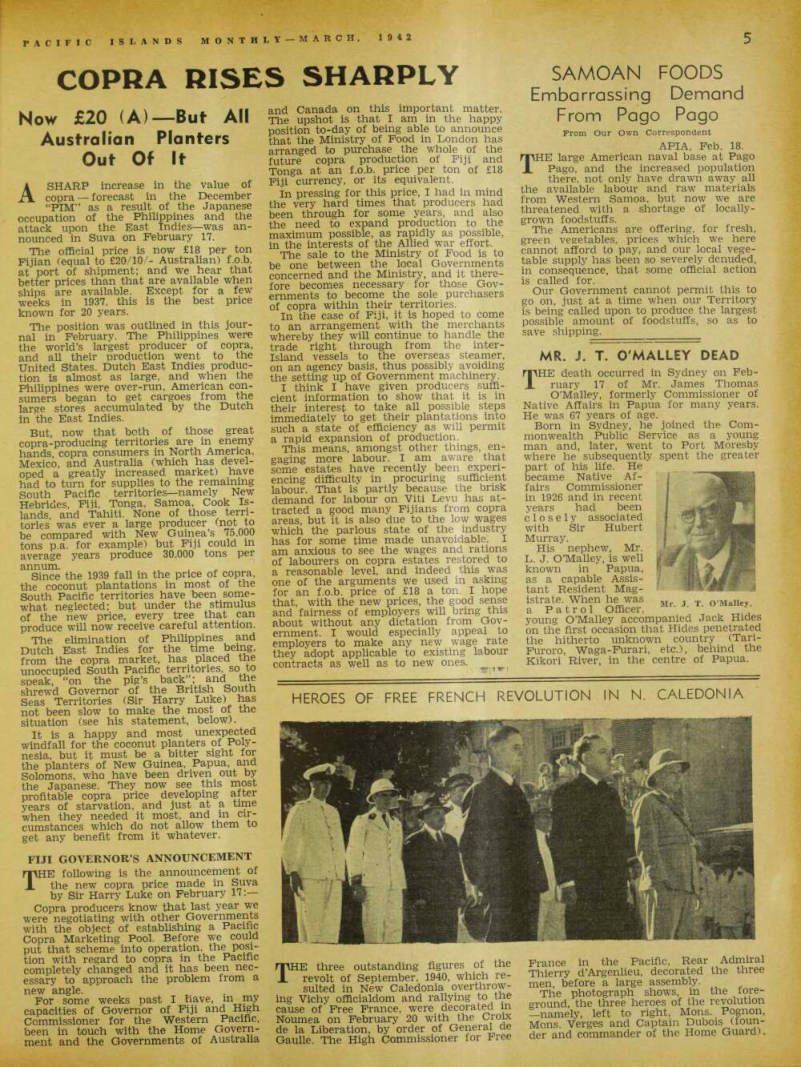
revolution
HEROES OF FREE FRENCH REVOLUTION IN N. CALEDONIA
in. rfoumea I PSJKS
the three
revolution
der and commander of the Home Guard).
Jungles ?
Fighting in N. Guinea Jungles ?
Some Guesses About What is Happening There
ALTHOUGH no official information comes from the interior of New Guinea, it is evident, from various signs, that some lively fighting is going on there, between the invading Japs and the New Guinea men who remained and enrolled in the defence forces, or were cut off.
The Japs in Malaya boasted of their prowess in jungle fighting. The Aust ralians in New Guinea may teach them something new about that art.
There are at least three considerable parties of experienced New Guinea men in the jungle—those from Rabaul, who are somewhere in New Britain; those from Kavieng, who are in New Ireland: and the Morobe men, who are in the mainland region behind Salamaua.
Reports from Berlin and Tokio, on March 16, indicated that the Japs, having landed at Salamaua, were planning to “infiltrate” through the jungle, and cross the island, so as to take Port Moresby in the rear. Already (purred Berlin) the Japs had met the Australians in the interior.
If that is the case, it will be: God help the Japs! The jungle trip from Morobe to Port Moresby, through incredible moun tains and trackless jungles, is so tough that only the most experienced Euro peans will tackle it. If the Jans could survive it, it would be a useless' column that eventually would arrive at Port Moresby.
The men who now form the militia of New Guinea, and who apparently are carrying on a jungle war against the in vaders, are highly experienced recruiters, traders and prospectors. They know the conditions, how to handle the natives and how to live on the country. They can be expected to create a European organisa tion and to train a jungle army of native scouts and fighters; and if the Japs try to occupy the interior of New Guinea or to cross the great island into Papua our jungle fighters probably will enjoy themselves thoroughly.
Actually, the Japs have no chance whatever of crossing New Guinea and attacking Port Moresby from the rear.
Their only hope is to work along the coast —from Salamaua south-eastward to Samarai, and from Samarai westward to Port Moresby, There is much anxiety in Australia for the safety of the men left behind in New Britain, New Ireland and Morobe.
Some of the elderly men, unaccustomed to roughing it, may be suffering con siderable hardship.
But if we know our Australians, it may be assumed that the young and middle-aged men are having the time of their lives. Probably, by now, they are organised under the leadership of men experienced in jungle life; they will have the assistance of the natives, and plenty of native food; they will be able to get a fair amount of European food stuffs and equipment from the stores they took with them into the jungle, and ■ from the many isolated plantations which will be thrown open to them; and their job will be to wipe out the Japanese wherever and whenever they find them They will suffer from lack of all sorts of “home comforts”. But, against that, they can set the knowledge that they are engaged on a great adventure and a valuable military job. We make a guess that remarkable things are happening in the New Guinea jungles, these days, and that our men will have some colour
ful stories to tell when the little yellow men are at last driven away.
Which would you rather be, Mr.
Reader—a business man in Sydney, try ing to hold your dwindling assets to gether, and driven half crazy by war time rules and regulations; or an Aus tralian irregular soldier, marching free in the New Guinea jungle, with a useful rifle and good companions, and an adventurous job to do?
G. and E. Officers
Garvey For Africa :: Fox- Strangways Awaits Orders
IT is reported that Mr. Ronald H.
Garvey, who went to Ocean Island from the New Hebrides in October to act as Resident Commissioner of the Gilbert and Ellice Colony, has arrived in Suva, en route to his new appointment in Nyasaland, Central Africa. He was in Ocean Island when the Japanese declared war, and he saw the fine new Residency there blown to pieces by a bomb on December 10.
Mr. Fox-Strangways, who arrived in Australia from Nyasaland in November, en route to assume office as Resident Commissioner in the G. and E. Colony and who returned to Sydney after being turned back in the Central Pacific, was seconded for service in the Solomons, and he had temporary charge of the de fence forces there. He at present is in Sydney, awaiting orders.
"War News"
Australian newspapers, publishing Pacific Islands war news daily, make all the usual faux pas in names and descriptions. A small Jap force landed at Kessa, in Buka (part of the Mandated Territory), whereupon “Japanese Naval Force in the Solomons", yelled a leading newspaper. The Japs occupied Finsch hafen, in New Guinea, and a Sydney journal said it was “60 miles west of Lae". The late Sir Hubert Murray was described as “a former governor of New Guinea”. And so on—and on.
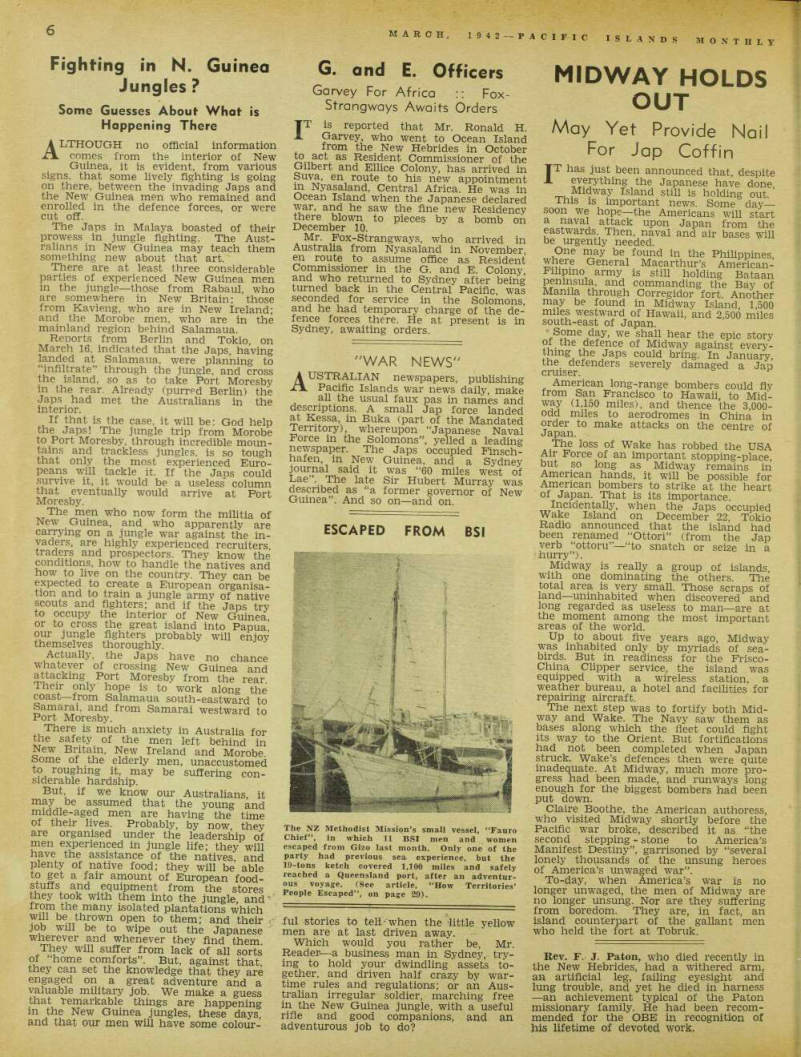
Escaped From Bsi
The NZ Methodist Mission’s small vessel, “Fauro Chief”, in which 11 BSI men and women escaped from Gizo last month. Only one of the party had previous sea experience, but the 19-tons ketch covered 1,100 miles and safely reached a Queensland port, after an adventur ous voyage. (See article, ‘‘How Territories’
People Escaped”, on page 29).
Midway Holds
Out
May Yet Provide Nail For Jap Coffin
IT has just been announced that, despite everything the Japanese have done Midway Island still is holding out This is important news. Some day soon we hope—the Americans will start a naval attack upon Japan from the eastwards. Then, naval and air bases will be urgently needed.
One may be found in the Philippines, where General Macarthur’s American- Pilipmo army is still holding Bataan peninsula, and commanding the Bay of Manila through Corregidor fort. Another may be found in Midway Island, 1,500 miles westward of Hawaii, and 2,500 miles south-east of Japan.
Some day, we shall hear the epic story of the defence of Midway against every thmg the Japs could bring. In January, the defenders severely damaged a Jap cruiser.
American long-range bombers could fly from San Francisco to Hawaii, to Mid way (1,150 miles), and thence the 3,000odd miles to aerodromes in China in order to make attacks on the centre of Japan, The loss of Wake has robbed the USA Air Force of an important stopping-place, but so long as Midway remains in American hands, it will be possible for American bombers to strike at the heart of Japan. That is its importance.
Incidentally, when the Japs occupied Wake Island on December 22, Tokio Radio announced that the island had been renamed “Ottori” (from the Jap verb “ottoru"—“to snatch or seize in a hurry").
Midway is really a group of islands, with one dominating the others. The total area is very small. Those scraps of land—uninhabited when discovered and long regarded as useless to man—are at the moment among the most important areas of the world.
Up to about five years ago, Midway was inhabited only by myriads of sea birds. But in readiness for the Frisco- China Clipper service, the island was equipped with a wireless station, a weather bureau, a hotel and facilities for repairing aircraft.
The next step was to fortify both Mid way and Wake. The Navy saw them as bases along which the fleet could fight its way to the Orient. But fortifications had not been completed when Japan struck. Wake’s defences then were quite inadequate. At Midway, much more pro gress had been made, and runways long enough for the biggest bombers had been put down.
Claire Boothe, the American authoress, who visited Midway shortly before the Pacific war broke, described it as “the second stepping - stone to America’s Manifest Destiny", garrisoned by “several lonely thousands of the unsung heroes of America’s unwaged war".
To-day, when America’s war is no longer unwaged, the men of Midway are no longer unsung. Nor are they suffering from boredom. They are, in fact, an island counterpart of the gallant men who held the fort at Tobruk.
Rev. F. J. Paton, who died recently in the New Hebrides, had a withered arm, an artificial leg, failing eyesight and lung trouble, and yet he died in harness —an achievement typical of the Paton missionary family. He had been recom mended for the OBE in recognition of his lifetime of devoted work.
Copra Grading In
Fiji
COPRA grading in Fiji—that perennial source of argument and vituperation —has broken out again. Now that Fiji finds itself suddenly and unexpectedly the chief copra producer of the South Pacific, the Government once more is trying to persuade the coconut growers that grading is all for the best.
Generally, the principle of grading seems to be approved; but there is a furious lack of agreement as to method.
The class who may be called the tough old planters object strongly to the plan under which the young men of the Department of Agriculture become the official graders. They say that grading by so-called experts, through eye and nose and touch, is not real grading; and why should the hard-working planter depend for his grade and price upon the personal copra predilections of Depart ment of Agriculture officials?
The Government, of course, asks the critics to name a better and more prac ticable system. The only way to correctly grade copra is to subject it to chemical analvsis—but such a process would be wearisome and expensive, and the system of grading bv expert officials works well enough elsewhere—in NG, for instance.
The “Fiji Times” has entered the lists with the reasonable argument that, as it is provided in the grading law that the oil expressed must not exceed 3 per cent, of free fatty acid, calculated as launc acid, some way of correctly ascertaining the free fatty acid content should be provided. “If”, says the newspaper, it was not intended to subject copra to a chemical analysis, it clearly was wrong to base the copra grade upon a specific reouirement.”
One sunnoses they will find a way out of the difficulty. For the moment, all that matters to the planter is that his copra is really worth something again, after all these years.
Mr. David Collins, of the British Colo nial Service, who was transferred from Fiji to the Gilbert and Ellice Colony (headquarters at Ocean Is.) last October, is in Sydney at present, awaiting orders.
Postal articles addressed to the follow ing residents of New Guinea (who are believed to be in Australia) have been sent to the “PIM” office. Union House, 247 George St., Sydney. If the gentlemen named will call or send their addresses, the articles will be forwarded. S. B.
Barker (Wau). Dr. Theodore Braun (Madang), J. D. Marshall (Rabaul), A. J.
Peadon (Upper Ramu).
World-War In The Pacific
First Phase Is Ended :: What Will Be The Next Development?
OINCE the "PIM" was published in February, the Japanese have captured and occupied Singapore; captured and occupied most of the Dutch East Indies, including Java; driven the British out of most of Burma and occupied Rangoon; extended their occupation of New Guinea from Rabaul to Lae, Salamaua, and Finschhafen.
The first phase of the Pacific war has ended. There is much specu lation concerning the form which the next phase may take.
WHAT JAPAN HAS DONE, AND HOW SHE DID IT
NOW that Japan has completed the conquest of the Netherlands Indies, the armchair strategists of the world are discussing the question of “Where to next”; and the concensus of opinion is that the Japanese will now strike southwards to Australia, with a view to destroying the bases from which an American attack may come.
It would appear that the first and most important phase of this Japanese-Pacific war has ended, and that a new phase is opening, in which the conditions of war fare will be very different, and from which we may confidently expect very different results.
It is clear now that the Japanese, hiding behind their apparent ineptitude in the Chinese war, had in the last four or five years been most carefully and meticulously preparing for this attack upon Britain and USA, and that they went to war on December 7 with a plan complete in every detail and with a new —and, as it proved, a most successful — technique for landing on and occupying large Islands territories.
A necessary part of this technique was that Japan should have undisputed sea power; and by a series of bold enter prises and extraordinary good luck, she secured control of the sea in the North west Pacific. Consequently, the invasion and subduing of Hongkong, Malaya, Philippines, Singapore, Borneo, Dutch East Indies, and New Guinea went exactly according to plan, and like clockwork.
New methods of transporting and land ing troops were put into operation, so that every party landed from a particular ship was a self-contained unit, and was not dependent upon other parties landing from other ships, which might be sunk.
As a result, troops were deployed imme diately they landed. Under our old system, troops from transports usually had to link with troops from other transports, before they could be deployed.
The Japanese have also developed new and successful methods of jungle warfare; and although their individual soldiers are very poor stuff, not comparable in any way with European soldiers, they nevertheless have robot enrage and they work exceedingly well, in their robot like formations, and they travel very swiftly, carrying only light equipment and a handful of rice.
It is apparent now that much of this was foreseen by the Allied Command after the Japanese attack commenced m Malaya and the Philippines, and we had lost command of the sea; and all our operations that have taken place since have been delaying operations—our com manders knew they could not hold the Islands territories, including the East Indies, against the overwhelming masses Japan was throwing into the campaign.
American Aid—When?
BUT, now, the situation has changed.
The Japanese have finished with islands (unless they turn south eastwards towards New Zealand), and they must face European troops based on land masses—largely American and Aus tralian forces in Australia, and British forces (supported by Indian and Chinese) in Western Burma and India.
Not only do the Allies now know exactly what they have to face, but also they are beginning to feel the benefit of the enormous forces which America is moving into the battlefield.
It was pointed out in this journal in December, immediately after Japan struck at USA, that it would be fool hardy to expect substantial American aid inside of six months. America was a peaceful democracy, unwilling and un prepared for war; and, although she will in the end prove to be the decisive factor, this great nation cannot change quickly from peace to wartime conditions.
Nevertheless, all the signs and portents indicate that the Americans are coming into the battle-line much more quickly and more efficiently than they did m 1917-18, and American help of a char acter that will halt the swarming little yellow men can be expected very soon, now.
Courses Open To The Japs
FOUR courses now appear to be open to the Japanese;— 1. —They may stand on their present line and proceed to consolidate their gains. After all, they have got the territories they wanted Indo - China, Thailand, Burma, Malaya, Hongkong, Philippines, Borneo, East Indies, and New Guinea —everything needed for the crea tion of that Eastern Asiatic empire of which they have dreamed. But they can not be such fools as to believe that they can hold all this territory unless they first defeat the United States. Therefore— 2—Continuing to employ their successful
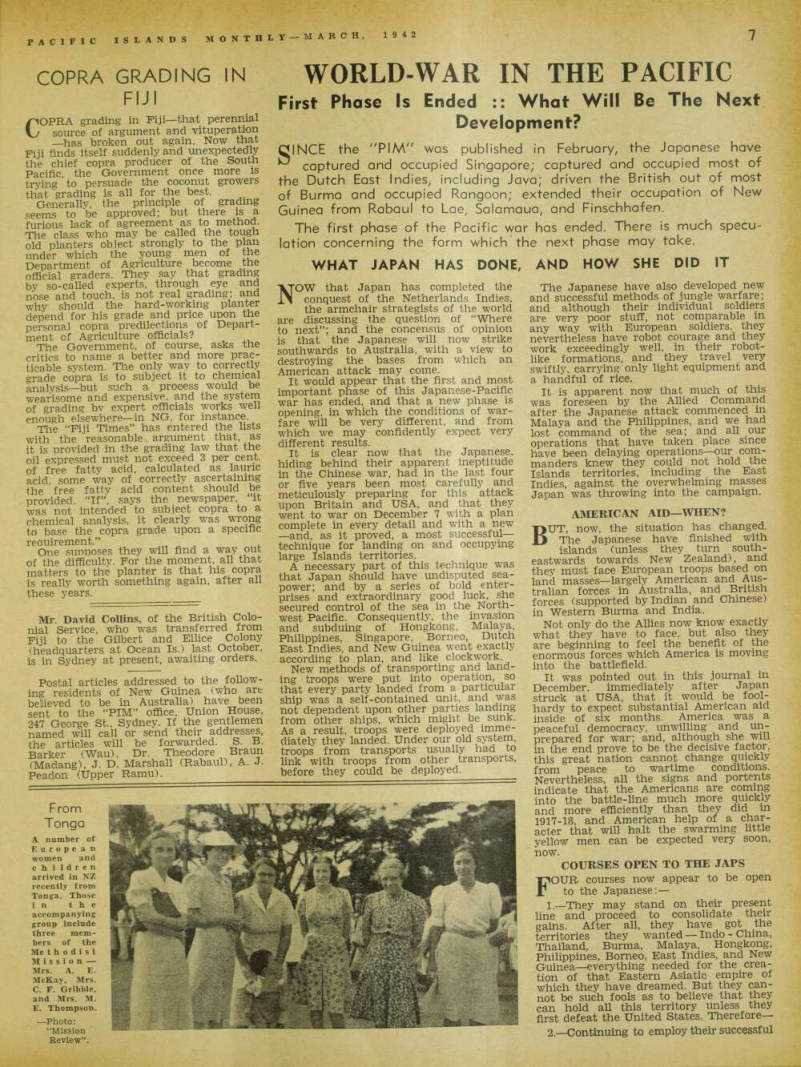
From
Tonga
A number of European women and children arrived in NZ recently from Tonga. Those in the accompanying group include three mem bers of the Methodist Mission Mrs. A. E.
McKay, Mrs.
C. F. Cribble, and Mrs. M.
E. Thompson. —Photo: “Mission Review”.
technique for overwhelming and occupy mg^lslands territories, they may strike south-eastwards, occupying successively the Solomons, New Hebrides, Fiji, Tonga, and (especially) New Zealand. Strategists immediately will say that this would be madness—they could not possibly hold such extended lines of communication.
But strategists said the same thing when the Japanese made their first southwards rush, and stretched their lines of com munication across 2,000 and 3,000 miles.
Their success may encourage them to stretch them out to New Zealand, in the belief that audacity will win and that they thus will be able to interpose an effective barrier in the communications between the United States and Australia. 3. —The Japanese may strike directly southwards at Australia. In this case, they will have to employ entirely new tactics, and meet conditions and forces of which hitherto they have had little experience. Ij; is possible that the leading American strategists, in their secret hearts, are praying that the Japanese will do just that very thing. 4. —The Japanese may not try to extend their southward thrust beyond the southern shores of New Guinea (or the northern shores of Australia) but, in stead, may concentrate all their power on a drive into India, in the confident belief that the masses of Indians will seize this opportunity to rise against British rule.
If the Japs adopted this latter plan, it would be done in collaboration with Hitler, who in the coming European spring, hopes to make a mighty thrust
down through the Balkans and Middle Asia, to join up with the Japanese in India. If this attempt is made, it will mean that Germany is confident of hold ing Russia and of standing up success fully to a powerful British attack on a new .i-.uropean front, yet to be opened up.
Our Fate Is In Europe
IT is probable that Japan’s grand strategy will await the events of the European spring and that, in the meantime, Japan will very actively proceed to consolidate her territorial gams.
If that should be so, the fate of our Pacific Territorities actually will be de cided upon the Russian front. If the con fidence of the Russians that they can cripple Hitlerism in this 1942 summer is justified, there quite easily might be a collapse of the war in Europe—in which event Japan would be “out on the end , a bough”. anc * a g°°d time would be had by all Americans and Australians.
Hut if Hitler should escape from the clutches of the Bear on the Russian — anc * would be wise to recognise that, in this respect, anything may hap pen—and be able to give effective help to Japan by a thrust from Europe, then the task before the Allies may be one of tremendous difficulty.
We people of the South Seas then would have to pin our hopes to the Americans, knowing that life here will be intolerable in the future, unless this swarming of a semi-human race from Japan is decisively smashed and driven back.
How Long Will Japs be in New Guinea?
MEANWHILE, what of New Guinea, Papua and the Solomons, our Pacific Territories which we have had to evacuate, and which now are partially occupied by the enemy?
Papua and the Solomons are still clear of Japs; but the latter regularly send reconnaissance planes—which are able to do a spot of bombing—from their Rabaul, New Ireland and Buka bases, over the Solomons, so that all ordinary activities there have been paralysed.
So far, only the Mandated Territory (Rabaul, Gasmata, Salamaua, Lae, Finschhafen, Kavieng, Buka and Kieta, and perhaps Wewak and Lorengau) have suffered Jap occupation.
There is nothing to indicate when we British may expect to reoccupy our Terri tories—but, when that time comes, it
most definitely will indicate the turn of the tide.
At present, clearly, the enemy intends to use New Guinea—and Papua, if he can get it—for operations against North Aus traha. When the tide turns, New Guinea wd l ° ne the drs t F’acific territories which the Jap will abandon— and his going will automatically clear Papua and the Solomons.
But much must happen before then so it would be wise to regard the three Territories as lost to us during 1942 If the Japs begin to occupy the Solo mons m force—there is no sign of it yet —that will be an event of significance.
It probably will indicate that they do not fear the American Navy, and that they plan a push down through New Hebrides upon the valuable territories of New Caledonia, Fiji and New Zealand
Eric Ramsden
Organiser of Pacific Islands Society Has Been Very III
HUNDREDS of Islands people will learn with regret that Mr. Eric Ramsden, honorary secretary of the Pacific Islands Society, Sydney, has suffered a severe breakdown in health, and has been obliged to resign, for the present, all business activities. He was responsible for the formation of the original Pacific Is lands Club; and, under his indefatigable care, aided by presidents like Dr. Hogbin, Mr. “Jock” Marshall and, in later years, Mr. Alfred Stephen, the organisation gained a wide membership and popularity and served a most useful purpose in bringing Islanders in Sydney into con tact with each other and with visitors from overseas. It is most unfortunate that Mr. Ramsden is laid aside just at a time when the Society could be of help to large numbers of Islanders, who have been driven from their homes to Aus tralia by war conditions.
It is understood that a new secretary will be appointed soon, to enable the
Club to resume its monthly meetings.
Meanwhile, friends of the Society will hope for Mr. Ramsden’s early recovery, so that he may resume his active interest in Pacific affairs.
They Object To "Japs"
WE are told that our new Asiatic enemies strongly object to being called “Japs”. We are asked to re member that they are the actual “Sons of Heaven”, and the chosen people of the earth, and should be referred to with respect. For a while, Axis radio stations tried to retaliate upon us by referring to the British as “Brits”—but it fell very flat. Persons writing to friends who are prisoners in Japanese hands would be wise, however, not to use the contraction in their letters; otherwise the letters will be destroyed.
Flight-Lieutenant Eric Griffiths, a New Zealander, was killed on February 23, when his plane crashed into a native bure on Vitl Levu Island, Fiji.
Tarawa
men still on
No Recent Information
THE fate of the European men who were on Tarawa Island, Central Gilberts, when the Japanese at tacked, is still unknown. The following note from a man with some special knowledge is helpful, however:— “As to what has happened to the folk on Tarawa your guess is as good as mine, ihe last I heard was in December. Then all were fit and well and enjoying liberty on the island—the Japs had come and gone away. I assume, from the recent American raid on the Marshalls and Puritan, that the Japs have not es tablished much in the way of forward bases in the Gilberts. So I imagine all the Europeans are still at large, but con fined to a diet of fish, fowl, coconut, eggs, pawpaw, taro, etc. s I understand that ‘Helena’ (Burns Fhilp schooner) was last seen being towed out of Tarawa by the Japs, loaded as never before with goods from the Burns, ‘Nimanoa’ (Government yacht) is on the reef, and blown up, I believe.”
So far as is known, the Europeans re maining on Tarawa include Dr. Steenson Dr. Isaac, Captain Holland and Mr’
English (Administration) Captain Har ness, Mr. Stead, Mr. Sinclair, and Mr Hunt (officers from “Nimanoa”) Mr Jenner, Mr. Clarke and Captain Handley (Burns, Philp and Co.). In addition, there are several well-known Euronesian people tnere who have European status They are mostly people of German-Marshall Islands descent, who were driven out of the Marshalls by the Japanese after the last war.
Carpenters' Cautious
Trading Firms'
Profits
Carpenters' Cautious Policy
DURING the month, shareholders in W. R. Carpenter and Co. Ltd. re ceived the following circular, dated February 27: “Owing to the uncertainty of the war position in the Pacific, the directors have considered it inadvisable to declare the usual interim dividend payable in March, and have therefore decided to deal with the full year’s figures at the annual meeting m six months’ time, when the position may be clarified, particularly as to the nature of the regulations relating to the limitation of dividends.
“The directors, however, wish to re assure shareholders that, notwithstanding the losses and damage sustained in the Islands, they consider that the capital of the Company is satisfactorily protected.”
At one time, most of the Carpenter assets were in New Guinea: and, had that arrangement continued, the firm would have been obliged to suspend operations.
During the past 10 years, however, the firm, while still holding large interests in New Guinea, has extended its activities into several other Territories and fields of industry, so that, to-day, although New Guinea, Solomons and Gilbert and Ellice are evacuated, its operations can continue actively elsewhere. Nevertheless, the now widespread character of the Pacific war must seriously affect the turnover of all the Pacific trading firms.
Advertisements & other items, p. 10 (1 item)
8
MARCH. 19 4 2 -PACIFLC ISLANDS MONTHLY
Cash Elusive
Papuans' "Impressment" Orders
WHEN bombs began to fall regularly in Port Moresby, and military officialdom made it clear that civi lians would be cordially farewelled, store managers were faced with a pretty prob lem They were in charge of thousands of pounds worth of merchandise—what could they do with it in an evacuation?
Some was looted, some was destroyed, some was taken by the military authori ties under “impressment”, and most was stored away, in the slender hope that, it may be kept safely, and restored to cir culation when the invaders are driven off.
The store managers leaped with joy when they got impressment orders—the army wanted the goods, the Common wealth would pay, and their worries were partly solved. Actually, their worries were just commencing.
One well-known Port Moresby com mercial man, who arrived in Sydney with a pocketful of impressment orders, de clares that he has been referred, in vain, to every Federal Department in the city; and now he thinks that, if he is ever to get the Commonwealth cash, he must go to Canberra and roost indefinitely on the steps of the Treasury.
Suspended For The Duration
Duration
THE following formal notifications tell their own story:— Australasian Petroleum Company Pty.
Ltd. (which has been carrying on ex tensive oil prospecting in Papua, and whose drill at Kariava was down oyer 5 000 feet) reports: “We have suspended all operations in Papua and New Guinea”.
Sandy Creek Gold Sluicing Ltd., New Guinea, reports: “The Company’s New Guinea manager, Mr. W. Johnson, has arrived in Sydney and has confirmed advice previously received unofficially. By order of the Administration, gold recovery operations ceased towards the end of January and the staff left the properties.
Gold on hand could not be brought away’.
Bulolo Gold Dredging Ltd., and New Guinea Goldfields Ltd., formally closed down on January 26. Actually, operations ceased on January 21, when Lae and Salamaua were “shot up” by Japanese aeroplanes.
Dependants of Territories Civil
Servants
THE following is from the official report of the House of Representa tives, Canberra, on February 25: Mr. Anthony: I desire to address to the Prime Minister a question relating to the position of the dependants of officials of the New Guinea and Papua Administrations who have been com pelled, as the result of the Japanese invasion, to leave those territories. Many of the members of those Administrations have joined the New Guinea Voluntary Defence Forces, and some of their dependants, who are at present in Aus tralia, are practically destitute because of the insufficient provision for making payments to them. Will the Prime Min ister take immediate action to place the payments to those dependants upon a satisfactory basis?
Mr. Curtin: That matter has been receiving attention and action has been taken in some instances—those which have come to the notice of the Treasurer.
The whole matter has been looked at as one deserving of, not only sympathetic consideration, but also urgent considera tion.
Colony
Solomons and G. and E.
Colony Offices Opened in Sydney
OFFICES for the despatch of business relating to the British Solomon Is lands Protectorate and the Gilbert and Ellice Islands Colony—both of which are under the jurisdiction of the High Commissioner for the Western Pacific (Sir Harry Luke), Suva—have been opened in Sydney.
Mr. F. E. Johnson (Treasurer of the Solomons Administration) has opened an office at Ocean House, 34 Martin Place, Sydney (Telephone B 1710), for the trans action of BSI business.
Mr. S. G. Clarke, Treasurer of the Gilbert and Ellice Colony, who recently has arrived in Sydney from Ocean Island, has opened an office, for the transaction of G and E Colony business, in Bank of New Zealand building, George Street, Sydney.
Both offices, of course, maintain com munications with Suva.
In consequence of the evacuation of the two territories, the tremendous dis turbance of administrative and commer cial machinery, and the presence in Australia of so many evacuated officials and civilians, there is plenty of work for the two Administration officials.
New Guinea and Papua
OFFICES for the transaction of business connected with the evacuated Ad ministrations of New Guinea and Papua have been established in Sydney.
Papuan officials have an office on the Bth floor of the Grace Building, York Street, Sydney—no telephone.
New Guinea officials are using the offices of New Guinea Trade Agency, Grace Building, York Street, Sydney— telephone MA 1280.
The NG Trade Agency, now attending to the inquiries of thousands of evacuees, has been obliged to use so large a staff that it could not be accommodated in the Commonwealth Bank, and it was moved, in February, to Grace Building.
Commercial Firms
work”, in connection with Vy their organisations in New Guinea, Papua and Solomons, is being done by Burns, Philp and Co. Ltd. and W. R.
Carpenter and Co. Ltd. at their head offices in Sydney, where key men from their various Islands branches are located, at present. .
Steamships Trading Co. Ltd., who operated a chain of stores, trading sta tions and plantations throughout Papua, and controlled much transport, are opera ting, for the present, at the offices of their Sydney agents, Nelson and Robert son Ltd., Spring Street, Sydney. Both Captain A. S. Fitch, managing director, and Mr. E. V. Crisp, director, are there Mr. E. J. Frame, manager of the British New Guinea Development Co.
Ltd., of Port Moresby, has been accom modated in an office by Burns, Philp and Co. Ltd., Sydney, where he is attending to his Co.’s affairs.
Rev. R. J. Maddox, Methodist mission ary of Faleula, Western Samoa, intends to retire from active work in the Pacific Islands mission field next year.
Mr. David Norman Trenery. manager in Australia and New Zealand for the Atlas Assurance Ltd., of London, died m Victoria last month. This company has a controlling interest in the Pacific In surance Co., of Fiji, and Mr. Trenery was a frequent visitor to Suva and other Central Pacific towns.
Compensation
Various Plans For Insurance Against War Damage
IN an article on page 11, an attempt is made to estimate, roughly, the amount of economic loss, actual and potential, which the Japanese war has brought to the Pacific Territories.
It should be noted that all the British Pacific administrations are trying to es tablish compensation funds, on a war risk insurance basis, from which persons suffering loss by war may receive some compensation.
Australia has done it simply by com pelling all owners of buildings to insure, and giving owners of all property other than buildings, the option of insuring, at a flat rate of 8/- per cent. Property owners in North Australia, Papua and New Guinea have been allowed to enter this insurance fund, and to make their insurances retrospective to January 1, which means that those who have suf fered losses through the Japanese attacks will be compensated to the full extent that the fund permits. But they may have to wait a long time, before they know the amount of their compensation.
Canberra, in February, announced that compensation for damage will be payable after the war, but the War Damage In surance Commission is empowered to pay up to £5O in cases of immediate distress, pending investigation of claims. Coconut trees on New Guinea plantations, des troyed or damaged in enemy raids, come within the scope of the insurance scheme.
Fiji
THE Governor of Fiji, on January 9, set up a Committee to plan a system of insurance of property against war damage, and he announced on February 16 that a plan for Fiji was well advanced, and would be submitted for London’s ap proval. It would be retrospective to January 1. , The Fiji Committee, on February 16, said the plan which it had recommended to the Government provided; War dam age cover available only to those persons holding fire insurance policies, and the war damage indemnity limited to the amount covered by the fire insurance policy on the identical interest.
Sir Harry Luke, in his announcement, dealt only with Fiji, which has not yet suffered war damage. It is presumed that he, as High Commissioner for the Western Pacific, will seek a similar plan for Solo mon Islands, Gilbert and Ellice Colony, New Hebrides and Tonga. There already has been considerable war damage in the two former territories, and it is sur prising that no announcement has been made.
Advertisements & other items, p. 11 (1 item)
Your Wropper !
Look on the Front of
The figures stamped there (if any) show the date when your subscription expires. This date will appear on wrappers of three Issues preceding expiration, thereby giving three months’ notice.
If, at the end of that time, we have not been instructed to continue to send the Journal to you, it will be discontinued.
Your subscription (8/- per annum, or 10/- In the case of countries outside the British Empire —which includes postage) may be sent direct, or may be paid to any of our agents (listed on Page 3).
The postage required for this issue is:— To Australia and New Zealand IVfed.
To United Kingdom, via All-sea route .. IVfed.
To other British Possessions 2V2d.
To USA and Foreign Countries 3%d.
PACIFIC PUBLICATIONS PTY. LTD.
Union House, 247 George St., Sydney.
Captain William
Michie
Killed in Darwin by Jap Bomb
ALL people connected with the Terri tories of the Western Pacific learned wi , th dee P re gret, early in March,’ that when the Japanese bombed Darwin on February 19, they killed Captain Wil liam Michie, one of the best known and probably the best-loved of the Burns, Philp skippers.
Captain Michie was born in Aberdeen 56 years ago; he was educated at Murray House, Edinburgh; he came to Australia in 1913; and he joined the BP service, as second or third officer, in 1917. He served, since then, on practically every one of the Burns, Philp ships; and, for many years past, he has been one of the big firm’s most reliable and trusted com manders. He was best known in New Hebrides, Solomons, New Guinea and Papua.
He will be remembered for at least two remarkable performances. When the Vulcan and Matupi volcanoes threatened to overwhelm Rabaul in May, 1937, a radio was sent to Captain Michie, on the “Montoro”, up near Kavieng. He hurried south, lay off the Nodup beach, and took aboard an extraordinary number of evacuees, whom he landed safely at Kokopo. He should have received a dec oration for what he did on that occasion, but he was not even publicly thanked In January, 1938, when in command of the “Macdhui”, he was responsible for a rescue at sea that is unique. A Miss Buckingham was missed from the ship, and Captain Michie went back over his own track; and 21 hours later, about 17 miles away, they found the woman, afloat, and still alive.
Captain Michie, who leaves ja widow and a son, transferred to the ship on which he met his death only a few hours before she sailed.
The Skipper Hated Japs
By R. W. Robson
IMADE a round trip on the “Macdhui”, just before war broke out, and I lived with Captain Michie under the bridge in what is called “the captain’s spare cabin”. I had travelled with him on other occasions; but I saw much of him in 1939, and I found him one of the most lovable of men.
There is irony in his death, insomuch that, while reserved on most subjects, he was fiercely outspoken on the subject of the Japanese, their ceaseless south wards infiltration, and their stealthy spy ing around the Islands. He knew what was coming and, because I had been shouting vainly for years about the Jap menace, he spoke freely to me.
As we left Rabaul harbour in August, 1939, I was with him on the bridge, and he took his ship close by a small, white, Japanese vessel. She was a mysterious craft —she was not a trader, and she was trim and Navy-like in appearance, and filled with young Japs of a naval type even at that moment, they were swarming through Rabaul’s avenues, kodak-ing everything in sight. No one knew what the ship was doing there.
The skipper regarded her sourly. “I’ll bet she’s got secret guns, and a load of torpedoes” he said, and pointed out cer tain curious things in the ship’s con struction. “They’ve been away at the back, surveying and charting. We'll wake up to it, when it’s too late.”
Prophetic words! William Michie paid with his life for our blindness and stupidity.
He knew what was coming. He was a staunch Presbyterian and a clean mouthed man; but I remember with
pleasure the strong, salty words of the sea which he applied to the name of Robert Menzies, when that gentleman’s Australian Government put wharf lab ourers in gaol for refusing to load scrap iron on vessels bound for Japan.
Captain Michie had three loves—his home, his golf and his motor-car. The proudest moment of his life was when he got second place in a Centenary motor-race from Sydney to Adelaide Every evening, when I sailed with him in 1939, there was a solemn ritual. The skipper would tenderly collect his clubs march out onto the boat-deck, take his careful stance, and whack mightily and meticulously at a tethered ball. He knew the tricks and hazards of every Islands course.
He had few social graces—but he was a good-living, frank-spoken, hard-work ing Scotsman, an able commander and a splendid seaman, highly esteemed—the kind of man who can ill be spared.
Captain J. F. Spring Brown, retired commodore of the Union SS Company, died in Sydney in January at the age of 68. For many years, before he left the sea and settled down at his home in Rose Bay, NSW, in 1935, he was on the Sydney-Vancouver run, calling regu larly at Fiji. One of his last commands was the RMS “Aorangi”.
New Guinea Pygmies
There are tribes of pygmies in the ranges of the northern watershed of the main island of New Guinea. In this unique photograph, taken by Rev. P. Deutscher, of the Finschhafen Lutheran Mission, another Lutheran missionary (Rev. G. Bergmann) is seen in a Boana Moun tain village with one of the little men; and. between them, there is a dwarf. Dwarfs are not unique, but a pygmy dwarf is something unusual.
I n this connection , it is worth noting that Lord Moyne (otherwise Guinness, of the famous stout) has been dropped out of the Churchill Government, after a short reign as Colonial Secretary. it was Lord Moyne who went “ex ploring along the north coast of New Guinea about 1936, and who subsequently and com placently claimed that he had “discovered” a race of pygmies hitherto unknown to science.
That well-known missionary and anthropologist, father Kirschbaum (subsequently killed in an aeroplane accident) challenged the claim of the British and was able to prove that he (Kirschbaum) had found the pygmies and des cribed them in a scientific magazine some years earlier.
Preparations
Ready!
New Caledonia's Grim Preparations
From Our Own Correspondent
T Noumea, Feb. 20.
H E people of New Caledonia are quietly and grimly making all prep arations commensurate with their knowledge that this Colony (long coveted may at any moment be in the The provisioning of the Colony to a greater extent from its own resources is being prepared—also the replacement of motor by animal traction, where possible as motor vehicles are in demand for other purposes. Passenger “transport in com mon is being introduced in Noumea and suburbs, where air raid precautions have been organised. ■ Almos S every man not in the services is enrolled in the Home Guard, whose section commanders are occupied with organisation details. A decree makes it plain that any person acting actively or passiyeiy against those in authority will be “dealt with”.
These and other decisions meet with genera! approval, town and bush being sohdiy behmd our silent, hard-working High Commissioner.
Hi a broadcast, Governor Sautot said: The battieground which this island may possibly become is part of a gigantic en semble, throughout which the defenders of human liberties and Christian civilisa tion are confronted by the foes of all liberty and all religion. In this fight, we can count on our allies, who every day are reinforcing the different zones of Pacific combat.”
The Yellow Peril In
Papua!
AUSTRALIA’S Pacific Territories have suffered an invasion by yellow men from the north, and yellow journa lists from the south —and both are hard to bear.
While the Japs have been dropping bombs, “our special war correspondents on the North Australian front”—cow re porters in peace-time—have been shooting masses of blurb into the helpless folk in Australia.
They perhaps can be forgiven for telling Australia’s generals how to win the war —“New Guinea must have more inter ceptors”; “it is imperative for New Guinea to stand”—they have to send something to their bawling news editors; but when they begin to rhapsodise about Islands conditions, they become a sort of irrita ting entertainment.
One gentleman, for instance, refers to the proclamation which put Port Moresby under military rule, and proceeds:— “It would have been the end—even had the Japs not done some bombing first—of the heyday of the Islands, the long afternoon cocktail parties, the visits of rich planters, the easy, well-paid life of the white man in the tropics. For to day, the Islands are no longer glamorous.
The palm trees, the natives with frangi panni and hibiscus in their hair, the flowering poincianas, and the coral are still there. But the atmosphere is gone.”
That “easy, well-paid life” —how about it, Mr. Loudon, or “Gappy” Fitch, or Mr.
Frame, or Mr. Jewell? “Glamorous Is lands” —he should see Port after a six months’ drought! “Natives with frangi panni and hibiscus in their hair”—we really must be coarsely Australian, and say “Gripes!”.
Advertisements & other items, p. 12 (1 item)
10
MARCH. 1942-PAOIFIC ISLANDS MONTHLY
Pacific Territories
What War Has Done To South
Survey of Our Losses and Some Probabilities
An attempt is made in this article to assess the present military, strategical, administrative and commercial position in those South Pacific Territories which have been directly affected up to date by the southwards drive of the Japanese.
DURING the past month the following
events and developments have been officially announced:— Feb. 18.—RAAF reconnaissance reveals much enemy shipping in Rabaul.
Feb. 19.—RAAF raids Rabaul.
Feb. 24.—Enemy aircraft drop 70 bombs on Pt. Moresby. Damage unimportant. One killed; 5 injured.
Feb. 24.—R)AAF bomb Japs in Rabaul.
Feb. 25.—RAAF heavily raid enemy in Rabaul.
Feb. 27. —RAAF bomb enemy in Rabaul.
Feb. 28.—RAAF bomb enemy at Gasmata.
Feb. 28.—Japs drop 100 heavy bombs on Pt.
Moresby: but little damage and few casualties.
March 2.—Single Jap plane drops bombs on Tulagi (Solomons).
March 3.—Pt. Moresby heavily bombed by 15 Jap planes.
March 4.—Two small-scale moonlit raids by Japs on Pt. Moresby.
March s.—Jap bombers raid Lae and Bulolo, New Guinea. No casualties at Bulolo, but BGD installations were heavily damaged.
March 7.—Ten Jap bombers raid Pt. Moresby.
March B.—Jap troops land and occupy Sala maua, New Guinea. Later, warships and planes heavily shell Lae, which is then occupied by Jap troops. Landings are on large scale, protected by 4 cruisers and several destroyers.
March B.—RAAF bombers heavily attack Jap ships at Salamaua, scoring direct hits. All planes returned.
March B.—Ten Jap bombers raid Pt. Moresby.
March 10. —Jap planes attacked Buna (North east coast of Papua).
March 10. —Jap forces land and occupy Fin schhafen, 60 miles east of Lae.
March 10 and 11.—Heavy RAAF raids on Jap forces in NG—7 enemy ships damaged.
They indicate, as forecast in the “PIM” in January and February, that the Jap anese, advancing step by step, are making preparations to strike at Pt. Moresby, with a view to destroying that advanced Australian base, and of closing up the Torres Strait seaway between Eastern Australia and the United States on the one hand, and British India on the other.
The attacks on Darwin, Wyndham and Broome, in north-west Australia, may be
regarded as part of Japan’s general
strategical plan of destroying or hindering
all communication between North America and British India.
The military position in the different territories may be set out thus: —
Northern Australia And Dutch
NEW GUINEA—The Japs have made severe raids on various points but have not made any attempt at invasion. It is
possible that they will attempt invasion,
but only with a view of holding certain important points, so as to interrupt our communications. All civilian activities have now ceased, and North Australia is under military rule.
PAPUA (South-eastern New Guinea) All civilians have been evacuated, and the Territory now is completely under military administration. Fort Moresby is believed to be strongly held by Australian and Allied forces. An attempt by the Japanese to occupy some of the islands in Eastern Papua is expected, but nothing has been attempted up to March 11.
NEW GUINEA (that is, north-east section of New Guinea, New Britain, New Ireland, Admiralty Islands, Buka and Bougainville)—Having seized Rabaul on January 22, the Japanese landed forces estimated at 10,000 and then very slowly and cautiously began to thrust south wards They occupied Gasmata (southern coast of New Britain) and from that point they made air raids on Port Moresby
and, once or twice, on Samarai. On March 8 they thrust further westwards, and occupied Salamaua and Lae. Japan ese apparently are in occupation at Kavieng (northern point of New Ireland), Kieta (a small centre in Bougainville), and Lorengau (Admiralty Islands). No landings by Japs are reported on the north coast of the mainland, at Madang or Wewak, but those places are within the enemy’s patrol zone.
SOLOMON ISLANDS Practically all civilian population evacuated, but the group is still under the administration of the High Commissioner for the Western Pacific, whose headquarters are in Suva.
Very few officials remain. The position generally is obscure. A handful of mis sionaries refused to be evacuted, but most of them are now safely in Australia or NZ. Japanese planes occasionally come over and bomb Tulagi and other centres, but no attempt at occupation is reported.
Gilbert And Ellice Islands
COLONY AND NAURU—It appeared in January and February that the consider able European population of Nauru and Ocean Island (mostly British Phosphate Commission staff) were cut off from any hope of rescue—the Japanese being ap parently all round them—but it became known early in March that the position is not hopeless, and better news is anticipated. The Japanese have not occupied Nauru or Ocean Island —which is surprising, in view of the fact that they so ardently covet the large reserves of phosphate rock on those is lands—but they have occupied the most
northerly islands of the Gilbert Group— Butaritari and Abaiang.
New Caledonia, New Hebrides,
Fiji, Tonga, Western Samoa—Al
though a good many women and children have left those territories—for the most part, voluntarily—conditions of life in most of them are normal, and adminis trative and commercial activities are pro ceeding much as usual. As a matter of fact, the sensational rise in the value of copra during recent weeks has done much to stimulate commercial activity throughout Polynesia.
Probably, the island most in danger at the moment is New Caledonia. It is well
known that Japan is eager to own this island, not only owing to its great mineral resources, but also because of its strate gical position. It is only 700 miles from the Queensland coast. However, the Jap anese dare not attack New Caledonia until they first occupy the Solomons and New Hebrides.
Cook Islands. Tahiti, French
OCEANIA Conditions fairly normal * copra trade very good.
Ng Administration Smashed
WITH the landing of the Japanese at Salamaua and Lae, the large and valuable Mandated Territory of New
Guinea may be regarded as having passed into enemy occupation.
The civil administration is gone entirely Whatever administration still functions in out-of-the-way places—such as, perhaps, along the northern coast —is under Australian military direction.
The Japanese invasion was so sudden that it was not possible to evacuate the civilian population (men only) from the New Britain and New Ireland areas, and it is believed that several hundreds of Europeans from Rabaul are now with the remnants of our armed forces, somewhere in the New Britain jungle west of Rabaul; while another large party of Europeans— officials, planters, and soldiers—from the New Ireland district, are in the jungle in the vicinity of Namatanai. Even if it is not possible to send ships to bring these people away to safety, it may be expected that they will maintain themselves for a long time in the jungle and that, as opportunity offers, they will escape southwards in small parties.
Although most of the civilians were successfully evacuated from the western end of the New Guinea Territory—espec ially the Morobe goldfield—the fact remains that the personnel of the NG Administration was smashed up in a tragic fashion. As far as can be ascer tained, the following is the fate of the heads of departments:— The Administrator (Sir Walter Mc- Nicoll), who was very seriously ill at Lae when the Japs struck, was eventually taken to Sydney, where he is making a satisfactory recovery.
Mr. Harold Page, Government Secretary and Deputy Administrator, has not been seen since the Japanese occupation of Rabaul.
Mr. H. O. Townsend (Treasurer) and Mr. G. G. Hogan (Crown Law Officer) were both in Rabaul when the Japanese struck, and their fate is unknown.
Mr. R. Melrose and Mr. E. Taylor, of the District Services Department, nave bom escaped. Mr. Melrose is in Australia and Mr. Taylor in Port Moresby.
Mr. E. P. Holmes (Department of Lands) was in Lae when the disaster oc curred, and he somehow managed to reach Wau, and thence was evacuated to Australia.
Mr. George Murray (Department of Agriculture) who returned to Rabaul from sick leave only a few days before the Japanese invasion, was last heard of in Rabaul and is believed to be in the jungle with the other Europeans.
The fate of the majority of New Guinea’s public servants is unknown.
They mostly are in the jungle.
Grave Economic Losses
WITH the practical abandonment of New Guinea to the enemy, it is possible to have a rough stock taking, and to form some estimate of the enormous losses suffered by com panies and individuals mostly Aust ralians —operating in New Guinea. They are approximately as follow: — PLANTING—The capital value of the coconut plantations in the Mandated Ter ritory is approximately £2,000,000. It is un likely, of course, that these plantations will be destroyed—when the invaders are driven
out the owners will be able to resume possession. In the meantime, plantations will “go bush” and suffer deterioration through lack of attention; all native labour corps will be broken up and lost; plantation houses in many cases will be destroyed and the majority will be looted, if not by the enemy, then by the uncon trolled natives, and all plantation equip ment, gardens, etc., will either deteriorate or be destroyed. It may be taken as cer tain that every plantation owner will suffer some considerable loss.
MINES —The whole of the mining population was hurriedly evacuated from the Morobe goldfield and from the smaller goldfields behind Wewak. As reported elsewhere, the Commonwealth Govern ment will fully protect the rights of the mining companies and miners, but the whole of the very valuable equipment has been simply left unattended, and it will suffer grave deterioration, mostly from rain and floods. Mining equipment requires constant supervision, especially things like water races.
The big companies, like Bulolo Gold Dredging Ltd., New Guinea Goldfields Ltd., Koranga Sluicing, Sandy Creek Gold Sluicing Co., and so on, have had to abandon huge quantities of valuable material and, if their absence from New Guinea should extend to 12 months — which is quite likely—their losses will be enormous. In the report of Bulolo Gold Dredging Ltd. for the year just closed, the value of dredges, dredge equipment, aeroplanes, hydro-electric plant, general plant, buildings, etc., is shown in the balance sheet as 8,088,081 dollars—and this probably is a conservative estimate.
It is hard to make a guess—but prob ably the value of the mining equipment which has been left in New Guinea is not less than £4,000,000 Australian. Gold worth from £1,500,000 to £2,000,000 was being produced every year in NG—and
the interruption of this production is in itself a grave loss.
STORES AND TRADING —There were two big companies (Burns, Philp and Co.
Ltd., and W. R. Carpenter and Co. Ltd.) trading in New Guinea, and many smaller concerns, and their annual turn-over was enormous. Commercial firms and traders owned valuable buildings and stocks not only in such places as Rabaul, Wau, Salamaua, Lae, Madang, Kavieng, but also in a couple of scores of smaller centres. All these places, including in most instances valuable stocks, have been abandoned to the enemy.
While it is possible that in the majority of plantations something will be left for the returning owner, it can be taken as certain that the enemy will loot every store and workshop in the various little towns. All this may be regarded as a total loss. It is likely also that the natives —especially the sophisticated, European ised natives —finding themselves out of European control, will indulge in an orgy of looting. They will carry off anything that the Japanese do not take.
TRANSPORT Transport in New Guinea was provided first by ships run ning between Australia and the Territory —all of which are believed to have been saved; secondly, by fleets of aeroplanes, owned by Guinea Airways Ltd., W. R.
Carpenter and Co. Ltd., and a number of smaller concerns. Some important units of these airfleets have been saved, but a considerable proportion were destroyed by the Japanese, mostly at Lae, Salamaua and Bulolo.
In addition, the big companies owned small vessels which traded between the various islands; and traders and planters generally had hundreds of small boats— schooners and launches —with which they maintained communications. A consid erable proportion of these craft are be lieved to have been lost. Wherever
possible, of course, planters and traders have hidden their schooners and launches.
Industrial Enterprises There
are a couple of desiccated coconut fac tories in New Guinea —an important one owned by W. R. Carpenter and Co. Ltd. at Pondo and another at Lindenhafen— and it is feared that these places will be destroyed.
The sawmilling industry had been making rapid strides in recent years and sawmills were located at several points
around New Britain. It is presumed that these establishments also will fall into the hands of the invaders.
It is very difficult to form any estimate of the economic losses which we have suffered in New Guinea, but the following may be an approximation:— Coconut plantations .. .. £2,000.000 Mining equipment 4,000,000 Loss of gold output for one year 1,000,000 Trading stores and stocks, say 1,000,000 Sea and air transport and equipment, say 750,000 Desiccated coconut factories, sawmills, etc., say .. .. 500,000 Total £9,250,000 That probably is an under-estimate.
The loss to the owners will be covered by the New War Risk Insurance funds established in Australia.
Position In Papua
WHEN we come to Papua, the outlook is not quite so bad. It is true also that all civilians have been with drawn from this territory, which is now under military rule, and that no com mercial activity worth noting is proceed ing. But, at the moment of writing, the Japanese have not invaded Papua and plantations, stores, mines, etc., are not yet in enemy hands, and there should be a better chance of saving movable property.
The position in Papua, however, is that all Administrative officials —except a few kept especially by the military—have been withdrawn, all commercial establish ments have been closed, all mines have been closed down —and this includes the drilling plants which were seeking min eral oil in Central Papua. The industries of Papua which are now menaced by the enemy may be shown thus: — Coconut and coffee plantations.
Rubber plantations.
Stores and trading establishments.
Sea transport equipment.
Gold mining equipment (Kokoda, Misima, etc.).
Oil drilling equipment.
All these valuable assets need not yet be regarded as lost; but if the Japanese should invade Papua in any force, a large proportion of them, probably running into millions of pounds, would have to be written off.
The Solomons
THE position, in the Solomons is some what similar to that in Papua. Most of the administrative machinery and practically all the planters have been withdrawn and the Solomons basic in dustry—namely, coconut growing—is in process of deterioration. There are few, if any, Japanese in the Solomons, as yet —their activities seem to be confined to visits by reconnaissance planes but plantations properties will suffer damage from uncontrolled undergrowth and loot ing natives.
Most of the store managers have been withdrawn and, as far as is known, con siderable stocks were destroyed in the abandoned stores. If remaining stocks are guarded by loyal natives, they need not be regarded as a write-off unless the Japanese actually come and loot. The amount of loss in the Solomons will de pend largely upon the extent of the Japanese invasion of that group.
There is no indication, as yet, of how owners are to be compensated for losses in this and other British territories. They do not come under the Australian plan.
Nauru And Ocean Island
IN both of these islands, there are masses of very valuable machinery and equipment, assembled during the last twenty years, for the purpose of
working the enormous phosphate deposits.
The position in relation to this plant and equipment is not known. The Jap anese do not appear to have occupied either of the two islands, but it may be taken as certain that, if they do, they will find that the plant and equipment have been entirely destroyed. This would represent a loss to British interests of at least £1,000,000.
Gilbert And Ellice Islands
WHEREVER possible, members of the very small European community in this colony were evacuated before the Japanese struck, although a few were taken prisoner. It is known that the Japanese occupy the most northerly is lands (Butaritari and Abaiang).
The only property of any value in the colony comprised the stores of the trading firms (Burns Philp (SS) Co. Ltd., and On Chong and Co. Ltd.), a few small vessels, and coconut plantations, owned almost wholly by the natives. Therefore, the economic loss in this section of the colony is not serious.
Rev. and Mrs. E. L. Sykes, Presbyterian missionaries at Malo, New Hebrides, are at present in Sydney. Mrs. Sykes will not be returning to the Condominium, owing to a recent serious illness which necessi tates her residence in Australia for some time.
Miss Florence Taylor, daughter of a Methodist missionary who spent the early years of her life on a Mission station in New Britain, has achieved a measure of fame in Australia in recent months, Possessing a delightful contralto voice, she was “discovered” by a radio amateur talent quest last year and since has had endless broadcasting and theatre engage ments in all States of the Commonwealth.
She is only 20 years of age.
Advertisements & other items, pp. 13-16 (1 item)
George Brown & Co.
MILITARY GOGGLES
For perfect protection against GLARE, WIND, and DUST. The strong and comfortable frames are fitted with scientifically-designed WILLSON, or CROOKE’S Lenses, and have ventilated leather side shields. Supplied in strong metal cases.
WILLSON Lenses, 15/-. CROOKE S Lenses, 9/6.
Other types with Crooke’s Lenses, 5/6, 6/6 pair.
Our finely illustrated coloured Catalogue will be forwarded by return post on application.
ON PARLE FRANCAIS
««n n#rv ¥ TT> PITT & KING STREETS,
PROUDS PTY. LTD. SYDNEY
s?
E M A Ti U sr /
REA
MULTI - VALVE
BANDS
POWERFU
Used by • Commander R. E. Byrd on his South Pole Expedition. • Official Australian Adviser to British Broadcasting Commission. • Mr. R. N. Shaw, Editor Short-wave Section “Wireless Weekly”. • Mr. L. J. Keast, Editor Short-wave Section “Radio World”.
There is not a better radio obtainable.
AC & BATTERY MODELS
Full particulars from
GEORGE BROWN & CO.
Electrical Engineers
PTY. LTD.
267 Clarence Street, Sydney, N.S.W.
PHOTOGRAPHY
has a
War-time Job !
SNAPSHOTS
froßlhSme
... a cheerful stimulating job, keeping up spirits at home and abroad.
Studio portraits for those at home . . . welcome snapshots - from - home for our service men abroad—are both bringing distant ones closer! □b: I mu i"" 1 mu nun The nation has here in Australia a photographic factory producing supplies for both defence and home needs.
KODAK (A/asia) Pty. Ltd.
Branches in all States.
PACIFIC ISLANDS SOCIETY
Visitors from the Islands to Sydney (or those interested in Islands affairs), are advised to communicate with the honorary secretary of the above Society, which has been formed to study the history, traditions, economics, and political developments of the Pacific Islands.
Regular monthly meetings will be held throughout 1942 at Hotel Carlton, Sydney.
Address for Correspondence:
THE PACIFIC ISLANDS SOCIETY,
Box 2434 MM., G.P.0., Sydney.
KAMBALA
Church of England Girls’ School ft k A. u Kambala Church of England School for Girls at Rose Bay, Sydney, provides complete modern education for girls from the age of five. Under the direction of the Principal, Miss F. Hawthorne, 8.A., and a fully qualified staff, Kambala offers thorough preparation for either academic or professional careers.
Sport and physical training is supervised by a competent Sports Mistress.
For full prospectus apply to the Principal or Secretary.— Miss F. Hawthorne, B.A.
R. E. Cox, Esq., 28 Bond Street, Sydney.
Knox Grammar School
WAHROONGA, NEW SOUTH WALES, AUSTRALIA
(Headmaster, Dr. W. Bryden, M.Sc.) The School is situated 12 miles from Sydney, 600 feet above sea level, and accepts day boys and boarders from six years of age. Boys prepared for all usual Examinations.
Spacious playing fields, swimming pool, well equipped gymnasium, library. Cadet Corps, etc. Prospectus on application. ih m - ■ mi
m Eskimos, whose main \
DIET IS FISH & SEAL MEAT/*
NEVER HAVE DENTAL CARIES ■%
SCIENTISTS SAY DENTAL DECAY
OFTEN STARTS WHEN SOFT. STARCHY-
FOODS ARE LEFT BETWEEN THE TEETH- .
TO START BACTERIAL MOUTH ",
FOAMS BETWEEN VOUR^
6 TEETh and floats!
AWAY THESL
' DANGEROUS*?
FOOD
DEPOSITS.
'gfi
///I
TABLE MANNERS
ARE UNIQUE. HE CARVES
OFF THE PORTION OF
MEAT HE CAN'T CRAM
INTO HIS MOUTH
V*. rpy •Night is
THE PERIOD
OF GREATEST
DENTAL DECAY
p FOOD DEPOSITS LEFT
i BETWEEN TEETH FORM IDEAL"
BREEDING GROUNDS FOR DEADLY
DENTAL DECAY GERMS TO START
. bacterial mouth' use kolynos
f BEFORE BED EVERY NIGHT.
& KOLYNOS CLEANS TEETH
- SURGICALLY G ANTISEPTICALLY
Bright down to the enamel- Vf
LEAVES TEETH GLISTENING WITH
* FASCINATING
LOVELINESS
°a® 0 J*?' d?;
ftflCt fOOrf
00 10
pay
Filariasis
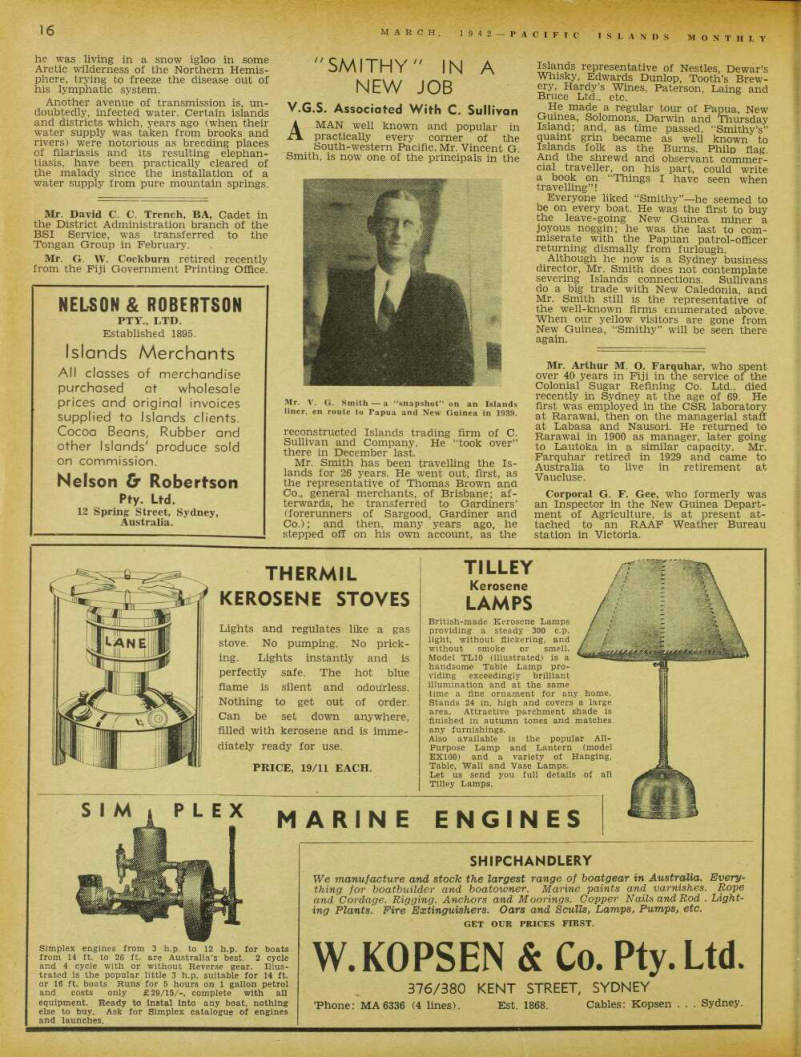
Mosquitoes Not the Only Agency
From Our Tahiti Correspondent AUTHORITIES in tropical diseases agree that Filariasis is conveyed from one human being to another through the agency of the mosquito.
Long observation of this disease in these islands has convinced this writer that the mosquito is not the only agent of transmission. The natives of Tahiti have always maintained that certain parcels of land are breeding grounds of the disease and that anyone inhabiting these areas will contract the malady.
Thirty years ago a French savant, liv ing in the Islands, investigated the history of the several parcels, and told this writer that the native assertion was well founded. There was every evidence that the ground had become infected with filaria which then entered the human body after the manner of the hook-worm.
This extract from Doctor Victor Reiser’s “An American Doctor’s Odyssey”: “. . . it was later discovered that the filaria is a white thread-like worm which, after be ing deposited by the mosquito on the skin, bores its way into the lymphatics and blocks them”, lends credibility to the theory.
We once saw a very convincing example of this method of infection. A tract of land of very evil reputation was about to pass into the possession of a man of our acquaintance. We resolved to warn him.
Now this individual was one of those persons who believed that wisdom had established her throne in his intellect and, therefore, any questioning of his pontifical pronouncements assumed the iniquity of lese-majesty.
Nevertheless, we girded our loins and told him in detail how for generations no native would live on that piece of land because history showed that every tenant had contracted elephantiasis. The neighbouring lands were free of infection and there was no filariasis thereabout.
Our acquaintance scoffed at our warn ing and moved in.
On schedule time, according to native reckoning, he developed full blown filariasis and the last we heard of him
he was living in a snow igloo in some Arctic wilderness of the Northern Hemis phere, trying to freeze the disease out of his lymphatic system.
Another avenue of transmission is, un doubtedly, infected water. Certain islands and districts which, years ago (when their water supply was taken from brooks and rivers) were notorious as breeding places of filariasis and its resulting elephan tiasis, have been practically cleared of the malady since the installation of a water supply from pure mountain springs.
Mr. David C. C. Trench, BA, Cadet in the District Administration branch of the BSI Service, was transferred to the Tongan Group in February.
Mr. G. W. Cockburn retired recently from the Fiji Government Printing Office.
Advertisements & other items, pp. 17-18 (1 item)
St. Ignatius’ College
UNION
ASSURANCE SOCIETY LTD.
(Incorporated in England)
FIRE ACCIDENT
FIJI A. E. PEARCE & CO.
RABAUL COLYER WATSON
(New Guinea) Ltd.
N. S. WALES 109 PITT STREET,
SYDNEY.
S. Morrison, Mgr.
CONTROLLING OFFICE —
413 Collins St., MELBOURNE
ALAN H. RUSSELL,
Resident Manager.
St. Ignatius’ College
Riverview Sydney
Boys are prepared for Intermediate and Leaving Certificate Examinations and for Exhibitions, Scholarships and Bursaries at the University.
Boys are arranged in three Divisions according to age. Each Division has its own Library, Debating Society, Cricket and Football Fields, and Tennis Courts.
Senior and Junior Rowing Sheds, with a large fleet of pleasure and racing boats.
Private Swimming Baths.
Prospectus and further particulars on application to the — Rector: St. Ignatius’ College, Riverview, Sydney, Australia.
Tel.: JB 1106.
BOARDING AND DAY SCHOOL
Conducted by the Jesuit Fathers QNE OF SY DNEY'S GREAT PUBLIC SCHOOLS it HI » I tl
NELSON & ROBERTSON
PTY., LTD.
Established 1895.
Islands Merchants
All classes of merchandise purchased at wholesale prices and original invoices supplied to Islands clients.
Cocoa Beans, Rubber and other Islands 7 produce sold on commission.
Nelson Cr Robertson
Pty. Ltd. 12 Spring Street, Sydney, Australia.
New Job
"Smithy" In A
V.G.S. Associated With C. Sullivan
A MAN well known and popular in practically every corner of the South-western Pacific, Mr. Vincent G.
Smith, is now one of the principals in the
reconstructed Islands trading firm of C.
Sullivan and Company. He “took over” there in December last.
Mr. Smith has been travelling the Is lands for 26 years. He went out, first, as the representative of Thomas Brown and Co., general merchants, of Brisbane; af terwards, he transferred to Gardiners’ (forerunners of Sargood, Gardiner and Co.); and then, many years ago, he stepped off on his own account, as the
Islands representative of Nestles, Dewar’s Whisky, Edwards Dunlop, Tooth’s Brew ery, Hardy’s Wines, Paterson, Laing and Bruce Ltd., etc.
He made a regular tour of Papua, New Guinea, Solomons, Darwin and Thursday Island; and, as time passed, “Smithy’s” quaint grin became as well known to Islands folk as the Burns. Philp flag And the shrewd and observant commer cial traveller, on his part, could write a book on “Things I have seen when travelling”!
Everyone liked “Smithy”—he seemed to be on every boat. He was the first to buy the leave-going New Guinea miner a joyous noggin; he was the last to com miserate with the Papuan patrol-officer returning dismally from furlough.
Although he now is a Sydney business director, Mr. Smith does not contemplate severing Islands connections. Sullivans do a big trade with New Caledonia, and Mr. Smith still is the representative of the well-known firms enumerated above.
When our yellow visitors are gone from New Guinea, “Smithy” will be seen there again.
Mr. Arthur M. O. Farquhar, who spent over 40 years in Fiji in the service of the Colonial Sugar Refining Co. Ltd., died recently in Sydney at the age of 69. He first was employed in the CSR laboratory at Rarawai, then on the managerial staff at Labasa and Nausori. He returned to Rarawai in 1900 as manager, later going to Lautoka in a similar capacity. Mr.
Farquhar retired in 1929 and came to Australia to live in retirement at Vaucluse.
Corporal G. F. Gee, who formerly was an Inspector in the New Guinea Depart ment of Agriculture, is at present at tached to an RAAF Weather Bureau station in Victoria.
Mr. V. G. Smith—a “snapshot” on an Islands liner, en route to Papua and New Guinea in 1939.
Advertisements & other items, p. 18 (1 item)
W.KOPSEN & Co. Pty.Ltd.
LAN
THERMIL
KEROSENE STOVES
Lights and regulates like a gas stove. No pumping. No pricking. Lights instantly and is perfectly safe. The hot blue flame is silent and odourless.
Nothing to get out of order.
Can be set down anywhere, filled with kerosene and is immediately ready for use.
PRICE, 19/11 EACH.
TILLEY
Kerosene
LAMPS
British-made Kerosene Lamps providing a steady 300 c.p. light, without flickering, and without smoke or smell.
Model TLIO (illustrated) is a handsome Table Lamp providing exceedingly brilliant illumination and at the same time a fine ornament for any home.
Stands 24 in. high and covers a large area. Attractive parchment shade is finished in autumn tones and matches any furnishings.
Also available is the popular All- Purpose Lamp and Lantern (model EX100) and a variety of Hanging, Table, Wall and Vase Lamps.
Let us send you full details of all Tilley Lamps.
PL E X
I M
MARINE ENGINES
Simplex engines from 3 h.p. to 12 h.p. for boats from 14 ft. to 26 ft. are Australia’s best. 2 cycle and 4 cycle with or without Reverse gear. Illustrated is the popular little 3 h.p. suitable for 14 ft. or 16 ft. boats Runs for 5 hours on 1 gallon petrol and costs only £29/15/-, complete with all equipment. Ready to Instal Into any boat, nothing else to buy. Ask for Simplex catalogue of engines and launches.
SHIPCHANDLERY
We manufacture and stock the largest range of boatgear in Australia. Everything for hoatbuilder and boatowner. Marine paints and varnishes. Rope and Cordage. Rigging. Anchors and Moorings. Copper Nails and Rod . Lighting Plants. Fire Extinguishers. Oars and Sculls, Lamps, Pumps, etc.
GET OUR PRICES FIRST.
W.KOPSEN & Co. Pty.Ltd.
376/380 KENT STREET, SYDNEY
'Phone: MA6336 (4 lines). Est. 1868. Cables: Kopsen . . . Sydney.
The Secret Story Of Hess
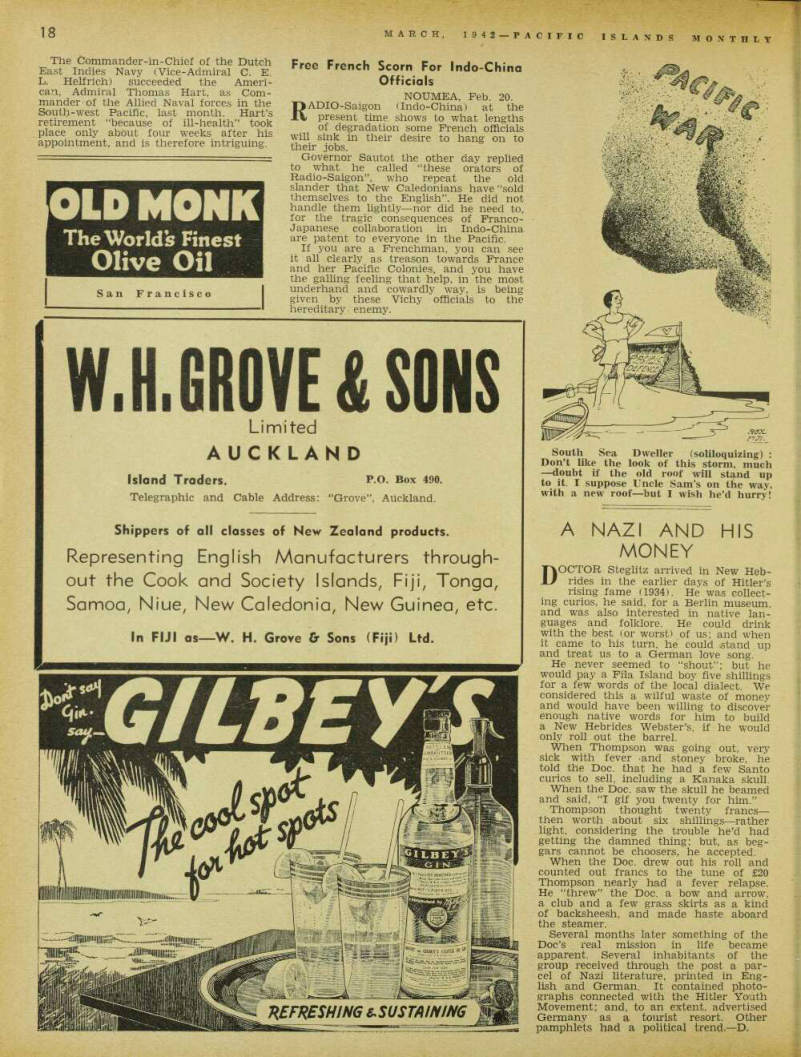
"Inside" Stories of the War
BACK GROUND reasons for Hess’s flight to Britain were recently given in a BBC broadcast to Germany, and the “Yorkshire Evening News” published a translation which at once raised the question why the facts should not have been broadcast to the world. Praising the enterprise of the Yorkshire paper, “World’s Press News” restates the facts as revealed. Extracts follow: Story starts in the autumn of 1939, when Hitler assembled his henchmen and told them that the decisive hour had come. The German-Soviet Pact had been signed, the German armies on the Polish frontier were awaiting the order to attack.
Hitler was not sure what Britain would do if Germany did attack Poland, but he was prepared for war both against France and Britain, although he would have preferred to avoid it.
Two men spoke in that conference — one was Goering, the other Hess. Goering agreed to any adventure in the West, but warned against war with Russia.
Hitler patted the German-Soviet pact on his desk and assured Goering “we will never have war with Russia, or not before Britain has been smashed”.
Hess For England
BUT Hess jumped up. He implored Hitler not to break with England.
Their duty was to smash the Bol sheviks and not to make pacts with them.
But they could only save Europe and the world, shoulder to shoulder with England.
Hitler became impatient. He said the decision was made. Not the plutocratic England, but the young nations would be the victors, and accounts with the Bolsheviks “would be settled when the West was theirs”.
The breach in the Nazi Party ostensibly disappeared with the outbreak of war.
But Hess and his friends did not cease to criticise and implore Hitler to stop the war against Britain. Hess continued to hope for an understanding with London.
Bomb Was For Hess
THAT was, the background prior to the beer-cellar bomb outrage at Munich in November, 1939.
That bomb was intended for Hess. The people who planned it were Goering and Himmler. Their opportunity came when Hitler asked Hess to make a speech for him. Counting on that, Goering rigged the ropes. Three days before the rally, SS men inspected the cellar, closed all doors, stayed inside for two hours. They set the bomb in the pillar, timed for a few minutes before 9.
The plan of Goering and Himmler was to call the Feuhrer away for an urgent meeting just before the bomb exploded.
Hess, who would be speaking within a yard of the bomb, would continue, and, they hoped, be killed.
But Hitler changed his mind. He was afraid Hess would criticise the Soviet pact and decided belatedly to make the speech himself.
Goering’s problem was to save Hitler without revealing the danger. By super human efforts, Himmler and he managed to get Hitler to break off his speech un completed and leave the cellar at 8.48.
Ten minutes later, the explosion came, killing several Nazis but not injuring Hess. The plot, of course, was kept secret, even Hitler not being told.
Eighteen months passed—to May, 1941.
Again Hitler assembled his lieutenants and told them he was going to settle ac counts with the Soviet.
This time Hess applauded and Goering disagreed. Hess implored Hitler to make
peace with Britain and get her to help Germany against Russia. Hitler hesitated.
When Hess Fled
GOERING and Himmler once again realised the danger threatening their plans and again decided to get rid of Hess and finish his influence with Hitler.
Through an indiscretion, Hitler learned of the first assassination planned against Hess. He called Hess and told him all about it. Hess saw that his life was worth next to nothing. He quickly made up his mind and flew to England.
Himmler and Goebbels immediately declared him insane, but Hitler realised how unscrupulous Himmler and Goering
were and thought he himself might be next on the list. He did not dare to strike against Himmler, but his rage did turn against Goering. Consequently, Goering was disgraced and confined.
In our next issues : <c Miscalculations regarding Joseph Stalin“ Why Hitler Did Not Invade Britain in July-August, 1940”.
The Commander-in-Chief of the Dutch East Indies Navy (Vice-Admiral C. E.
L. Helfrich) succeeded the Ameri can, Admiral Thomas Hart, as Com mander of the Allied Naval forces in the South-west Pacific, last month. Hart’s retirement “because of ill-health” took place only about four weeks after his appointment, and is therefore intriguing.
Advertisements & other items, pp. 19-20 (1 item)
Ssni
Islands' Visitors to Sydney Will find excellent accommodation at
"106" PRIVATE HOTEL
204-8 Victoria Street, Kings Cross, Sydney.
Every Comfort, Splendid Table.
Tariff from 35/- per week.
MRS. C. PYATT, Proprietress.
Tel. FL 4272.
*\ V N\ X \".V 3> mm s~r- S 5 -dl o t- -0 a. uJ 7®eO -i ; >v v
SSNi
ft --=- >-; i m & av 9?
N ◄ ?.. v: V'* O r Z&
OLD MONK
The Worlds Finest Olive Oil San Francisco
W.H.GROVE £ SONS
Limited
AUCKLAND
Island Traders. P.o. Box 490.
Telegraphic and Cable Address: “Grove”, Auckland.
Shippers of all classes of New Zealand products.
Representing English Manufacturers throughout the Cook and Society Islands, Fiji, Tonga, Samoa, Niue, New Caledonia, New Guinea, etc.
In FIJI as—W. H. Grove & Sons (Fiji) Ltd.
\T» & » * 4
fits
I ■a L» ~L'‘J^msst " •t; -
REFRESHING S. SUSTAINING
C ree French Scorn For Indo-China
Officials
Noumea, Feb. 20.
RADIO-Saigon (Indo-China) at the present time shows to what lengths of degradation some French officials will sink in their desire to hang on to their jobs.
Governor Sautot the other day replied to what he called “these orators of Radio-Saigon”, who repeat the old slander that New Caledonians have “sold themselves to the English”. He did not handle them lightly—nor did he need to, for the tragic consequences of Franco- Japanese collaboration in Indo-China are patent to everyone in the Pacific.
If you are a Frenchman, you can see it all clearly as treason towards France and her Pacific Colonies, and you have the galling feeling that help, in the most underhand and cowardly way, is being given by these Vichy officials to the hereditary enemy.
South Sea Dweller (soliloquizing) : Don’t like the look of this storm, much —doubt if the old roof will stand up to it. I suppose Uncle Sam’s on the way, with a new roof—but I wish he’d hurry!
A Nazi And His
Money
DOCTOR Steglitz arrived in New Heb rides in the earlier days of Hitler’s rising fame (1934). He was collect ing curios, he said, for a Berlin museum, and was also interested in native lan guages and folklore. He could drink with the best (or worst) of us; and when it came to his turn, he could stand up and treat us to a German love song.
He never seemed to “shout”; but he would pay a Fila Island boy five shillings for a few words of the local dialect. We considered this a wilful waste of money and would have been willing to discover enough native words for him to build a New Hebrides Webster’s, if he would only roll out the barrel.
When Thompson was going out, very sick with fever .and stoney broke, he told the Doc. that he had a few Santo curios to sell, including a Kanaka skull.
When the Doc. saw the skull he beamed and said, “I gif you twenty for him.”
Thompson thought twenty francs— then worth about six shillings—rather light, considering the trouble he’d had getting the damned thing; but, as beg gars cannot be choosers, he accepted.
When the Doc. drew out his roll and counted out francs to the tune of £2O Thompson nearly had a fever relapse.
He “threw” the Doc. a bow and arrow, a club and a few grass skirts as a kind of backsheesh, and made haste aboard the steamer.
Several months later something of the Doc’s real mission in life became apparent. Several inhabitants of the group received through the post a par cel of Nazi literature, printed in Eng lish and German. It contained photo graphs connected with the Hitler Youth Movement; and, to an extent, advertised Germany as a tourist resort. Other
pamphlets had a political trend.
D.
Lucky Escapes
How Three G. and E. Colony Officers Reached Suva
THE luck of the Bevington family should be written into the annals of the Central Pacific. Mr. E. R.
Bevington was Administrative Officer in the Central Gilbert Islands, and he resided at Tarawa with his young wife and two very young children. It was feared that when the Japs occupied Tarawa on December 9, the Bevington family were taken prisoners, along with other Europeans.
It later was learned that, only a couple of days before Japan struck, the women and children, including Mrs. Bevington and her two infants, were evacuated from Tarawa on the mission schooner, “John Williams”.
On December 9 or 10, Mr. Bevington was on the little Government patrol vessel, “Kiakia”, heading back from an outer island to Tarawa, and ignorant of the Jap attack on Tarawa. Fortunately, British headquarters somewhere were alert, and recognised “Kiakia’s” danger.
A warning was broadcast and, by great good luck, “Kiakia” picked it up, and altered course. Next day, a further mes sage was picked up, and “Kiakia” was headed south, for Suva.
Captain G. J. Webster and Mr. Bev ington had a “sticky” trip. They were short of motor fuel and very short of water; but, by careful economy, and sailing part of the way, they made Suva without accident.
Meanwhile, the women from Tarawa had reached Suva, quite ignorant of the Jap landing at Tarawa. They realised,
then, that probably they would not see their husbands for many a long day.
But Mrs. Bevington received a hint that she might be “lucky”.
She was lucky. Two days later the “Kiakia” arrived.
The very next day, a south-bound ship came in. Sir Harry Luke bundled the Bevington family aboard, and they are now enjoying a three-months’ furlough in New Zealand. It was easy to take, after 4£ years’ continuous service in the Gilberts.
A short time after the Bevingtons arrived in Auckland, there was a knock on their flat door—and there was Mr.
D C. I. Wernham, who they thought had been chopped off at his post (Ad ministrative Officer) at Funafuti. Ellice Islands. He, also, had had extraordin ary luck—he had been able to get away, at the last moment, on the Roman Catholic mission schooner, “Santa Tere tia”, which had escaped from the Gil berts.
Up to the present, as far as is known, Messrs. Bevington and Wernham, and Captain Webster of the “Kiakia”, are the only male officials of the Gilbert and Ellice Islands Administration who have escaped.
A young woman of 22, who writes a lively, entertaining letter—Miss Marjorie McLeod, of 9814-87 Avenue, Edmonton, Alberta, Canada wants to correspond with a young man or woman resident of the Pacific Islands. An Australian air man gave her a copy of the “PIM”, from which she has decided that there is a colourful world south of the equator which she would like to know better.
Dolorous Days
In Tahiti
THE Brotherhood of the Bottle, at Tahiti, are having a heart breaking time of it, in these dolorous days.
The cellars are empty. The jealously hoarded private stocks of Scotch whisky, cognac, Bourbon Delight, Jersey Light ning ( apple brandy ), gin, liqueurs, schnapps, and matured rum have dwindled to the vanishing point.
The flowing rivers of strong waters that once slaked the burning thirst of des perate refugees from the desert of prohibition, have shrunken to a trickle of brackish, noisome liquid in the beds of sun-blasted wadies.
A bottle-a-day man we know filters this raw essence from the sugar cane, through a compound of charcoal and arrow-root to ameliorate the stench of molasses and Blatta Orientalis—the characteristic aroma of our local product.
Others take aspirin tablets to deaden the olfactory nerve centres before saluting the sun over the yard-arm.
In the dear, dead days of long ago— when the sending of distilled liquors to the outer islands was interdicted—the Tuamotu natives found consolation in Eau de Cologne. But that spring, too, has now dried up.
One does not know whence relief will
come, or when.-
A.C.R.
Sappers R. St. John and L. Boyer, both formerly of Fiji (the latter having been a member of Morris, Hedstrom Ltd.’s Labasa staff) are serving overseas with the 2nd New Zealand Expeditionary Forces in the Western Desert.
Advertisements & other items, pp. 21-22 (1 item)
Equal to the World’s Best
Throughout Australia and Overseas there is an ever-increasing demand for
COLONIAL & BRONTE
HIGH-GRADE CANNED MEATS
There is no better quality—none more wholesome.
TRADE MEATS FOR THE ISLANDS
order
“COLONIAL” BRAND
Roast, Corned and Boiled Beef Packed in 6,5, 4,3, 2, 1 lb. and 12 oz. tins.
Also Corned Beef in 12 oz. Taper Tins.
Roast, Corned and Boiled Mutton. 1 lb. and 12 oz. tins.
Choice Dripping 36 lb., 2 lb., 1 lb. tins, and 1 lb. packets. v cam p die-' .
WHOUSAU MIATCO.
DELICIOUS
BRONTE" HOT MEALS
Steak and Kidney Pudding.
Beef Steak Padding.
Sausages and Tomato.
Sausages and Vegetable.
Lamb and Green Peas.
Corned Beef and Boston Beans with Tomato Sauce.
Steak and Tomato.
Under present conditions it is wise to ensure that you have ample stocks of all our lines.
The Colonial Wholesale Meat Coy. Pty. Ltd.
30 GROSVENOR STREET, SYDNEY
Modern Refrigeration for the South Sea Islands
The ELECTROLUX
KEROSENE OPERATED
REFRIGERATOR
MARVEL
OF
MODERN
SCIENCE
ap
THE
MIRACLE
OF
ICE
FROM
HEAT
ELECTROLUX offers economical, modern and completely efficient
REFRIGERATION FOR ISLANDS' HOMES,
FREEZES CONTINUOUSLY WHILE SMALL LAMP BURNS.
Freezing controlled by simply regulating height of flame. Uses only gallon of kerosene per week.
MOTOBLESS ... NO PARTS TO GET OUT OF ORDER.
MODEL L 22
Capacity 2.2 cubic feet.
MODEL L3BO
(as Illustrated) Capacity 4 cubic feet.
GUARANTEED FOR TWO YEARS.
Write to your Local Distributor for prices and full details.
MODEL LKSSO
Capacity 5.5 cubic feet.
OBTAINABLE FROM ALL W. R. CARPENTER Cr CO. LTD.
BRANCHES THROUGHOUT THE ISLANDS
Representation in Papua and New Hebrides.
Islands Industry
Beekeeping As An Islands Industry Part III —How To Refine Bees-wax
By F. J. Morgan
THE preparation and sale of bees-wax was of such importance in earlier days that some of the most impor tant laws of the land were enacted to control the sale and protect the buyer from adulterated wax.
The Wax Chandlers Company, one of the wealthiest of the Guilds of the City of London, came into being about 600 years ago, because of the importance of the wax-chandler’s trade. Tithes and taxes were often paid in bees-wax, and the wealth of a monastery in early England and Europe was often the measure of its bees-wax. The adulteration of bees-wax is still a criminal offence, and care must be taken to ensure that one does not offend. It may be stated that adulteration is very easily detected.
We might point out at this stage that tropical Africa is becoming the world’s most important source of bees-wax. Top prices on the London market have been won by a firm in Tanganyika specialising in this work. By careful grading according to colour:, light wax will bring the best price, and the packing of cwt. lots, ac cording to colour, is greatly appreciated.
The firm also standardised the si£e of their blocks to 14 lb. weight each.
As bees-wax is used in making sweets, cosmetics and in the pharmacy, it must be free from acid or lead, which should not be used in refining. When aiming at a wax market, it is well to take great care in preparing the product. Bees-wax must not be overheated, and should not come in contact with copper or galvanised iron. Any metal container used for melted wax should be tinned.
SO long as the beekeeper has plenty of sunshine, a solar extractor is ex cellent for breaking down combs and cappings, but it should not be used for diseased or old brood-combs.
Anyone handy with tools can make a good solar extractor. It simply consists of a sloping wooden bench, which may be faced with tinned sheet, under a glass cover. At the lower edge of the sloping bench is a wire strainer to catch dross, and below the strainer a trough with slightly flared sides, so that the wax, when liquid, runs down the slope, through the strainer into the troughs, and when cool will fall out of the trough easily when inverted.
Common dimensions are: Length, 5 feet; width of bench 2 feet 6 inches; depth, being difference in height between the highest side of the bench and lower, 4 1 inches. The glass cover is furnished with two sheets of glass, with a space of 1 inch between them, and the space inside, between the glass and the tinned surface of the bench, should be about 3 inches.
The whole should be made into a box which sits flat on the ground, and the glass top should be on hinges so that it can be raised. If small wheels can be attached underneath the box, so that it can be swung round to face the sun at all times, so much the better.
After solidifying in the moulds at the base of the extractor, the wax should be clean and ready for marketing, but if it is at all dirty or discoloured it should be refined.
REFINING is carried out quite simply by filling one-third of a kerosene tin with water and then dropping in the wax, in small pieces, until it is filled to about 3 inches from the top. The tin is then placed over a slow fire until the
wax has melted, but it should not be allowed to boil. As soon as melted, remove from fire and cover tin with hessian or sack and stand to cool and settle. The dross will sink to the bottom and form a layer between the wax and water. Before the wax begins to harden take a dipper and remove it gently, pouring into tinned moulds with sloping sides; half a kerosene tin, cut lengthwise, can be adapted to this purpose.
Stop dipping as soon as you come to the dross. The dross, being mixed with wax and water should be melted again, and then strained through a hessian bag into another mould, and allowed to settle and cool. On cooling, remove from the mould and cut the dross from the bottom of the wax block with a knife. It will scrape off fairly easily.
With bees-wax selling at 2/-.to 2/4 per lb., Australian currency, it is more profitable than honey to produce, considering
the cost of freight and honey-tins. Care in refining pays, and is rewarded by highest prices in all markets.
Everything needed to start beekeeping can be procured from reliable manufac turers in Australia, most of whom are quite willing to give expert advice to the beginner when requested.
When consigning honey or bees-wax to agents, it is advisable to mark packages clearly with the name and address of the agent. The sender’s name and address should also be shown. Take care, also, to write a covering letter to the agent instructing him to sell, and advising how many tins of honey are being shipped and the weight; or, in the case of wax, how many pounds, what colour and how packed. Tack a label with sender’s name and address on each block of wax, as a further precaution in case of delay in shipping.
(Concluded)
Advertisements & other items, p. 23 (1 item)
Foster's Lager
mm\m
4g A I H/q Pi 1 18 B *f Om 4*r 1/
AUSTRALIA’S NATIONAL BEVERAGE
Letter From a Fiji Girl in Wartime England
WE are still patiently awaiting the invasion, which I am convinced will never come. The raids are very mild —no “blitz” for ages.
Odd bombs continue to be dropped here and there, but no one pays much at tention. “Oh yes,” they say, “Chesham Place got it.” Or “they tried to get Lam beth Bridge, but missed it”; and so on.
It’s vaguely irritating, that’s all.
Extraordinary how one’s mental atti tude changes. How one used to get stewed up over the devastated East End. for instance, though houses there are built of matchwood and fifth-rate brickwork, and the slightest bit of blast pushes them all into the street. Now, as long as nothing actually drops near me or the people who matter to me, I don’t give a damn.
Sounds callous, but that’s life, in war time. By the time you have seen a few bits and pieces of what were living people, you just don’t care.
Something came over to-day and did some dive-bombing. I gazed out of the window, thinking it was one of ours, un til I saw some swastikas around, so I withdrew hurriedly.
AFTER eighteen months in an under ground ambulance station, my eyes began to trouble me; and, with the war in London temporarily at a stand still, I got myself a job as transport driver at an aerodrome of the ATA (Air Transport Auxiliary).
I stayed at the ambulance station until it was time to catch the train; when, suddenly, I remembered something left behind in the flat. That very morning, the RE’s had started digging out a 11ton delayed-action bomb nearby (it had been there 6 months already).
An immense area was roped off. It was too maddening. Every time I thought I had evaded the policemen, they would just catch me, plant themselves in the middle of the road and say: “You can’t do that there ’ere, miss!”
At last, I found one who was more sympathetic and, after much explaining and much fluttering of eyelashes, he said: “Alright, miss, I haven’t seen you—if anyone stops you, remember, haven’t seen you!”
The work of the AT A consists of de livering completed aircraft from the factories to the RAF operational aero dromes. Our “taxi” aircraft fill up with pilots in the a.m., and dump them one by one at the x various factory airfields, where they pick up the new machines to fly them to their ultimate destination.
The pilots are then collected again by the “taxi”; and if anyone gets stranded not far from , or the “taxi” is full, I leap in my hearse and fetch them. In this way I have to remain at the aero drome until the last pilot is in. Then I am driven in turn by the other driver (male) to my billet in the village.
My uniform (if it comes—l filled in the forms four weeks ago and now live in hopes) is quite smart. Dark blue coat cut like a man’s military tunic, and skirt and pale blue shirt and tie. I am not entitled to wear wings, so had to content myself with ATA in gold on pocket and forage cap—otherwise I fear I might look too much like a French railway porter.
AT first, there was too little to do; but now I like it better. In addition to being driver, I have been appointed assistant medical orderly. My first case was an engineer, with three fingers
broken by a propeller blade. I had to splint and tie it up—everything went with a swing and he is doing fine. I am also in charge of the bar—l can pour a pretty glass of ale but never take anything myself.
Then the manageress of the pilots’ mess resigned, and I took over until a new one is found. There are over 50 people to cater for, which with every thing rationed and nothing obtainable in this town, takes some doing. There are not many vegetables, no tinned or dried fruit (fresh fruit has been long non existent) so puddings are a headache.
People here have to queue up, the scarcity of food being more due to lack of distribution, I think, as there is al ways plenty of everything in London, though it’s expensive. And just when our staff is being doubled the meat ration is reduced by two-thirds. I shall have my job cut out to feed our brave bird-men.
AT times it’s quite amusing, the re quests and questions with which the pilots come to me. One asks if I could put some fresh elastic in his flying helmet, the old one being perished? Yes, I could.
Another has left his ration-book some where —could I ring up and have it send to him? I’ll do that.
Someone else wants his fiancee to visit him; can she spend the day at the aerodrome whilst he is out flying? No, certainly not! Sort of universal aunt— what? But I enjoy it.
However, on the whole, I don’t feel that I do very much useful work, although transport drivers are necessary and the boys have to be fed.
To-day, for instance, was really more play than work. It was lovely and sunny
and warm and, my uniform still not de livered, I put on a red and white pinafore frock, and sailed up to the aerodrome.
My first job was to drive some one to , a vast RAF station. The only women there are WAAF’s with their dreary uniforms, so you can imagine the chaos I created in my scarlet and white outfit.
The guards on duty nearly lost their eyes, the parachutists forgot all about their ’chutes, and senior officers had to inspect the car and be introduced. Even my fare got quite flirtatious and talked about taking a picnic basket and picking primroses on the way back!
I sat in a deckchair, in the sun, after our return, watching the boys play foot ball—a most agreeable way of serving one’s country at war!
IHAVE just returned from a visit to the metropolis. The moon was nearly full and, in anticipation of an air raid, I signed on as part-time driver at my old ambulance station, just for the night, as it’s the safest place I know of!
However, nothing happened and I shopped, lunched, dined, drank and danced for three days without stopping and then returned here, quite exhausted, but feeling it was worth it.
I now think it's time I went abroad.
When in London next, I am going to the HQ of the WAAF’s to see can they send me out to the Far East or some where. Then, should peace break out, I would be more than half-way home to Fiji!
Advertisements & other items, p. 24 (2 items)
22
MARCH, 1942 PACIPIC ISLANDS MONTHLY
Plum Pudding
X z
You'll earn tribute from your family when you serve Swallow's delicious Plum Pudding. They're full flavoured and expertly prepared by Swallow's master cooks. Everybody loves plum pudding and the rich goodness of Swallow's is unique.
Specially fropic-packed in air-fight tins of exact quantities... but always allow for extra helpings. lb. ... 3 serves, 1 lb. ... 6 serves, 1 lb. ... 9 serves, 2 lb. ... 12 serves, 3 lb. ... 18 serves.
SWALLOW & ARIELL LTD.
Port Melbourne, A usjralia
Governmental Treatment
Of Small Planters
A RESIDENT of Fiji, an independent planter, writing to the editor of the “PIM” in October (two months before Japan struck!), hits straight from the shoulder:— Maybe, it is still considered that our now intensified propaganda re our shin ping shortage will continue to hide (1) the shocking mismanagement of the war so far: (2) the deliberate policy of ex ploitation of primary producers in all Colonies: and (3) the attacks on civilian morale in order to make it fighting mad against the German people.
So much for democracy! It’s there on paper, and has been for many years, but isn’t it about time it was put into practice?
What a dreadful mockery of democratic ideals it is, this callous treatment of genuine planters and the native primary producers. The demoralizing effects of unpayable prices and neglected planta tions were serious enough three years ago; but, to-day, the stagnation and semi-starvation to be found throughout the South Seas is a disgrace to the British Empire.
It is true that some efforts are now being made to stimulate production and improve the quality of copra, but the motive behind all this apparently is not to keep everybody on their toes, so to speak, but rather to keep everybody still on their knees. The Governments should not adopt a Pontius Pilate attitude any longer, and should most certainly not permit (or create) conditions which are, really, only favourable to “big” business interests It can be emphatically stated that the coconut industry out here has been crucified for the sake of the trading, gold-mining, and shipping combines.
Maybe it is still thought that this war can be won without enormous quantities of fats and oils. Surely the truth will be realized in time, and every effort made at last to encourage the British Colonies, particularly in the Pacific, to participate fully in the great Battle of Food which is now commencing.
Strange Gold Story
From Misima
THE Misima goldmines (Eastern Papua) have closed down, and the Europeans have been evacuated, so it doesn’t matter. But, had conditions there been normal, a few bitter share holders in Gold Mines of Papua would have been asking some pertinent ques tions about the recent activities of Mr.
Alistair Alexander. Gold Mines of Papua Ltd. put in a great plant at Misima, and started grandiloquently to dig for gold, with its 5/- shares quoted at over 17/-. Then it found that it had missed the Umuna lode and was getting the wrong kind of ore, and finally it ceased
operations.
Now, Mr. Alexander has taken up leases on -the opposite (or northern) side of the ridge, and they straddle the old GMOP leases: and Mr. Alexander not only claims that he is getting phe
nomenally rich assays (from 27 to 88 ounces to the ton seem fantastic figures, but they are what he reports) but he also says that he and Boyd, and the late Scotty Buchanan urged GMOP to begin mining on the north instead of the south side of the ridge. These old prac tical miners were ignored—and GMOP crashed.
However, just when Mr. Alexander was becoming really busy, and a few other people very interested and argumenta tive, the Japs came, and evacuation was ordered: and the discussion can be resumed after the war.
Owing to war developments in the Pacific, Crown Prince Tuboutoa did not return to Tonga with his brother in December. The brothers remained in Sydney over the holidays. Jione Gu has now left for Queensland, where he will study tropical agriculture, and Tuboutoa is still in Sydney.
Mrs. Jeanne Parr, an Englishwoman who had lived in Fiji for over 20 years, died in Suva in January. She is survived by two sons—Mr. Cecil Parr (Acting Headmaster of Lau Provincial School) and Mr. Geoffrey Parr (formerly of the Fiji Police Force, now serving with the RAAF, in Britain).
Advertisements & other items, pp. 25-26 (1 item)
<Jscenes Of Splendour Usher In Festivities
I) J«
London—June, 1887.
The city had a foretaste of the splen-
dour of the Queen’s Jubilee celebra-
tions, when the Indian envoys arrived
yesterday. The Indian Princes rode
through the streets in gorgeous,
jewel-bedecked Eastern costumes,
and excited much wonder and admi-
ration. Cheering crowds welcomed
the Princes as they made their way to the Palace to call on Her Majesty,
and many luxurious receptions
and repasts will honour our
distinguished visitors.
TRYING TO BE LIKE US !
The widespread popularity of Foster Clark's Creamy Custard has inspired many imitations, but for pure ingredients, real flavour and food value, Foster Clark's Creamy Custard remains unequalled. Custards made merely to sell at a low price cannot be compared with Foster Clark s!
Always ask your grocer for Foster Clark's Creamy Custard and refuse cheap substitutes.
NEW VOGUE IN ENTERTAINMENT
BEGINS.
70 Years ago Foster Clark's Creamy Custard was first made, and so delighted hostesses of the Victorian era that Foster Clark Custard Confections became the vogue for gay parties, lunches, teas and suppers. To-day Foster Clark's is the leading Custard wherever the British flag flies. Its creamy quality and delicious flavour are sheer delight. Serve Foster Clark's Custard to your family.
Foster Clark's Creamy Custard is made in Vanilla, UPS 8, Lemon, Almond, and Standard—and in various sizes to suit all households. There is a penny packet to try! Foster Clark’s Creamy Custard is more economical, because it goes fur.her.
You will be able to serve more helpings per packet or tin of Foster Clark's Creamy Custard!
There is no substitute for
OLD MONK
VIRGIN PURE
OLIVE OIL
San Francisco
PRESCOTT Pty. Ltd.
SUSSEX ST., SYDNEY,
are sole wholesale agents for
PINEAPPLE BACON&HAMS
DAISY brand BUTTER "375" BUTTER in TINS irb.-21b.-slb. Sixes.
LEA & PERRINS’ Sauces and Most other Super-Quality Lines of the Trade, such as Cheese, Eggs. Etc.
make sure you have at hand an ample Reserve of these Always . . .
Australia’s Choicest Products Beetroot Brussels Sprouts Spinach White Turnips Cabbage Sweet Corn Carrots Tomato Puree Parsnips Tomato Sauce Celery Tomato Soup Tutti Fruit Sauce Green Peas French Beans Cauliflower 9 H t
QoxdenVal
Delicious
2-4 BROWN STR-E-CT, N-EWTOWN
SYDNEY. AUSTRALIA
Garden
Vale
Ready-toserve Vegetables
Early Timber-getters
Landed in Papua About 1885
BY D. H. OSBORNE, ROSSEL IS., PAPUA
YOUR account of a party of gold seekers going to the Fly River, Western Papua, in 1875, reminds me of how a party of timber-getters went to Papua, some ten years later.
They were located on the Daintree River, North Queensland, in 1885 or 1886, and financed by Blair & Co., timber merchants, of Melbourne. The cedar cut out, and they decided to try the south coast of Papua. The leader’s name was Page; and, as far as I remember, others of the party were Dan Henderson, Jack Peterkin, Tom Green, Sweaney, and several South Seas islanders, including Harry Niue and Charlie Ware.
They left Cooktown in two boats. One must have been a fair size, because they took a team of working bullocks with them, to haul timber. On the way across, the smaller boat was in tow. She capsized in a squall, some time after noon. Dan Henderson and two islanders were on board at the time. Dan and one man swam, and were picked up; the other was drowned. He was trapped below.
They sent some timber to Melbourne, from Papua. The building boom had burst, and the timber market was de pressed. They returned, after a short time, to North Queensland, and followed tin-mining. Henderson and Peterkin were in the party of prospectors who found Mount Spurgeon, in the Cairns hinterland.
Tom Green died on Sudest Island years later. Page went south. Sweaney was the bullock driver. He used to say the bul locks had to tunnel through the tall grass and their hoofs would melt if the bullocks were left in the sun any length of time.
They must have landed west of Port Moresby, because they brought back bows and arrows and twine-meshed dilly-bags, also some coconut oil.
There was no government in the coun try at the time. They met some missionaries. One South Sea islander, Charlie Ware, met some of his friends in the Mission, and joined them.
They were the first men to get Winchester rifles in the north. Previously, the firearms were all single-shot, mostly Sniders. The Queensland police were armed with the Snider. They were clumsy weapons, with a bore about the size of a 12 gauge shot-gun. The natives were friendly. They did not go far inland.
Immature Nutfall
Letter to the Editor A COPY of September “PIM” has just reached me, and I was rather per turbed to find that I am referred to there as the . . . “entomologist who dis covered the cause of nutfall in the Solomon Islands”.
This is not so. Both in my book, and in my paper on “Immature Nutfall”, I have pointed out that R. A. Lever, who was then BSI Government entomologist, was the man who first cast suspicion on “George” as the culprit, and that this happened a few months before I arrived in the Solomons.
The chief credit for the discovery, how ever, is perhaps due to the general and Island managers of Lever’s Pacific Plan tations, who had persisted in their belief that nutfall was due to insect attack ever since their cage experiments in Guadalcanal in 1930, in face of the official view “that nutfall was primarily a physiological problem, intimately asso ciated with soil conditions, rainfall and cultivation”. (See BSI Agric. Gaz. 3 (1) 1935.) Finally, this company succeeded in persuading the officials to initiate further cage experiments on their Guadalcanal estates, with the result that “George’s” misdeeds were brought home to him.
I am, etc.,
J. S. Phillips.
Biological Field Station, Slough, Bucks, England. 30/12/41.
The engagement was announced a short time ago of Miss Adrienne Winifred May, only daughter of Mr. and Mrs. Marshall May, of Sydney (formerly of Fiji) to Sergeant - Pilot Anthony Harris, now serving in Britain with the RAAF. Miss May was a popular young member of the Suva and Lautoka communities during her five years’ residence in Fiji, where her father was connected with the Loloma and Emperor goldmining com panies.
Pioneer
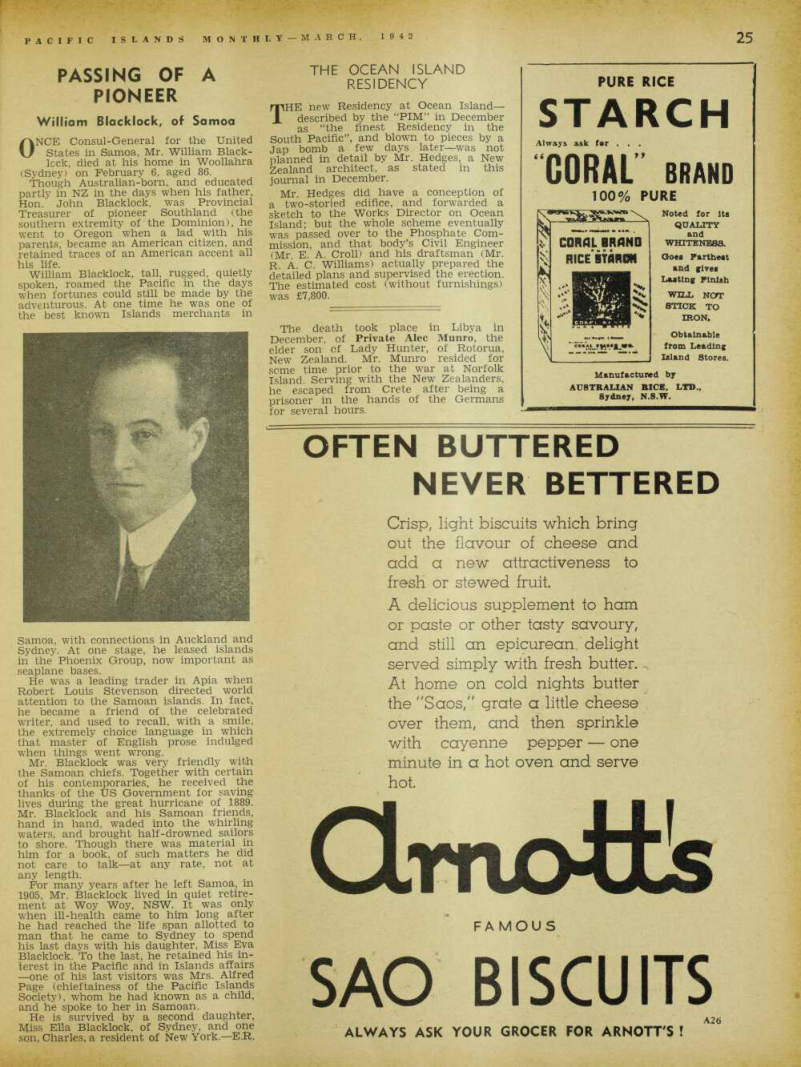
Passing Of A
William Blacklock, of Samoa
ONCE Consul-General for the United States in Samoa, Mr. William Black- Icck, died at his home in Woollahra (Sydney) on February 6, aged 86.
Though Australian-born, and educated partly in NZ in the days when his father, Hon. John Blacklock, was Provincial Treasurer of pioneer Southland (the southern extremity of the Dominion), he went to Oregon when a lad with his parents, became an American citizen, and retained traces of an American accent all his life.
William Blacklock, tall, rugged, quietly spoken, roamed the Pacific in the days when fortunes could still be made by the adventurous. At one time he was one of the best known Islands merchants in
Samoa, with connections in Auckland and Sydney. At one stage, he leased islands in the Phoenix Group, now important as seaplane bases.
He was a leading trader in Apia when Robert Louis Stevenson directed world attention to the Samoan islands. In fact, he became a friend of the celebrated writer, and used to recall, with a smile, the extremely choice language in which that master of English prose indulged when things went wrong.
Mr. Blacklock was very friendly with the Samoan chiefs. Together with certain of his contemporaries, he received the thanks of the US Government for saving lives during the great hurricane of 1889.
Mr. Blacklock and his Samoan friends, hand in hand, waded into the whirling waters, and brought half-drowned sailors to shore. Though there was material in him for a book, of such matters he did not care to talk —at any rate, not at any length.
For many years after he left Samoa, in 1905, Mr. Blacklock lived in quiet retire ment at Woy Woy, NSW. It was only when ill-health came to him long after he had reached the life span allotted to man that he came to Sydney to spend his last days with his daughter, Miss Eva Blacklock. To the last, he retained his in terest in the Pacific and in Islands affairs —one of his last visitors was Mrs. Alfred Page (chieftainess of the Pacific Islands Society), whom he had known as a child, and he spoke to her in Samoan.
He is survived by a second daughter, Miss Ella Blacklock, of Sydney, and one son, Charles, a resident of New York. —E.R.
The Ocean Island
Residency
THE new Residency at Ocean Island— described by the “PIM” in December as “the finest Residency in the South Pacific”, and blown to pieces by a Jap bomb a few days later—was not planned in detail by Mr. Hedges, a New Zealand architect, as stated in this journal in December.
Mr. Hedges did have a conception of a two-storied edifice, and forwarded a sketch to the Works Director on Ocean Island; but the whole scheme eventually was passed over to the Phosphate Com mission, and that body's Civil Engineer (Mr. E. A. Croll) and his draftsman (Mr.
R. A. C. Williams') actually prepared the detailed plans and supervised the erection.
The estimated cost (without furnishings) was £7,800.
The death took place in Libya in December, of Private Alec Munro, the elder son of Lady Hunter, of Rotorua, New Zealand. Mr. Munro resided for some time prior to the war at Norfolk Island. Serving with the New Zealanders, he escaped from Crete after being a prisoner in the hands of the Germans for several hours.
Advertisements & other items, p. 27 (1 item)
Sao Biscuits
PURE RICE
STARCH
Always ask for it
CORAL BRAND
100% PURE
CORAL BRAND
RICE BTfIRON
N, s. s: co*At Noted for Its
QUALITY
and
WHITENESS.
Goes Farthest and gives Lasting Finish
WILL NOT
STICK TO
IRON,
Obtainable from Leading Island Stores.
Manufactured by
AUSTRALIAN BICE. LTD.,
Sydney, N.B.W.
OFTEN BUTTERED
NEVER BETTERED
Crisp, light biscuits which bring out the flavour of cheese and add a new attractiveness to fresh or stewed fruit.
A delicious supplement to ham or paste or other tasty savoury, and still an epicurean, delight served simply with fresh butter.
At home on cold nights butter the "Saos," grate a little cheese over them, and then sprinkle with cayenne pepper one minute in a hot oven and serve hot.
FAMOUS
SAO BISCUITS
ALWAYS ASK YOUR GROCER FOR ARNOTTS !
A 26
Polynesians
Racial Make-up of Polynesians
Recently, in a scientific book, i saw a reference to Rev. J. Deihl, of Western Samoa; and I was reminded of some interesting things about the Polynesians which that lovable misry a B S o CientlSt tOW me in APla 3 f6W Father Deihl said that Sullivan, in • Study in Somatology”, a Bishop Museum publication, .had insisted that there was quite a large slice of CaucarSSoif 1 raci al make-up of the Polynesian. He said that Sullivan, after -^ idy^of To^ an * and Samoans, ? ad 5 1 \ lded . the . racial charac t eris tics of vi G nesian parts, and had allotted them as follows:-
Caucasian 5 parts Ethiopian 2 Mongolian and allied mixtures 10 In other words, the Polynesian is 60 per cent. Mongol or similar type 30 per cent. Caucasian, and 10 per cent. Ethio pian.
That would explain why Euronesian children (offspring of a European-Poly nesian union) are usually more Euro pean than Polynesian: the Polynesian parent already is nearly one-third European. It might explain, also, why the best children from mixed marriages m Polynesia usually are those from Chmese-Polynesian unions—the Polyne sian parent, already, is more than half Mongoloid, and the Mongol-Caucasian- Ethiopian mixture, as achieved through a Chinese-Polynesian marriage, seems to be quite a good one.—R.W.R.
Cleanly Tahiti
A Reply to Dr. Lambert
From Our Tahiti Correspondent T'HE author of that spicy book, “A JL Yankee Doctor in Paradise”, has this to say about our much-written-about island: “A misunderstanding prevented my visiting Tahiti, which would have fascinated me as a study of what not to do with a native people”.
After reading his book, one is of the opinion that the learned doctor started to write Hawaii in the above sentence; then lost his courage, and wrote Tahiti instead. Of course, had he written Hawaii his bones might now be bleaching at the foot of the Pali on Oahu.
Nevertheiess, we should like to hear the fetor’s unexpurgated opinion of that Smo-Japanese-Nordic Blonde Para dise. Every Wednesday and Friday night at our radio, before the Japanese war we listened to lady tourists raving over the whited sepulchre of its loveliness— and shuddered.
We are sorry Doctor Lambert did not have opportunity to inspect Tahiti. He would, indeed, have seen much to criticise, but more to commend.
He would have found a comrade-in arms in that valiant, lovable old warrior who, as doctor and mayor (with Jovian thunders tempered by Falstaffian wit), battled for over 25 years against disease, filth and the rum traffic, and raised Papeete from the state of a festering cesspool to the clean, sanitary spotless town it is to-day; the seat of a maternity hospital which has consigned puerperal septicemia to the dark memories of an unhappy past.
The genial Yankee doctor might have been surprised and pleased to find a colony in the South Pacific free from yaws, malaria, tropical dysentery and, to the best of our knowledge and belief, hook-worm.
He would have approved and applauded the work of the scholarly Valleteau de Mouillac, who instituted modern treat ment of leprosy and founded the station on Tahiti which—although, perhaps, not so perfect in its appointments as Mokogai—has never required the sacrifice of a Father Damien.
Other able men in our medical service would, no doubt, have received his ac colade as worthy to sit in the company of those in the services of our sister archipelagoes.
Doctor Lambert was born under the shadow of the Shwangunk Mountains, from whose craggy summits, over the dis tant Catskills, we have seen sunsets rivalled in splendor only by those which glorify the heavens over the peaks of our South Sea Moorea. The men from thereabout are like the tough granite of their hills and will speak their minds, come what may.
For this reason, and because he is one of the world’s great doctors; because he has written one of the most exciting books we have read for many a day; be cause we wish him to live to see the full fruition of his work in the Pacific; we send this warning (after the manner of a nurse of our childhood) to him in his California abiding-place: “The Native Sons will get you, if you don’t watch out”.
Miss Nell Fagan, headmistress of the Melanesian Mission’s Girls’ School at New Torgil, Aoba Island, New Hebrides, ar rived in Victoria in February on furlough.
During her visit, she will carry out depu tation work for the Australian Board of Missions. Miss Fagan was formerly at Raga Island for some years,
Advertisements & other items, p. 28 (1 item)
Chi Vers
BURNS PHILP
Registered
(SOUTH SEA) CO. LTD.
lnc. in Fiji SUVA Islond Traders and Shipowners \Also Branches at: Fiji: Levuka, Lautoka, Labasa, Ba, Sigatoka, Rotuma.
Tonga: Nukualofa, Haapai, Vavau.
Samoa: Apia, Pago Pago (American Samoa).
Solomons: Makambo, Gizo, Faisi.
New Hebrides: Vila. , ... Gilberts: Tarawa.
Code Address: "Burnsouth". Norfolk Is. Niue. Wallis Is. Futuna Is.
CHI VERS
FAMOUS ENGLISH PRODUCTS
CANNED ENGLISH VEGETABLES
CANNED ENGLISH FRUITS
OLDE ENGLISH MARMALADE
GOLD MEDAL JAMS
JELLY CRYSTALS, ETC.
Obtainable from all leading Grocery Stores
WRITE TO DEPARTMENT “A”
CHI VERS & SONS LTD.
Histon, Combs., Eng.
FOR ATTRACTIVE RECIPE BOOK
<C"' nMjlli.
CHIV£RS
C6LO
9T4MDARD
fresh
ENGLISH
PEAS
L*g»»
Was There Malaya-Mindedness in
the Solomon Islands?
Letter to the Editor THANKS for the article, “Alternatives to Copra”, in December “PIM”.
This is the kind of information we have been waiting for for years.
If ever we exiled planters go back to the Pacific we must seek economic sal vation from the industrial products based on the coconut palm. We must get rid of our copra complex and enlist the aid of the industrial chemist to assist us in turning our estates to fuller account. The industrialisation of Austra lia in recent times indicates the direc tion where we should look for this aid.
Re “unsaleable smoked” copra: it was rather a coincidence that about a week after my letter of 8/11/41 was written (it appeared in December “PIM”, p. 19), smoked copra became marketable at £5/12/6 per ton on the beach in the Gizo District, after being unsaleable for over a year. This supported in a drama tic manner (i.e.. from nothing, to £5/12/6 per ton) the doubts I expressed (re the alleged unmarketability of “smoked”) in my letter in the February “PIM” (“The Future of Copra”, p. 30).
DID you read that despatch of the “Times” correspondent from Bata via on the Singapore disaster, and the causes that led to it? The article was described by “The Economist” as the “most terrible despatch that had been printed for years”.
It surely was. as it indicted a Colonial Administrative System that has probably had no parallel in history for ineptitude.
Our BSI Administration was all that the “Times” correspondent said the Malayan (or for that matter the Indian) Adminis tration was. (You have to live in countries ad ministered by the Colonial Office to appreciate the falsity of the legend that has grown up about the ability of Brit ish Administrations to run coloured countries. This colossal boloney and ballyhoo has created an official Maginot mindedness of smug self-satisfaction and fatuousness which has required the fall of Singapore—and the possible loss of half an Empire—to dispel: if it has been dispelled, which I doubt. You can’t alter fools.) I made myself practically a social outcast during my 30 years in the Solo
mons, so far as Officialdom was con cerned, for holding the above views, and giving 'expression to them in the old “Planters’ Gazette” and elsewhere. The opinions of Gill of the “Solomon Islands Planters’ Gazette” were termed “Bolshe vism” by the Pooh-bahs, sycophants and yes-men of the BSI. But when the London “Times” says the same things— alas, too late!—they are called words of wisdom.
When we British people go back to the Islands there must be a New Order all right—politically, commercially and economically. Australia must run those places and sack the duds of the Old School Tie brigade. We shall have to scrap the sentimental notions of govern ment, that have nearly lost us an Empire, and run things realistically.
Never again should it be possible for an Administration to practically wipe out the pioneer class of small planters and traders (who opened up the Islands, and would have garrisoned them in war) by allowing monopolistic corpora tions and alien Chinese to supplant them, and to drive them from the coun try.
Friends of mine are fighting for the country in which they went bankrupt.
Are their Chinese supplanters fighting for us, or China? Not on your life!
Reverse the situation: Would German, Japanese or Chinese in similar circum stances, have allowed us to do these things to them? Again, not on your life!
They think of us only as soft fools for allowing them to get away with it.
And that is the root of the matter—we have been mad, soft fools; and the Orientals have known it—and profited by it.
I am, etc.,
Leslie F. Gill.
Caulfield, Melbourne, Vic. 23/2/1942.
Miss Audrey Harcourt, of the Secre tariat branch of the Fiji Administration, was in New Zealand in February spending three months’ furlough.
Mr. Henry Dexter, formerly of East ern Papua, sends greetings to old Papua friends from his tomato-farm at “Sama rai”, West Lane. Hayling Island, Hamp shire, England, and comments on events in Papua as reported by “PIM”. One wonders what he would think of Papua to-day!
Mr. John K. Brownlees, formerly Dis trict Officer in the Solomon Islands recently took up duties at Nukualofa, Tonga, as Secretary to the Government.
Rev. Alexander Hardie, MA, of St Andrew’s Presbyterian Church, Suva, re turned to New Zealand from Fiji last month. He and Mrs. Hardie served in the Colony for six years.
Advertisements & other items, pp. 29-30 (1 item)
fk»st ttoEfrtooft
WoP&'loofe.S
Masted S
j«> inc&iil&nf twirk
hoi di CoU Heats.
It is made from pure mustard and Its colour and tastiness lends itself to decorative and appetising savouries.
Here is a recipe for a delicious mayonnaise dressing, which will keep indefinitely, and makes an attractive colour contrast to salads: 3 A cup Water V 2 cup Holbrooks Pure Malt Vinegar 4 tablespoons Holbrooks Mustard Sauce 2 tablespoons Flour 1 tablespoon Sugar 1 tablespoon Butter V 2 teaspoon Salt Yolks of two Eggs Dash of Cayenne Pepper Melt butter, stir in flour, then all the liquids, salt, sugar and cayenne pepper. Add the beaten yolks of eggs to the hot mixture and stir until thick.
MS-2 •••
PRODUCING UNIFORM GOOD RESULTS SINCE 1868
ALWAYS ASR FOR IT
TAKE THE
“LEAD” FEELING
OUT OF YOUR LECS
Get More Oxygen in Your Blood and Get that Pep that Sends You Bounding Up the Stairs.
People who smother to death die because oxygen has been completely cut off from them. Just as surely you are slowly smothering if your blood lacks red corpuscles. Red corpuscles are your oxygen carriers. They carry the oxygen you breathe in to every part of your system Without enough oxygen-carrying corpuscles, your kidneys, liver, stomach and bowels slow down. Your skin gets pale, flabby, often pimply. Your nerves may become jittery—you tire quickly— feel depressed.
What you need is Dr. Williams’ Pink Pills. These world-famous pills help you make more and better red corpuscles and thus increase the oxygen-carrying power of your blood. Get Dr. Williams’
Pink Pills to-day at your chemist or store and see for yourself how quickly this time-proven blood-builder will help give you back your pep and clear complexion.* *•
Queensland's Kindness
To Evacuees From Territories
rE kindness of Queensland people to the women and children passing through their towns, as part of the evacuation of New Guinea and Papua, was described in terms of unmeasured praise by Mrs. A. Bowring, a well-known resident of Edie Creek, NG “A large party of us. women and children, arrived unexpectedly in Cairns ” said Mrs. Bowring. “Many were sick and miserable and depressed—some of , been brought away nractically without luggage. What those Red Cross women and Voluntary Aids did for us there is unbelievable.
“They did not merely conduct us to hotels and say, ‘Well, there’s your room —God bless you!’ They gave up their Christmas holidays so that they could look after us. Those girls went around the hotels, took the mothers away for a rest and looked after and bathed the babies.
“In Brisbane, they met us, bringing the keys of our hotel rooms. Each woman got a room to herself, where she could he up and rest. Every little thing was thought of—the mothers as well as the babies were cared for. On the trains in every compartment allotted to evacuees we found fruit and cold drinks awaiting “At Townsville, they treated us like royalty. A Tourist Department official at Cairns, a Mr. Bryce, and two officials at Townsville, and a little Voluntary Aid who came along on the train with us south of Brisbane, especially earned our gratitude.
“I landed in Cairns without luggage
—it had remained at Wau. I mentioned it to Mr. Bryce. Soon after, a Mrs Bowden arrived with a bedroom outfit for me. Others offered to get the stores opened, to meet the travellers’ needs A Mrs Loudon arrived with two beautiful frocks for me—a perfect stranger “We evacuees never will forget the women of Queensland—they were mar vellous.”
Nicholas Hagen
A CHEERY letter of good wishes is to hand from Mr. Nicholas Hagen of Noumea, well-known merchant and snip-owner, who was so very ill in Syd ney last year. He appears to have made a g° od recovery, to have settled down philosophically at his home in Noumea to await the outcome of a struggle in which all that we hold dear in our civilisation is at stake. The present spectacle of his well-loved France sad dens him; but he writes:— “There is one thing that cannot be lost That is the traditions of a past and it will be up to us, or the next generation, to remember this, and gradu ally rebuild.
I think that Australia’s condition and geo-economic position will remain un changed; but the mentality of the masses will have to be fashioned to meet the exigencies that not onlv will be imnosed, but imposed by droit devolve ”
Wise words!
Rev. F. J. Searle, of Lawes College (London Missionary Society), Fife Bay Papua, arrived in Sydney at the end of February on leave. When he completes his furlough, he will retire from the service of the LMS.
Advertisements & other items, p. 30 (1 item)
Australia's Fastest Selling Tyre
m
5 LENT
Dunlop
‘6s’ GOLF
BALLS
The fastest selling first-line ball in Australia, Known for its: Sealed Power, Greater Distance and Exclusive Permanised Pattern for Longer Accurate Life.
IN AUSTRALIA , AS
VICTOR
Dunlop
SPORT &
SANDSHOES
Comfort and Wear in Every Pair of Dunlop Sport and Sandshoes. Available in all popular styles for sports wear.
Dunlop
WEATHER
COATS
E x ceptionally smart, well fitting Weather Coats for Men, Women and Children. Tailored styles in the latest thoroughly waterproof materials.
THROUGHOUT THE BRITISH EMPIRE, MOST PEOPLE RIDE ON DUNLOP TYRES.
OTHER Dunlop
PRODUCTS
Tennis Equipment.
Belting.
Car Accessories.
Bathing Caps.
Cycle Tyres.
Garden Hose.
Household Gloves and Aprons, etc.
DUNLOP RUBBER AUSTRALIA LTD,. 27-33 WENTWORTH AVENUE, SYDNEY, N.S.W.
How Territories’ People Escaped
Remarkable Stories of Adventure in N. Guinea, Papua and Solomons
THE Japanese struck so swiftly at New Guinea and the Solomons that Europeans had little warning of the danger; and, in innumerable cases the evacuations were arranged so qJicklv that the unfortunate people had no chance of making nreoaratfons for departure. In hundreds of cases, plantations, stores, trading stations S were abandoned at an hour's notice-left in the care of scaredl and mystified natives while the owners escaped southwards with little more than the clothes they wore. In many cases, isolated Europeans got away >u ck,l y of'thllr Ventures launches. Many others are still in the jungle. Every day, stories of their adventures, sacrifices and hardships are reaching Sydney.
How Kevin Parer Died
THE tragic story of how Kevin Parer, who had been flying in New Guinea for over 10 years —he owned a number of commercial planes—was killed at Salamaua by the Japs on January 21, was told in detail by Mr. Val. Horton, of Salamaua, when he reached a Queens land port with other evacuees in mid- February.
Parer was about to take oft from Salamaua in his Dragon when Japanese aeroplanes dived low and set the machine ablaze with incendiary bullets. One struck Parer, who was in the cockpit.
Pilot Ernest Clarke, whose plane nearby had been bombed, dived for protection under Parer’s plane and when the Japs flew off he helped Parer out. They made for a shelter trench but, before Parer could reach it, he was killed by shrapnel.
Clarke, already nicked in the leg by four bullets and severely burned when trying to lift Parer out of his burning Dragon, sprained both ankles in his dive into the trench. He now is in hospital in Australia, having been carried by natives in a party which trekked to Papua and, later, came on to Australia from Port Moresby.
Parer, who was a brother of the famous Australian aviator, Ray Parer, left a widow and three young children.
More Precious Than Gold
“T>E careful with this . . . now take it J 3 easy”, anxiously said one of a party of evacuees from New Guinea as he handed a friend a small parcel, on arrival at a Queensland port. “This has got more value —sentimentally—than a whole bag of Bulolo gold-dust”, he added.
The evacuee was Mr. J. B. Sedges, aviation official on Morobe Goldfield, and he explained, later, that the packet con tained the first and only fruit from a mango tree planted years ago by Mrs.
Doris Booth, first white woman to make her home on the NG goldfields.
The mango was given to him by Mr.
Norman Wilde, a notable aviator and a brother of Mrs. Booth, for delivery to the Booth household in Queensland, where Mrs. Wilde now is staying.
Escape In 19-Tons Launch
ASAD sequel to the escape of five men and six women from the Solomon Islands to Australia, last month, m the 19-tons Mission launch “Fauro Chief’, was the death a week later in hospital of a member of the party, Mr. Charles Beck, who was mainly responsible for navigating the boat over 1,100 miles to safety.
The party comprised Dr. A. G. Rutter (in charge of the Methodist Mission at Gizo), Mr. E. J. Leadley (Mission edu cation officer), Mr. A. W. Bourne (planter), Mr. E. Manlehoft (BP & Co.), Mr. Beck.
Mesdames Bourne and Maplehoft, and four women missionaries. Misses V. Cannon, L.
Jones, G. McDonald, and E. Hartness.
They left Gizo at two hours’ notice, when warned that the Japs were dropping bombs on Faisi, less than 20 miles away Although he had no previous nautical experience, Mr. Bourne was appointed
skipper. Mr. Beck, though suffering from illness which had incapacitated him for many years, acted as navigator; he was an old seafaring man, able to steer by instinct during the day and by stars at m On’the third day out, Mrs. Bourne fell overboard when the vessel lurched in a
heavy swell, but she was quickly rescued.
Twice, within a few hours, the launch ran hard on a reef; both times the crew got it oft undamaged. Caught in a terrific storm, they hove to for four days to ride it out.
On the 14th day, they sighted a light house on the Australian coast and picked up their course. Four days later they reached port.
Freak Shooting
DESCRIBING the bombing of Lae (where Guinea Airways’ big estab lishment was situated), Mr. George Bellamy, of Edie Creek told of some freak exhibitions of machine-gunning. A Jap fighter came over low and fired at Mrs.
F. S. Stewart’s hotel. There were twelve bottles of whisky lined up on a bar shelf—each bottle was hit fair in the middle!
Souvenir
NOW in Sydney, Mr. B. Smith, saw miller and builder, of Morobe, New
Guinea, has a unique souvenir of the first Japanese raid on Wau. It is a propeller”, used in guiding the 250 lb. bombs released by Jap seaplane raiders.
He picked it up beside a crater, after 9 planes had dropped 30 or 40 bombs Mr. Smith said he found that a shallow trench, with one’s head about two feet below ground level was easily the best protection against bombs and machine gunning. “But the mosquitoes were worse than anything else,” he added, grimacing.
“I think I would rather face an enemy machine-gun than any more of those ‘man-eaters’. They would even fight you for possession of a trench.”
Heroic Australian Airmen
BEFORE the Jap invasion armada of 11 vessels put into Rabaul (former oo 9 a Pit a l of New Guinea) on January £3. their planes carried out 10 or 12 “blitz” raids on the town. They were opposed to an RAAF squadron of Wirra way machines, and the heroism and daring of the young Australian fighter pilots who flew these slow aircraft (compared with the modern Jap “Zero” fighter, patterned after the Nazi Messer schmitt) are given the highest praise by New Britain people who have reached Sydney.
i T J lree J? a 7 s prior to the actual Jap iandmg, Rabaul had its worst raid. Most ot the population by that time had taken "2 hills and the town was practically dead . The Japs came over with 110 bombers, dive-bombers and flying-boats escorted by 26 fighters—most, apparently’ from aircraft-carriers standing out at ‘T had my glasses on the Jap air fleet when I noticed six RAAF planes streak into battle,” said one Rabaul man. “I saw heroism such as could not be equalled anywhere—those Australian lads flew straight into the closely packed waves of Jap planes. They got plane after plane before they were shot down by superior numbers. The air was filled with screaming fighters and burn ing machines hurtling earthward.
The tail of one of our planes was completely shot away by a cannon-burst but the pilot made a successful forced landing. As the crew of another bailed out, they were machine-gunned by Jap fighter planes spiralling down.”
With most of their planes lost, the RAAF personnel later carried out a ‘‘scorched earth” policy before being evacuated—they blew up the aerodromes.
Destroyed petrol pumps, demolished buildings and made all equipment use less. They left, after hearing of a Japanese landing a few miles away.
A Daring Attack
WING-COMMANDER John Lerew, who commanded the RAAF squad ron at Rabaul which put up such gallant resistance during the Japanese onslaught, had revenge on the Japs a few weeks later when , they occupied Gasmata, on the south coast of New Britain, early in February. From an advanced RAAF base, Lerew led a bomber squadron in an attack on enemv shipping in Gasmata Bay and shot down two of the protecting Jap fighter planes and bombed the ships at mast head height, scoring direct hits on two and setting a third on fire. After the attack, he was reported missing: but. following a week’s silence, he returned unexpectedly to the base.
American Gunner’S Courage
IF ever a man deserved a medal it was a Norwegian ship’s gunner who cracked back at the Japs during a heavy air raid on Rabaul. just before I got away,” said Mr. Eric Howard, master of a small NG Administration vessel, who reached Sydney in February. He described how the gunner (a young American) stood in the wing of the bridge with his machine-gun trained on attacking dive-bombers and blazed away until the gun was red hot. ‘‘The 6,000-tons freighter was at the wharf,” recounted Mr. Howard, “and the first plane bombed the ship for’ard, the second got her amidships, and a third hit the hatches aft. In a minute she was ablaze from end to end, and the wharf was burning fiercely. Flames licked the gunner, but he fought on until the bridge where he stood collapsed on the deck below. Then, badly burnt, he dived overboard, got ashore, and made for the hills.
“I don’t know what happened to him afterwards,” added Mr. Howard, “but it was certainly the bravest piece of work I’ve ever seen.”
Copra Schooner Sunk
MR. Howard also told of the sinking by machine-gun fire of the copra schooner “Helga”, in the harbour.
Seven or eight natives were killed by bullets. The Catholic Mission boat, “Julius”, was attacked, too, and he be
lieved that a priest and a sister were killed in this raid.
Accompanying Mr. Howard was Mr.
Ted Bishton, well-known member of the AWA staff. “Bish” sent the last radio message from Rabaul to the outside world before the station was wrecked to save it falling into Japanese hands.
Seven Sevenths Safe
SEVEN members of the Seventh Day Adventist Mission in the Solomon Islands reached a Queensland port in mid-February after sailing 900 miles in a ketch, in seven days. They are Pastor J. C. H. Perry (SDA superintend ent in the Group, previously in New Hebrides), Pastor A. R. Barrett (Mission secretary, of Batuna, Marovo Lagoon), Pastor D. Ferris (head of the SDA on Malaita Island, formerly a missionary in New Hebrides), Mr. J. Cormack (district director of SDA work in the Western Solomons), Mr. J. P. Howse (Choiseul Island), Mr. J. Gosling (superintendent of Amyes Hospital at Kulumbangara), and Mr. C. Tucker (Mission engineer).
Jap Bombs Spray Death
IN raids on Port Moresby (Papua), the Japs are using a type of bomb so sensitive that it explodes at the slightest touch, said Mr. T. P. Gough, who has arrived in Australia after snending 13 years in the Territory as Officer-in-charge of Police at Moresby.
Giving particulars of the bombs, he said they exploded as soon as they hit even the foliage of trees. Although those that reached the earth made only 18-inch holes, they sent out a hail of old hack saw and razor blades and jagged pieces of metal that razed everything in their path. Moresby residents have nick named them “grass-cutters” because for yards around where they explode the ground is shorn of grass.
Nurse Was Heroine Of Epic
Trek From Salamaua
ii 7HEN Mr. R. Melrose, Director of Dis- Tf trict Services in New Guinea, arrived in Townsville (Queensland) in mid-February, he gave details of an epic trek made by a party of over 30 sick and infirm Morobe men from Sala maua to Papua.
The Japs raided Salamaua around noon on January 21, causing heavy dam age. Next day, 130 residents of the dis trict struggled through swamp country to the Government evacuation camp, in the hills. It was decided to get every one away to safety, if possible; so the party was divided into two sections —the healthy and the sick.
Those who were fit set off to walk 55 miles over a jungle track to Wau, across the 7,000 ft. mountains. They were led by District Officer “Nick” Penglase. It was a long, arduous journey, but they arrived intact.
The other group—the sick, the halt and the lame—left for Buna, in Papua.
A string of 13 canoes was paddled along the coast, through open sea, and the party landed at a point on the north east coast of Papua. From there, they hiked along a coastal track, pinnaces loaded with food skirting the coast and keeping up with the party. One of the boats was overturned in heavy seas on a river bar, and only one bag of rice was saved out of 1,000 lb.
The evacuees were under the leader ship of Mr. Melrose. Included among the sick men, carried by seven natives, was Mr. Dick Tebb, 61-years-old Morobe trader.
After 10 days of great hardships, they arrived at Buna. Later, they made their way inland to Kokoda, where planes picked them up, and in no time they were set down in Port Moresby.
All members of the party were loud in their praise of the one woman who made the journey—Nurse Esther Stock. She bore a man’s part in the trek, tending the wounded and sick, cheering the worn-out stragglers ,and helping in a dozen different ways. “She had more guts than the lot of us put together!” declared one grateful man, when he reached Moresby.
Sister Stock went to New Guinea from Victoria four years ago, and was attached for some time to the Government Hos pital at Wewak.
Apprentices Baptism
MALCOLM Goad, 17-years-old appren tice with Guinea Airways Ltd., missed meeting the Japs in the air over Bulolo by only five minutes. The Jap fighters were sighted as the GA plane (a 3-engined Junkers, loaded with 400 dozen bottles of beer, in which he was passenger, with Pilot “Bert” Heath) came in to land. Heath put the plane down beside two other Junkers, which had been brought inland for safety, and they had time only to dash for cover when six enemy aeroplanes swooped down and completely shot up the planes on the
ground.
Young Goad later came to Australia from Papua in a small plane; and he had the unenviable experience of having to
refuel it in mid-air from spare tins of petrol to give it sufficient range to reach the Australian mainland. He is the son of Mr. J. C. Goad, who was Government Medical Officer at Kavieng, New Ireland.
Escape And Honeymoon
THE Japs were busily bombing Rabaul one day in January when Mrs. Neva Bowles, young, good-looking and en terprising, came into Rabaul harbour in
her little coaster, loaded with timber from her sawmill at Waterfall Bay, New Britain, which she had successfully estab lished m six years in New Guinea.
The liveliness ashore did not deter her.
She landed, investigated, and decided she had better go elsewhere. But she took with her, aboard her little ship, a number of escaping Rabaul citizens including W-A. k uke ’ of Amalgamated Wireless, Ltd. s NG staff. They presently aban doned the little timber ship, and got aboard a bigger vessel; and, by devious routes, they eventually reached Australia.
In Sydney, exactly one month after es caping from Rabaul, Mrs. Bowles married Mr. Luke, and went off with him to his new job in WA. She does not know what has happened to her sawmill, or her timber-ship, or her little home in Water fall Bay; but she is not worrying. After all, there always will be Japs and other Asiatic plagues; but honeymoons come but rarely.
Jap Airmen “Capture” Kieta
KIETA, the little village of eight build ings on the east coast of Bougainville Island, in the Northern Solomons Group (but included in Australia’s Man dated Territory) was “captured” on January 23 by two Japanese airmen armed only with a Jap flag, said Mr M. C. Mann (medical assistant in the NG Health Department) who escaped from Kieta with 14 other Bougainville
residents in a 9-tons mission ketch. They reached Port Moresby (Papua) after an eventful 1,000 miles voyage, without charts or navigating instruments. ‘Kieta was completely undefended,” said Mr. Mann, “and Jap reconnaissance planes came over at noon on several eonsecutive days to find out the strength of the town. When they found they were unopposed, a seaplane landed in Arawa Bay. Two Jap airmen rowed ashore in a collapsible boat and planted the ‘Rising Sun’ on the beach.”
Incidentally, all the Australian news papers (including the usually accurate ‘Sydney Morning Herald”)—at no time ever noted for correct reporting of Pacific Islands news—referred to Kieta as “the administrative capital of the Solomons”
Kieta, of course, is only a tiny place on the shores of a fairly good harbour.
Bougainville, before 1914, was German territory, and is now part of the Mandated Territory of New Guinea.
Bishop Stayed To Face Japs
MR. Mann also told how Bishop Thomas Wade, of the Marist Mission, refused to leave Kieta with the other Europeans. Though it was known that a Jap warship was patrolling outside the harbour, Bishop Wade (who is an American) declared he would not think of abandoning his work and leaving the natives. He urged the planters and Gov ernment officials to seek safety but declined himself, saying that he would don his robes and go down to meet the invaders if they came ashore, and ask them to respect his religion On reaching Port Moresby, Mr. Mann enlisted in the military forces there, des pite rib injuries sustained when climbing the schooner’s mast to look for land during the voyage from Kieta.
Six Kieta Men “Go Bush”
ANOTHER evacuee from Kieta, Mr.
J. H. Merrylees, District Officer, re ported that six planters were still “in the bush” on Bougainville—including Mr. T. E. Ebery, well-known trader, of Buin. Mr. Merrylees said that before leaving he spent half an hour burning official papers; then, with the help of several other man, he blew up the wire less station at Kieta.
Their trip to Port Moresby in the schooner included an escape from a Jap bomber when they were 10 miles out at sea. They put into Woodlark Island (Eastern Papua) not knowing whether the Japs were in possession of it or not, but there was no sign of the enemy when they landed.
A Hidden El Dorado
NEW Guinea miners evacuated to Sydney say there is at least four tons of gold, valued at over £BOO,OOO cached in the Territory. They hope to retrieve it all after the war.
“We were forbidden to take any gold out of the territory,” stated one old miner. “Planes that evacuated us from the interior of New Guinea had room only for passengers—gold was worth nothing! Despite the ban on gold as air freight, however, some miners managed to smuggle ingots out with them.”
11 Days In Canoe
NINETEEN-years-old Max Rowe, who was a clerk in the Salamaua office of Guinea Airways Ltd., made a getaway from the town by canoe after an attack by Japanese bombers.
When the raid was over, he waded knee-deep through a swamp for an hour, then walked for two hours up the moun tains to reach a pre-arranged evacuation camp. A party of men then returned to the beach, only to find that natives had taken all the canoes. Eventually, they induced some natives from a small island
nearby to take them down the coast to Buna, in Papua.
Hugging the coastline by day and sleeping in native villages at night, they reached their destination after 11 days, with rice as their staple diet. Because the natives accompanying them were not over-enthusiastic about their job, each night one of the party guarded the canoes after the paddles had been taken away. , r „ Young Rowe later was taken from Buna to Moresby by plane and then continued on to Australia. He is now at Unley, in South Australia.
Daru’S Only Casualty
UP until mid-March, the only “air raid” casualty in Daru, at the mouth of the Fly River, Western Division of Papua, was a native. It happened this way: Australian bombers passed over the low-lying island (which is surrounded by mangrove swamps), but they were mis taken for Japanese raiders. The native, who was employed by the Administration, jumped into a creek; he was seized by a crocodile and killed.
Dutch New Guinea Bombed
PERIODICALLY during the past three months, long-range Japanese 4engined flying-boats have raided the small towns and centres along the coast of Dutch New Guinea. Without any oppo sition, the planes leisurely select their targets and proceed to blast them off the face of the earth.
One such raid carried out on Babo, when five civilians were killed and 15 injured, was described recently by an eyewitness who reached Australia. He said that the town received no warning —the first they knew of it was when bombs began to fall. The Japs first attacked the jetty with 1,000 lb. bombs, then flew in low over the township and
dropped 150 small bombs. Two direct hits were made on an important Government building.
Natives panicked when the raid began and came back only when they got hungry.
He also described the straffing by Jap fighters of Dutch seaplanes based on Dobo, the port of Wamar Island, in the Aru Group (off the southern coast of DNG). One seaplane, which had been doing transport work in that part of the Indies, took off with one motor mis sing, its tail battered and the whole machine shaking badly, but the pilot managed to evade the Japs.
He Stayed Behind
MR. F. Goodwin, of Wau, who reached an Australian port last month after a perilous journey from Papua aboard a copra ship, told the newspapers that among a party of 18 men who reached Wau from Lae just before he left was Mr. Vic. Horsby, aged 71. Mr.
Horsby left Lae when the bombings began and got away to Salamaua in a pinnace; then, with other Morobe men, he trekked for days through the jungle, from Salamaua to Wau. When he arrived in Wau, he said: “Well, boys, I’m leaving you here. I’m going to give a hand at the hospital”. And there the party left him.
Mr. Goodwin came away at short no tice, with only a raincoat wrapped around a few papers and personal oddments, a bamboo cane—and a chunk of shrapnel, souvenir of the Jap raids on Wau.
Missionary Wounded
REV. J. W. Burton, general secretary of the Methodist Mission, told a Meth odist gathering in Sydney at the end of February that the Mission property at Vunairima, near Rabaul (New Britain), including the hospital, the George Brown
training home, and technical institutions, had been bombed and destroyed. He said that Rev. W. D. Oakes, when rescuing documents from the Mission station near Kavieng (New Ireland), which had been set afire by incendiary bombs, was wounded by Jap machine-gun bullets.
His present whereabouts are not known, but it is assumed that he is in the jungle inland with other Europeans.
Oil Man Still Prospecting
FOR a couple of years now, Australasian Petroleum Co. Pty. Ltd. has been carrying on intensive search for oil in Papua and when the Japs entered the war, drilling was in progress at the com pany’s first deep test-well put down at Kariava, on the Vailala River. It was decided last month to evacuate all the APC staff to Australia. However, one geologist, Mr. G. A. V. Stanley, who has spent many years in both Papua and New Guinea was reluctant to leave, and he obtained permission to go off into the hills to carry on oil prospecting. With him, he took a couple of native carriers and 12 months’ supply of food.
The company’s vessel ferried the rest of the personnel down the Vailala and was making her way across to the Aus tralian mainland when the tail-shaft broke. Fortunately, the 23-tons ketch
Gill Gili”, originally from Eastern Papua, encountered her drifting off Cape York.
The APC boat was given a 350-miles tow to Cairns.
Among the arrivals on the “Gili Gili” was Mr. A. H. Simpson, accountant at Cuthbert’s Misima Goldmine Ltd., who said that residents of Misima had been given 15 minutes to evacuate the island.
About £30,000 worth of gold was left in the sludge at the company’s cyaniding plant when operations ceased at the end of January.
Liquor Looted At Lae
AN official report of Jap air raids on Lae (New Guinea’s new capital) issued by the authorities in Febru ary, said that 60 planes took part in the main attack, in which Guinea Airways’ hangers, stores and workshops were set on fire and destroyed.
Although residents had 15 minutes’ warning of the approaching planes, few took shelter until the enemy fighters were overhead. Even then there were no casualties.
After .the fighters had attacked the aerodrome buildings with cannon fire, bombers went into action for three quarters of an hour. Between bombings, the fighters continued their machine gunning.
One unsavoury feature of the report was the disclosure that after the Lae bombing the liquor store of Burns, Philp and Co. Ltd. was broken into and beer and spirits looted by Chinese and natives. It was said that one or two Europeans also took part in the looting Large numbers of natives got drunk; so’ to prevent a recurrence of this,' officials destroyed all liquor stocks, except a little brandy for medicinal purposes. report added that members of the NG Volunteer Rifles destroyed 2,000 drums of petrol, valuable maps, and motor cars left behind by civilians evacuated from the town.
First To Fall
DURING a dog-fight over Rabaul in the first big air raid, watchers saw a Japanese fighter plane, bullet riddled by an RAAF gunner, spin crazily out of the sky and crash on the top of the mountains behind the town. Resi dents, after the raid, climbed up to the spot and found two dead Japanese airmen inside the burnt-out plane—the first enemy to fall on Australian territory.
Clutched in the hands of each was a tiny sack of soil —Japanese soil.
Picture Show Disappeared
FOR the first raid on Wau (New Guinea), Jap bombers came in from the east at 10,000 ft. and made two runs across the town and aerodrome, dropping about 30 bombs, Mr. Harry Blake, ground engineer with Stephens Aviation Co., told Sydney reporters at the end of February. The picture show was the first to disappear amid a cloud of dust, then a house near the aero drome.
“One bomb blew away a corner of Dr E. Giblin’s home,” stated Mr. Blake, “but before the dust had cleared the doctor (who must be 60 years old), raced through the wreckage to rescue his medi cal instruments. He said that, whatever happened, he just had to have those things safe, in case of casualties.”
First Shanghai, Then Rabaul
WHEN she was evacuated from Rabaul recently, it was the second time that the Japanese war-lords had driven Mrs. H. G. Hunter . from her home. After 34 years’ residence in Shanghai, she was forced to leave owing to the Sino-Japanese conflict; so she made her home with her son in New Guinea, three years ago. Then the Japs stretched yellow fingers. towards New Britain, so again Mrs. Hunter packed up and left. Now she is living with her daughter in Adelaide, South Australia.
Died At Sea
MR. Reg. Fletcher, well-known planter, trader and miner, of Eastern Papua, died early in February, while being taken from Fergusson Island (largest of the D’Entrecasteau Group) to Samarai in a small open boat.
Miss Edith Twyford, of the Methodist Mission’s hospital at Salamo, Fergusson Island, who now is in Sydney, said: “The day before we left, I brought him to our hospital from an isolated island where he had a coconut plantation. Asked by the Government to leave Fergusson as there was some likelihood of a Japanese air raid —the Japs had dropped bombs on Samarai only a few days previously—we embarked in a launch for Samarai, in the hope of being picked up by a larger vessel.
Mr. Fletcher died during the first day out. We called in at East Cape, on the Papuan mainland, and gave him a Christian burial”.
When the party reached Samarai, they found that the residents, except for Gov ernment officials, had already been evacuated. The whole town was set to be
fired if the Japs came. One store was open but the proprietor and staff had gone.
“No vessel was available to take us from Samarai,” continued Miss Twyford, “and we were getting ready to leave in the ketch ‘Tolema’ for Townsville, when a message came asking us to go straight to Port Moresby. We took on board three engineers from the Misima Island gold mines, who were waiting at Samarai, and set out for Moresby.”
Included in the party from Fergusson Island were Misses Nell Pitty and Hazel Muir (Mission nurses) and Misses Daisy Coltheart and Florence Pearce (Mission teachers). At Moresby, the women joined a Burns, Philp boat built to accommodate 12 but packed with 132 evacuees, including some Chinese. The boat left for Australia at midnight three hours before Jap raiders came over and bombed the town.
“Blitz” On New Ireland
WE escaped from New Ireland soon after the Japs occupied Kavieng and plastered our township of Namatanai with bombs,” stated two plan ters, Messrs. S. M. Pasley and A. C.
Brereton, whose coconut properties were situated along the road out of Namatanai, New Ireland. “We saw enemy planes coming over Kavieng in waves of 50, 60 and then 100. They smashed the place to pieces; then they came over Namatanai.
We counted 69 planes flying above us and then lost the score.
“Seeing great clouds of smoke arising from the bombings,” they continued, “we decided it was time to get out. A few of us boarded an 8-tons launch, without sails. We had plenty of petrol, so we thought our best plan would be to make for Tulagi, in BSI. We had to cross 650 miles of ocean, in and out of the islands.
Jap bombers seemed to be everywhere, so mostly we sheltered during the day and travelled by night.
“With only one day of bad weather, we made Tulagi within a week. Our good luck held, for not long after our arrival, we were able to connect with a ship bound for Australia —and here we are.”
In The Hills
MR. Pasley, in an interview, told the newspapers that some planters did not attempt to leave Kavieng.
These were the men who long had sub scribed to the theory that if they took plantation stores up into the wild hills of New Ireland, they would be able to hold out for at least a year, undetected by the invaders. "But,” added Mr. Pasley, “I am not at all certain that the natives would not give away their positions to
the Japanese.”
Evacuee Liner’S Escape
WHILE she was taking off the last women and children evacuees from New Britain, a well-known Islands liner had a narrow escape in Rabaul nar bour, late in December. Japanese bombers failed to sight the vessel during their first raid. On the second and third raids, however, two 500 lb. bombs fell close to the ship—no damage was done but she rolled heavily for a few minutes after the bombs exploded under water.
Later, the liner went on to Tulagi, in the Solomon Islands, to pick up a further batch of refugees. Among a party of SDA Mission women, who embarked at Gizo, were Mrs. H. Perry (wife of the Mission superintendent at Batuna), Mrs.
J. Howse (of Choiseul Island), and Sister E. Totenhofen (of Marovo Lagoon).
Alive—But Lost His Hair
MR. E. (“Pudge”) Noble, of Lae, New Guinea, reached Australia recently from Papua, in company with 40 other men and women on board a 500tons copra vessel that normally carries only the nine members of crew. On the
ship he cared for two stretcher cases — one wounded in the thigh, the other shell-shocked. The six-days’ voyage in the tiny vessel, tossed by heavy seas and fighting its way through rains, was described as “a veritable nightmare”.
Mr. Noble had been in New Guinea for nine years and, in recent months, was en gaged on the construction of the new administrative centre at Lae. When the Japs machine-gunned the town with in cendiary bullets, he was sprayed with oil
from an exploding tank nearby; after sniffing for a moment or two he dis covered that his hair was alight. He dived into a trench and extinguished it with mud—but lost a fine head of hair in the process.
Later, he and other Lae men tramped 60 miles to Wau, through flooded rivers and by native tracks over high mountains.
One of Mr. Noble’s legs “cracked up” on the journey—he was wounded during the last war in the other —but he managed to reach Wau, from whence a plane took him to Port Moresby. “We made it somehow and I reckon I’m lucky to be here, alive and well,” he said when he set foot in Australia.
Gallant Commercial Pilots
MEN and women of Morobe never will forget the gallant part played by New Guinea commercial air pilots in evacuating them and their children to Papua, so that they could get away South to safety. Two of the dozen fliers who earned much praise for their work. Mr.
Eric Stephens (a former Royal Flying Corps veteran and head of Stephens Aviation Co. in New Guinea) and Mr.
Norman Wilde (a miner-airman) reached Australia at the end of February.
In a little over a fortnight, Pilots Stephens and Wilde carried nearly 200 evacuees from several inland aerodromes in New Guinea to Port Moresby. This entailed flying more than 72,000 miles over some of the most treacherous coun try in the world, in incredibly difficult flying weather. An order from the civil aviation authorities in mid-February that all but Service planes must leave New Guinea ended their evacuation work.
Much of their flying was done in the 11-years-old three-engined “Faith in Australia”, the late C. T. P. Ulm’s famous monoplane, which flew the first official airmail to NG in 1934. She was taken over by Stephens Aviation Co. last June, after doing “joy-riding” service at Mascot
aerodrome (NSW) for seven years.
Mr. Stephens said that when the plan for evacuating residents by air was first suggested, his engineers worked day and night to make the “Faith” airworthy.
Despite the rigours of her task, the plane never faltered. “She didn’t have much speed, so we were lucky that an enemy plane never once got on our tail”, he remarked.
“The old bus escaped Japanese bombs many times”, continued Mr. Stephens.
Scurrying for cover while Jap bombers roared overhead was part of the daily routine. They usually came over in squadrons of nine and dropped their ‘eggs’ from a fair height. At Salamaua, Lae, and Bulolo, I saw machine-gunning from practically ground level.”
On their last job, the two airmen flew 11 passengers from Port Moresby to the Australian mainland. The “Faith” had been stripped of seats and the passengers lay huddled together on the floor. The “Faith” did not return to Pt. Moresby.
At one time, early in February, Wau people feared that Mr. Stephens and the “Faith in Australia” had been forced down in the jungle on one of his return trips to Morobe after landing a batch of refugees at Moresby. But apparently he merely had been delayed, for he showed up at Wau a few days later.
Used Abandoned Plane
MR. Wilde, who was co-pilot on many of the trips with Mr. Stephens, found abandoned at Pt. Moresby a Guinea Airways Fox Moth machine, which he promptly commandeered for rescue work. “I did not know in what condition the engine was, but I filled her up with petrol and oil and hoped for the best. In this Moth, which had a normal capacity of pilot and one passenger, I flew 11 Chinese from Salamaua to Moresby in one hop. It took me a mile and a half to take off—and then I scraped the tree-tops near the drome.
On another occasion, a small Mandated Airlines machine piloted by Captain F Bryce, and my ‘borrowed’ Moth, trans ported 45 evacuees to the coast in six trips, straight-off.”
Telling of the escape from Jap bombers, Mr. Wilde said that about a quarter of an hour after he had left Wau he noticed nine enemy aircraft. His Moth carrying a load of Asiatic women and children, was flying at 10,000 ft.; the Japs were 2,000 ft. overhead.
“For two hours I played hide and seek in the clouds. I was trying to get altitude to enable me to reach Pt. Moresby, but bad weather and a petrol gauge hovering around zero mark compelled me to make a dash back to Wau. I returned, only to find that the airfield had been bombed; but I managed to make a safe landing ”
Mr. Wilde’s own little Simmonds Spar tan aeroplane was still in New Guinea when he left. It had been flown in recent weeks by Father J. C. Glover, a young Australian priest attached to the Catholic Mission (Society of the Divine Word) at Alexishafen, in the Madang district.
Father Glover, in last reports, was still carrying on his work, in the Morobe district.
“Scorched Earth” In Bsi
WITH only a two-shilling piece in his pocket, Mr. H. S. Brearley, planta tion manager of Choiseul Island (the large island in the north of the Solomons Group, near the Protectorate boundary), escaped in a small cutter to Tulagi, where he picked up a liner which brought him safely to Australia in mid-February.
During his journey in the small boat, he had a “close shave” when a 4-engined Jap float-plane sighted him in the open sea and dropped bombs 300 yards away, then flew off.
“On my way to Tulagi, I headed in for Gizo to see if I could be of any assistance,” he related. “It was not day light, and I saw that the local store was
burning, so I headed out again—the ‘scorched earth’ policy had been applied, to leave nothing for the Japs. Stores at Faisi also were burnt out, and those at Makambo (Tulagi) were stripped of everything of value.”
The vessel on which he reached Aus tralia was bombed by the Japs one morn ing-missiles fell nearby, drenching the decks with spray from the explosions, but there were no casualties. Some of the evacuees on the liner said they owed their escape to thick weather that reduced visibility for the raiders.
Lae Smashed By Bombs
“rpHE Japs systematically bombed X everything at Lae when about 60 bombers and fighters made the original attack on January 21”, described Mr. Henry G. Eekhoff. storekeeper trader in the Huon Gulf, TNG, who ar rived in Sydney with other evacuees in mid-February. “They smashed the han gars of Guinea Airways Ltd., the lighting plant, and planes on the ground. Our town took 12 years to build, and in a few minutes it was practically obliterated.”
After the raid, Mr. Eekhoff and other Lae men took to the hills. Later, 19 of them embarked on a 4\ days’ walk into Wau, over a survey road, carrying their own packs and food in calico flour bags.
Mr. Eekhoff was not long a stranger in Australia —the first person he met was Mrs. Doris Booth, who had been his friend and neighbour 20 years ago when he first went to the Territory. In recent weeks, Mrs. Booth has sought out eva cuees from New Guinea and unofficially welcomed them to Australia.
Pt. Moresby Shops Looted
SHOPS and dwellings at Port Moresby (Papua) were looted after the Japanese air raids of February 3 and 4, declared Mr. C. Brough, employee of Burns, Philp and Co. Ltd., who ar rived in Sydney at the end of February.
Thieves lifted cases of foodstuffs, liquor and clothing from a couple of the big stores. From private homes, also, food and valuables were taken.
A store manager declared that ‘the looters were not natives”.
Mr. S. Muddell, who came by the same liner, stated that after the first raid, business places closed early in the after noons. Employees of the majority of firms “went bush” to escape the bombs at night and returned to work in the morning. He added that the only civilian killed in the raids left his home while bombs were falling and ran towards a shelter. He was struck by shrapnel.
Played Piano In Air Raid
OVERHEAD, Jap planes droned across Wau; a siren wailed its warning.
At short, regular intervals came the detonation of bursting HE bombs; one hit the kitchen of the local hotel. Of those in the hotel bar, who had not “gone to earth”, one walked across to the old, much-used piano, sat down and began to knock out the tune of “So Long, Letty”!
The music-strummer was Bert Kincaid, 50-years-old miner, who had been in New Guinea for over 18 years. To his friends, later, he explained: “When the bomb hit the kitchen, I thought ‘l’m here, so I might as well stay now’. So I had another drink, played the piano for a while, then hopped outside to give a hand to an injured Chinese”. .
The casual Mr. Kincaid now is in Sydney, having been evacuated from the Territory with other men too old for military service.
Slipped Away From Rabaul
BETWEEN 300 and 400 civilians are still hiding in the hills beyond Rabaul (now occupied by the Japs), cording to Mr. Arthur Ridge, of the NG Administration staff, who escaped from
New Britain at the end of January and now has returned to his home in Prospect, South Australia.
After the Japanese landed, he sought refuge in the thick country behind Rabaul; then, with two companions, he slipped away in a small boat, under cover of darkness. They were able to link up with an inter-island schooner, already overloaded with fleeing civilians, and this vessel eventually took them to Papua.
Other men who reached Australia from Rabaul told of incidents during the Jap bombings. Apparently thinking it was a tanker, they bombed and sank the old “Westralia”, moored in the harbour as a coal hulk. Other sailing ships and light craft were machine-gunned. The only civilian building to be directly bombed was one owned by Burns, Philp and Co.
Ltd., which received a direct hit—it was destined for use for military purposes, but the plan had been cancelled.
1,000 Miles In Tiny Ketch
NONE of the 15 men who sailed from Bougainville Island (in the Man dated Territory of New Guinea) for Papua in mid-January in the Mission ketch “Bilua” had had any experience at sea, but the little vessel travelled nearly 1.000 miles through reef-strewn seas without charts, and weathered severe storms.
An account of the voyage was sup plied by Rev. C. T. J. Luxton, of the NZ Methodist Missionary Society, whose station was at Buka Passage, and by Mr.
C W. M. (“Pard”) Evans, NG prospector, when they reached Sydney last month.
“We left Kieta in a small boat owned by Wang You, a Chinese storekeeper, just 15 minutes after a large Jap plane landed”, said Mr. Luxton. “At a village along the coast, we picked up the ‘Bilua’ and sailed to Empress Augusta Bay, on the other side of the island. There we decided to make for Woodlark Island, in Eastern Papua. We did not land at Woodlark—several of us thought it might be in Jap hands—so we spent the night at anchor and left for Samarai at dawn.
“The RM at Samarai saw that we were provided with food and clothing, before we set out for Fort Moresby. On the
way, sheets of blinding rain drenched us, for the ketch had neither cabin nor shelter. Loaded with cases of petrol, we could not even find relief in indulging in a smoke. At Moresby, the Navy took over the ‘Bilua’. Four of the men were absorbed by the Military—the rest came 0 n to Australia by another vessel.”
Mr. Evans said that the members of the party, in addition to Rev. Luxton an d himself, were: Dr. A. V. G. Price (Govt. Medical Officer), Pastor C. Pascoe (SDA missionary at Rumba), Messrs, w N g couzens and M. Mann (NG Administration Medical Assistants), War rant officer H G ridley (NG Police Force), Messrs. H. Doherty (wireless operator), w R D ishon (Patrol Officer), G. Ham mond (clerk in the District Services Dept.), J. M. Joyce (of Iwi Plantation), j Trnic (of Arawa Plantation) C Doyle (p i an tation manager), S. Laurence (man ager Qf Burns> philp and Co.’s Kieta branch), and J. H. Merrylees (DO).
Mr. Charles McLeod has been accepted by the Presbyterian Mission for service in New Hebrides. At present, he is re maining at Croydon (Victoria), until such time as his passage can be arranged to the Group.
Mr. Ben. W. Taylor, who has been a member of the Fiji Government’s Edu cation Department since 1924, retired in January. He has been headmaster of the Southern Provincial School during the past two years.
Mr. Noel McNally, who had been Supreme Court reporter in Fiji since 1938, died in the Colonial War Memorial Hospital, Suva, in January, following an operation. A New Zealander, he went to Fiji in 1926, serving with Morris, Hed strom Ltd., until he joined the Govern ment Agriculture Department in 1929. He was transferred later to the Attorney- General’s Department (1934-36), and then was seconded to the Supreme Court Registry in 1937. He is survived by Mrs.
Elsa McNally and two young sons.
Advertisements & other items, pp. 31-39 (1 item)
<Masse batteries
< b a iSi k-'-J If a battery is needed, there is a
Masse designed specially for the job
are Tigers for work —they simply lap it up !
OBTAINABLE EVERYWHERE ... Ask your Island distributors.
MAS. Hi
M
it. a
■"V
ITf fIMPL* AtITHMtTIC *
to find that 5 x 15 is greater than 3x20. Similarly, you can prove that it costs more to paint your house with "cheap” paint than with BERGER’S PAINT, because it requires more paint and you don’t get half the service ! 8.P.” has all the qualities necessary for entire satisfaction. "8.P.” gives a solid covering that defies the weather, it will protect your property for years and, furthermore, the quality of "8.P.” is guaranteed on the can. For satisfaction on the job, use— n m *
AGENTS THROUGHOUT THE ISLANDS.
Keeps on Keeping on
Timber, Joinery
ETC.
PREPARED BUILDINGS ready for erection a specialty.
SHIP AND BOAT BUILDING.
TIMBERS specially catered for.
PIBROLITE. PLYWOODS,
GALVANISED IRON.
CONSIGNMENTS shipped
by RETURN STEAMERS
to the Islands.
John W. Eaton
PTY. LTD.
WEST CRESCENT STREET,
NORTH SYDNEY.
Telephones: XB 4051 (6 lines.)
PERMANENT ROOFING FOR
ALL TYPES OF BUILDINGS
can be readily obtained when you specify CORRU- GATED DURABESTOS (asbestos-cement) sheets. They cannot corrode, they resist salt air, Industrial fumes, rain and hail. Descriptive booklet free. Wunderlich Limited (Estd. 52 years), Crown and Cleveland Sts., Redfern, Sydney. r~7/ ! / a y« y deep corrugated
DURABESTOS
—-cjunjorLt roofing & wall siding sheets
Woven Wire for all Industry
COPRA DRYING TRAYS, FLOORS, Etc.
FRUIT DRYING TRAYS, MINING SCREENS.
Heavy Mosquito Gauze in Phosphor Bronze and other Metals Impervious to Salt Sea Air.
WIRE DOOR MATS AND GENERAL WIRE WORKS
E. WRIGHT & CO. LTD.
Office and Works: 148-152 Cleveland Street, Sydney, N.S.W.
Telegraphic Address: "Wrightmake,” Chippendale.
BITUMENOID ROOFING
MADE IN AUSTRALIA.
Bltumenold Roofings, Dampcourse and Insulating Pelts are made from the world’s best raw materials. Warranted to stand the most rigid tests.
BITUMENOID THE BEST
Roofing, 1,2, 3-ply; Flooring, Waterproof Materials; Saturated Felt; Jointing; Natural Asphalt Dampcourse: 2 and 3-ply Dampcourse; 1-2 lb. Lead-core Dampcourse; Roofing Cement; Asphalt Paints; Roofing Compound.
SAMPLES AND PRICE LISTS ON APPLICATION.
MAXWELL PORTER & SON LTD.
ESTABLISHED 1888.
107 REDFEBN ST., REDFEBN, SYDNEY, N.S.W.
BUILDERS’ SUPPLIES.
’Phone: M 3157. Cables Bitmneßold.
The House of Steel
for Quality Cutlery
n CD We have a large range of Scissors, Knives, Razors, etc.
W. JNO. BAKER [?£
3 HUNTER STREET, SYDNEY.
Established 1888.
The Most Extensive Manufacturers in the British Empire of
RUBBER STAMPS,
INKS, STENCILS,
Marking Devices,
ACME STAMP PADS
OFFICE 4 STATIONERY SUPPLIES
We also Manufacture & Supply a Complete Line of
LIMEWASHING AND
SPRAYING MACHINES
for all purposes.
Let us know your requirements and we will quote by return.
WRITE FOR OUR GENERAL CATALOGUE
Limewashing Machine
EXCELSIOR SUPPLY CO. PTY. LTD.
278 Post Office Place,
MELBOURNE, VIC.
HEAD OFFICE :
160 BROADWAY,
Formerly known as George St., West,
SYDNEY/ N.S.W.
50 Victoria Street,
WELLINGTON, N,Z.
There Is no substitute for
OLD MONK
VIRGIN PURE
OLIVE OIL
San Francisco
We are Specialists in Trade Soap for Send us your enquiries
EXPORT SOAP COMPANY
41 Church Street, Newtown, Sydney, N.S.W.
Cable Address: XSOAP, Sydney.
'Phone: LA2436.
MERIDEN
Church of England Grammar School for Girls.
REDMYRE ROAD, STRATHFIELD, N.S.W.
Situated In beautiful and healthy surroundings within 15 minutes of Sydney.
Comfortable, modern accommodation for boarders. Education from Kindergarten to Leaving Certificate Honours. Scientific Physical Culture and instruction in Art and Musical Appreciation.
Prospectus on Application.
A. B. DONALD Ltd.
AUCKLAND
ISLAND TRADERS & GENERAL MERCHANTS
P.O. Box 1509. Cables & Telegrams, "Kingdom", Auckland.
All over the British Empire, every minute of every day, more and more smokers are saying, "Better buy Capstan they're blended better."
CAPSTAN
Cigarettes and Tobacco
■7Ae
Vim Vigour
omc
ALL CHEMISTS
KEEP FIGHTING FIT!
Take lONYEAST Vitamin B, D & E Tonic. Confers lasting benefits whilst achieving immediate results. A 10-day course 3/6, or 3 bottles for 10/-.
Write —
lONYEAST
Box 1966 X, G.P.0., Brisbane, Qld.
jpnhnu,. . " % Sm , f te nt S' 00 " d p»c>f' c ei *■ iV»* »■*** -»‘:rt> **£.*- % S ° va socW' ceotre cv>«' ne ’ *** ttf* 1 \* * e s oi se^ S - .. S o^.'° r ir a><' ei O b ' e ’
A»Tf- (b V e , e se^'
mrm
fa>. ✓ 500
CANDLE
POWER
I 300
CANDLE
POWW
Coleman
_y>4e
ofr ilw, niqlct!
All Types Mantles
BRIGHTER LIGHT
for
BETTER SIGHT
Coleman Products can be obtained from all Leading Firms throughout the Pacific Islands.
I*mj
EASE
Instant Lighting Irons Kerosene Pressure Stoves
OF OPERATION
combines
ECONOMY with COMFORT
In case of difficulty in obtaining supplies write to:— Pearce & Co., Suva, Fiji Is.
CERTAIN DEATH
TO
COCKROACHES
AUSOLINE
Never known to fail.
IVs a paste—they eat it—they die Packed in 6 oz., 1 lb. & 3 lb. tins.
Obtainable from: —
BURNS, PHILP & CO. LTD.
W. R. CARPENTER & CO. LTD.
MORRIS, HEDSTROM LTD.
W. S. TAIT & CO. FTY. LTD.
AUSOLINE CO.
314 Crown St., Sydney.
Steamships Trading
Company Limited
PORT MORESBY SAMARAI MISIMA, PAPUA.
WHOLESALE Gr RETAIL MERCHANTS, SHIPOWNERS,
PLANTERS, ENGINEERS & SLIP PROPRIETORS
Customs, Shipping, Insurance, and Forwarding Agents.
MANAGING AGENTS AND VISITING REPRESENTA-
TIVES FOR COCONUT AND RUBBER ESTATES.
A full range of Merchandise always in stock, including Plantation, Al^dassesrf^hi^repairs'Sd^gfne 1 overhauls undertaken Vessels up to 500 tons gross slipped at any tide on our patent Slipway, Port Moresby.
AnirNTS FOR —Vacuum Oil Co. Pty., Ltd., Bankers & Traders Ins. Co., Royal AGENTS FOR. jacuum on o American Trading & Shipping Co..
Wunderlich. Ltd.. Dodge Motor Co.. Diamond T Motor Trucks Johnston Outboard Motors, Sawmillers & Traders, Ltd., Coral Sea Insurance Co., Australian General Electric Refrigerators, B.A.L.M. Paints, Acme Bakery Co.
SYDNEY REPRESENTATIVES: Nelson & Robertson Pty. Ltd., 12 Spring Street.
WRITE, CABLE, OR CALL FOR PARTICULARS
STEAMSHIPS TRADING COMPANY LIMITED
Head Office: Port Moresby. Cable Address;' Steamships .
Guinea
Miners From New
Special Steps For Their Protection
IN order to protect the Interests of the many gold-miners evacuated from New Guinea, the Evacuated Miners Association of New Guinea was formed early in February, with Mr. Norman White as chairman and Mr. E. A. de Lautour as hon. secretary. It was decided that the Association’s Sydney office be the office of Pacific Publications Pty. Ltd., Union House, 247 George Street, Sydney.
A deputation from the Association met the Australian Minister for Territories (Senator Fraser) and Mr. J. R. Halli gan, on February 19, when the follow ing letter was formally presented:— In order that they may take joint action on matters affecting their common interests, a
number of the gold-miners recently evacuated from the Morobe and other goldfields in New Guinea have formed an association, entitled as above, and I have been requested, by the inau fnn g ° f Association . to place before you the following requests, which are supported y formal resolutions of the Association. 1. It is urged that the Commonwealth Gov ernment, or the Administration—whichever is functioning in regard to such matters—proclaim a moratorium, or similar enactment, to apply to the recognised goldfields of New Guinea and to cover the period of the war and twelve months thereafter, so that we may be protected in our rights, titles, and interests in all min ing claims, leases, interests, tributes, machin ery, homestead leases, water rights, agricultural interests, etc. connected with the industries in which we were engaged, and all registered agreements associated therewith. We would point out that almost innumerable interests of the above description were recognised and in operation at the time that the evacuation was ordered, and that, unless some step of the nature of a moratorium is taken, our rights, titles, and interests may become forfeitable through such things as non-payment of rentals, non-fulfilment of manning, working, or other conditions associated with registered agreements, etc. In other words, our valuable interests on the New Guinea goldfields may be rendered null and void through conditions imposed by the evacuation, over which we have no control. 2. We also ask that the authority now in control in New Guinea should take steps—by hiding or burying, or by some other suitable means—to protect all gold and silver products of our industry; which products are believed to have been located in the Customhouse at Sala maua, the offices of Mandated Airlines at Wau and Salamaua, and in other parts of the Ter ritory, where they were awaiting shipment at the time of evacuation. 3. We especially would appeal to the Com monwealth Government to recognise that we, the independent gold-miners of New Guinea,’ have the right to ask for prior consideration when the time comes to permit civilians to return to the Territory, so that we may be given a proper opportunity to resume our occu pation there; and we also would point out that we are entitled to ask for Government assistance in obtaining transportation to the Territory. 4. We would point out that it is desirable that the New Guinea Administration, or what ever authority is now in control of the Terri tory, should, as soon as possible, clarify the position in regard to indentured native labour and the large sums, the property of the vari ous mine-fields employers, which are held by the Administration in the shape of deferred wages. Will the Administration accept respon sibility for returning the indentured natives to their employers when such a course is prac ticable or desirable: or will the Administration undertake to return the sums referred to (de ferred wages) to the employers when so requested?
We would point out that these matters are of vital concern to large numbers of gold miners who have been evacuated from New Guinea: and accordingly we should be grateful for your early consideration and decision.
Thanking you in anticipation.
Yours faithfully,
E. A. De Lautour
Hon. Sec., Evacuated Miners Association of New Guinea.
The Minister gave the deputation a very sympathetic hearing. He said that protection of their leases and other rights would be given them as from the time of evacuation. The other matters brought before him would have atten tion as soon as possible.
Leading Aircraftsman Charles Sollitt, son of Mr. and Mrs. C. Sollitt, of Nausori, Fiji, who was serving in the Royal Aus tralian Air Force, was reported “missing after air operations”, in January. He was born in Fiji and was a member of the CSR Co. staff in Auckland, NZ; in the Air Force he was a radio operator.
Mr. T. O. Sexton, wireless operator in the Gilbert and Ellice Islands Colony, recently was seconded to the British Solomon Islands Service and took up duties in January.
Advertisements & other items, p. 40 (1 item)
Go0 d
health’
it with 9 \X?V f %
Genesis Of The Condominium
History of on Extraordinary Experiment in Colonial Administration
By A. Middenway
( COME day , when the war is over , there will be far-reaching changes in the Governments of the Pacific Territories.
One Administration that is certain to be changed is that of the New Hebrides Con dominium. Here is the history of that extraordinary political experiment. It was compiled, as the result of much research, by Captain A. Middenway, who died in 1940, after long years of service in the British Solomons. The late Captain Middenway’s article will be of much value when the Condominium is under review. — Editor.) IN the settlement of the New Guinea problem in 1883, international ap peasement was the main factor; in the establishment of the British Solomon Islands Protectorate, humanitarian in fluences predominated ; while in the creation of the Condominium in the New Hebrides, the ardour of the Australian colonies was stimulated by their interest in missionary enterprise.
The New Hebrides Group was dis covered by Quiros in 1606; Bougainville visited it later, and in 1774, Captain Cook mapped and named it and at the same time took possession of New Caledonia by right of discovery. The latter is but one of the actions of her navigators that Great Britain did not confirm, and in this instance, one that would ultimately have avoided a Pacific international
problem. ... .
The first protestant missionaries settled in the New Hebrides in 1839, under the auspices of the London Missionary Society. But the field was later assigned to the Presbyterian mission bodies in Canada, Scotland, Australia and New Zealand, thus giving the colonies a definite interest.
IN 1841, when the See of New Zealand was established, the inaccurate boun daries, transcribed from the letters patent of the colony itself, included the New Hebrides in a vast area of about 4,700 square miles of ocean; but in 1878, when Sir George Grey, then Premier of New Zealand, protested that the islands were within the boundaries of that colony, the Imperial Government informed him that this was no longer the case.
In 1848, Bishop Selwyn established the Melanesian Mission on the Isle of Pines (south of New Caledonia) and hoped from there to complete the spiritual con
quest of both New Caledonia and the New Hebrides. But by this time the Presby terian Mission had been extended to all the islands in the New Hebrides Group, with the exception of three of the smaller islands which had been allotted to the Melanesian Mission.
In 1851, when Bishop Selwyn re-visited the Isle of Pines, he found that his teachers had gone to other islands and that the Vicariate Apostolic, established by the French Roman Catholics in New Caledonia, embraced the Isle of Pines, the Loyalty Islands and Belep.
THE New Hebrides lie to the northward of New Caledonia and the most dis tant is about 200 miles from Noumea.
French influence spread through the group by reason of its proximity, and it is evident that Great Britain considered it both logical and probable that the Group would eventually be absorbed in New Caledonia. There would appear to be little doubt that the matter had been the subject of conversations between France and the Foreign Office; and this is supported by the fact that the New Hebrides were omitted from the islands which are specifically mentioned as within the jurisdiction of the High Com missioner in the Western Pacific Order in-Council of 1877.
However, the matter was put beyond doubt in 1878, when the Australasian colonies demanded annexation. The French Government protested, and drew attention to articles which had appeared in Australian newspapers, bringing from the Colonial Office an assurance that “Her Majesty’s Government have no in tention of proposing any measure to Parliament with a view of changing the condition of independence which the New Hebrides now enjoy”. This declaration be came known as the “1878 Understanding’.
c Efate and other localities, both from the over! a company was being formed in New Caledonia to colonise the New Hebrides and so “force France to take possession of the Group as Britain had to do in Fiji”.
Feeling in Australia ran high, and five 0 f the colonies sent petitions to the Colo nial Office, demanding action.
Victoria took the lead, as in that colony the Presbyterian Mission had established its headquarters. In their memorandum, dated July 21, they wrote: “At some time of which we are not aware, a rather vague understanding appears to have been come to with the Government of France that the New Hebrides should be relinquished as a possession of the Crown and their independence recognised”.
This brought from Lord Derby a reply to the effect that the independence of the New Hebrides had been recognised and acce pted by both Governments and, at the same time, the French Government re ceived a further assurance that the exist ing agreement was considered binding and no interference was meditated. rpOWARDS the end of 1883, the agitation X for British action was strengthened by the proposal of the French Government to make fuller use of the penal settlement in New Caledonia, and the belief that such action was necessary to prevent the French from using the New Hebrides as she was using New Caledonia.
The transport of convicts to New Cale donia gan in 1864 . i„ 1865, 205 had r S ed 2 ''’SfcM
Hasrs. xjrssn. *s
»®® “ bounds of the " „ The Agent-General for New Zealand protested: “It is vain for anyone to imagine that habitual criminals, steeped in vice and debauchery, and stained with
every crime, to whom a distinct promise is given of absolute freedom on their arrival m the French colony, will really be interned within its limits”.
ALTHOUGH all the colonies were sup porting a vigorous annexation policy before the end of 1883, Mr. Stuart, the Premier of New South Wales, felt personally that after the repeated ex change of assurances between England and France, the rights of France in the Group would have to be recognised, and he suggested, possibly for the first time that “a joint protectorate by England and France over the New Hebrides and other groups would be the best and most practical solution of the question”.
When the conference of Premiers met
Sydney at the end of 1883, the New r f anked next to New Guinea as a matter for urgent attention.
J> G -, Paton ’ in a letter to the ?w 0r £ n( s fading for annexation, said S. Br itish did not annex the New Hebrides, undoubtedly some other nation would, and that neither the French nor any other nation had spent a farthing on them for their good. He pleaded for annexation because the Missions engaged m civilising the islands, by giving them the gospel, were British societies, and all the two millions of money spent in the missionary efforts in the South Seas was British money.
The Premier of Victoria enthusiastically supported the Missions’ plea for annexa tion and claimed that “the people of England are at our back”.
The Premier of New South Wales, how ever, did not think the people of England were interested; and, added: “If it turned out, as I believe it would, that there was some sort of agreement or understanding between Fmnce and England that neither should take possession of the Group our action in urging annexation was in direct violation of such agreement and might actually defeat the object we had at heart by causing the French to use it as a justification for carrying out the annexation themselves”.
The New South Wales Premier suc ceeded in convincing the conference that the "understanding of 1878” was an ob stacle to annexation. Eventually a reso
iution wa,s passed that the understanding with France should give way to “some more definite engagement which shall secure these islands from falling under foreign dominion”, and that the British Government should seize any opportunity oi negotiating “with the object of obtain ing control of the islands in the interests of Australia”.
The convention also declared itself em phatically against the intention of France to transport large numbers of relapsed criminals to the Pacific; and, in spite of an earher disallowance of a Queensland Bill, the colonies decided to pass uniform laws to prevent the landing on their shores of escapees from New Caledonia.
IN acknowledging the resolutions of the convention, Lord Derby re-affirmed Great Britain’s attitude towards the New Hebrides, but took up the matter of the penal settlement at New Caledonia with the Foreign Office.
The French Government, however saw no cause for the alarm that the colonies had displayed with regard to New Cale donia, since the relapsed criminals would not be actual convicts, would not be numerous and would be prohibited from leaving the island. Mr. Ferry, speaking for France, said he desired to show every consideration but “he could not admit that any foreign country had the right to prevent France from sending convicts to one of her own colonies”.
The French assurances were not accep table to the colonies for, at the time, their police authorities had records of 247 es capees arnd expirees who had effected their landing in New South Wales and Queensland between 1874 and 1883.
WITH the seizure of the northern por tion of New Guinea by Germany, there was considerable international unrest, and it was not altogether un reasonably feared in Australia that colo nial interests in the New Hebrides would be bartered away without reference, for the sake of placating foreign nations.
Petitions continued to reach the Colo nial Office from varied colonial sources, until anxiety was momentarily set at rest by Lord Derby’s assurance to the Presbyterian Church of Otago (NZ), that the British Government would never en tertain any proposal for French an nexation “without consulting the Aus tralasian colonies and without securing conditions satisfactory to those colonies; and further, that no Government of this country would ever think of giving over the New Hebrides to France without taking care that they would never become a penal settlement”.
Within the next few months (in 1885) Germany agreed to renounce, for herself, in favour of France, any claim she may have had in the New Hebrides and Tahiti, and undertook not to interpose any ob stacles to French sovereignty in New Hebrides, should such a step be proposed.
Early in 1886, the Federal Council of Australia again approached the Imperial Government, pointing out that as all missionary activity was the work of the colonies, there was naturally a keen pub lic feeling attaching to the future of the New Hebrides.
IN June, 1886, without any warning or notice, France established one or two military posts in the Group. She claimed that the step was forced on her by the occurrence of outrages, and that she would be glad to withdraw as soon as satisfactory arrangements were made for peace and security.
This created a further feeling of anxiety, and the Foreign Office opened negotiations with France which led to a suggestion from that country that the Suez Canal be discussed concurrently with the New Hebrides. This, however, was rejected.
In the meantime, political uncertainty in France hindered further discussion.
When this was overcome, France intro duced the abrogation of the Declaration of 1847, which prevented her sovereignty over Raiatea. Great Britain agreed, in consideration of a plan being agreed upon "for the future protection of life and property in the New Hebrides by means of a joint commission”.
THE agreement, eventually made, pro vided for a joint Naval Commission of French and British Officers to be charged with the duty of maintaining order and protecting life and property.
It was laid down that no Naval Officer, whether British or French, was to take independent or isolated action, and that in the event of trouble arising, the Joint Commission should assemble and take necessary action.
Considering the definite rivalries of the two nationalities at the time, the Com mission worked satisfactorily for a few years, but eventually outlived its useful ness. From time to time, a joint protec torate was discussed, but this was strongly opposed by the Deakin Ministry, and it was not until the Colonial Office had made it clear that understandings with France prevented Britain obtaining full control that, very reluctantly, Mr. Deakin agreed to the principle of joint control.
A declaration was signed at London on April 8, 1904, which aimed at ending the difficulties arising from an absence of jurisdiction over the natives, and settling disputes regarding landed property; but, for more than a year, nothing con structive was done.
Both the Commonwealth and New Zealand became impatient. Mr. Deakin pressed for some action, but urged that any proposed settlement should be sub mitted to Australia and New Zealand before being concluded.
IT was not until February, 1906, that delegates from France and Great Britain met, and a convention was signed in March for submission to the respective governments. It provided, first, that the Group of the New Hebrides, including the Banks and Torres Islands, should form a region of joint influence, and among other provisions it was stipu lated that citizens of the two Signatory Powers should enjoy equal rights of residence, etc., each of the two powers retaining jurisdiction over its subjects; that each Country should appoint a High Commissioner and a Resident Commis sioner, and each Resident Commissioner should have control of a body of police of the same strength, sufficient to guarantee the protection of life and prop erty; that each of the Commissioners and the joint Court should be established at Vila and should administer the following services in common: police, posts and telegraphs, public works, ports and har bours, lighthouses, public health and finance. No fortifications should be erected or penal settlements established.
It was also provided that no native should be allowed to acquire the status of a subject of either power or to come under its protection. Citizens of other powers resident in the Group were per mitted, within six months, to choose which law they would come under, and provision was made for the settlement of land disputes and for the control of the labour traffic. The sale of arms and alcoholic liquors to natives was totally prohibited. The convention contained 68 articles.
Before confirming the instrument, Lord t Elgin had to submit it to Australia and ‘New Zealand.
Mr. Deakin protested that not only had the Dominions not been invited to send a representative to the conference, but they did not know officially that it was being held and they were now asked for
their opinion in a despatch which ended with the words: “The draft convention must be confirmed or rejected practically as it stands”. He contended that a system which put French and British settlers under different jurisdiction would be unsatisfactory, and suggested amendments.
On the other hand, New Zealand dis trusted joint protectorates but was in formed by the Imperial Government that they could not entertain the idea of making concessions elsewhere to obtain the entire withdrawal of France, nor could they, owing to the distribution of population, effect an equitable partition.
By the time the despatches from the Dominions had reached England, further complications had arisen; and, although Lord Elgin was prepared to put forward some of the colonial suggestions, he felt it was wiser to ratify the draft as it stood, lest France should put forward counter-proposals.
Australia and New Zealand, having no alternative, withdrew their objections.
The convention was ratified on October 20.
In handing over the administration of British interests to the High Commis sioner, Lord Elgin described the arrange ment as a species of “Condominium” for which there was no diplomatic precedent, since the country had no institutions of its own and no political organisation.
Miss Rewa Chapman, second daughter of Mr. and Mrs. W. Chapman, of Nausori, Fiji, recently married Mr. George Dight, formerly of Mosman, NSW, at Nausori.
Mrs. M. A. Carew (Assistant Mistress at Suva Girls’ Grammar School), and Miss N. J. Burnley (Assistant Mistress at Levuka Public School) resigned from the Fiji Civil Service last month.
Mr. Newton Davidson, who had been living in retirement on Nananu-i-Cake Island, off the Ra coast, Fiji, for the past 15 years, died last month at the age of 76. An Englishman, he went to Fiji many years ago in the employ of Vuna plan tation, Taveuni Island. Later, he was an attendant at the CSR Co.'s hospital at Labasa. He is survived by Mrs. Davidson.
Dr. and Mrs. W. Armstrong, Presby terian missionaries of Tanna Island, New Hebrides, have completed their furlough in Australia. They returned to the Con dominium early this month,
Canon John Stafford Needham, chair- .man for the past 20 years of the Austrahan Board of Missions (which is responsible for the Anglican mission work m Papua and on the mainland of New ? g ": died in Sydney on February 26 -
Advertisements & other items, pp. 41-44 (3 items)
39
PACIFIC ISI ANDS MONTHLY MARCH, 1942
Burns Philp Trust
TIMr
/ mm w. m f H E
RESPITE FROM
A MAJOR WORRY
The imminence of danger to every member of the community renders it more advisable than ever to assure that the execution of your will and administration of your estate are not entrusted to any one individual or small group of individuals.
The organisation of Burns Philp Trust Company Limited is such that continuity of service cannot be interrupted by the death or incapacitation of any officer or officers of the organisation.
By placing your affairs in the hands of Burns Philp Trust Company Limited (whether for administration after death or during lifetime) you secure not only the advantage of collective and experienced judgment, but the assurance of uninterrupted attention to your Estate.
Two special booklets dealing with this vital matter will be forwarded on request.
DIRECTORS —James Burns - Robert John Nosworthy - Lewis Armstrong - Joseph Mitchell MANAGER—C. H. Chester
Burns Philp Trust
COMPANY LIMITED
7 BRIDGE STREET. SYDNEY
PHONE: B 7901. Box 543 B ' GP *°- Sydney -
BIRKMYRE’S
WATERPROOF CANVAS
9 The Original and Best for all purposes where a thoroughly waterproof covering is required.
SAILCLOTHS, DUCKS, &c.
of FLAX. HEMP, and COTTON.
FISHING NETS.
LINES and TWINES
Extensive Stocks Carried.
Ensuring Prompt Despatch
GOUROCK ROPES &
CANVAS LTD.
397 KENT STREET, SYDNEY, N.S.W.
SYDNEY'S LEADING
SAILMAKER
and RIGGER
Also Manufacturer of all Canvas and Rope Work.
ISLANDS WORK a
Speciality.
HARRY WEST
Balmain East, Sydney. Tel.: WllO5
Ship Chandlery Hardware
/Write for j
Ship Chandlery /
Cataloaue J
Catalogue
Special "In Bond” Prices for all Islands enquiries quoted on application.
Sole Agents for
BROOMFIELDS LIMITED
152 SUSSEX STREET SYDNEY.
Cables: "Boom”, Sydney.
Large and Complete Stocks of
SHIP CHANDLERY
IRONMONGERY OF ALL KINDS, PAINTS
WHITE LEAD AND OILS.
P. H. MUNTZ & CO.’s 3-CROWN BRAND METAL SHEATHING
PEACOCK & BUCHANS’ ENGLISH READY-MIXED PAINTS^
Scott’s “Renown” Brand Rope,
Cable Address Ropeyard, Sydney.
Cordage and
Binder
Twine
of Every
Description
MANUFACTURED AT
MASCOT, N.S.W.
J. SCOTT
PTY. LTD.
Head Office and Store:
163 CLARENCE STREET,
SYDNEY,
N.S.W.
EYE LOTIO
For Inflamed Eyes and Eyelids
SOLD EVERYWHERE
Gland Discovery
Restores Youth
In 24 Hours
weak body, impure blood, failing i who are old and worn-out before their time will be delighted to learn of a new gland discovery by an American Doctor.
This new discovery makes it possible to quickly and easily restore vigour to your glands and body, to build rich, pure blood, to strengthen your mind and memory and feel like a new man in only 8 days. In fact, this discovery, which is a home medicine in pleasant, easy-to-take tablet form, does away with gland operations and begins to build new vigour and energy in 24 hours, yet it is absolutely harmless and natural in action.
The success of this amazing discovery, called Vl-Stim has been so great in America that it is now being distributed by all chemists here under a guarantee of complete satisfaction or money back. In other words, Vi-Stim must make you feel full of vigour and energy and from 10 to 20 years younger, or you merely return the empty package and your money will be refunded. A special, double-strength bottle of 48 Vi-Stim tablets costs little and the Sufferers from guarantee protects you.
GUARANTEED
t to Restore
Vi-Stim
Manhood and Vitality . . .
HOME DEFENCE
I i K< • M* ♦
ALWAYS KILLS
KANGAROO BRAND
Ropes,
Cordage,
and Twines for every purpose Backed by 86 years of service.
Manufactured by
M. DONAGHY AND SONS,
Pty. Ltd.,Geelong and Sydney.
Fiji Representatives;
PEARCE AND CO.
LIMITED
P.O. BOX 237, SUVA
40
MAR.CH, 1942 P A lp t . , pacific inlands monthly
By H.C.R., Samoa
Eat Coconuts
Wartime Suggestions for the Islands Kitchen
THE coconut contains a great deal more of value than is generally known. Not only does the kernel of the ripe nut yield a great quantity of oil, by rendering or pressing, but the nut in its varying stages between the “green” or drinking nut (often holding 3 or 4 pints of nourishing beverage) and the mature, or ripe nut, is made use of in the preparation of a great number of nourish ing foodstuffs, invalid dishes, and beverages.
Not only jam, but curd-cheese, coconut butter, coconut chips, mock-meat, creams, sauces, cakes and puddings, invalid-gruels, ice-cream, custards, etc., to say nothing of the long list of tasty and nutritive dishes both baked and boiled, which are daily consumed by the inhabitants native to the Pacific Islands, in some form or other, at every meal, are given by the coconut.
But there is still scope for a wider range of uses for the Popo and its numerous products. Relatively few of the white settlers in these Pacific Isles are aware that the coconut has other uses than for its “milk” as a beverage; and the “oil” for cooking, etc. Everyone knows that the husks “burn”, and that the “shells” make charcoal.
It has been suggested, and wisely so, that “large employers might encourage
their employees to use fresh coconuts as food (July, 1941, “PIM”.) But, actually, in the Pacific Islands, as elsewhere, a relatively small amount of Popo (or the mature nut) is consumed in the raw state. The reason of this is that the native prefers to see the expressed “cream” from the rasped nut, as this forms a more palatable combination with the taro, yam, tania, kumera, and the taamu rootsticks.
Even in the remote Gilberts, where one may read that “the native thrives on his diet of coconuts and fish, though he may often eat raw fish”, he will as a rule “cook his coconut-cream with the giant tubers of the pula’a”. This, of course, is done in the ordinary way—baked in the “umu”.
WHEN the cream expressed from the Popo (mature coconut) is gently heated over a fire, it forms into a solid, custard-like mass. If the cooking is continued, and the creamy-custard is stirred, evaporation takes place while the product resolves into a bland, white, coconut-oil, and a white curd-like sub stance. This curd is rich in sugar and in protein—one of the essential parts of food.
The coconut-curd may be either baked, or gently fried, to form a substance of most agreeable flavour. The product takes a nice brown colour; and, if pressed to remove the surplus of oil, the curd will be found to make up into several forms of savouries and sweets.
For instance: Take a couple of table spoons of the browned curd; two cupfuls of mashed taro, tania, kumera, or yam (or the Irish potato, if preferred); add a pinch of mixed herbs; season with salt and pepper; form into “croquettes”, and fry a golden brown colour. Serve with onion sauce. To this recipe may be added bacon or cheese, tomatoes, or. any kind of minced meat or fish.
The macaroon-like flavour of the coco nut-cream-curd, when baked or fried, lends itself splendidly to the preparation of many kinds of “lollies”, or sweetmeats.
It keeps well in jars; and will blend with peanuts, chufas, almonds, and walnuts, as a most economical butter.
Various Recipes
HERE is the Islands way of making “coconut jam”. Take three very young, green coconuts. Halve, or open, and, with a spoon, remove the tender, white pulp. (This soft, creamy-pulp is most delicious in a fruit salad.) It consists almost wholly of pure albumen, and is agreeably sweet. Put into a pan, over a small fire, add one large table-spoon of sugar, and boil this with a teaspoonfull of water, until it becomes a caramel brown. To this, add the pulp of the young coconut, and cook till it thickens.
Nourishing soups are prepared by cut ting into dice, pumpkins, papayas, onions and a few tomatoes (when available).
The cut vegetables are lightly fried to a medium brown colour. Boiling water is added to cover, seasoning to taste, and, lastly a spoonful of curry powder is stirred into the vegetables, and about half a teacup of coconut cream added just before serving. To this may be added, when cooking, any kind of meat, either raw or cooked. But, as a vegetarian dish, this coconut stew, or soup, is excellent.
Coconut cream, added to a prepared fish soup, is delicious. Even the bones, after filleting fish, may be boiled, to gether with the fish-heads, to form a most excellent soup. Strain off the liquor; add a chopped onion, pepper and salt to taste, rice enough to slightly thicken the soup, and, lastly, half a cup of coconut cream is added before serving. In the Islands, a tin of ordinary salmon very often enters the composition of this nutritious soup.
In place of fish, lobster, crab, or the
smaller shellfish often form the base of a soup. Native oysters, prawns, squid or cuttle-fish, and the various sizes of clam, make splendid stews and soups. Such soups will be found delicious if shredded taro is used to thicken —just being stirred in while boiling. An onion or shallots should be used, and, lastly, the most im portant ingredient is a cupful of coconut cream, blended in the stew or soup, before serving. (Add chopped watercress or parsley, when these are to hand.)
Curries
AS for curries—meat or fruit curries, as made in the Orient—nothing makes a curry so “really it” as does a half-cup of coconut-cream stirred into the prepared curry. Don’t bother about the “Bombay-Duck”, as long as you have on hand a bottle of your excellent home made mango, or papaya chutney. Curry is generally liked about three times in a week. In India, and in Fiji—every day.
Nothing beats a half meat, half fruit curry. It’s good to eat, and good for one’s health. Almost any kind of fruit may be used: Apples, fresh or dried; in the Is lands there are papayas, mangos and vis.
But diced vegetables, too, may form part of a curry in which some cold remains of a roast, or poultry, may be used to advantage.
If the meat content of a curry should be on the small side, then fry the diced vegetables to a light brown before using.
The use of onions and tomatoes affords a nice curry; but pumpkin, too, diced and fried, then “curried”, say with a slice of bacon (if to hand) makes it nice.
But these are not merely economical dishes to be used in wartime only; they form a basis to work on anywhere in the Islands, anytime.
Make a curry sauce of mashed, boiled mango; add a cup of coconut-cream, and pour this over some nice, lightly-boiled fish (not too small). Then you will have discovered something you will try again and again.
Sweets
SWEETS, too, when prepared with the rich cream pressed from a rasped or grated coconut, have a delicate flavour which is widely liked. For in stance, dice a ripe papaya; mash up a spoonful of the ripe pulp of the fruit with the juice of a large lemon; add this to the “dice”, add sliced ripe bananas, if you have them, and top off with a little coconut cream. Serve cool. Sweeten with sugar, if liked, or honey.
Make a fruit-salad of almost any ripe fruit in season and cool off. Pulp a half papaya, sweeten nicely, and add the juice of a lemon. This can be beaten up to form a nice flavoured syrup to cover the fruit salad. Serve with a little coconut-cream, in glasses, chilled.
Banana custard is easy to prepare, and the kiddies love this. Slice some ripe bananas; cover with boiling water, cook for three or four minutes; then add one heaped tablespoon of dry cassava starch or the arrowroot, to each pint of custard.
Boil till thickened, then add half a cup of coconut-cream. Serve either hot or cold.
No sugar.
Butter And Cheese
COCONUT-CURD cheese is made as follows: Put into a wide-mouthed
jar, on the cool side of the stove, the cream expressed from, say, eight ripe nuts. On several following days, add the cream from two more nuts —say, until the jar contains the expressed cream from fourteen nuts in all.
This will ferment, and the curd will rise to the top. Have ready a shallow box lined with cheesecloth. Now pour the curd, with as little of the whey as possible, into the box. Season with salt, to taste. Allow the whey to drain away, then put on top a flat board, which can be very lightly weighted, to com mence to press the curd cheese. Take care to catch and save the pure white oil which will run out from the mass. This oil is splendid for all cooking purposes, or may be used with a perfume, as a toilet, or hair oil. The cheese will be “set” in about two weeks. (This recipe from the late Judge Gurr.)
Coconut Butter
COCONUT butter is easy to make and answers in most ways as well as the imported product, except that the commercially-made butter (or shortening) is specially “hardened” by a secret trade process of oil hydrogenation. This process separates the hard, from the soft com ponents of coconut oil, and thus it may remain fairly solid, even in the tropics.
But the home-made product must be kept in an ice chest, if it is to be solid, like dairy butter. Nevertheless, this eco nomical and tasty product is well worth while making in small quantities for present use.
Take the cream expressed from, say, four ripe coconuts; put the cream, after straining carefully through a piece of thin calico, into a deep pan or vessel to “set” (just as in the case of cows’ milk).
But this must be done in the early morn ing, and the skimming done the same evening. If done at night, the cream and the “whey” will harden solid in the cold night air. Skim off the cream, without getting any of the clear, jelly-like whey into it, add salt to taste, and put aside to harden in a cool place, but preferably in an ice-box, or refrigerator The same process can be carried out in an ordinary butter churn, the centrifugal force separating the cream from the whey. Then, too, coconut butter is much improved by cooling the product down to a low degree of temperature. This has the effect of separating the olein, or “soft” oil, thus leaving the stearin, or harder fat, much more solid.
Coconut butter can be used for all cooking purposes, and for biscuits and cakes as a shortening. For the purpose of frying, this oil finds an enormous sale in both USA and in Europe. Home-made oil may be stored in bottles for future use; a “crown” cork is best.
Coconut Oil For Cooking
THE most rapid way of preparing coco nut oil for domestic purposes is as follows. Rasp up on a coconut grater, say twelve ripe nuts. Do this early in the morning; press out the cream, and pour into a very shallow pan. Put the pan in the full sun during the day, and, if not quite “oiled” by evening time, put the pan into a warm oven to finish. Pour off the oil from the curd, and bottle.
Another method: Place the freshly grated coconut, spread thinly, on a sheet of clean roofing iron. Tilt the iron so as to catch the oil, as it runs, into a pan, and let this stand in the full sun. When all the clear white oil has run out, strain and bottle. Both these methods yield a clear, water-white oil, with very little coconut-odour.
By the baking process, the resulting oil is unpleasantly strong in coconut odour, and so less desirable for cooking purposes.
Mr. Tula Banner, 21-years-old son of Mr. Peter Banner, of the Colonial Sugar Refining Co. Ltd., Rarawai, Fiji, was drowned last month in the upper reaches of the Ba River. Young Banner was an expert swimmer, but it appeared that he suddenly was seized with cramps when swimming in about 20 ft. of water.
Pilot Officer A. Mewa, the first Indian member of the Royal NZ Air Force to gain a commission, is the son of the late Mr. Ramjan Mewa, who lived for many years in Suva, Fiji.
Advertisements & other items, pp. 44-46 (1 item)
Gold
Alien Taylor 81 Co. Ltd.
COMMERCIAL ROAD, ROZELLE,
SYDNEY
Sawmillers and Wholesale Suppliers of Hardwoods for Constructional Purposes GIRDERS . . . PILES . . . POLES . . . SLEEPERS, Etc.
EXPORTING TO PACIFIC ISLANDS SINCE 1893
Highest Prices Paid For
GOLD
Garrett & Davidson’s organisation is acknowledged far and wide as the main clearing house for precious metals in the Southern Hemisphere.
They have earned a reputation for accuracy and integrity in all their business dealings, which is proved by the fact that they are privileged to handle more gold from the Islands of the Pacific than any other organisation.
Therefore for your complete and lasting satisfaction, you are advised to transact all your precious metals business through the house of Garrett & Davidson.
GARRETT & DAVIDSON PTY. LTD.
ASSAYERS METALLURGISTS REFINERS
Bank of N.S.W. Buildings,
REGENT AND GEORGE STS., SYDNEY.
'Whetherjcaj^u ll^
c\ merely a
f
STORES, FACTORIES, HOME AND
OFFICE. —Electrical fittings, Crompton Lamps, Fans, Floodlighting.
Household Electrical Appliances, Radio Receivers and Equipment. Jas. Rodgers’ Cutlery and Plateware, Cutglass and Perfection E.P.N.S. Ware.
“Olympic” Spark Plugs.
(g ELECTRICAL EQUIPMENT.—Parkin-
son Motors, Crompton Switchgear, Transformers, Instruments, Meters, Callender Wires and Cables, Lighting Equipment, Electric Drills, © MINING. Crushing Machinery, Screens, Feeders, Rock Drills, Excavators, Diesel and Crude Oil Engines, Hoists and Runways, Roller Bearings, etc.
NOVESBROSMLTD.
lIS CLARENCE ST.. SYDNEY.
II WATT ST..NEWCASTLE.
I 197 ELIZABETH ST .. BRISBANE. J
QUALITY GUNS & FISHING TACKLE
QUALITY GUNS BOUGHT, SOLD OR EXCHANGED.
Write for Firearms Catalogue (600 illustrations) and Fishing Catalogue (400 illustrations), 143 ELIZABETH STREET (Near Market St.) SYDNEY.
’PHONE: MA 3540.
S I L RO H U
ivepAjoui]ucil
HP
SAUCE
& m r sauce v uMia, nund/ed vufed A Lea< Perrins product
Edgell
QUALITY PRODUCTS
Asparagus. Cauliflower. Brussels Sprouts Green Peas. Carrots.
Soups.
Islands Distributors: C. SULLIVAN & CO., 379 Kent St., Sydney.
asdasdadadasdsad
Roll Of Honour
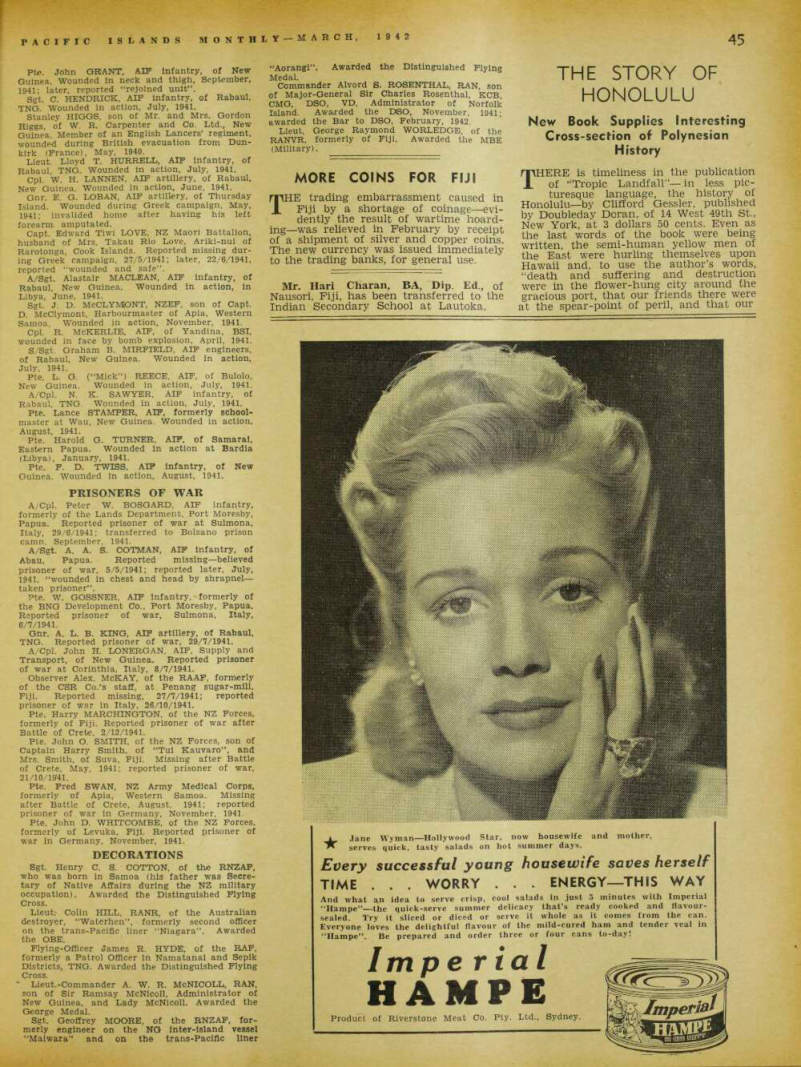
(It is hoped to assemble, here, the names of men, former residents of the Pacific Territories, which appear in British and Free French casualty lists, or in lists of honours awarded.
We should be grateful if relations and friends would send us details.)
Killed
Pilot-Officer Len BAYLISS, flying instructor in the RAAF, formerly of Rabaul, New Guinea.
Killed in Sydney, 18/11/1940, when he fell from a trainer aircraft in flight.
A/Bdr. Neville W. BERTWISTLE, AIF artillery (tank unit), formerly a clerk on the staff of W. R. Carpenter and Co. Ltd., of Rabaul, New Guinea. Killed in action, April, 1941.
Pte. W. R .M. BRADNAM, of the NZ Forces, formerly of Fiji. Reported killed in action in the Middle East, 25/11/1941.
Flight-Lieutenant G. J. I. CLARICE, of the RAAF, formerly Assistant Flight Superintendent of Carpenter Airlines, New Guinea. Killed in action during operations off Dakar (French West Africa), while attached to HMAS “Aus tralia”, September, 1940.
Flying-Officer Jack R. COATH, of the RNZAF, formerly on the staff of the Bank of New Zealand, in Suva, Fiji. Killed October, 1941, when a training aircraft crashed in NZ.
Pte. Felix CRAIG, AIF, formerly of accounts department, Australasian Petroleum Co., Port Moresby, Papua. Killed in action, June, 1941.
Observer V. L. DEARMAN, of the RAAF, for merly overseer and clerk at the Colonial Sugar Refining Co., Ltd., Rarawai, Fiji. Reported killed in action in the Middle East, October, 1941.
Captain Kenneth GARDEN, of the RAF Ferry Command, formerly of Guinea Airways Ltd., in New Guinea. Killed. 2/9/1941, when a bomber he “ferried” from USA crashed on west coast of Britain.
Flying-Officer Moresby GOFTON, of the RAF, son of Mrs. F. S. Stewart, of Wau, New Guinea Reported missing, 17/5/1940—presumed killed in air operations.
Pte. Wallace GRAHAM, of the NZ Forces (infantry), formerly on the staff of Morris Hedstrom Ltd., Fiji. Killed in action in the Middle East, November, 1941.
Flying-Officer Alan JOHNSTONE, of the RAF, who was born in Suva, Fiji, In 1915. Killed during bombing raid on Kristiansand, Norway, April, 1940.
Pte. L. F, McCarthy, AIF infantry, form erly supercargo on W. R. Carpenter and Co.’s inter-island vessels “Desikoko” and “Mako”, in New Guinea. Reported “killed in action” in Syria, 30/10/1941.
Pte. Edward Harold PRICE, 2nd NZEF (Machine-gun Battalion), youngest son of Mr. and Mrs. J. Price, Savu Savu West, Fiji. Killed in action during the Libyan campaign, Middle East, 27/11/1941.
Captain W. H. ROBERTS, NZEF, who was Accountant in the Samoa Treasury Dept., dur ing 1934-35. Killed in action in Libya, Decem ber, 1941.
Cpl. Alex. C. SCOTT, AIF, formerly manager at Kieta, TNG, for Burns, Philp and Co. Ltd.
Killed in action in the Middle East, 19/6/1941.
Pte. Popoare TANGIITI, of the NZ Forces (Maori Battalion), formerly of Mangaia, Cook Islands. Reported “missing after Battle of Greece—presumed dead”, July, 1941.
Died From Wounds
Pte. Ernest HENRY, AIF, formerly of the Rabaul (NG) staff of Burns, Philp and Co.
Ltd. Died from wounds received in Battle of Crete, 1/6/1941.
Pte. Walter PEARSON, of first NG quota of AIF (infantry). Died from wounds received In action, 24/6/1941.
A/Bdr. W. R. SCOTT, AIF, of New Guinea.
Died from wounds, July, 1941.
Sgt.-Pilot Peter Clarkson WISE, of the RAF, son of Mir. W. Wise, OBE, Director of Public Works, Fiji. Died from wounds received during bombing raid over Germany, January, 1941.
Died From Illness
Pte. Clarence A. HUTTON, AIF, formerly of Edie Creek, TNG. Died from illness, April, 19’4L Major P. J. WOODHILL, AIF infantry, formerly legal assistant in the Crown Law Office, Rabaul, New Guinea. Reported “deceased”, December, 1941.
Missing
Pte. P. F. BAILEY, AIF infantry, of Rabaul, TNG. Reported missing, 17/2/1942.
Pte. E. L. CHRISTIE, AIF infantry, of Rabaul, TNG. Reported missing, 17/2/1942.
Pte. A. G. DICKSON, AIF infantry, of Rabaul, TNG. Reported “missing, believed wounded”, 17/2/1942.
Pte. Ernest (“Paddy”) McGEADY, NZEF, son of Mrs. J. McGeady, of Suva, Fiji. Reported “missing, believed killed”, in Libya, January, 1942.
Pte. R. J. PASCOE, AIF infantry, of Rabaul, TNG. Reported missing, 27/1/1942.
Pilot Tom PATTERSON, of the RNZAF, formerly of Levuka, Fiji. Reported missing, in November, 1941, after bombing raid on the Continent.
Gnr. Allan H. ROSS, AIF artillery, formerly planter in New Britain, TNG. Reported missing —believed prisoner of war, 28/9/1941.
Pte. William RUPE, of the NZ Forces (Maori Battalion), formerly of Aitutaki, Cook Islands.
Reported “missing after Battle of Greece”, July, 1941.
Pilot James SIMPSON, of the RAF, formerly of Vatukoula, Fiji. Reported missing after air operations over Malta, in the Mediterranean, 1/7/1941.
LAC Charles SOLLITT, RAAF wireless opera tor, son of Mr. and Mrs. C. H. Sollitt, of Nausori, Fiji. Reported missing after air opera tions in New Guinea, 21/1/1942.
Pilot-Officer Neville George STOKES, of the RAF, formerly a pilot with Guinea Airways, Ltd., in New Guinea. Reported missing after air operations in Europe, December, 1941.
Wounded
Pte. V. BLANCO, AIF infantry, of Thursday Island. Wounded in action, July, 1941.
L/Cpl, J. P. BLENCOWE, AIF infantry, of Rabaul, TNG. Wounded in action, July, 1941.
Pte. George BUCKNELL, AIF, son of Mr. and Mrs. C. Bucknell, of Korolevu, Fiji. Wounded in action in Malaya, January, 19’42.
Pte. Thomas BYERS, AIF infantry, of Thurs day Island. Wounded in action. May, 19’41.
Acting Warrant-Officer V. M. I. GORDON, AIF infantry, of Wau, TNG. Wounded in action, February, 1942.
Pte. John GRANT, AIF infantry, of New Guinea. Wounded in neck and thigh, September, 1941; later, reported “rejoined unit”.
Sgt. C. HENDRICK, AIF infantry, of Rabaul, TNG. Wounded in action, July, 1941.
Stanley HIGGS, son of Mr. and Mrs. Gordon Higgs, of W. R. Carpenter and Co. Ltd., New Guinea. Member of an English Lancers’ regiment, wounded during British evacuation from Dun kirk (France), May, 1940.
Lieut. Lloyd T. HURRELL, AIF infantry, of Rabaul, TNG. Wounded in action, July, 1941.
Cpl. w. H. LANNEN, AIF artillery, of Rabaul, New Guinea. Wounded in action, June, 1941.
Gnr. E. G. LOBAN, AIF artillery, of Thursday Island. Wounded during Greek campaign, May, 1941; invalided home after having his left forearm amputated.
Capt. Edward Tiwi LOVE, NZ Maori Battalion, husband of Mrs. Takau Rio Love, Arikl-nui of Rarotonga, Cook Islands. Reported missing dur ing Greek campaign, 27/5/1941; later, 22/6/1941, reported “wounded and safe”.
A/Sgt. Alastair MACLEAN, AIF infantry, of Rabaul, New Guinea. Wounded in action, in Libya, June, 1941.
Sgt. J. D. McCLYMIONT, NZEF, son of Capt.
D. McClymont, Harbourmaster of Apia, Western Samoa. Wounded in action, November, 1941.
Cpl. R. McKERLIE, AIF, of Yandina, BSI, wounded in face by bomb explosion, April, 1941.
S/Sgt. Graham B. MIRPTELD, AIF engineers, of Rabaul, New Guinea. Wounded in action, July, 1941.
Pte. L. G. (“Mick”) REECE, AIF, of Bulolo, New Guinea. Wounded in action, July, 1941.
A/Cpl. N. K. SAWYER, AIF infantry, of Rabaul, TNG. Wounded in action, July, 1941.
Pte. Lance STAMPER, AIF, formerly school master at Wau, New Guinea. Wounded in action, August, 1941.
Pte. Harold G. TURNER, AIF, of Samaral, Eastern Papua. Wounded in action at Bardia (Libya), January, 1941.
Pte. F. D. TWISS, AIF infantry, of New Guinea. Wounded in action, August, 1941.
Prisoners Of War
A/Cpl. Peter W. BOSGARD, AIF infantry, formerly of the Lands Department, Port Moresby, Papua. Reported prisoner of war at Sulmona, Italy, 29/6/1941; transferred to Bolzano prison camp. September, 1941.
A/Sgt. A. A. S. COTMAN, AIF Infantry, of Abau, Papua. Reported missing—believed prisoner of war, 5/5/1941; reported later, July, 1941, “wounded in chest and head by shrapnel— taken prisoner”.
Pte. W. GOSSNER, AIF infantry,' formerly of the BNG Development Co., Port Moresby, Papua.
Reported prisoner of war, Sulmona, Italy, 6/7/1941.
Gnr. A. L. B. KING, AIF artillery, of Rabaul, TNG. Reported prisoner of war, 29/7/1941.
A/Cpl. John H. LONERGAN, AIF, Supply and Transport, of New Guinea. Reported prisoner of war at Corinthia, Italy, 8/7/1941.
Observer Alex. McKAY, of the RAAF, formerly of the CSR Co.’s staff, at Penang sugar-mill, Fiji. Reported missing, 27/7/1941; reported prisoner of war in Italy, 26/10/1941.
Pte. Harry MARCHINGTON, of the NZ Forces, formerly of Fiji. Reported prisoner of war after Battle of Crete, 2/12/1941.
Pte. John O. SMITH, of the NZ Forces, son of Captain Harry Smith, of “Tui Kauvaro”, and Mrs. Smith, of Suva, Fiji. Missing after Battle of Crete, May, 1941; reported prisoner of war, 21/10/1941.
Pte. Fred SWAN, NZ Army Medical Corps, formerly of Apia, Western Samoa. Missing after Battle of Crete, August, 1941; reported prisoner of war in Germany, November, 1941.
Pte. John D. WHITCOMBE, of the NZ Forces, formerly of Levuka, Fiji. Reported prisoner of war in Germany, November, 1941.
Decorations
Sgt. Henry C. S. COTTON, of the RNZAF, who was born in Samoa (his father was Secre tary of Native Affairs during the NZ military occupation). Awarded the Distinguished Plying Cross.
Lieut. Colin HILL, RANR, of the Australian destroyer, “Waterhen”, formerly second officer on the trans-Pacific liner “Niagara”. Awarded the OBE.
Flying-Officer James R. HYDE, of the RAF, formerly a Patrol Officer In Namatanal and Sepik Districts, TNG. Awarded the Distinguished Flying Cross. ’ Lieut.-Commander A. W. R. McNICOLL, RAN, son of Sir Ramsay McNicoll, Administrator of New Guinea, and Lady McNicoll. Awarded the George Medal.
Sgt. Geoffrey MOORE, of the RNZAF, for merly engineer on the NO inter-island vessel “Maiwara” and on the trans-Paciflc liner
“Aorangi”. Awarded the Distinguished Plying Medal.
Commander Alvord S. ROSENTHAL, RAN, son of Major-General Sir Charles Rosenthal, KCB, CMG, DSO, VD, Administrator of Norfolk Island. Awarded the DSO, November, 1941; awarded the Bar to DSO, February, 1942.
Lieut. George Raymond WORLEDGB, of the RANVR, formerly of Fiji. Awarded the MBE (Military).
More Coins For Fiji
THE trading embarrassment caused in Fiji by a shortage of coinage—evi dently the result of wartime hoard ing—was relieved in February by receipt of a shipment of silver and copper coins.
The new currency was issued immediately to the trading banks, for general use.
Mr. Hari Charan, BA, Dip. Ed., of Nausori, Fiji, has been transferred to the Indian Secondary School at Lautoka.
The Story Of
Honolulu
New Book supplies Interesting Cross-section of Polyesian History
THERE is timeliness in the publication of “Tropic Landfall” —in less pic turesque language, the history of Honolulu—by Clifford Gessler, published by Doubleday Doran, of 14 West 49th St., New York, at 3 dollars 50 cents. Even as the last words of the book were being written, the semi-human yellow men of the East were hurling themselves upon Hawaii and, to use the author’s words, “death and suffering and destruction were in the flower-hung city around the gracious port, that our friends there were at the spear-point of peril, and that our
nation’s life was at stake on that wide, blue frontier of which Honolulu was the centre and the gate”.
But the book has little to do with war.
It is the story of how “Brown’s Harbour”,
a native fishing village in 1790, became within a century Honolulu, the world famed city of tropical glamour. One is taken, step by step, through a most romantic and colourful history the period of the rival kings; the rise and fall of missionary influence; and brutalising decades of the sandalwooders and whalers; the extraordinary story of the an £ es i ation; anc * then, “Americanisation” —that period in which lei selling is a stnctly commercialised industry, in which the haunting ukulele music wafted from the crowded pier is synthetic and only remotely related to the ancient chants of Hawaii, m which the diving boys were
designed and trained as bait for sen timental tourists. Nevertheless, as the author insists, Honolulu has an “atmos phere that is distinctive and unfor gettable, like that of Tahiti.
Americanisation ” —was there a sneer in the use of that word? There should not be because, if American enterprise and industry have capitalised the glamour of Honolulu, they also have turned the once remote group into the richest, most pro ductive and most useful territory in the Pacific. And what America has done to Hawaii, America can and will do to many South Pacific lands, after the war, when she has saved them from Japan’s barbarous hordes.
The author wanders over a wide, but fascinating field. His history bristles with stories of sea-adventure. In 150 years, there came into Honolulu an extra ordinary number of folk who had been either shipwrecked, suffered mutiny, been boarded by pirates, or were searching for buried treasure; and Mr. Gessler, with a keen eye for drama, has lined up most of the stories, and the essential dates But one hopes that he, as an historian, is more accurate in his other stories than he is in the chapter which he devotes to “Bully Hayes”. He appears, in his sum mary of the career of that famous old sea-rover, to have gone for his “facts” to the novelists, pamphleteers and penny-a liners who, by the score, wove semi romantic stories around the picturesque “Bully”. It so happens that this reviewer holds (for publication, one day) a couple of lengthy old manuscripts which contain the complete and true story of the life of “Bully” Hayes; and, while they are as interesting and exciting as any modern writer could ask, they show the liberties that have been taken with the story of Hayes, and that the real man was very different from the incredible creation of the pamphleteers and penny-a-liners Mr. Gessler tells the story of Hawaiian immigration—so that one begins to under stand how the territory acquired that amazing agglomeration of Chinese, Por tuguese, Gilbert Islanders, Japanese and Filipinos. He tells also of how these races are mixing. He says they are producing an attractive hybrid people, loyal to the United States, That clearly was written prior to the Pearl Harbour incident.
Australia and New Zealand, Canada and California were often attacked on their policy of barring their doors against Jap immigration; but everything they ever did is justified by what happened in Hawaii in December, 1941—the story of which has not yet been told.
The author delves most interestingly in the field of Polynesian origins and Polynesian migrations. He accents the theory—already well proved—of the Euro poid origin of Polynesia: and is content with the explanation of an exploratory eastwards voyage, to account for the presence of the kumera and other South American things in Polynesia.
He is not sure about the technique of Polynesian navigators—is inclined to dis miss the claim that they used ingenious instruments of their own design. Mr.
Gessler should get in touch with Mr.
Harold Gatty, Pan American Airways manager at Auckland, and the navigator who first flew around the world with Wiley Post. Mr. Gatty has a remarkable collection of material for his forthcoming book on the history of navigation, and he knows more than any other man about Polynesian navigation. Mr. Gatty probably will prove that the Polynesians did use the devices referred to by Mr. Gessler.
“Tropic Landfall” is a big volume, most “readable”, and valuable as a book of reference. One notes, in the copious index, the names of practically every event, trend, person, and ship which has gone on record in the Polynesian section of the Pacific during the past hundred years.—R.
Advertisements & other items, pp. 47-48 (1 item)
Impe rial
★ Jane Wyman—Hollywood Star, now housewife and mother, serves quick, tasty salads on hot summer days.
Every successful young housewife saves herself
TIME . . . WORRY . . . ENERGY—THIS WAY And what an idea to serve crisp, cool salads in just 5 minutes with Imperial “Hampe”—the quick-serve summer delicacy that’s ready cooked and flavoursealed. Try it sliced or diced or serve it whole as it comes from the can.
Everyone loves the delightful flavour of the mild-cured ham and tender veal in “Hampe”. Be prepared and order three or four cans to-day!
Impe rial
HAMPE
Product of Riverstone Meat Co. Pty. Ltd., Sydney.
Cl
Imperial
GRAMOPHONE RECORDS
SEND US YOUR ORDERS.
Goods sent C.OD. at no extra charge.
Catalogues sent without obligation.
THE TALKERIES,
161 Castlereagh Street, SYDNEY.
READ THE
B.P. MAGAZINE
AUTUMN NUMBER
iiiiiiiitiiiiiiiiiiiiiiiiiiiiiiiniiiiiiin
NOW ON SALE
Short Stories --- Pictures Travel Articles Pages for the Children Stage Latest Fashions Screen A
ONE SHILLING PER COPY.
ON SALE AT ALL NEWSAGENTS AND BOOKSELLERS
Asthma Mucus Dissolved in 1 Day
Since the discovery of Mendaco by a famous physician it is no longer necessary for anyone to suffer from choking, wheezing, gasping Asthma. Mendaco does away with expensive injections and offensive smokes.
All you do is to take 2 tasteless tablets with meals and Mendaco starts circulating through the blood in 10 minutes. Soon the choking mucus and phlegm dissolves. You breathe easily and freely. Your nerves relax, you get good, fresh, pure air into your lungs, and vigour returns.
Sleep Like a Baby
Thousands of former sufferers from Asthma say that the very first dose of Mendaco brought them glorious ease and comfort, and that they slept soundly the very first night. Then their vigour returned and they felt healthier and stronger, and 5 to 10 years younger. The reason for this is that Mendaco acts in natural ways to overcome the effects of Asthma. (1) It dissolves, liquefies and removes the strangling mucus or phlegm ; (2) It relaxes thousands of tiny muscles in your bronchial tubes so that the air can get in and out of your lungs ; (3) It promotes body vigour, and stimulates the building of rich, revitalised blood.
No Asthma for Five Years
Mendaco not only brings almost immediate results, free breathing and comfort and enables you to sleep, but also builds up the system to ward on future attacks. Mr. J. R.
writes : “I was almost dead with Asthma.
Had lost 40 lbs. in weight, suffered coughing, choking and strangling every night—couldn’t sleep—expected to die. Mendaco stopped spasms first night and I have had no Asthma since in over 2 years.” Mrs. A. W. writes : “I had Asthma for 25 years. After using Mendaco I can sleep all night and have not had an attack since taking it.” Mrs. G. E. C. writes : ‘‘l bless the day I first heard of Mendaco. What a god-send it is to a poor woman like me who for 35 years never knew what it was to have a good night’s rest.
The constant fight between Asthma and sleep was wearing me down, but I feel now I want to forget my past suffering.”
Benefits Immediate
The very first dose of Mendaco goes right to work circulating through your blood and helping nature rid you of the effects of Asthma. Try Mendaco under an iron-clad money back guarantee. You be the judge.
If you don’t feel entirely well and fully satisfied after taking Mendaco just return the package and the purchase price will be refunded. Get Mendaco from your Chemist today and see how well you sleep tonight and how much better you will feel. mm toNQUf n s A s t h m
Mendaco
Now in 3 sizes
3/-6/- and 12/-
Territories
Residents
Evacuees in Australia
THE following are the names of people who have been evacuated from New Guinea, Papua and Solomons, and are living temporarily in Australia. In most cases, they are an addition to the lists we published in February; in others, they represent changes of address.
Many people (especially men) have come to Australia, in addition to those listed. Some record of them appears to have been made by the New Guinea Trade Agency; but the complete official list of them, which we were anxious to publish this month as a matter of pub lic convenience, is not yet available at the Agency.
The following list has been compiled by our staff from numerous sources.
A Alt, Mrs. H. (NG), c/o Mrs. O. Schulz, “The Gums”, Murtoa, V.
Armit, L. P. B. (P), c/o Travel Dept., Bank of NSW, Sydney, NSW.
B Barrett, A. R. (BSD, c/o SDA Mission, Wahroonga, NSW.
Bartlett. Rev. H. K. (P), c/o Methodist Mission, 139 Castlereagh St., Sydney,
Nsw.
Bates, Mrs. R., and 1 child (NG), 26 Seaview St., Caulfield, V.
Behrendorff, Mrs. L. (NG), 121 Dornoch Terrace, Sth. Brisbane, Q.
Bell, Mrs. Joan, and 1 child (NG), c/o L. F. D. Carter, 431 Sandy Bay Rd., Hobart, T.
Bellamy, George (NG), Sydney, NSW.
Bensley, B. (NG). Escaped from N.
Britain. In Australia.
Bieri, Mrs. A. (NG), c/o Mrs. C. Graham, Collins Rd., St. Ives, NSW.
Bitton, I. (NG), Sydney, NSW.
Blake, Harry (NG), Sydney. NSW.
Boerner, Mrs. M. (NG), c/o-Mr. O. Krieg, Nuriootpa, SA.
Boreham, Robert (NG), Sydney, NSW.
Bourne. Mr. and Mrs. A. W. (BSD, Brisbane, Q.
Brearley, H. S. (NG). In Australia.
Brereton, A. C. (NG), Sydney, NSW.
Britten, E. (NG), Commonwealth Inves tigation Office, Little Collins St., Mel bourne, V. .
Brooks, Rev. A. J. (P), c/o Methodist Mission, 139 Castlereagh St., Sydney,
Nsw. A „
Brough, C. (P), c/o BP and Co. Ltd., 7 Bridge St., Sydney.
Brown, (NG). In Australia.
C Cannon, Miss Vera (BSD, c/o NZ Meth odist Mission, Probert Chambers, Queen St., Auckland, NZ.
Clarke, Pilot Ernest (NG), Sydney, NSW.
Coltheart, Miss Daisy (P), c/o Methodist Mission, 139 Castlereagh St., Sydney,
Nsw.
Cormack, J. (BSD, c/o SDA Mission, Wahroonga, NSW.
Cruickshank, H. (NG), c/o BP and Co.
Ltd., Bridge St., Sydney, NSW.
Cutler, F. O. (NG), Middle Brighton, V.
D Deland, Dr. and Mrs. C. M., and four children (NG), Goodwood, SA.
De Lautour, E. A. (NG), 55 Pittwater Rd., Pymble, NSW. (JX 1445.) Doering, Mrs. F. (NG), c/o Rev. Venz, Highfields, via Toowoomba, Q.
E Edwards, D. (NG), Sydney, NSW.
Eekhoff, H. G. (NG), Room 807, Masonic Club, 171 Castlereagh St., Sydney, NSW.
Eekhoff, Mrs. H. G. (NG), Dalby, Q.
Evans, C. W. M. (NG), Sydney, NSW.
Exon, Mrs. F. (F), c/o J. F. Herring, “Tiverton”, Maryborough, V.
F Farnsworth, W. (NG), c/o AWA Ltd., 47 York St, Sydney, NSW.
Ferris, D. (BSD, c/o SDA Mission, Wahroonga, NSW.
Fisher, Mr. and Mrs. C. R. (P), c/o LMS, 250 Pitt St., Sydney, NSW.
G Gill, L. F. (BSD, 3 Heywood St., Caul field, SE7, V.
Goad, Malcolm (NG), Sydney, NSW.
Goodwin, F. (NG). Escaped from Wau.
In Australia.
Gordon, Rev. H. P. K. (P), c/o Methodist Mission, 139 Castlereagh St., Sydney,
Nsw.
Gosling, J. (BSD, c/o SDA Mission, Wahroonga, NSW.
Gough, T. P. (P), Sydney, NSW.
Grant, Rev. R. V. (P), c/o Methodist Mission, 139 Castlereagh St., Sydney,
Nsw.
Gridley. H. C. (NG), Sydney, NSW.
Grieg, Mr. and Mrs. K. E. M. (P), c/o Mrs. Chalmers, 13 Knowle Ave., Arn cliffe, NSW.
H Harmon, R. B. (NG), Sydney, NSW Hartness, Miss Effie (BSD, c/o NZ Meth odist Mission, Probert Chambers, Queen St., Auckland, NZ.
Harvey, (NG). Escaped from N.
Britain. In Australia.
Haydon, W. A. (NG), 22 Carey St., Manly, NSW.
Henning, C. (P), Sydney, NSW.
Herbert-Hughes, Mr. and Mrs. W, (P),
Portland, Hawkesbury River,
Nsw.
Hickey, L. (P), Melbourne, V.
Hiscqck, (NG). Escaped from N. Bri tain. In Australia.
Hobbs, W. G. (BSD, c/o Lever’s Pacific Plantations Pty. Ltd., 469 Kent St., Sydney, NSW.
Holmes, E. P. (NG), “Carinthia”, Spring field Ave., Potts Point, NSW Horton, Val. (NG), Brisbane, Q Howard, Eric (NG), Sydney, NSW Howse, Mr. and Mrs. J. P. (BSD, c'o SDA Mission, Wahroonga, NSW I IS °NSW red ' <BSI) ’ 2 Lea St " Croydon ' J Johnson, Mr. and Mrs. J. A. (NG) 2 O'Connell St., West End. Sth. Bris bane, Q.
Jones, Sister Lina (BSD, c'o NZ Meth odist Mission, Probert Chambers Queen St., Auckland, NZ.
K Kincaid, Bert. (NG), Sydney, NSW.
L Leadley, E. J. (BSD, c/o NZ Methodist Mission, Probert Chambers, Queen St Auckland, NZ.
Lehner, Mrs. S. (NG), 248 Young St, Nth. Unley, Adelaide, SA.
Lett, Mr. and Mrs. Lewis (P), c/o Bank of NSW, Melbourne, V.
Livingstone, Mrs. M. E. (NG), 24 Fair light St., Manly, NSW.
Luke, Mr. and Mrs. W. A. P. (NG). c/o AWA Ltd., Perth, WA.
Luxton, Rev. C. T. J. (NG), c/o Metho dist Mission, 139 Castlereagh St., Sydney, NSW.
M MacNamara, J. P. (NG), “Malola”, 3 Ed mund St., Chatswood, NSW.
McAdam, (NG). In Australia.
McCarthy, J. (P), c/o Hotel Metropole, Sydney, NSW.
McDonald, Sister Grace (BSD, c/o NZ Methodist Mission, Probert Chambers, Queen St, Auckland, NZ.
McEwan, Mrs. M. (NG), c/o 11 Rose St., Bowral, NSW.
Mager. Mrs. J. (NG), c/o Rev. Venz, Highfields, via Toowoomba, Q.
Maplehoft, Mr. and Mrs. (BSD, c/o BP and Co. Ltd., 7 Bridge St.. Sydney,
Nsw.
Markham, H. A. (BSD, c/o Mr. Black, BP and Co. Ltd., Bridge St.. Sydney,
Nsw.
Meares, Mrs. C. D„ and 2 children (NG), 27 Gerald St., Murrumbeena, SE9, V.
Merrylees, J. H. (NG), Sydney, NSW.
Minehan, M. (NG). In Australia.
Muddell, S. (P), Sydney, NSW.
Muir, Miss Hetty (P), c/o Methodist Mission, 139 Castlereagh St., Sydney,
Nsw.
Murray, Mrs. P. I. (NG), c/o Mrs. Morri son, Morrison Rd., Ryde, NSW.
N Neal, S. G. (NG), c/o BP and Co. Ltd., Bridge St., Sydney, NSW.
Neill, Robert (NG), Sydney, NSW.
Newall E. P. (NG), Flat 6, 111 Darling hurst Rd., Sydney, NSW.
Noble, E. (NG). Escaped from Lae. In Australia Nolan, H. W. (P), c/o SDA Mission, Wahroonga, NSW.
O Osborne, P. R. (P), c/o Cuthbert’s Misima Goldmine Ltd., 22 Bridge St., Sydney,
Nsw.
p Pascoe, C. (NG), c/o SDA Mission, Wahroonga, NSW.
Pasley, S. M. (NG) Sydney NSW.
Pearce, Miss Florence (P), c/o Methodist Mission, 139 Castlereagh St., Sydney,
Nsw.
Perry Mr. and Mrs. J. (BSI), c/o SDA Mission, Wahroonga, NSW.
Pitty, Miss Nell (P), c/o Methodist Mis sion, 139 Castlereagh St., Sydney, NSW.
Flatten, Rev. G. J. (NG), c/o Methodist Mission, 139 Castlereagh St., Sydney,
Nsw.
Pollard, P. C. (NG). In Australia.
Purvis, W. (P), Southport, Q.
R Radke, Mrs. T. (NG), c/o Rev. J. Stolz, 39 Hill St., Nth. Adelaide, SA.
Rawson, Capt. J. W. (BSI), c/o Lever’s Pacific Plantations Pty. Ltd., 469 Kent St., Sydney, NSW.
Reid, Mrs. J. D. (NG), 35 Pittwater Rd., Gladesville, NSW.
Rentoul, A. C. (P). In Australia.
Ridge, Arthur (NG), Prospect, SA.
Rigby, J. R. (NG), Sydney, NSW.
Rooke, Mrs. Muriel (NG), 50 O’Donnell St., Nth. Bondi, NSW.
Rowe, Max (NG), Unley, SA.
Rutter, Dr. A. G. (BSI), c/o NZ Meth odist Mission, Frobert Chambers, Queen St., Auckland, NZ.
S Schamann, Mrs. H. (NG), c/o Rev. M.
Larsen, Murtoa, V.
Sedges, J. B. (NG), Brisbane, Q.
Seton, C. W. (BSI), 111 Darlinghurst Rd., King’s Cross, NSW.
Simpson, A. H. (P). In Australia.
Sinclair, Dr. B. A. (NG), Sydney, NSW.
Smith, Mrs. A. A., and 3 children (NG), c/o Mrs. M. Carden, Queen St., Moruya, NSW.
Smith, B. (NG), Sydney, NSW.
Smith, F. P. (P), c/o BP and Co. Ltd., 7 Bridge St., Sydney, NSW.
Stahl, Rev. and Mrs. W. F. (NG), c/o F.
Holtkamp, Murtoa, V.
Stephens, Eric (NG), Brisbane, Q.
Stewart, Mrs. F. S. (NG), 93 Woodlands St., Balgowlah, NSW.
Stock, Nurse E. (NG), Brisbane, Q.
T Taylour, H. (NG), 22 Wentworth St., Dover Heights, NSW.
Tebb, R. (NG). In Australia.
Thomas, Mrs. G. (NG), c/o Mr. A. T.
Saxby, Taree, NSW.
Totenhofer, Sister E. (BSI), c/o SDA Mission, Wahroonga, NSW.
Tucker, C. (BSI), c/o SDA Mission, Wahroonga, NSW.
Twyford, Miss Edith (F), c/o Methodist Mission, 139 Castlereagh St., Sydney,
Nsw.
V Vaskess, Mrs. H. (F), 94 Birriga Rd., Bellevue Hill, NSW.
W Wagner, Mrs. H. (NG), c/o Mr. A. Becker, Tanunda, SA.
Wagner, Mrs. E. (NG), c/o 83 Ashley St., Torrensville, Adelaide, SA.
Wells, Mrs. A. (P), “Kirketon”, 229 Dar linghurst Rd., King’s Cross, NSW.
Welsch, Mrs. J. (NG), c/o Mr. G. Krueger, Murtoa, V.
West, G. A. (BSD, c/o Dr. Williams, Bourke St., Goulburn, NSW.
White, Norman (NG), 23 Eton Rd., Lind held, NSW. (JA 1963.) Wilde, Norman (NG), Brisbane, Q.
Williams, (NG). Escaped from N.
Britain. In Australia.
Williams, Rev. H. T. (P) c/o Methodist Mission 139 Castlereagh St., Sydney,
Nsw.
Wood, P. J. (P). In Australia.
Wyborn, A. (P), 9 Parks Ave., Merrylands,
Nsw.
In the above list, the following abbreviations are used: New Guinea —NG; Papua—P; British Solomon Islands—BSl; Fiji—F; Queensland—Q; New South Wales —'NSW; Victoria —V; South Australia—SA; Western Australia —WA; Tas mania—T; New Zealand —NZ.
The recent appointment of Mr. D. C.
Campbell, of Uganda (Africa), to be Colonial Secretary of Fiji, has been revoked and Mr. Campbell instead will proceed to Gibraltar.
Advertisements & other items, pp. 49-50 (1 item)
ms* Pi
At Blue Mountains—Sprlngwood, N.S.W.
Springwood Ladies* College
Est. 1897. Kindergarten to Leaving Certificate. Tennis, Riding, Swimming, Team Games. Unequalled climate. Pure Jersey Milk. Senior and Junior Houses.
Open-air sleeping. Inclusive fees. Special vacation arrangements for Island pupils.
M. E. DURAND, Principal.
SURE,SAFE WAY TO
✓ aM X /
m mmim
mu comma
When you take Genuine Vincent’s A.P.C. Powders or Tablets you are taking the original, scientific prescription of Aspirin, Phenacetin and Caffeine as first used in one of Australia’s largest public hospitals. That is why you can be so confident of safer, more soothing relief from the pain of all tropical complaints.
Does Not Affect the Heart.
Powders & Tablets, 1/6 and 2/6.
Singles, 2d. ea
FOR SAFETY’S SAKE—SAY “VINCENT’S.’
f
ms* Pi
7 **/
Guard against Infection with Tenax!
Germicidal Soap used regularly is an
unsurpassed safeguard against external germ
infection. It is kind to the most sensitive skin, yet its germicidal action is eleven times as rapid as carbolic. It is non-irritant and non-poisonous.
At All Chemists and Stores.
TENAX ‘Uhe Genuinely Germicidal SOAP
Now Only
TENAX
9 D. per Tablet.
TWIT
SOAP
BV APPOINTMENT
Horlkks is Ideal
for Emergency Rations
For emergencies, with the addition of water only, Horlicks is a complete food, providing warmth and energy, body-building and tissue-repairing material.
Even after it has been opened Horlicks will keep in perfect condition indefinitely if the top is firmly replaced.
It would be difficult to find a more valuable food to keep by in case of emergency.
HORLICKS
Fifth Column In Fiji?
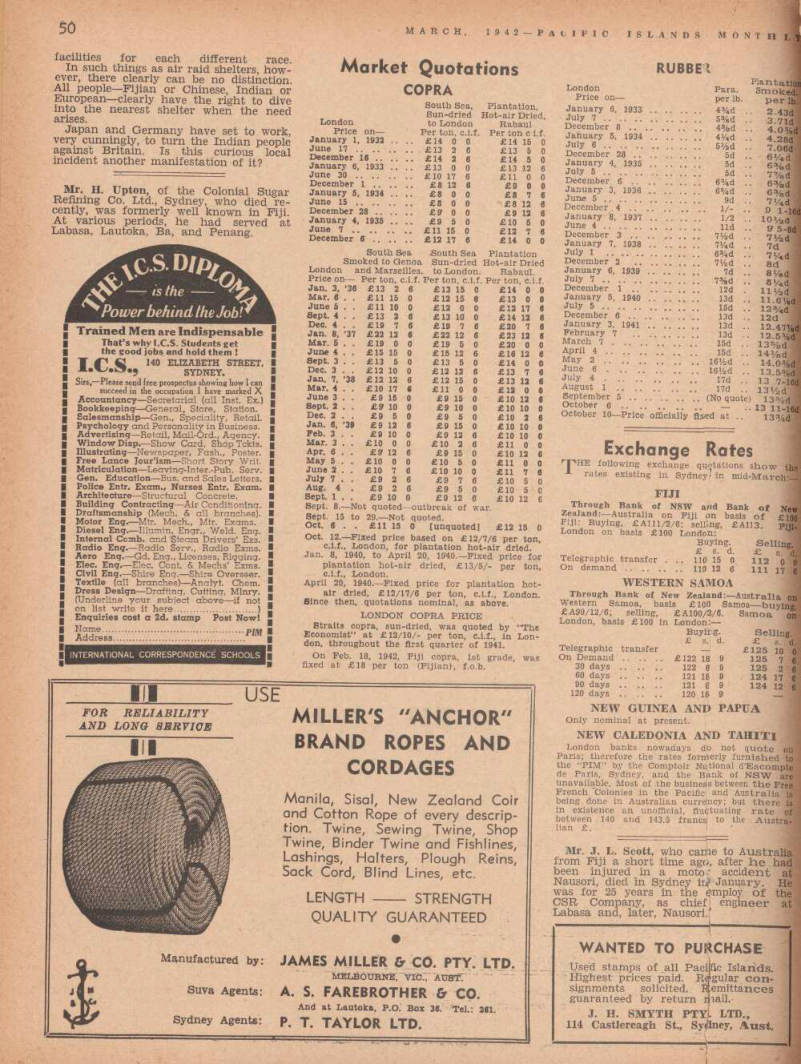
Prom Our Own Correspondent
Suva, Feb. 20.
SOME suspect that Fifth Columnists are trying to work upon our Indian people. How else can we explain the silly but persistent rumour that air raid shelters which have been provided here by the Government may not be used by the Indians?
The Indians are sensitive—ridiculously so—on this subject of racial distincticms being made in the use of public facilities.
They are up in arms at the mere sugges tion of distinctions being made between Indians and Europeans—yet we have four communities here (Europeans, Indians, Chinese and Fijians) who are widely separated by history, traditions and stan dards of living, and embarrassments often can be avoided by providing separate
facilities for each different race.
In such things as air raid shelters, how ever, there clearly can be no distinction.
All people—Fijian or Chinese, Indian or European—clearly have the right to dive into the nearest shelter when the need arises.
Japan and Germany have set to work, very cunningly, to turn the Indian people against Britain. Is this curious local incident another manifestation of it?
Mr. H. Upton, of the Colonial Sugar Refining Co. Ltd., Sydney, who died re cently, was formerly well known in Fiji.
At various periods, he had served at Labasa, Lautoka, Ba, and Penang.
Advertisements & other items, pp. 51-52 (1 item)
Aunt Mary’s
There is no suhstituie for
OLD MONK
VIRGIN PURE
OLIVE OIL
San Francisco
READY TO HEAT
AND SERVE!
Aunt Mary’s
PREPARED SOUPS AND
TASTY MEAL-TIME PRODUCTS
include delicious Mulligatawny, Tomato, Pea and other rich Soups, also Baked Beans with Tomato Sauce, Curried Baked Beans, Spaghetti with Cheese, Curried Spaghetti and other appetizing, wholesome iood products. Ready to heat and serve 1
Aunt Mary’s
PREPARED
VEGETABLES
offer a great variety of fullflavoured, nutritious dinner vegetables; ready to heat and serve. All Aunt Mary's food products are packed in 1 lb. cans for Tropical conditions
and SOLD BY ALL STORES.
tomato^
General Merchants and
Agents
s it M & Cm REPRESENTING LEADING FIRMS IN THE PACIFIC' ISLANDS
379 KENT STREET,
SYDNEY.
Telephones: MJ 4657 (5 lines).
Islands Produce Sold on Shippers’ Account Buyers of all Islands’ requirements on Commis Liberal Advances against Consignments. sion Original Invoices Furnished. 25 Years’ Islands Trade Experience.
Bankers: Bank of New South Wales. Correspondence in English and French.
\S- & D '%
-isthe '
■ Power behind the Job!
Trained Men are Indispensable That’s why I.C.S. Students get the good jobs and hold them !
140 ELIZABETH STREET,
SYDNEY.
Sirs, —Please send free prospectus showing how 1 can succeed in the occupation I have marked X Accountancy —Secretarial (all Inst. Ex.) Bookkeeping —General. Store, Station.
Salesmanship —Gen., Speciality, Retail.
Psychology and Personality in Business.
Advertising —Retail, Mail-Ord., Agency.
Window Disp. —Show Card, Shop Tckts.
Illustrating —Newspaper, Fash., Poster.
Free Lance Jour'ism —Short Story Writ.
Matriculation —Leaving-Inter.-Pub. Serv.
Gen. Education —-Bus. and Sales Letters.
Police Entr. Exam., Nurses Entr. Exam.
Architecture —Structural Concrete.
Building Contracting —Air Conditioning.
Draftsmanship (Mech. & all branches).
Motor Eng. —Mtr. Mech., Mtr. Exams.
Diesel Eng. —lllumin. Engr., Weld. Eng.
Internal Comb, and Steam Drivers' Exs.
Radio Eng. —Radio Serv., Radio Exms.
Aero Eng. —Gd. Eng., Licenses, Rigging.
Elec. Eng. —Elec. Cont. & Mechs' Exms.
Civil Eng. —Shire Eng.—Shire Overseer.
Textile (all branches) —Analyt. Chem.
Dress Design —Drafting, Cutting, Mlnry. (Underline your subject above—if not on list write it here ) Enquiries cost a 2d. stamp Post Now!
Name...
Address pm
INTERNATIONAL CORRESPONDENCE SCHOOLS
11l
FOR RELIABILITY
AND LONG SERVICE
USE
MILLER'S "ANCHOR"
BRAND ROPES AND
CORDAGES
Manila, Sisal, New Zealand Coir and Cotton Rope of every description. Twine, Sewing Twine, Shop Twine, Binder Twine and Fishlines, Lashings, Halters, Plough Reins, Sack Cord, Blind Lines, etc.
LENGTH STRENGTH
QUALITY GUARANTEED
Manufactured by; JAMES MILLER & CO. PTY. LTD.
MELBOURNE, Via, AUST. T
Suva Agents: A. S. FAREBROTHER & CO.
And at Lautoka, P.O. Box 36. Tel.: 261.
Sydney Agents: p. T. TAYLOR LTD.
Market Quotations
Sept. B.—Not quoted—outbreak of war.
Sept. 15 to 29.—Not quoted.
Oct. 6 . . £ll 15 0 [unquoted] £l2 15 0 Oct. 12.—Fixed price based on £l2/7/6 per ton, c.i.f., London, for plantation hot-air dried.
Jan. 8, 1940, to April 20, 19'40.—Fixed price for plantation hot-air dried, £l3/5/- per ton, c.i.f., London.
April 20, 1940.—Fixed price for plantation hot air dried, £l2/17/6 per ton, c.i.f., London.
Since then, quotations nominal, as above.
London Copra Price
Straits copra, sun-dried, was quoted by ‘‘The Economist” at £l2/10/- per ton, c.i.f., in Lon don, throughout the first quarter of 1941.
On Feb. 18, 1942, Fiji copra, Ist grade, was fixed at £lB per ton (Fijian), f.o.b.
Copra
South Sea, Plantation Sun-dried Hot-air Dried.
London to London Rabaul Price on— Per ton, c.i.f.
Per ton c l.f.
January 1 1933 £14 0 0 £14 15 0 June 17 £13 2 6 £13 5 0 December 16 .. £14 2 6 £14 5 0 January 6 1933 , , £13 0 0 £13 12 6 June 30 . • . . . , £10 17 6 £11 0 0 December 1 .. £8 12 6 £9 0 0
January 5
1934 . • .. £8 0 0 £8 7 6 June 15 . £8 0 0 £8 12 6 December 28 .. £9 0 0 £9 12 6 January 4 1935 • • . • £9 5 0 £10 5 0 June 7 . £11 15 0 £12 7 6 December 6 . . £12 17 6 £14 0 0 South Sea -South Sea Plantation Smoked to Genoa Sun-dried Hot-air Dried London and Marseilles, to London.
Habaul.
Price on— Per ton, c.i.f. Per ton, c.i.f Per ton. c.i.f.
Jan. 3, ’36 £13 2 6 £13 15 0 £14 0 0 Mar. 6 . . £11 15 0 £ 12 15 e £13 0 0 June 5 . . £11 10 0 £12 0 0 £12 17 6 Sept. 4 . . £13 3 6 £13 10 0 £14 12 6 Dec. 4 , . £19 7 6 £19 7 6 £20 7 6 Jan. 8, '37 £22 12 6 £22 12 6 £23 13 6 Mar. 5 . . £19 0 0 £19 5 0 £20 0 0 June 4 . . £15 15 0 £ 15 12 6 £16 12 6 Sept. 3 . . £13 5 0 £13 5 0 £14 0 0 Dec. 3 . . £13 10 0 £ 12 12 6 £13 7 6 Jan. 7, ’38 £12 12 6 £12 15 0 £13 12 6 Mar. 4 . . £10 17 < £11 0 0 £12 0 0 June 3 . . £9 15 0 £9 15 0 £10 13 6 Sept. 3 . . £9 10 0 £9 10 0 £10 10 0 Dec. 3 . . £9 5 0 £9 5 0 £10 3 6 Jan. 6, ’39 £9 12 6 £9 15 0 £10 10 0 Peb. 3 . . £9 10 0 £9 12 6 £10 10 0 Mar. 3 . . £10 0 0 £10 2 6 £11 0 0 Apr. 6 . . £9 12 6 £9 15 0 £10 13 6 May 5 . . £10 0 0 £10 5 0 £11 0 0 June 3 . . £10 7 6 £10 10 0 £11 7 8 July 7 . . £9 2 6 £9 7 6 £10 5 0 Aug. 4 . £9 2 6 £9 5 0 £10 5 0 Sept. 1 . . £9 10 0 £9 12 6 £10 12 6
Rubbel
London Price on— January 6, 1933 July 7 i Para, per lb. 4%d ..
Plantation Smoked, Per lb. 2.43d December 8 .. , January 5, 1934 4y 4 d - i id 4.0%d July 6 December 28 .. /,uoa January 4, 1935 July 5 6%d j December 6 ..
January 3, 1936 June 5 6%d December 4 ..
January 8, 1937 June 4 •74 0 \ 9 1-I6d 10 x /a d December 3 ..
•J O -Ou
January 7, 1938 July 1 7d December 2
• Yacl
January 6, 1939 7d ., 8>/ed July 7 December 1 .. ° 74U , January 5, 1940 13d .. n.6y,a July 5 December 6 ..
January 3, 1941 February 7 13d .. x -y 4 a 12d 12.4714d 12.5 %d 13%d 141/ed ! 14.0%d 13.5%d 13 7-16d 13 Va d 13 % d J 13 11-I6d 133/ 4 d March 7 . ..
April 4 ..
May 2 June 6 .
July 4 . ..
August 1 .. ., September 5 .. .
October 6 ..
October 10—Price officially fixed at ..
Exchange Rates
r T'HE following exchange quotations show the rates existing in Sydney- in mid-March:—
Fiji
Through Bank of NSW and Bank of New Zealand:— Australia on Fiji on basis of £inn Fiji: Buying. £Alll/2/6; selling, £AII3. Fiji.
London on basis £lOO London: J
Western Samoa
Through Bank of New Zealand:—Australia on Western Samoa, basis £lOO Samoa— buying £ A99/12/6; selling, £AIOO/2/6. Samoa on London, basis £lOO In London:—
New Guinea And Papua
Only nominal at present.
New Caledonia And Tahiti
London banks nowadays do not quote on Paris; therefore the rates formerly furnished to the “PIM” by the Comptoir National d’Escompte de Paris, Sydney, and the Bqmk of NSW are unavailable. Most of the business between the Free French "Colonies in the Pacific; and Australia is being done in Australian currency; but there is in existence an unofficial, fiutftuating rate of between 140 and 143.5 francs; to the Austra lian £. j Mr. J. L. Scott, who came to Australia from Fiji a short time ago, after he had been injured in a moto. - accident at Nausori, died in Sydney ir# January. He was for 25 years in the employ of the CSR Company, as chief engineer at
Labasa and, later, Nausori.?
Telegraphic transfer .
Buying. £ s. d. .. 110 15 0
Selling.
£ s. d. 112 o 0 On demand HI 17 6
Buyihg.
Selling.
£ s. d. £ s. d.
Telegraphic transfer
— £125 10 0 On Demand £122 18 9 125 7 6 30 days 122 8 9 125 2 6 60 days 121 18 9 124 17 6 90 days 121 S 9 124 12 6 120 days 120 18 9
Advertisements & other items, p. 52 (2 items)
50
MARCH, 1942 PACIFIC islands monthl
Wanted To Purchase
Used stamps of all Pad Qc Islands.
Highest prices paid. Regular consignments solicited. Remittances guaranteed by return piail.
J. H. SMYTH PTY. LTD.,
114 Castlereagh St., Sydney, Aust.
Islands Produce
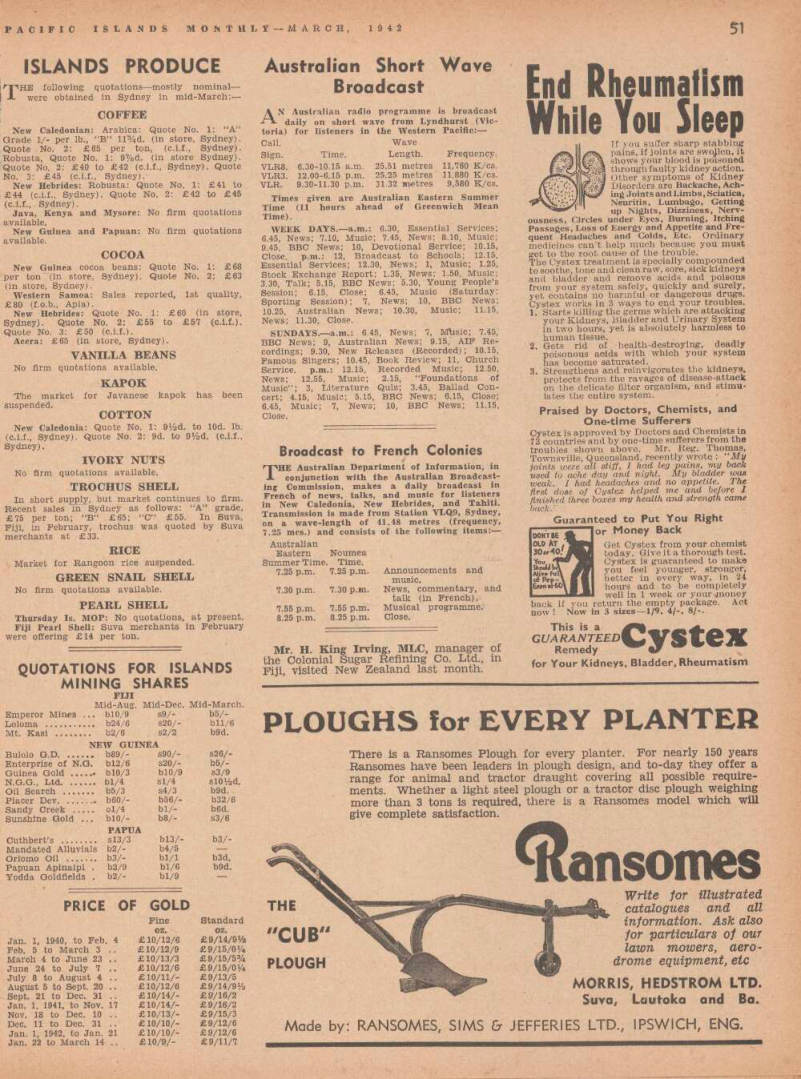
THE following quotations—mostly nominal— were obtained in Sydney in mid-March;—
Coffee
New Caledonian: Arabica: Quote No. 1: “A”
Grade 1/- per lb., “B” ll%d. (in store, Sydney).
Quote No. 2: £65 per ton, (c.i.f., Sydney).
Robusta, Quote No. 1: 9 7 /sd. (in store Sydney).
Quote No. 2: £4O to £42 (c.i.f., Sydney). Quote No. 3: £45 (c.i.f., Sydney).
New Hebrides: Robusta: Quote No. 1: £4l to £44 (c.i.f., Sydney). Quote No. 2: £42 to £45 (c.i.f., Sydney).
Java, Kenya and Mysore: No firm quotations available.
New Guinea and Papuan: No firm quotations available.
Cocoa
New Guinea cocoa beans: Quote No. 1: £6B per ton (in store, Sydney). Quote No. 2: £63 (in store, Sydney).
Western Samoa: Sales reported, Ist quality, £B6 (f.0.b., Apia).
New Hebrides: Quote No. 1; £6O (in store, Sydney). Quote No. 2: £55 to £57 (c.i.f.).
Quote No. 3: £5O (c.i.f.).
Accra: £65 (in store, Sydney).
Vanilla Beans
No firm quotations available.
Kapok
The market for Javanese kapok has been suspended.
Cotton
New Caledonia: Quote No. 1: OVad. to lOd. lb. (c.i.f., Sydney). Quote No. 2: 9d. to 9Vad. (c.i.f., Sydney).
Ivory Nuts
No firm quotations available.
Trochus Shell
In short supply, but market continues to firm.
Recent sales in Sydney as follows: “A” grade, £75 per ton; “B” £65; “C” £55. In Suva, Fiji, in February, trochus was quoted by Suva merchants at £33.
Rice
Market for Rangoon rice suspended.
Green Snail Shell
No firm quotations available.
Pearl Shell
Thursday Is. MOP: No quotations, at present.
Fiji Pearl Shell: Suva merchants in February were offering £l4 per ton.
Mining Shares
Quotations For Islands
Fiji
Mid-Aug.
Mid-Dec.
Mid-March.
Emperor Mines ... blO/9 s9/b5/- Loloma b24/6 s20/bll/6 Mt. Kasi b2/6 s2/2 b9d.
New Guinea
Bulolo G.D b89/s90/s26/- Enterprise of N.G. bl2/6 S20/b5/- Guinea Gold blO/3 blO/9 s3/9 N.G.G., Ltd bl/4 sl/4 sioy 2 d.
Oil Search b5/3 s4/3 b9d.
Placer Dev b60/b56/b32/6 Sandy Creek ol/4 bl/b6d.
Sunshine Gold ... blO/b8/s3/6 Cuthbert’s
Papua
si 3/3 bl3/b3/- Mandated Alluvials b2/b4/5 — Orlomo Oil b3/bl/1 b3d.
Papuan Apinalpi . b2/9 bl/6 b9d.
Yodda Goldfields . b2/bl/9 —
Price Of Gold
Fine Standard oz. oz.
Jan. 1, 1940, to Feb. 4 £ 10/12/6 £ 9/14/9 Va Feb. 5 to March 3 , , £10/12/9 £ 9/15/0 V* March 4 to June 23 , , £10/13/3 £9/15/5 % June 24 to July 7 , a £10/12/6 £ 9/15/0 Vt July 8 to August 4 . , £10/11/- £9/13/5 August 5 to Sept. 20 . . £10/12/6 £9/14/91/2 Sept. 21 to Dec. 31 . . £ 10/14/- £9/16/2 Jan. 1, 1941, to Nov. 17 £10/14/- £9/16/2 Nov. 18 to Dec. 10 , . £10/13/- £9/15/3 Dec. 11 to Dec. 31 . « £10/10/- £9/12/6 Jan. 1, 1942, to Jan. 21 £10/10/- £9/12/6 Jan. 22 to March 14 a . £10/9/- £9/11/7
Australian Short Wave
Broadcast
AN Australian radio programme is broadcast daily on short wave from Lyndhurst (Vic toria) for listeners in the Western Pacific:—
Times given are Australian Eastern Summer Time (11 hours ahead of Greenwich Mean Time).
WEEK DAYS.— a.m.: 6.30, Essential Services; 6.45, News; 7.10, Music; 7.45, News; 8.10, Music; 9.45, BBC News; 10, Devotional Service; 10.15, Close. p.m.: 12, Broadcast to Schools; 12.15, Essential Services; 12.30, News; 1, Music; 1.25, Stock Exchange Report; 1.35, News; 1.50, Music; 3.30, Talk; 5.15, BBC News; 5.30, Young People’s Session; 6.15, Close; 6.45, Music (Saturday: Sporting Session); 7, News; 10, BBC News; 10.25, Australian News; 10.30, Music; 11.15, News; 11.30, Close.
SUNDAYS.— a.m,: 6.45, News; 7, Mhsic; 7.45.
BBC News; 9, Australian News; 9.15, AIF Re cordings; 9.30, New Releases (Recorded); 10.15, Famous Singers; 10.45, Book Review; 11, Church Service, p.m.: 12.15, Recorded Music; 12.50, News; 12.55, Music; 2.15, “Foundations of Music”; 3, Literature Quiz; 3.45, Ballad Con cert; 4.15, Music; 5.15, BBC News; 6.15, Close; 6.45, Music; 7, News; 10, BBC News; 11.15, Close.
Call.
Wave Sign.
Time.
Length.
Frequency.
Vlr8.
6.30-10.15 a.m. 25.51 metres 11,760 K/cs.
Vlr3.
12.00-6.15 p.m. 25.25 metres 11,880 K/cs.
Vlr.
9.30-11.30 p.m. 31.32 metres 9,580 K/cs.
Broadcast to French Colonies
THE Australian Department of Information, in conjunction with the Australian Broadcast ing Commission, makes a daily broadcast in French of news, talks, and music for listeners in New Caledonia, New Hebrides, and Tahiti.
Transmission is made from Station VLQ9, Sydney, on a wave-length of 41.48 metres (frequency, 7.25 mcs.) and consists of the following items: —
Mr. H. King Irving, MLC, manager of the Colonial Sugar Refining Co. Ltd., in Fiji, visited New Zealand last month.
Australian Eastern Noumea Summer Time.
Time. 7.25 p.m. 7.25 p.m.
Announcements and music. 7.30 p.m. 7.30 p.m.
News, commentary, and talk (in French). 7.55 p.m. 7.55 p.m.
Musical programme. 8.25 p.m. 8.25 p.m.
Close.
Advertisements & other items, p. 53 (1 item)
Htansomes
End Rheumatism
While You Sleep
Jl If you suffer sharp stabbing I /jiv pains, if joints are swollen, it shows your blood is poisoned through faulty kidney action. mm Other symptoms of Kidney lllfw,# Disorders are Backache, Ach- Ktfr ing Joints and Limbs, Sciatica, Neuritis, Lumbago, Getting up Nights, Dizziness, Nervousness, Circles under Eyes, Burning, Itching Passages, Loss of Energy and Appetite and Frequent Headaches and Colds, Etc. Ordinary medicines can’t help much because you must get to the root cause of the trouble.
The Cystex treatment is specially compounded to soothe, tone and clean raw, sore, sick kidneys and bladder and remove acids and poisons from your system safely, quickly and surely, yet contains no harmful or dangerous drugs.
Cystex works in 3 ways to end your troubles. 1. Starts killing the germs which are attacking your Kidneys, Bladder and Urinary System in two hours, yet is absolutely harmless to human tissue. 2. Gets rid of health-destroying, deadly poisonous acids with which your system has become saturated. 3. Strengthens and reinvigorates the kidneys, protects from the ravages of disease-attack on the delicate filter organism, and stimulates the entire system. ' Praised by Doctors, Chemists, and One-time Sufferers Cystex is approved by Doctors and Chemists in 73 countries and by one-time sufferers from the troubles shown above. Mr. Reg. Thomas, Townsville, Queensland, recently wrote : My joints were all stiff, I had leg pains, my back used to ache day and night. My bladder was weak. I had headaches and no appetite. The first dose of Cystex helped me and before I finished three boxes my health and strength came back."
Guaranteed to Put You Right or Money Back Get Cystex from your chemist today. Give it a thorough test.
Cystex is guaranteed to make you feel younger, stronger, better in every way, in 24 hours and to be completely well in 1 week or your money back if you return the empty package. Act now ! Now In 3 sizes—1/9, 4/-, 8/-.
DOHT BE
OLD AT ,
30er40' Alive hi! of Fep- E»cn This is a
GUARANTEED
Remedy
Cystex
for Your Kidneys. Bladder, Rheumatism
PLOUGHS for EVERY PLANTER
There is a Ransomes Plough for every planter. For nearly 150 years Ransomes have been leaders in plough design, and to-day they offer a range for animal and tractor draught covering all possible requirements. Whether a light steel plough or a tractor disc plough weighing more than 3 tons is required, there is a Ransomes model which will give complete satisfaction. it
Htansomes
THE
"CUB
PLOUGH
Write for illustrated catalogues and all information. Ask also for particulars of our lawn mowers, aerodrome equipment, etc
MORRIS, HEDSTROM LTD.
Suva, Lautoka and Ba.
Made by: RANSOMES, SIMS & JEFFERIES LTD., IPSWICH, ENG.
German Guilt
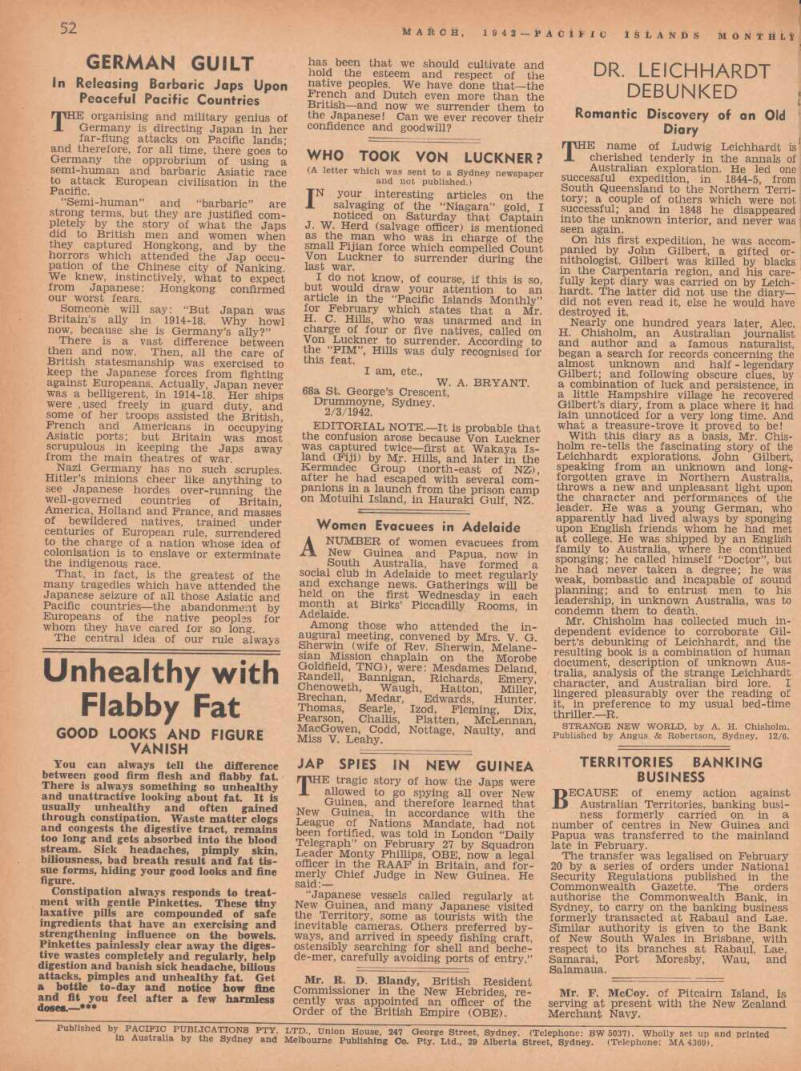
In Releasing Barbaric Japs Upon Peaceful Pacific Countries
THE organising and military genius of Germany is directing Japan in her far-flung attacks on Pacific lands; and therefore, for all time, there goes to Germany the opprobrium of using a semi-human and barbaric Asiatic race to attack European civilisation in the Pacific.
“Semi-human” and “barbaric” are strong terms, but they are justified com pletely by the story of what the Japs did to British men and women when they captured Hongkong, and by the horrors which attended the Jap occu pation of the Chinese city of Nanking.
We knew, instinctively, what to expect from Japanese: Hongkong confirmed our worst fears.
Someone will say: “But Japan was Britain’s ally in 1914-18. Why howl now, because she is Germany’s ally?”
There is a vast difference between then and now. Then, all the care of British statesmanship was exercised to keep the Japanese forces from fighting against Europeans. Actually, Japan never was a belligerent, in 1914-18. Her ships were .used freely in guard duty, and some of her troops assisted the British, French and Americans in occupying Asiatic ports; but Britain was most scrupulous in keeping the Japs away from the main theatres of war.
Nazi Germany has no such scruples.
Hitler’s minions cheer like anything to see Japanese hordes over-running the well-governed countries of Britain, America, Holland and Prance, and masses of bewildered natives, trained under centuries of European rule, surrendered to the charge of a nation whose idea of colonisation is to enslave or exterminate the indigenous race.
That, in fact, is the greatest of the many tragedies which have attended the Japanese seizure of all those Asiatic and Pacific countries—the abandonment by Europeans of the native peoples for whom they have cared for so long.
The central idea of our rule always
has been that we should cultivate and hold the esteem and respect of the native peoples. We have done that—the French and Dutch even more than the British—and now we surrender them to the Japanese! Can we ever recover their confidence and goodwill?
Who Took Von Luckner?
(A letter which was sent to a Sydney newspaper and not published.) IN your interesting articles on the salvaging of the “Niagara” gold, I noticed on Saturday that Captain J. W. Herd (salvage officer) is mentioned as the man who was in charge of the small Fijian force which compelled Count Von Luckner to surrender during the last war.
I do not know, of course, if this is so, but would draw your attention to an article in the “Pacific Islands Monthly” for February which states that a Mr.
H. C. Hills, who was unarmed and in charge of four or five natives, called on Von Luckner to surrender. According to the “PIM”, Hills was duly recognised for this feat.
I am, etc.,
W. A. Bryant.
68a St. George’s Crescent, Drummoyne, Sydney. 2/3/1942.
EDITORIAL NOTE.—It is probable that the confusion arose because Von Luckner was captured twice—first at Wakaya Is land (Fiji) by Mr. Hills, and later in the Kermadec Group (north-east of NZ), after he had escaped with several com panions in a launch from the prison camp on Motuihi Island, in Hauraki Gulf, NZ.
Women Evacuees in Adelaide
A NUMBER of women evacuees from New Guinea and Papua, now in South Australia, have formed a social club in Adelaide to meet regularly and exchange news. Gatherings will be held on the first Wednesday in each month at Birks’ Piccadilly Rooms, in Adelaide.
Among those who attended the in augural meeting, convened by Mrs. V. G.
Sherwin (wife of Rev. Sherwin, Melane sian Mission chaplain on the Morobe Goldfield, TNG), were: Mesdames Deland, Randell, Bannigan, Richards, Emery, Chenoweth, Waugh, Hatton, Miller, Brechan, Medar, Edwards, Hunter.
Thomas, Searle, Izod, Fleming, Dix, Pearson, Challis, Flatten, McLennan, MacGowen, Codd, Nottage, Naulty, and Miss V. Leahy.
Jap Spies In New Guinea
THE tragic story of how the Japs were allowed to go spying all over New Guinea, and therefore learned that New Guinea, in accordance with the League of Nations Mandate, had not been fortified, was told in London “Daily Telegraph” on February 27 by Squadron Leader Monty Phillips, QBE, now a legal officer in the RAAF in Britain, and for merly Chief Judge in New Guinea. He said:— “Japanese vessels called regularly at New Guinea, and many Japanese visited the Territory, some as tourists with the inevitable cameras. Others preferred by ways, and arrived in speedy fishing craft, ostensibly searching for shell and beche de-mer, carefully avoiding ports of entry.”
Mr. R. D. Blandy, British Resident Commissioner in the New Hebrides, re cently was appointed an officer of the Order of the British Empire (OBE).
Dr. Leichhardt
Debunked
Romantic Discovery of an Old Diary
fIIHE name of Ludwig Leichhardt is X cherished tenderly in the annals of Australian exploration. He led one successful expedition, in 1844-5, from South Queensland to the Northern Terri tory; a couple of others which were not successful; and in 1848 he disappeared into the unknown interior, and never was seen again.
On his first expedition, he was accom panied by John Gilbert, a gifted or nithologist. Gilbert was killed by blacks in the Carpentaria region, and his care fully kept diary was carried on by Leich hardt. The latter did not use the diary— did not even read it, else he would have destroyed it.
Nearly one hundred years later, Alec.
H. Chisholm, an Australian journalist and author and a famous naturalist, began a search for records concerning the almost unknown and half - legendary Gilbert; and following obscure clues, by a combination of luck and persistence, in a little Hampshire village he recovered Gilbert’s diary, from a place where it had lain unnoticed for a very long time. And what a treasure-trove it proved to be!
With this diary as a basis, Mr. Chis holm re-tells the fascinating story of the Leichhardt explorations. John Gilbert, speaking from an unknown and long forgotten grave in Northern Australia, throws a new and unpleasant light upon the character and performances of the leader. He was a young German, who apparently had lived always by sponging upon English friends whom he had met at college. He was shipped by an English family to Australia, where he continued sponging; he called himself “Doctor”, but he had never taken a degree; he was weak, bombastic and incapable of sound planning; and to entrust men to his leadership, in unknown Australia, was to condemn them to death.
Mr. Chisholm has collected much in dependent evidence to corroborate Gil bert’s debunking of Leichhardt, and the resulting book is a combination of human document, description of unknown Aus tralia, analysis of the strange Leichhardt character, and Australian bird lore. I lingered pleasurably over the reading of it, in preference to my usual bed-time
thriller.-
R.
STRANGE NEW WORLD, by A. H. Chisholm.
Published by Angus & Robertson, Sydney. 12/6.
Territories Banking
Business
BECAUSE of enemy action against Australian Territories, banking busi ness formerly carried on in a number of centres in New Guinea and Papua was transferred to the mainland late in February.
The transfer was legalised on February 20 by a series of orders under National Security Regulations published in the Commonwealth Gazette. The orders authorise the Commonwealth Bank, in Sydney, to carry on the banking business formerly transacted at Rabaul and Lae.
Similar authority is given to the Bank of New South Wales in Brisbane, with respect to its branches at Rabaul, Lae, Samarai, Port Moresby, Wau, and Salamaua.
Mr. F. McCoy, of Pitcairn Island, is serving at present with the New Zealand Merchant Navy.
Advertisements & other items, pp. 54-56 (3 items)
52
March, 1942 pacific islands monxhls
Published by PACIFIC_ PUBLICA’nONS PTY. LTD., Union House, 247 George Street, Sydney. (Telephone: BW 5037). Wholly set up and printed in Australia by the Sydney and Melbourne Publishing Co. Pty. Ltd., 29 Alberta Street, Sydney. (Telephone: MA4369).
Unhealthy with
Flabby Fat
GOOD LOOKS AND FIGURE
VANISH
You can always tell the difference between good firm flesh and flabby fat.
There is always something so unhealthy and unattractive looking about fat. It is usually unhealthy and often gained through constipation. Waste matter clogs and congests the digestive tract, remains too long and gets absorbed into the blood stream. Sick headaches, pimply skin, biliousness, bad breath result and fat tissue forms, hiding your good looks and fine figure.
Constipation always responds to treatment with gentle Pinkettes. These tiny laxative pills are compounded of safe ingredients that have an exercising and strengthening influence on the bowels.
Pinkettes painlessly clear away the digestive wastes completely and regularly, help digestion and banish sick headache, bilious attacks, pimples and unhealthy fat. Get a bottle to-day and notice how fine and fit you feel after a few harmless doses.—•••
Vi pf
M* \rM '1 f . v v v 'y . , Y ■ '• t . (S 1/
YYYv'As \X-
'('•■. -ini'i i,\i' h ■ , " - Y ra-Mv EVER ONWARD! ... In these progressive days the urgent call is for still greater speed . . . more intensive organization.
The problems involved in this aim are being successfully solved by Australian industry at war. Hand in hand with industry, and in the same progressive spirit, the Bank of New South Wales is helping to speed up the Empire drive to victory.
SMvSP-f
Vi pf
IYYAY ihi
&{• (JW* mi\ Y ,i W» i >\ i 595 C
FIRST CHOICE... with those
who prefer a bitter beer
If you like a bitter beer—you'll enjoy the rich wholesome flavor of Resch's Waverley Bitter Ale. Best appreciated after a hot, trying day—Waverley Bitter Ale is a real health drink for the tropics. For a refreshing change, make YOUR next order - - - -
WAVERLEY BITTER ALE
IN THE BOTTLE WITH THE GREEN LABEL