Pacific Territories
pp. 13-17 · Read in the full issue
What War Has Done To South
Survey of Our Losses and Some Probabilities
An attempt is made in this article to assess the present military, strategical, administrative and commercial position in those South Pacific Territories which have been directly affected up to date by the southwards drive of the Japanese.
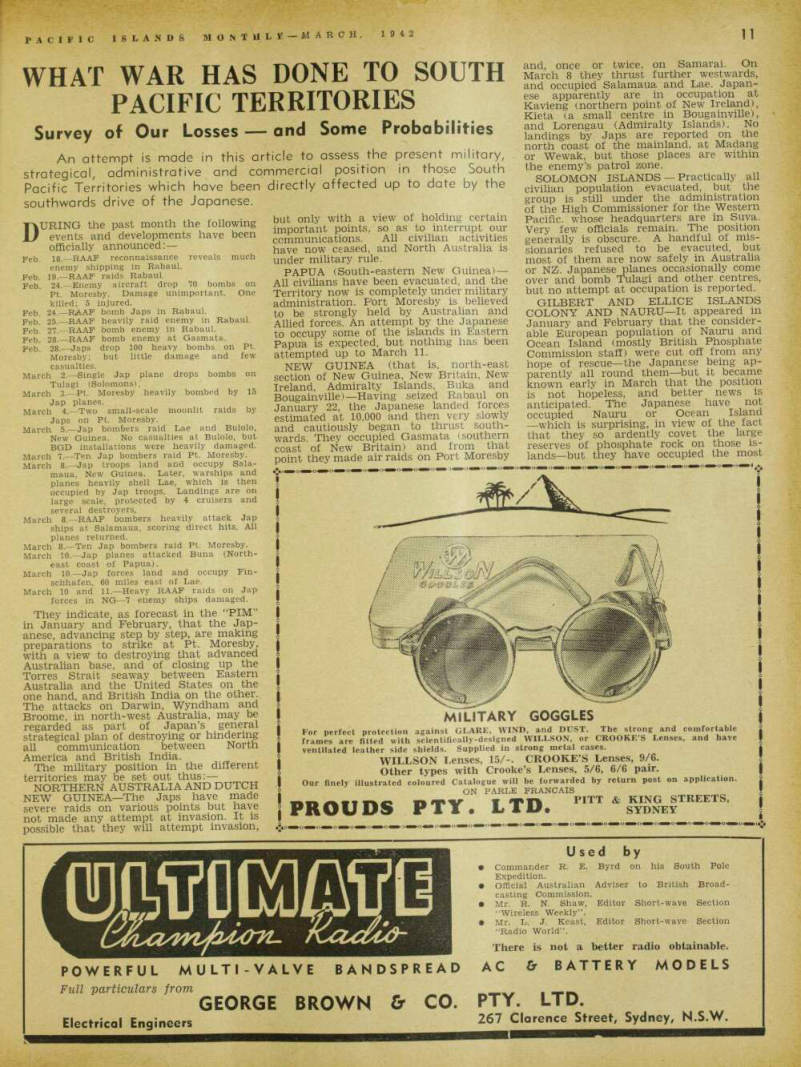
DURING the past month the following
events and developments have been officially announced:— Feb. 18.—RAAF reconnaissance reveals much enemy shipping in Rabaul.
Feb. 19.—RAAF raids Rabaul.
Feb. 24.—Enemy aircraft drop 70 bombs on Pt. Moresby. Damage unimportant. One killed; 5 injured.
Feb. 24.—R)AAF bomb Japs in Rabaul.
Feb. 25.—RAAF heavily raid enemy in Rabaul.
Feb. 27. —RAAF bomb enemy in Rabaul.
Feb. 28.—RAAF bomb enemy at Gasmata.
Feb. 28.—Japs drop 100 heavy bombs on Pt.
Moresby: but little damage and few casualties.
March 2.—Single Jap plane drops bombs on Tulagi (Solomons).
March 3.—Pt. Moresby heavily bombed by 15 Jap planes.
March 4.—Two small-scale moonlit raids by Japs on Pt. Moresby.
March s.—Jap bombers raid Lae and Bulolo, New Guinea. No casualties at Bulolo, but BGD installations were heavily damaged.
March 7.—Ten Jap bombers raid Pt. Moresby.
March B.—Jap troops land and occupy Sala maua, New Guinea. Later, warships and planes heavily shell Lae, which is then occupied by Jap troops. Landings are on large scale, protected by 4 cruisers and several destroyers.
March B.—RAAF bombers heavily attack Jap ships at Salamaua, scoring direct hits. All planes returned.
March B.—Ten Jap bombers raid Pt. Moresby.
March 10. —Jap planes attacked Buna (North east coast of Papua).
March 10. —Jap forces land and occupy Fin schhafen, 60 miles east of Lae.
March 10 and 11.—Heavy RAAF raids on Jap forces in NG—7 enemy ships damaged.
They indicate, as forecast in the “PIM” in January and February, that the Jap anese, advancing step by step, are making preparations to strike at Pt. Moresby, with a view to destroying that advanced Australian base, and of closing up the Torres Strait seaway between Eastern Australia and the United States on the one hand, and British India on the other.
The attacks on Darwin, Wyndham and Broome, in north-west Australia, may be
regarded as part of Japan’s general
strategical plan of destroying or hindering
all communication between North America and British India.
The military position in the different territories may be set out thus: —
Northern Australia And Dutch
NEW GUINEA—The Japs have made severe raids on various points but have not made any attempt at invasion. It is
possible that they will attempt invasion,
but only with a view of holding certain important points, so as to interrupt our communications. All civilian activities have now ceased, and North Australia is under military rule.
PAPUA (South-eastern New Guinea) All civilians have been evacuated, and the Territory now is completely under military administration. Fort Moresby is believed to be strongly held by Australian and Allied forces. An attempt by the Japanese to occupy some of the islands in Eastern Papua is expected, but nothing has been attempted up to March 11.
NEW GUINEA (that is, north-east section of New Guinea, New Britain, New Ireland, Admiralty Islands, Buka and Bougainville)—Having seized Rabaul on January 22, the Japanese landed forces estimated at 10,000 and then very slowly and cautiously began to thrust south wards They occupied Gasmata (southern coast of New Britain) and from that point they made air raids on Port Moresby
and, once or twice, on Samarai. On March 8 they thrust further westwards, and occupied Salamaua and Lae. Japan ese apparently are in occupation at Kavieng (northern point of New Ireland), Kieta (a small centre in Bougainville), and Lorengau (Admiralty Islands). No landings by Japs are reported on the north coast of the mainland, at Madang or Wewak, but those places are within the enemy’s patrol zone.
SOLOMON ISLANDS Practically all civilian population evacuated, but the group is still under the administration of the High Commissioner for the Western Pacific, whose headquarters are in Suva.
Very few officials remain. The position generally is obscure. A handful of mis sionaries refused to be evacuted, but most of them are now safely in Australia or NZ. Japanese planes occasionally come over and bomb Tulagi and other centres, but no attempt at occupation is reported.
Gilbert And Ellice Islands
COLONY AND NAURU—It appeared in January and February that the consider able European population of Nauru and Ocean Island (mostly British Phosphate Commission staff) were cut off from any hope of rescue—the Japanese being ap parently all round them—but it became known early in March that the position is not hopeless, and better news is anticipated. The Japanese have not occupied Nauru or Ocean Island —which is surprising, in view of the fact that they so ardently covet the large reserves of phosphate rock on those is lands—but they have occupied the most
northerly islands of the Gilbert Group— Butaritari and Abaiang.
New Caledonia, New Hebrides,
Fiji, Tonga, Western Samoa—Al
though a good many women and children have left those territories—for the most part, voluntarily—conditions of life in most of them are normal, and adminis trative and commercial activities are pro ceeding much as usual. As a matter of fact, the sensational rise in the value of copra during recent weeks has done much to stimulate commercial activity throughout Polynesia.
Probably, the island most in danger at the moment is New Caledonia. It is well
known that Japan is eager to own this island, not only owing to its great mineral resources, but also because of its strate gical position. It is only 700 miles from the Queensland coast. However, the Jap anese dare not attack New Caledonia until they first occupy the Solomons and New Hebrides.
Cook Islands. Tahiti, French
OCEANIA Conditions fairly normal * copra trade very good.
Ng Administration Smashed
WITH the landing of the Japanese at Salamaua and Lae, the large and valuable Mandated Territory of New
Guinea may be regarded as having passed into enemy occupation.
The civil administration is gone entirely Whatever administration still functions in out-of-the-way places—such as, perhaps, along the northern coast —is under Australian military direction.
The Japanese invasion was so sudden that it was not possible to evacuate the civilian population (men only) from the New Britain and New Ireland areas, and it is believed that several hundreds of Europeans from Rabaul are now with the remnants of our armed forces, somewhere in the New Britain jungle west of Rabaul; while another large party of Europeans— officials, planters, and soldiers—from the New Ireland district, are in the jungle in the vicinity of Namatanai. Even if it is not possible to send ships to bring these people away to safety, it may be expected that they will maintain themselves for a long time in the jungle and that, as opportunity offers, they will escape southwards in small parties.
Although most of the civilians were successfully evacuated from the western end of the New Guinea Territory—espec ially the Morobe goldfield—the fact remains that the personnel of the NG Administration was smashed up in a tragic fashion. As far as can be ascer tained, the following is the fate of the heads of departments:— The Administrator (Sir Walter Mc- Nicoll), who was very seriously ill at Lae when the Japs struck, was eventually taken to Sydney, where he is making a satisfactory recovery.
Mr. Harold Page, Government Secretary and Deputy Administrator, has not been seen since the Japanese occupation of Rabaul.
Mr. H. O. Townsend (Treasurer) and Mr. G. G. Hogan (Crown Law Officer) were both in Rabaul when the Japanese struck, and their fate is unknown.
Mr. R. Melrose and Mr. E. Taylor, of the District Services Department, nave bom escaped. Mr. Melrose is in Australia and Mr. Taylor in Port Moresby.
Mr. E. P. Holmes (Department of Lands) was in Lae when the disaster oc curred, and he somehow managed to reach Wau, and thence was evacuated to Australia.
Mr. George Murray (Department of Agriculture) who returned to Rabaul from sick leave only a few days before the Japanese invasion, was last heard of in Rabaul and is believed to be in the jungle with the other Europeans.
The fate of the majority of New Guinea’s public servants is unknown.
They mostly are in the jungle.
Grave Economic Losses
WITH the practical abandonment of New Guinea to the enemy, it is possible to have a rough stock taking, and to form some estimate of the enormous losses suffered by com panies and individuals mostly Aust ralians —operating in New Guinea. They are approximately as follow: — PLANTING—The capital value of the coconut plantations in the Mandated Ter ritory is approximately £2,000,000. It is un likely, of course, that these plantations will be destroyed—when the invaders are driven
out the owners will be able to resume possession. In the meantime, plantations will “go bush” and suffer deterioration through lack of attention; all native labour corps will be broken up and lost; plantation houses in many cases will be destroyed and the majority will be looted, if not by the enemy, then by the uncon trolled natives, and all plantation equip ment, gardens, etc., will either deteriorate or be destroyed. It may be taken as cer tain that every plantation owner will suffer some considerable loss.
MINES —The whole of the mining population was hurriedly evacuated from the Morobe goldfield and from the smaller goldfields behind Wewak. As reported elsewhere, the Commonwealth Govern ment will fully protect the rights of the mining companies and miners, but the whole of the very valuable equipment has been simply left unattended, and it will suffer grave deterioration, mostly from rain and floods. Mining equipment requires constant supervision, especially things like water races.
The big companies, like Bulolo Gold Dredging Ltd., New Guinea Goldfields Ltd., Koranga Sluicing, Sandy Creek Gold Sluicing Co., and so on, have had to abandon huge quantities of valuable material and, if their absence from New Guinea should extend to 12 months — which is quite likely—their losses will be enormous. In the report of Bulolo Gold Dredging Ltd. for the year just closed, the value of dredges, dredge equipment, aeroplanes, hydro-electric plant, general plant, buildings, etc., is shown in the balance sheet as 8,088,081 dollars—and this probably is a conservative estimate.
It is hard to make a guess—but prob ably the value of the mining equipment which has been left in New Guinea is not less than £4,000,000 Australian. Gold worth from £1,500,000 to £2,000,000 was being produced every year in NG—and
the interruption of this production is in itself a grave loss.
STORES AND TRADING —There were two big companies (Burns, Philp and Co.
Ltd., and W. R. Carpenter and Co. Ltd.) trading in New Guinea, and many smaller concerns, and their annual turn-over was enormous. Commercial firms and traders owned valuable buildings and stocks not only in such places as Rabaul, Wau, Salamaua, Lae, Madang, Kavieng, but also in a couple of scores of smaller centres. All these places, including in most instances valuable stocks, have been abandoned to the enemy.
While it is possible that in the majority of plantations something will be left for the returning owner, it can be taken as certain that the enemy will loot every store and workshop in the various little towns. All this may be regarded as a total loss. It is likely also that the natives —especially the sophisticated, European ised natives —finding themselves out of European control, will indulge in an orgy of looting. They will carry off anything that the Japanese do not take.
TRANSPORT Transport in New Guinea was provided first by ships run ning between Australia and the Territory —all of which are believed to have been saved; secondly, by fleets of aeroplanes, owned by Guinea Airways Ltd., W. R.
Carpenter and Co. Ltd., and a number of smaller concerns. Some important units of these airfleets have been saved, but a considerable proportion were destroyed by the Japanese, mostly at Lae, Salamaua and Bulolo.
In addition, the big companies owned small vessels which traded between the various islands; and traders and planters generally had hundreds of small boats— schooners and launches —with which they maintained communications. A consid erable proportion of these craft are be lieved to have been lost. Wherever
possible, of course, planters and traders have hidden their schooners and launches.
Industrial Enterprises There
are a couple of desiccated coconut fac tories in New Guinea —an important one owned by W. R. Carpenter and Co. Ltd. at Pondo and another at Lindenhafen— and it is feared that these places will be destroyed.
The sawmilling industry had been making rapid strides in recent years and sawmills were located at several points
around New Britain. It is presumed that these establishments also will fall into the hands of the invaders.
It is very difficult to form any estimate of the economic losses which we have suffered in New Guinea, but the following may be an approximation:— Coconut plantations .. .. £2,000.000 Mining equipment 4,000,000 Loss of gold output for one year 1,000,000 Trading stores and stocks, say 1,000,000 Sea and air transport and equipment, say 750,000 Desiccated coconut factories, sawmills, etc., say .. .. 500,000 Total £9,250,000 That probably is an under-estimate.
The loss to the owners will be covered by the New War Risk Insurance funds established in Australia.
Position In Papua
WHEN we come to Papua, the outlook is not quite so bad. It is true also that all civilians have been with drawn from this territory, which is now under military rule, and that no com mercial activity worth noting is proceed ing. But, at the moment of writing, the Japanese have not invaded Papua and plantations, stores, mines, etc., are not yet in enemy hands, and there should be a better chance of saving movable property.
The position in Papua, however, is that all Administrative officials —except a few kept especially by the military—have been withdrawn, all commercial establish ments have been closed, all mines have been closed down —and this includes the drilling plants which were seeking min eral oil in Central Papua. The industries of Papua which are now menaced by the enemy may be shown thus: — Coconut and coffee plantations.
Rubber plantations.
Stores and trading establishments.
Sea transport equipment.
Gold mining equipment (Kokoda, Misima, etc.).
Oil drilling equipment.
All these valuable assets need not yet be regarded as lost; but if the Japanese should invade Papua in any force, a large proportion of them, probably running into millions of pounds, would have to be written off.
The Solomons
THE position, in the Solomons is some what similar to that in Papua. Most of the administrative machinery and practically all the planters have been withdrawn and the Solomons basic in dustry—namely, coconut growing—is in process of deterioration. There are few, if any, Japanese in the Solomons, as yet —their activities seem to be confined to visits by reconnaissance planes but plantations properties will suffer damage from uncontrolled undergrowth and loot ing natives.
Most of the store managers have been withdrawn and, as far as is known, con siderable stocks were destroyed in the abandoned stores. If remaining stocks are guarded by loyal natives, they need not be regarded as a write-off unless the Japanese actually come and loot. The amount of loss in the Solomons will de pend largely upon the extent of the Japanese invasion of that group.
There is no indication, as yet, of how owners are to be compensated for losses in this and other British territories. They do not come under the Australian plan.
Nauru And Ocean Island
IN both of these islands, there are masses of very valuable machinery and equipment, assembled during the last twenty years, for the purpose of
working the enormous phosphate deposits.
The position in relation to this plant and equipment is not known. The Jap anese do not appear to have occupied either of the two islands, but it may be taken as certain that, if they do, they will find that the plant and equipment have been entirely destroyed. This would represent a loss to British interests of at least £1,000,000.
Gilbert And Ellice Islands
WHEREVER possible, members of the very small European community in this colony were evacuated before the Japanese struck, although a few were taken prisoner. It is known that the Japanese occupy the most northerly is lands (Butaritari and Abaiang).
The only property of any value in the colony comprised the stores of the trading firms (Burns Philp (SS) Co. Ltd., and On Chong and Co. Ltd.), a few small vessels, and coconut plantations, owned almost wholly by the natives. Therefore, the economic loss in this section of the colony is not serious.
Rev. and Mrs. E. L. Sykes, Presbyterian missionaries at Malo, New Hebrides, are at present in Sydney. Mrs. Sykes will not be returning to the Condominium, owing to a recent serious illness which necessi tates her residence in Australia for some time.
Miss Florence Taylor, daughter of a Methodist missionary who spent the early years of her life on a Mission station in New Britain, has achieved a measure of fame in Australia in recent months, Possessing a delightful contralto voice, she was “discovered” by a radio amateur talent quest last year and since has had endless broadcasting and theatre engage ments in all States of the Commonwealth.
She is only 20 years of age.