Lucky Fiji
p. 53 · Read in the full issue
Where Few Persons Pay War Tax
From Our Own Correspondent
Suva, Dec. 23.
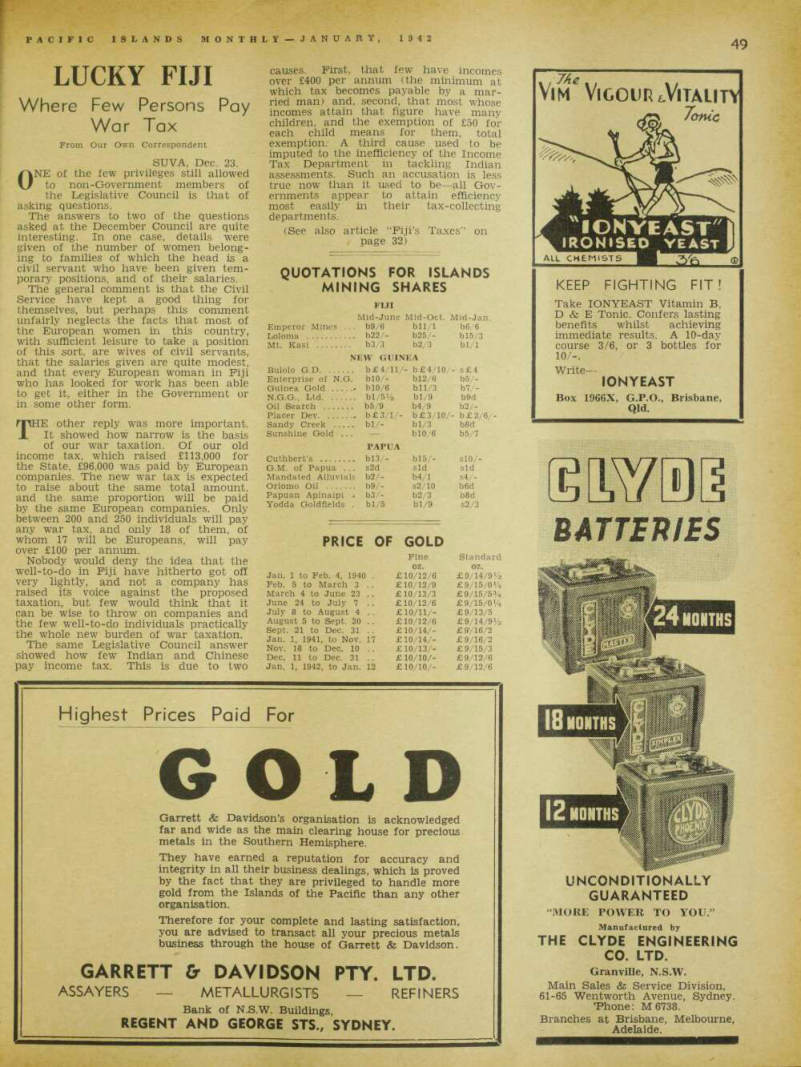
ONE of the few privileges still allowed to non-Government members of the Legislative Council is that of asking questions.
The answers to two of the questions asked at the December Council are quite interesting. In one case, details were given of the number of women belong ing to families of which the head is a civil servant who have been given tem porary positions, and of their salaries.
The general comment is that the Civil Service have kept a good thing for themselves, but perhaps this comment unfairly neglects the facts that most of the European women in this country, with sufficient leisure to take a position of this sort, are wives of civil servants, that the salaries given are quite modest, and that every European woman in Fiji who has looked for work has been able to get it, either in the Government or in some other form. rE other reply was more important.
It showed how narrow is the basis of our war taxation. Of our old income tax, which raised £113,000 for the State, £96,000 was paid by European companies. The new war tax is expected to raise about the same total amount, and the same proportion will be paid by the same European companies. Only between 200 and 250 individuals will pay any war tax, and only 18 of them, of whom 17 will be Europeans, will pay over £lOO per annum.
Nobody would deny the idea that the well-to-do in Fiji have hitherto got off very lightly, and not a company has raised its voice against the proposed taxation, but few would think that it can be wise to throw on companies and the few well-to-do individuals practically the whole new burden of war taxation.
The same Legislative Council answer showed how few Indian and Chinese pay income tax. This is due to two
causes. First, that few have incomes over £4OO per annum (the minimum at which tax becomes payable by a mar ried man) and, second, that most whose incomes attain that figure have many children, and the exemption of £5O for each child means for them, total exemption. A third cause used to be imputed to the inefficiency of the Income Tax Department in tackling Indian assessments. Such an accusation is less true now than it used to be —all Gov ernments appear to attain efficiency most easily tn their tax-collecting departments. (See also article “Fiji’s Taxes” on page 32)