Life On The “Lousy Islands"
pp. 25-30 · Read in the full issue

Some Impressions of a Visit to the Equatorial Atolls The Horrors of a Balanced Budget in G. and E. Colony.
By R. W. Robson
THIS article was written in November, before Japan launched her treacher ous attack upon the Anglo-Saxon Powers.
Since then, the line of Nauru, Ocean Island and the Gilberts has represented our northern frontier, close to and fac ing Japanese territory; and we do not know what has been happening there. I keep wondering about the fate of all the kindly, hospitable people I met there only a few weeks ago—young Bevington, AO at Tarawa, and his pretty young wife and infant children; loyal old Captain Hand ley; young Wernham, the grim and efficient AO at Funafuti; Dr. and Mrs.
Steenson, Dr. Isaac, and Mr. and Mrs.
English, all famed for their ready hospitality; Captain and Mrs. Holland, and their attractive daughter; Jenner and Clarke, of the BP store; young Williams, carrying out a weary job up in exposed Butaritari; Captain Harness and Engineers Sinclair and Hunt, and their pretty and charming young wives— what has happened to all those kindly Gilbert Islands people, there within 200 miles of the little yellow men?
We are anxious, also, for the safety of the folk on Ocean and Nauru Islands, which have been bombed repeatedly— Ronald Garvey, Acting RC, and one of the most hospitable men I’ve ever met; David Collins, just transferred from comparatively peaceful Suva; Cartwright and Clarke, and Leembruggen, and all those other officers whose spontaneous kindness made life on Ocean Island en durable; the remarkable J. G. Bridges— remarkable because he still so efficiently manages the great British Phosphate installation after two decades of that foul climate—one wonders how they ara making it.
What has happened in Nauru, where there are hundreds of Australian men, facing a Jap blitz?
Did Colonel Chalmers, Nauru’s doughty Administrator, treat Japanese bombs like he treated German shells? 1 was told that, a year ago, while the Huns were battering the cantilever, from a distance of a few hundred yards, the enraged Colonel, armed with a walkingstick, marched out to the beach, and stood out there in the open, and sneered at them.
He hadn’t even a pop-gun with which to defend his island; but he wanted the Huns to see that no one was afraid of them, anyway.
They are real people, those British and Australian folk up on our front line; and we anxiously await news of them.
R.W.R.
TiHE “Lousy Islands”—“lousy” being used in the modern sense, as applied to something poor, mean, comfortless, unattractive—lie along the Equator, eastwards of New Guinea, and northwards of Fiji, Samoa and the Southern Cooks.
Within the opprobrious term I include the Gilbert and Ellice groups, Ocean Island, the Phoenix group, the Tokelaus, and the Northern Cooks. Nauru escapes, by virtue of its pleasant valleys, leading down to cool beaches. Sunbaked Ocean Island is 460 feet high; but it is just one big. rounded lump of phosphate rock, surrounded by cliffs, with few valleys or beaches: and, in my jaundiced opinion, not a fit place for European habitation.
Except Ocean, not one of the Lousy Islands is more than 8 or 10 feet above sea-leveh—the average is about four.
Imagine it! Thousands and thousands
of square miles, dotted with islands, and not a hillock nor a running stream among the lot of them.
These, of course, are coralline atolls.
Each “island” really is a series of islets, strung out along a circular reef, which encloses a shallow lagoon. The lagoons range from five to 40 miles across. The width of each islet—and there may be 20 or 30 of them on a reef—is seldom over 300 yards; its length, up to 10 miles.
The islets are mostly on the eastern side of the lagoons, and the villages are mostly on the lagoon side of the islets.
The islets are practically all covered thickly with 50-feet high coconut palms and pandanius scrub.
Work that out, and you will under
stand why few of the villages get the south-east trades, which are about the only thing in this wide region to make life worth living.
AS a youth, I partook lavishly of Louis Becke and other colourful writers, whose Islands romances were based mostly on these equatorial atolls. I had always wanted to see the Line Islands.
Well, I have seen them: and my first reaction is to write this unpleasant, snarling article, in which I publicly won der why on earth Britain wants to retain possession of such a useless, comfortless territory.
Of course, the girl motive enters largely into the writings of Becke and Company. And I will admit that if an affair with a pretty Polynesian girl is a prime consideration in life, one can make happy contacts here with a brown, clean-skinned race of handsome island ers, whose manner is amiable, whose morals are easy, and who still retain a delightful respect for the wandering pa'alangi.
But, if one must frivol, why frivol in a continual bath of perspiration, where the only fresh water is that precariously collected in tanks, where mosquitoes howl in chorus the whole night through, and where one’s fresh food is confined rigidly within the limits of coconuts, fish, pigs and fowls?
The frivolities which entice imagina tive, ageing men to the Islands can be conducted so much more comfortably in those delightful Polynesian groups where clear, cold streams rush ceaselessly down out of mountains, and one can get bananas and pawpaws and green vege tables for the asking, and a mouthful of cold air occasionally, and one has some hope of avoiding sweat rashes.
In relation to those things, an Ellice or Gilbert islander has nothing in charm over a Samoan or Tahitian.
I went to the Lousy Islands with a lively curiosity; no man could have received greater kindness and hospitality than I enjoyed at the hands of all the Europeans there; but I came away with the conviction that one visit there, in a lifetime, is enough for any white man.
IHAVE spoken of creature comforts in relation to accommodation—food, and shelter and so forth. But, in one matter of sheer discomfort, the Lousy Islands can put it over all others.
I refer to transport.
From Funafuti north to Butaritari, from Ocean Island east to Manihiki, there is not one port worthy of the name —not one wharf at which even a ketch may tie up. At a limited number of the islands, your ship may anchor in a quiet lagoon, whence you are ferried ashore.
But, in most places, the ship rolls at an anchorage outside, while your boat either paddles frantically through the lagoon-passage, trying to keep ahead of a surging wave, or hops the reef into the lagoon. At first, it is adventurous, and good fun—what’s a ducking or two, among friends!—but one soon becomes fed up of it. I am not one who takes kindly to a wet bottom.
But this is nothing—the real problem of transport in the Lousy Islands are the sudden, satanic westerlies. They come screeching out of a clear sky, with little warning; and, at the first whisper of them, the captains up-anchor and head out strongly for the open sea.
Nearly all the anchorages are on the west of the atolls, and God help the ship that is caught by a westerly on a lee shore.
So, if you are a traveller in the Lousy Islands, you not only can suffer all the discomforts of sea-sickness and bucketing about—for nearly all the ships which go among these reefs are little, round-bottomed things that can roll like nothing on earth —but ycu are in ever lasting danger of being marooned.
Again and again. I heard of people who went ashore for a couple of hours, and remained for a couple of months, having been cut off by a ruthless west erly. They just settled down in a native
village, where time is not, and applied themselves philosophically to keeping the mtestmal tract active on a diet of coconuts and fish.
Only yesterday I heard of an elderly woman who had been hanging off an island for a week, with husband, in a little trading vessel, waiting for the sea to go down. Our ship’s doctor was called for urgently. She had been gripping her wire mattress for so many days, holding her position against the pitching of the ship, that the skin was torn from her hands and they had become badly infected.
Think of that, Madame Suva or Miss Rabaul, when next you travel in your comfortable liner. , T ... . , ND navigation! I still have the horrors when I remember even my modest experiences little ships bucking into enormous swells; creeping forward slowly in thick weather on a
charted course, and sliding sideways almost as rapidly on unsuspected sets and currents; skippers, who hadn’t seen sun or s t ar s f or days, frowning anxiously over charts that bristled with islands and reefs; ploughing ahead in the smothering darkness, knowing that you cannot locate these low, crouching atolls until you climb on top of them, if i were an insurance company I would charge these shipowners a pre mium of 110 per cent, per annum, on the principle that a man must make a 10 per cent, profit somehow, But one must give full honours to the skippers of the Lousy Islands—there are astonishingly few wrecks. They are real seamen. But that kind of voyaging has no pleasure in it for imaginative people who P cling to life as i do * l\/| OST of the Lousy Islands are Itl included in the Gilbert and Ellice Colony, governed by the British
Colonial Office, through the High Commissioner for the Western Pacific (Suva). The Phoenix Islands, an uninhabited Cinderella group which had been leased by Burns, Philp & Co. Ltd., were taken over by the G. and E. Administration in 1938; and, since then, nearly 2.000 people have been transported from the over-crowded Gilbert Islands to the Phoenix.
The Tokelaus and the Northern Cooks —two groups of useless little atolls, of little or no economic value—are administered by New Zealand, the one through Samoa and the other through Raro tonga. If Britain is going to hang on to the Gilbert and Ellice, she certainly ought to have charge of the Tokelams and Northern Cooks. They are all exactly the same kind of coconut-growing atoll, requiring exactly the same kind of administrative attention.
Twenty, or even ten years ago, I should have said that possession of these
Lousy Islands was not worth having Only Ocean Island, with its phosphate Bonanza, has any notable economic value. The G. and E. Colony in a nor mal year, produces copra worth around £60,000, and nothing else; and the cost of the Administration is around £60,000 per annum. If it were not for the revenues accruing from the £300,000 worth of phosphate produced each year in Ocean Island, the G. and E. Colony would be hopelessly bankrupt, But, to-day, there are two inter national factors to be considered. fIIHE first is Japan. If Britain walks 1 out of the Gilbert and Ellice, Japan walks in. And that is a matter of vital concern to all British communities to the southward.
The Japanese are too close now, for comfort, and they are not good neigh hours. They took over the Marshall and Caroline Groups, on a League of Nations
Mandate—which means that the people of other nations were to have reasonable access to them. But the Japanese never have granted access to anyone. On the contrary, they sternly have kept Europeans away, and they have ruth lessly hunted out most of the people of part-European blood who already were domiciled in the Marshalls and Caro lines.
But one of their Marshall Islands trad ing firms has been allowed to establish itself in Butaritari, in the Gilberts (Brit ish) ; and it periodically expresses its great sorrow because its repeated appli cations for permission to place branch trading stores throughout the group have been refused. The Japanese have no sense of humour.
So, for reasons of strategy, Britain must retain control of the Gilbert and Ellice Islands, as a sort of outer defence screen for the more valuable territories, further south. rpHE second factor, to be considered JL to-day, is the new value attained by the equatorial islands as landing places for trans-Pacific airlines. Recent Anglo-American competition for Canton Island (Phoenix Group) is an effective illustration of how a little equatorial island, useless and scorned and disowned, may attain international aviation value overnight.
The Lousy Islands may not be wanted as commercial airline stations; but, if Japan walked in there, there soon would be military aircraft stations around and about, and these chains and clusters of atolls, instead of being merely our outer defence screen, would attain a new, far more sinister signifi cance.
NO, unfortunately—we must keep the Lousy Islands; so let (us see if they could be better administered. I am definitely of opinion that they could.
I cast no aspersions upon the hand ful of devoted men of the British Colo nial Service who now govern the G. and E., with self-sacrifice and devotion to duty. I am throwing the largest brick my pen will carry at the system under which this Colony is governed.
Somewhere, sometime, some compla cent old official rooster, secure in the amenities of a good job and a cool cli mate, laid down the rule that the Gil bert and Ellice Colony should be gov erned in accordance with a balanced budget. The Colony’s revenues must take care of the Colony’s expenditure—and all sorts of surprising, extraneous things, like the pensions paid to retired G. and E. officials, and some of the cost of run ning the High Commission for the WP, are loaded onto the expenditure.
The Colony’s revenue comes from cus toms taxes, taxes on exports (phosphate and copra) and a few license fees, etc.
Even with the phosphate industry, there isn’t enough money for more than a skeleton administrative organisation.
So what happens? So far as I could see, the Colonial Office balances the G. and E. gets as near as pos sible to a balance—by depriving its unfortunate officials of many of the amenities of life. I was shocked to learn of the privations of these people, due to their isolation, lack of transport and the unproductive soil of these miserable, cor aline atolls. Not one of them whined, or uttered a word of complaint to me— that is not the young Britisher’s way; I saw it all for myself.
WHEN I was through there, the administrative officials had been without fresh food supplies, and mails, for many weeks. They were
ingeniously producing tasty dishes out of tins—but if you want to know how loathesome canned food can be, live on one of the Lousy Islands with it for a few weeks.
Fresh fish could be had, and the milk of a grated coconut; and sometimes, after a wild scramble, the house-boys returned triumphantly with a couple of eggs. But there was no milk, very little butter, no green vegetables, no fruit, no fresh meat.
I went out around various bungalows, and saw the pathetic remains of efforts made by various AO’s to grow vegetables and fruits. All had failed. The Lousy mlts!^ S pandamis W an 0t occasional breadfruit and a coarse variety of taro. No bananas, no oranges, no vegetables, and —except for a few miserable specimens —no pawpaws.
Hydroponics (the system of growing vegetables in tubs of water impregnated with chemicals) is favoured in this Colony; but there is a wartime lack of chemicals.
MR. Bevington, AO at Tarawa, in an effort to provide milk for his two young children, procured two goats, male and female. The cynical beasts destroyed Mr. Bevington’s lingering plants, ate Mrs. Bevington’s towels, committed nuisance in the outhouses; but there was not a sign of milk, or milk procedure.
I saw a good deal of the living conditions of officials in the Gilbert and Ellice Islands, and I was appalled. They are supplied with “tropical” houses, and some rough and primitive furniture, and a modest salary, and some rather miserable “allowances” (all in the depreciated
Australian currency!); and, after that, they have to fight like tomcats for any additional equipment and amenities.
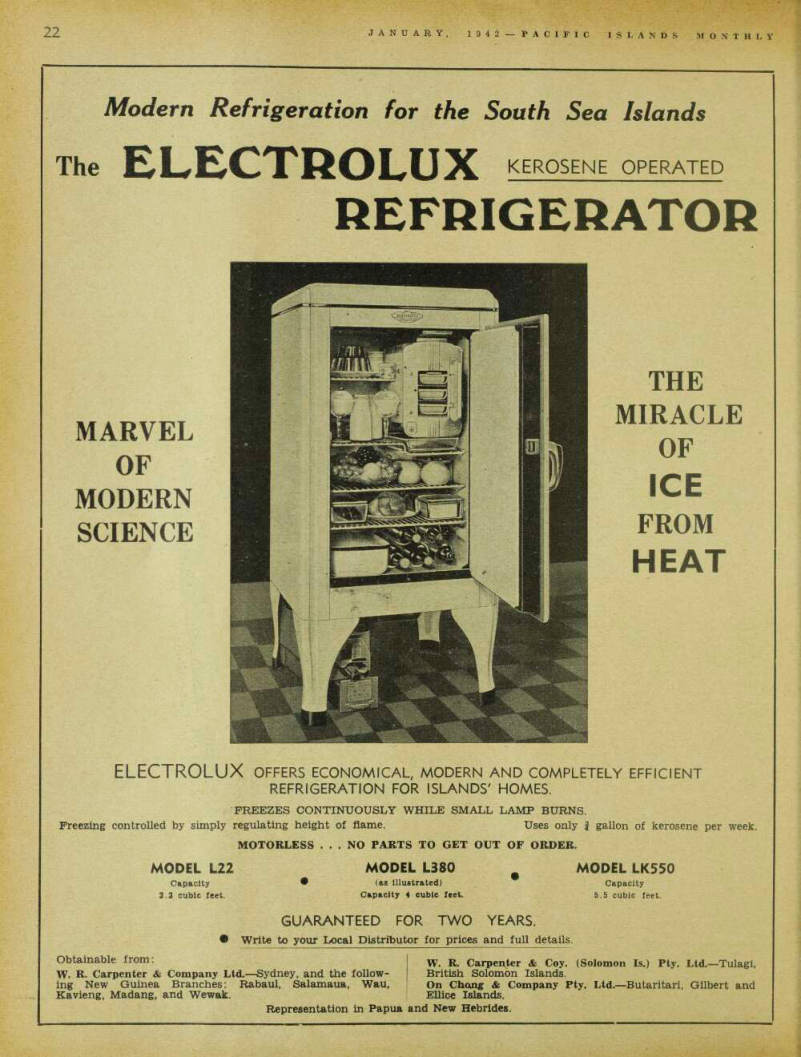
One would imagine that, there on the equator, where coolness is only a dream, a refrigerator would be standard equipment in every official’s home. Not on your life! The average official seems to get one only by fighting for it. If he wants a little electric lighting set for his house and office, he buys it himself.
All this, because complacent and comfortable officialdom somewhere says the G. and E. Colony must balance its budget. In the name of commonsense and fairness, Why?
WHY, because these equatorial islands TT are incapable of developing economic value, and are held mostly for strategical reasons, should these keen, highly-educated and carefullyselected young men be cruelly punished?
Why, since these men are prepared to serve the Colonial Office anywhere, and the luck of it brings them to the G. and E. Colony, should the Colonial Office not see to it that they are given the reasonable amenities of our civilisation?
Why should good housing, and comfortable transport, and refrigeration and lighting, and a dependable supply of fresh food and mails, depend upon whether the Gilbertese cut a lot of copra, or the Chinese at Ocean Island dig a lot of phosphate?
If Europeans go trading or planting in these islands, they choose their own lives, and lie upon the beds which they themselves make. But the administrative officer simply goes where he is told.
I take off my hat to these young men of the Colonial Office, for their cheeriness and loyalty under the most com-
fortless equatorial conditions I have seen. But why should they have to put up with it? If Britain wants the Lousy Islands, let her see to it that the men who take care of them for her live in reasonable comfort, A S a matter of fact, the whole posi tion, in relation to the administra tion of these small copra-producing islands of the equatorial belt, is due for review. Nothing will be done while the war con tinues; but there is no harm in discussing the matter now, in prepara tion f or the inevitable post-war re arrangement of Pacific territories. ** wc s oftanhosDhlte 0 f ta nhosDhlte ouf of'the^Lousv Elands there reason whv Britain
“ s * IS?
should continue to hold of except stxategical and aviation reasons.
morf Mtein
Zealand much more closely man Britain.
For purposes of administration and control, would it not be far better that the Gilbert and Ellice, all the Line islands to the eastward, the Phoenix Islands, the Tokelaus and the Northern Cooks, be thrown together into one dis trict or territory, under the control of Australia and/or New Zealand? It is necessary to hold them for the defence of the Dominions—then, let the Domin ions pay for them. That, surely, is a better plan than the Colonial Office one of trying to make the islands pay their way—and giving an unfortunate bunch of able young officers a taste of diluted hell, in the process, T , , , Island and Nauru are simply V/ phosphate deposits, useless for any other purpose: and they should be
thrown together in one administration.
The present arrangement is absurd.
Australia, under a mandate held jointly by Britain, Australia and New Zealand, governs Nauru. Britain, through the High Commissioner for the Western Pacific, and the Gilbert and Ellice Administration, governs Ocean Island—although there is not the slight est community of interest between Ocean Island and the rest of the Colony, while there is complete community of interest between Nauru and Ocean Island.
The real ruler of both islands is the British Phosphate Commission, which works the phosphate deposits, controls the shipping, directs the commerce and runs practically all the public services on each island, except education, police and health.
And it is an efficient organisation. It must get very tired of the jumble of governmental authorities with which it has to deal, between the two islands.
There seems to be no reason, except one of sentiment, why the BPC should
not be left to run both islands—an administrative officer or two being left on each to represent the official govern ment (Britain, or Australia, or New Zea land, as the case may be) and see to the welfare of the natives, of whom there are about 1700 on each island. Such an arrangement would be just as efficient as the present one, and far cheaper.
The only reason why Ocean Island is the headquarters of the G. and E. Col ony, or why it is included in the Colony at all, is that it is the Colony’s main source of revenue. But that reason is disappearing. Ocean Island phosphate deposits will be worked out in another 20 or 30 years; and then, one presumes, the place will 'be abandoned, and G. and E. headquarters will go elsewhere.
IHEAR echoes of a discussion as to the most suitable place for head quarters, after OI is finished— Tarawa, or Abemama, or Abaiang, or Butaritari. So far as I could see, there is little choice between them—each pro vides a sheltered lagoon into which medium-sized ships can go, and a mis erable, coconut-covered, unfertile island.
Rather than seek another headquar ters, this might be a suitable time to consider the whole future organisation and administration of these poor Cen tral Pacific Islands, on the lines indi cated.
In the meantime, Mr. Colonial Office, please forget that old fogey idea of bal ancing the G. and E. budget; and try to make living conditions reasonably tolerable for the handful of young men (and women, for their wives are stand ing by, most loyally) whom the ill-luck of the game has sent to keep the flag flying in the Lousy Islands.