and Sacrifice
pp. 7-8 · Read in the full issue
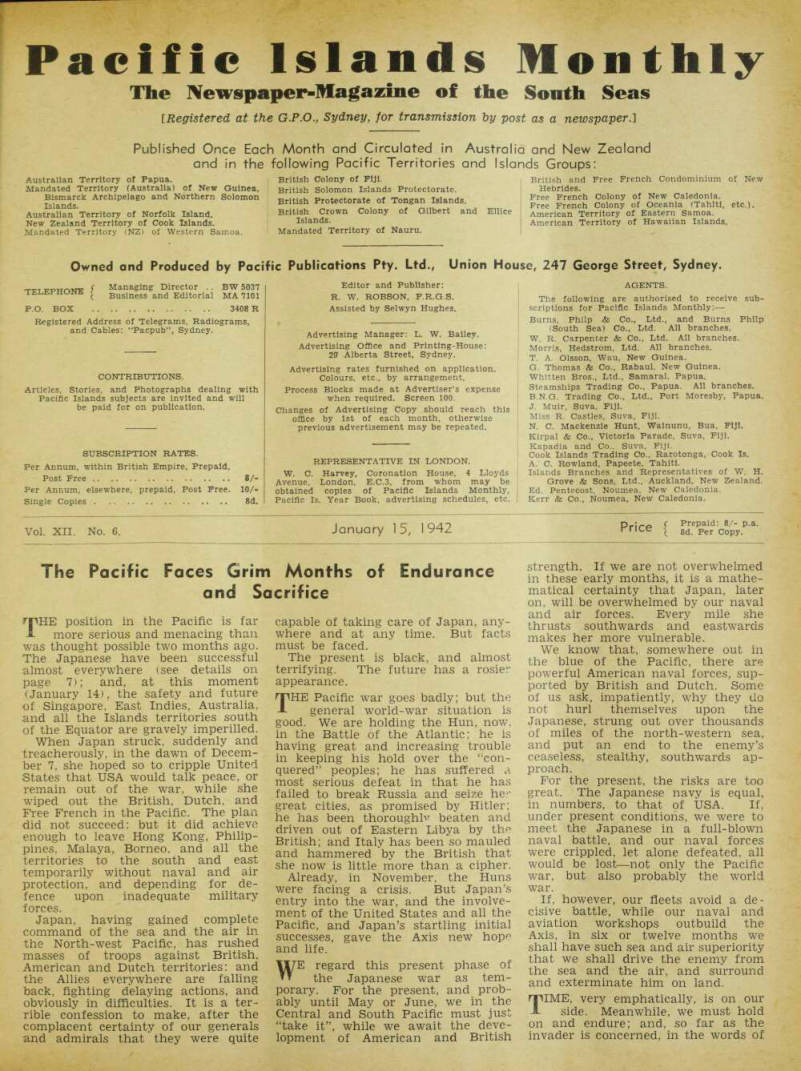
The Pocific Faces Grim Months at Endurance and Sacrifice
T tt „ ...
HE position in the Pacific is fai more serious and menacing than was thought possible two months ago.
The Japanese have been successful almost everywhere (see details on page 7); and, Jhi 8 moment (January 14), the safety and future of Singapore, East Indies, Australia, and all the Islands territories soutn of _Jk e Eqaator ar , e Savely imperilled.
When Japan struck, suddemy and treacherously, in the dawn of Decern- Q? r f 7 ’ 80 btates mat USA would taiK peace, or remain out of me war, wnne sne X ipe< i r OU V he (?t ISh fi, Free French m the Pacific. The plan did not succeed. but it did achieve enough to leave Hong Kong, Philippines, Malaya, Borneo, and all the territories to the south and east temporarily without naval and air protection, and depending for defence upon inadequate military nnninloto „ in the North-west Pacific, has rushed masses of troops against Britisxr> American and Dutch territories: and the Allies everywhere are falling back, fighting delaying actions, and obviously in difficulties. It is a terrible confession to make, after the complacent certainty of our generals and admirals that they were quite
, . . . . T capable of taking care of Japan, any where and at any time. But facts must be faced.
The present is black, and almost terrifying. The future has a rosie. appearance. rrHE Pacific war goes badly; but the X general world-war situation is good. We are holding the Hun, now, in the Battle of the Atlantic; he is having great and increasing trouble in k eep i n g hi s hold over the “con- Quered” peoples; he has suffered a most serious defeat i n that he has faile d to break Russia and seize her g reat cities, as promised by Hitler; he hag been beaten and driven out of Eastern Libya by the British; and Italy has been so mauled and hammered by the British that she now . g little more than a cipher, Already, in November, the Huns were facing a cr i S j S But Japan’s en^ry into war, and the involve ment of the United States and all the Pacifi c, and Japan’s startling initial successes, gave the Axis new hope and WE regard this present phase of ” the Japanese war as tem porary. For the present, and prob-ably until May or June, we in the Central and South Pacific must just “take it”, while we await the deye lopment of American and British
matical certainty that Japan, later on, will be overwhelmed by our naval and air forces. Every mile she thrusts southwards and eastwards ma kes her more vulnerable, We know that somewhere out in the b iue of the ’ Pacific there are powerful American naval forces sup ported by British and Dutch. Some of us ask, impatiently, why they do not hurl themselves upon the Japanese, strung out over thousands of miles of the north-western sea, and put an end to the enemy’s ceaseless, stealthy, southwards ap proach.
For the present, the risks are too great. The Japanese navy is equal, in numbers, to that of USA. If, under present conditions, we were to meet the Japanese in a full-blown naval battle, and our naval forces were crippled, let alone defeated, all would be lost—not only the Pacific war, but also probably the world war.
If, however, our fleets avoid a de cisive battle, while our naval and aviation workshops outbuild the Axis, in six or twelve months we shall have such sea and air superiority nrp Hrivp tVip pupidv the sea and the air and surroun d and exte rminate him on land, , „ rpiME, very emphatically, is on our side. Meanwhile, we must hold on and endure; and, so far as the invader is concerned, in the words of
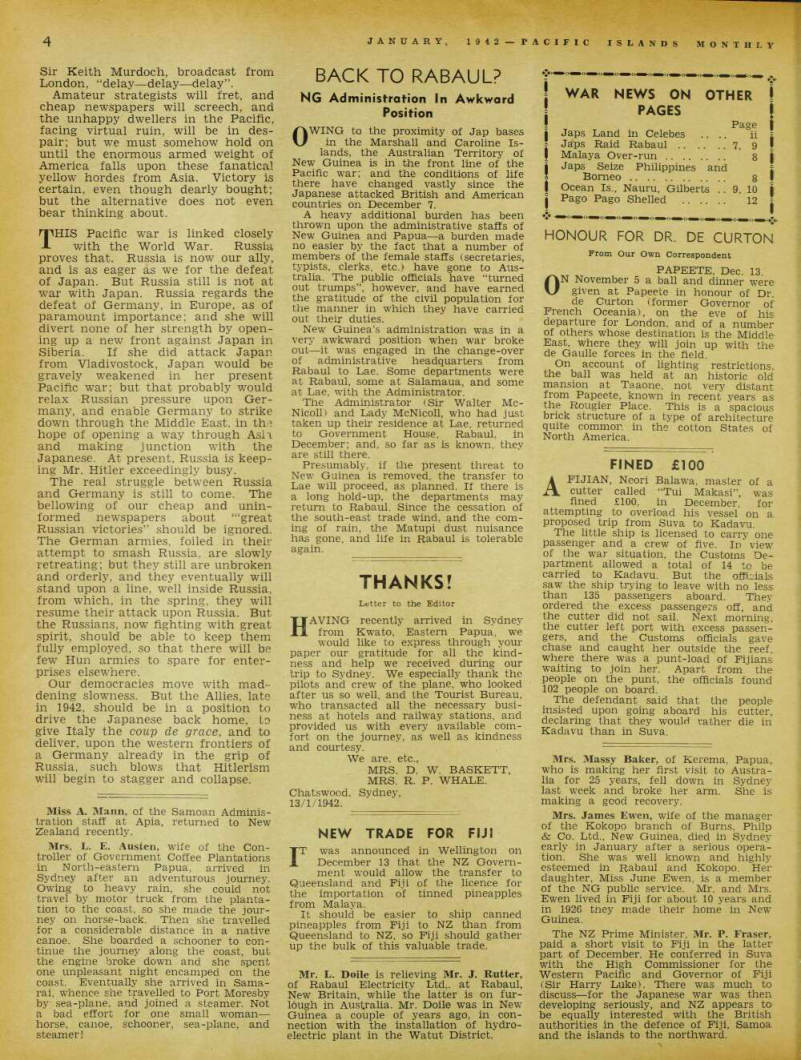
Sir Keith Murdoch, broadcast from London, “delay—delay—delay”.
Amateur strategists will fret, and cheap newspapers will screech, and the unhappy dwellers in the Pacific, facing virtual ruin, will be in des pair; but we must somehow hold on until the enormous armed weight of America falls upon these fanatical yellow hordes from Asia. Victory is certain, even though dearly bought; but the alternative does not even bear thinking about.
THIS Pacific war is linked closely with the World War. Russia proves that. Russia is now our ally, and is as eager as we for the defeat of Japan. But Russia still is not at war with Japan. Russia regards the defeat of Germany, in Europe, as of paramount importance; and she will divert none of her strength by open ing up a new front against Japan in Siberia. If she did attack Japan from Vladivostock, Japan would be gravely weakened in her present Pacific war; but that probably would relax Russian pressure upon Ger many, and enable Germany to strike down through the Middle East, in the hope of opening a way through Asia and making junction with the Japanese. At present, Russia is keep ing Mr. Hitler exceedingly busy.
The real struggle between Russia and Germany is still to come. The bellowing of our cheap and unin formed newspapers about “‘great Russian victories” should be ignored.
The German armies, foiled in their attempt to smash Russia, are slowly retreating: but they still are unbroken and orderly, and they eventually will stand upon a line, well inside Russia, from which, in the spring, they will resume their attack upon Russia. But the Russians, now fighting with great spirit, should be able to keep them fully employed, so that there will be few Hun armies to spare for enter prises elsewhere.
Our democracies move with mad dening slowness. But the Allies, late in 1942, should be in a position to drive the Japanese back home, to give Italy the coup de grace, and to deliver, upon the western frontiers of a Germany already in the grip of Russia, such blows that Hitlerism will begin to stagger and collapse.
Miss A. Mann, of the Samoan Adminis tration staff at Apia, returned to New Zealand recently.
Mrs. L. E. Austen, wife of the Con troller of Government Coffee Plantations in North-eastern Papua, arrived in Sydney after an adventurous journey.
Owing to heavy rain, she could not travel by motor truck from the planta tion to the coast, so she made the jour ney on horse-back. Then she travelled for a considerable distance in a native canoe. She boarded a schooner to con tinue the journey along the coast, but the engine broke down and she spent one unpleasant night encamped on the coast. Eventually she arrived in Sama rai, whence she travelled to Port Moresby by sea-plane, and joined a steamer. Not a bad effort for one small woman— horse, canoe, schooner, sea-plane, and steamer!