Pacific News-Review
pp. 3-4 · Read in the full issue
Notes And Comment On
The Progress Of The War
From Dec. 11 To Jan. 14
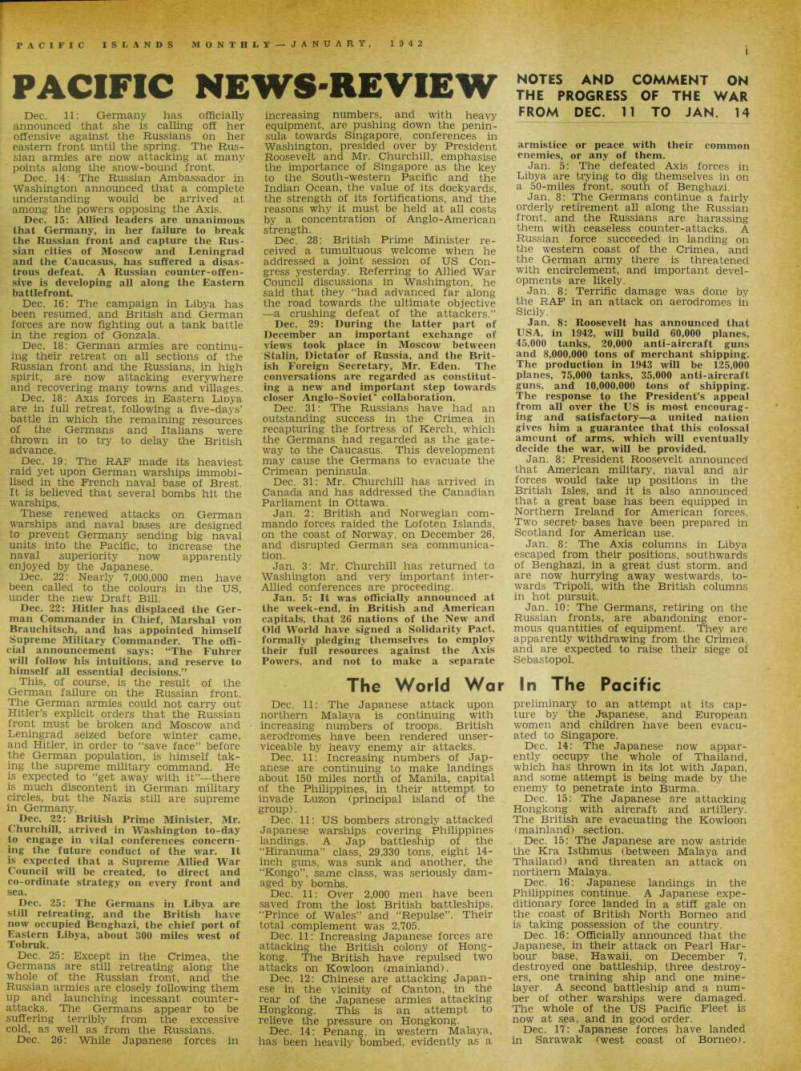
Dec. 11: Germany has officially announced that she is calling off her offensive against the Russians on her eastern front until the spring. The Rus sian armies are how attacking at many points along the snow-bound front.
Dec. 14; The Russian Ambassador in Washington announced that a complete understanding would be arrived at among the powers opposing the Axis.
Dec. 15: Allied leaders are unanimous that Germany, in her failure to break the Russian front and capture the Rus sian cities of Moscow and Leningrad and the Caucasus, has suffered a disas trous defeat. A Russian counter-offen sive is developing all along the Eastern battlefront.
Dec. 16: The campaign in Libya has been resumed, and British and German forces are now fighting out a tank battle in the region of Gonzala.
Dec. 18: German armies are continu ing their retreat on all sections of the Russian front and the Russians, in high spirit, are now attacking everywhere and recovering many towns and villages.
Dec. 18: Axis forces in Eastern Lioya are in full retreat, following a five-days’ battle in which the remaining resources of the Germans and Italians were thrown in to try to delay the British advance.
Dec. 19; The RAF made its heaviest raid yet upon German warships immobi lised in the French naval base of Brest.
It is believed that several bombs hit the warships.
These renewed attacks on German warships and naval bases are designed to prevent Germany sending big naval units into the Pacific, to increase the naval superiority now apparently enjoyed by the Japanese.
Dec. 22; Nearly 7,000,000 men have been called to the colours in the US, under the new Draft Bill.
Dec. 22: Hitler has displaced the Ger man Commander in Chief, Marshal von Brauchitsch, and has appointed himself Supreme Military Commander. The offi cial announcement says: “The Fuhrer will follow his intuitions, and reserve to himself all essential decisions.”
This, of course, is the result of the German failure on the Russian front.
The German armies could not carry out Hitler’s explicit orders that the Russian front must be broken and Moscow and Leningrad seized before winter came, and Hitler, in order to “save face” before the German population, is himself tak ing the supreme military command. He is expected to “get away with it”—there is much discontent in German military circles, but the Nazis still are supreme in Germany.
Dec. 22: British Prime Minister, Mr.
Churchill, arrived in Washington to-day to engage in vital conferences concern ing the future conduct of the war. It is expected that a Supreme Allied War Council will be created, to direct and co-ordinate strategy on every front and sea.
Dec. 25: The Germans in Libya are still retreating, and the British have now occupied Benghazi, the chief port of Eastern Libya, about 300 miles west of Tobruk.
Dec. 25: Except in the Crimea, the Germans are still retreating along the whole of the Russian front, and the Russian armies are closely following them up and launching incessant counter attacks. The Germans appear to be suffering terribly from the excessive cold, as well as from the Russians.
Dec. 26: While Japanese forces in
increasing numbers, and with heavy equipment, are pushing down the penin sula towards Singapore, conferences in Washington, presided over by President Roosevelt and Mr. Churchill, emphasise the importance of Singapore as the key to the South-western Pacific and the Indian Ocean, the value of its dockyards, the strength of its fortifications, and the reasons why it must be held at all costs by a concentration of Anglo-American strength.
Dec. 28; British Prime Minister re ceived a tumultuous welcome when he addressed a joint session of US Con gress yesterday. Referring to Allied War Council discussions in Washington, he said that they “had advanced far along the road towards the ultimate objective —a crushing defeat of the attackers.”
Dec. 29: During the latter part of December an important exchange of views took place in Moscow between Stalin, Dictator of Russia, and the Brit ish Foreign Secretary, Mr. Eden. The conversations are regarded as constitut ing a new and important step towards closer Anglo-Soviet* collaboration.
Dec. 31: The Russians have had an outstanding success in the Crimea in recapturing the fortress of Kerch, which the Germans had regarded as the gate way to the Caucasus. This development may cause the Germans to evacuate the Crimean peninsula.
Dec. 31: Mr. Churchill has arrived in Canada and has addressed the Canadian Parliament in Ottawa.
Jan. 2; British and Norwegian com mando forces raided the Lofoten Islands, on the coast of Norway, on December 26, and disrupted German sea communica tion.
Jan. 3: Mr. Churchill has returned to Washington and very important inter - Allied conferences are proceeding.
Jan. 5: It was officially announced at the week-end, in British and American capitals, that 26 nations of the New and Old World have signed a Solidarity Pact, formally pledging themselves to employ their full resources against the Axis Powers, and not to make a separate
armistice or peace with their common enemies, or any of them.
Jan. 5: The defeated Axis forces in Libya are trying to dig themselves in on a 50-miles front, south of Benghazi, Jan. 8: The Germans continue a fairly orderly retirement all along the Russian front, and the Russians are harassing them with ceaseless counter-attacks. A Russian force succeeded in landing on the western coast of the Crimea, and the German army there is threatened with encirclement, and important devel opments are likely.
Jan. 8: Terrific damage was done by the RAF in an attack on aerodromes in Sicily.
Jan. 8: Roosevelt has announced that USA, in 1942, will build 60,000 planes, 45,000 tanks, 20,000 anti-aircraft guns and 8,000,000 tons of merchant shipping.
The production in 1943 will be 125,000 planes, 75,000 tanks, 35,000 anti-aircraft guns, and 10,000,000 tons of shipping.
The response to the President’s appeal from all over the US is most encourag ing and satisfactory—a united nation gives him a guarantee that this colossal amount of arms, which will eventually decide the war, will be provided.
Jan. 8: President Roosevelt announced that American military, naval and air forces would take up positions in the British Isles, and it is also announced that a great base has been equipped in Northern Ireland for American forces.
Two secret* bases have been prepared in Scotland for American use.
Jan. 8; The Axis columns in Libya escaped from their positions, southwards of Benghazi, in a great dust storm, and are now hurrying away westwards, to wards Tripoli, with the British columns in hot pursuit.
Jan. 10: The Germans, retiring on the Russian fronts, are abandoning enor mous quantities of equipment. They are apparently withdrawing from the Crimea, and are expected to raise their siege of Sebastopol.
The World War In The Pacific
Dec. 11: The Japanese attack upon northern Malaya is continuing with increasing numbers of troops. British aerodromes have been rendered unser viceable by heavy enemy air attacks.
Dec. 11: Increasing numbers of Jap anese are continuing to make landings about 150 miles north of Manila, capital of the Philippines, in their attempt to invade Luzon (principal island of the group).
Dec. 11: US bombers strongly attacked Japanese warships covering Philippines landings. A Jap battleship of the “Hiranuma” class, 29,330 tons, eight 14inch guns, was sunk and another, the “Kongo”, same class, was seriously dam aged by bombs, Dec. 11: Over 2,000 men have been saved from the lost British battleships, “Prince of Wales” and “Repulse”. Their total complement was 2,705.
Dec. 11: Increasing Japanese forces are attacking the British colony of Hong kong. The British have repulsed two attacks on Kowloon (mainland).
Dec. 12: Chinese are attacking Japan ese in the vicinity of Canton, in the rear of the Japanese armies attacking Hongkong. This is an attempt to relieve the pressure on Hongkong.
Dec. 14: Penang, in western Malaya, has been heavily bombed, evidently as a
preliminary to an attempt at its cap ture by the Japanese, and European women and children have been evacu ated to Singapore.
Dec, 14: The Japanese now appar ently occupy the whole of Thailand, which has thrown in its lot with Japan, and some attempt is being made by the enemy to penetrate into Burma.
Dec. 15: The Japanese are attacking Hongkong with aircraft and artillery.
The British are evacuating the Kowloon (mainland) section.
Dec. 15: The Japanese are now astride the Kra Isthmus (between Malaya and Thailand) and threaten an attack on northern Malaya.
Dec. 16: Japanese landings in the Philippines continue. A Japanese expe ditionary force landed in a stiff gale on the coast of British North Borneo and is taking possession of the country.
Dec. 16: Officially announced that the Japanese, in their attack on Pearl Har bour base, Hawaii, on December 7, destroyed one battleship, three destroy ers, one training ship and one mine layer A second battleship and a num ber of other warships were damaged.
The whole of the US Pacific Fleet is now at sea, and in good order.
Dec, 17: Japanese forces have landed in Sarawak (west coast of Borneo).
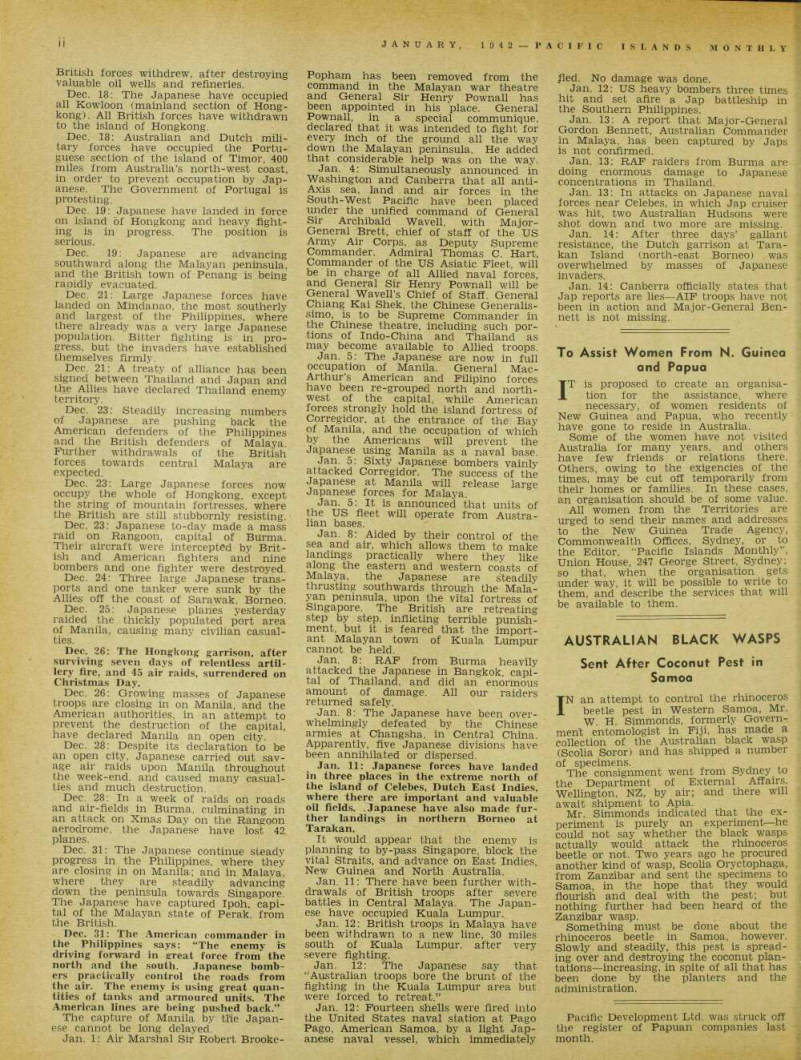
British forces withdrew, after destroying valuable oil wells and refineries.
Dec. 18: The Japanese have occupied all Kowloon (mainland section of Hong kong). All British forces have withdrawn to the island of Hongkong.
Dec. 18: Australian and Dutch mili tary forces have occupied the Portu guese section of the island of Timor. 400 miles from Australia’s north-west coast, in order to prevent occupation by Jap anese. The Government of Portugal is protesting.
Dec. 19: Japanese have landed in force on island of Hongkong and heavy fight ing is in progress. The position is serious.
Dec. 19: Japanese are advancing southward along the Malayan peninsula, and the British town of Penang is being rapidly evacuated.
Dec. 21: Large Japanese forces have landed on Mindanao, the most southerly and largest of the Philippines, where there already was a very large Japanese population. Bitter fighting is in pro gress, but the invaders have established themselves firmly.
Dec. 21: A treaty of alliance has been signed between Thailand and Japan and the Allies have declared Thailand enemy territory.
Dec. 23: Steadily increasing numbers of Japanese are pushing back the American defenders of the Philippines and the British defenders of Malaya.
Further withdrawals of the British forces towards central Malaya are expected.
Dec. 23: Large Japanese forces now occupy the whole of Hongkong, except the string of mountain fortresses, where the British are still stubbornly resisting.
Dec. 23: Japanese to-day made a mass raid on Rangoon, capital of Burma.
Their aircraft were intercepted by Brit ish and American fighters and nine bombers and one fighter were destroyed.
Dec. 24: Three large Japanese trans ports and one tanker were sunk by the Allies off the coast of Sarawak. Borneo.
Dec. 25: Japanese planes yesterday raided the thickly populated port area of Manila, causing many civilian casual ties.
Dec. 26; The Hongkong garrison, after surviving seven days of relentless artil lery fire, and 45 air raids, surrendered on Christmas Day.
Dec. 26: Growing masses of Japanese troops are closing in on Manila, and the American authorities, in an attempt to prevent the destruction of the capital, have declared Manila an open city.
Dec. 28: Despite its declaration to be an open city, Japanese carried out sav age air raids upon Manila throughout the week-end, and caused many casual ties and much destruction.
Dec. 28: In a week of raids on roads and air-fields in Burma, culminating in an attack on Xmas Day on the Rangoon aerodrome, the Japanese have lost 42 planes.
Dec. 31: The Japanese continue steady progress in the Philippines, where they are closing in on Manila; and in Malaya, where they are steadily advancing down the peninsula towards Singapore.
The Japanese have captured Ipoh, capi tal of the Malayan state of Perak, from the British.
Dec. 31: The American commander in the Philippines says: “The enemy is driving forward in ereat force from the north and the south. Japanese bomb ers practically control the roads from (he air. The enemy is using great quan tities of tanks and armoured units. The American lines are being pushed back.”
The capture of Manila by the Japan ese cannot be long delayed.
Jan. 1: Air Marshal Sir Robert Brooke-
Popham has been removed from the command in the Malayan war theatre and General Sir Henry Pownall has been appointed in his place. General Pownall, in a special communique, declared that it was intended to fight for every inch of the ground all the way down the Malayan peninsula. He added that considerable help was on the way.
Jan. 4: Simultaneously announced in Washington and Canberra that all anti- Axis sea, land and air forces in the South-West Pacific have been placed under the unified command of General Sir Archibald Wavell, with Major- General Brett, chief of staff of the US Army Air Corps, as Deputy Supreme Commander. Admiral Thomas C. Hart, Commander of the US Asiatic Fleet, will be in charge of all Allied naval forces, and General Sir Henry Pownall will be General Wavell’s Chief of Staff. General Chiang Kai Shek, the Chinese Generalis simo, is to be Supreme Commander in the Chinese theatre, including such por tions of Indo-China and Thailand as may become available to Allied troops.
Jan. 5: The Japanese are now in full occupation of Manila. General Mac- Arthur’s American and Filipino forces have been re-grouped north and north west of the capital, while American forces strongly hold the island fortress of Corregidor, at the entrance of the Bay of Manila, and the occupation of which by the Americans will prevent the Japanese using Manila as a naval base.
Jan. 5; Sixty Japanese bombers vainly attacked Corregidor. The success of the Japanese at Manila will release large Japanese forces for Malaya.
Jan. 5: It is announced that units of the US fleet will operate from Austra lian bases.
Jan. 8: Aided by their control of the sea and air, which allows them to make landings practically where they like along the eastern and western coasts of Malaya, the Japanese are steadily thrusting southwards through the Mala yan peninsula, upon the vital fortress of Singapore. The British are retreating step by step, inflicting terrible punish ment, but it is feared that the import ant Malayan town of Kuala Lumpur cannot be held.
Jan. 8: RAF from Burma heavily attacked the Japanese in Bangkok, capi tal of Thailand, and did an enormous amount of damage. All our raiders returned safely.
Jan. 8: The Japanese have been over whelmingly defeated by the Chinese armies at Changsha, in Central China.
Apparently, five Japanese divisions have been annihilated or dispersed.
Jan. 11: Japanese forces have landed in three places in the extreme north of the island of Celebes, Dutch East Indies, where there are important and valuable oil fields. Japanese have also made fur ther landings in northern Borneo at Tarakan.
It would appear that the enemy is planning to by-pass Singapore, block the vital Straits, and advance on East Indies, New Guinea and North Australia.
Jan. 11: There have been further with drawals of British troops after severe battles in Central Malaya. The Japan ese have occupied Kuala Lumpur.
Jan. 12: British troops in Malaya have been withdrawn to a new line, 30 miles south of Kuala Lumpur, after very severe fighting.
Jan. 12: The Japanese say that “Australian troops bore the brunt of the fighting in the Kuala Lumpur area but were forced to retreat.”
Jan. 12: Fourteen shells were fired into the United States naval station at Pago Pago, American Samoa, by a light Jap anese naval vessel, which immediately
Ped. No damage was done.
Jan. 12: US heavy bombers three times hit and set afire a Jap battleship in the Southern Philippines.
Jan. 13: A report that Major-General Gordon Bennett, Australian Commander in Malaya, has been captured by Japs is not confirmed.
Jan. 13: RAF raiders from Burma are doing enormous damage to Japanese concentrations in Thailand.
Jan. 13: In attacks on Japanese naval forces near Celebes, in which Jap cruiser was hit, two Australian Hudsons were shot down and two more are missing.
Jan. 14: After three days’ gallant resistance, the Dutch garrison at Tara kan Island (north-east Borneo) was overwhelmed by masses of Japanese invaders.
Jan. 14: Canberra officially states that Jap reports are lies —AIF troops have not been in action and Major-General Ben nett is not missing.