Memorial to Commodore
p. 26 · Read in the full issue
Goodenough in BSI
TRADITION dies hard with Navy men— and Mr. Major Harper, ex-RN, Solo mon Islands’ planter, trader, re cruiter and, recently, master of W. R.
Carpenter &' Co. Ltd.’s inter-island vessel Bams”, is no exception.
When he put into Carlisle Bay, Santa Cruz Group, a couple of months ago, one of the first things he did was to send a boat’s crew ashore to repaint the iron cross erected there to the memory of Commodore James Goodenough, RN, and re-stack the stones at its base.
The cross, stayed by four embellished supports, stands on the left side of the little cove at Carlisle Bay. Within a circle, at the intersection of the iron cross-pieces, is an inscription recording the attack made on Goodenough by Santa Cruz natives on August 12, 1875. The Commodore died from tetanus, as a re sult of arrow wounds, on the 20th, on board HMS “Pearl”, and he was buried m St. Thomas’ Cemetery, North Shore Sydney, on August 24, 1875. In the grave, beside him, were laid to rest the bodies of two young seamen also killed in BSI.
Goodenough was Commodore of the Australian Naval Station from 1873 until 1875 and in that capacity visited many of the Central and Western Pacific Islands —Fiji, Niue, Samoa, New Caledonia, Nor folk Island, New Hebrides, and Solomon Islands. In Fiji, he was regarded as the “Father of the Colony”, for it was mainly the result of his wise counsel and delicate handling of the position that Fiji became part of the British Empire.
Incidentally. Mr. Harper himself has rejoined the Navy—he was accepted by the RAN last month and given the rank of Warrant Officer.
Mr. Allan Ericksen, of Suva, Fiji, re cently married Miss Kath. Huntley, of Hamilton, NZ-, Miss A. I. Hames. a New Zealander re
at^SlSl S &° 01
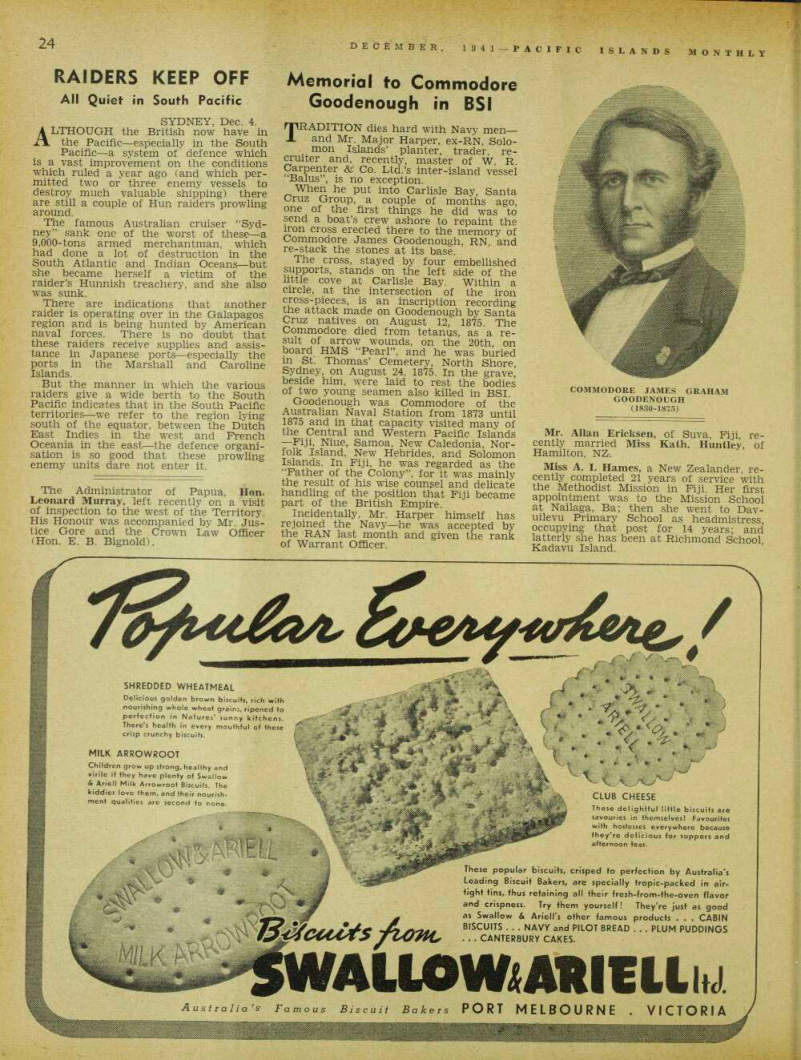
Commodore James Graham
Goodenough
(1830-1875)