Gambusia
pp. 22-23 · Read in the full issue
The Triumph Of
How Colonel Chalmers Routed the Nauru Mosquitoes
AS a result of my visit to Nauru I can write one of the most interest ing chapters in the history of war fare against mosquitoes in the Pacific.
Three years ago, in the wet period following the long drought. Nauru swarmed with mosquitoes—thev made night life a misery. To-day. they are few, and are becoming fewer The change has been wrought by Gambusia fish.
Nauru is one of those queer coral islands with a depression in the centre there are less than a dozen of them altogether, I am told.
There once was the usual atoll—a wide circle of coral reef, enclosing a shallow lagoon. This Nauru atoll (like Ocean Island Maks tea Island, a mighty resting place of birds) was deeply sub merged. The combination of seawater, coral and bird-excreta formed phos nhate. Then it was thrust up again well above its former level.
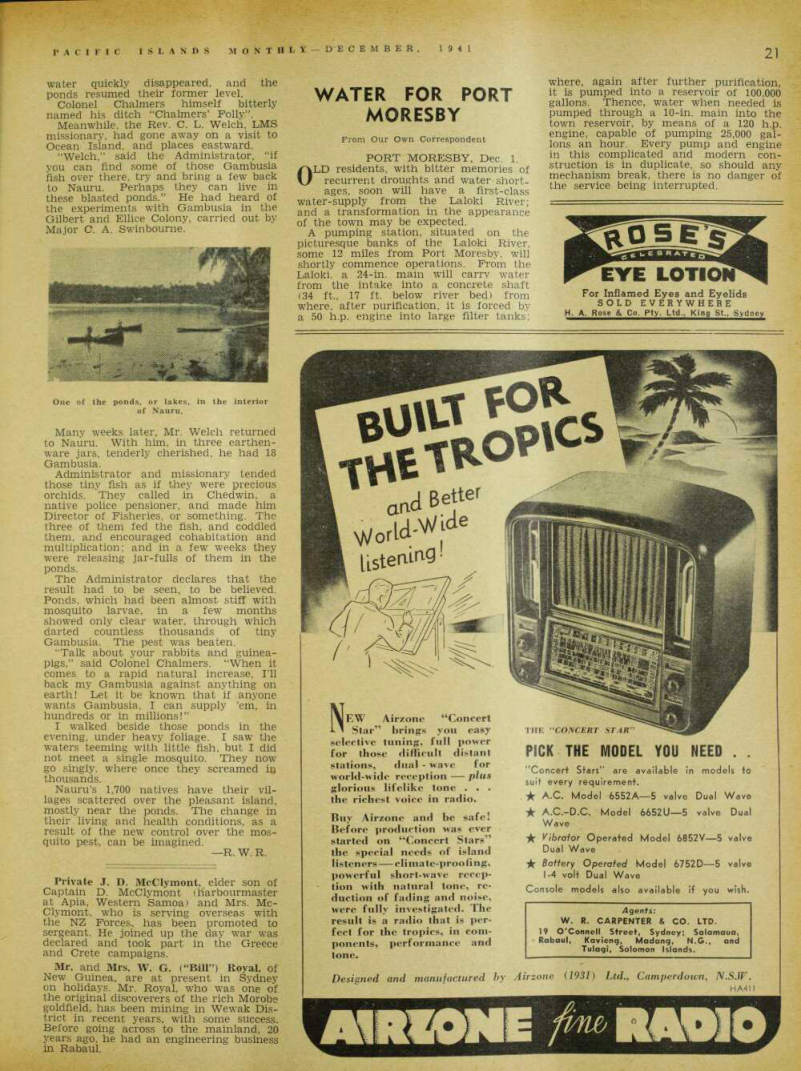
Nauru’s former internal lagoon now is a vast series of brackish waterholes, half buried in vegetation—a veritable answer to a breeding mosquito’s prayer.
The Europeans usuallv fought the Nauru mosquitoes with oil. They spent hundreds (maybe thousands) of pounds in oiling the breeding-water, but Mr. and Mrs. Mosouito were as prolific as ever. Finally, the residents accepted the mosouito pest as a necessary condition of life on lonely Nauru.
Then came a new Administrator,
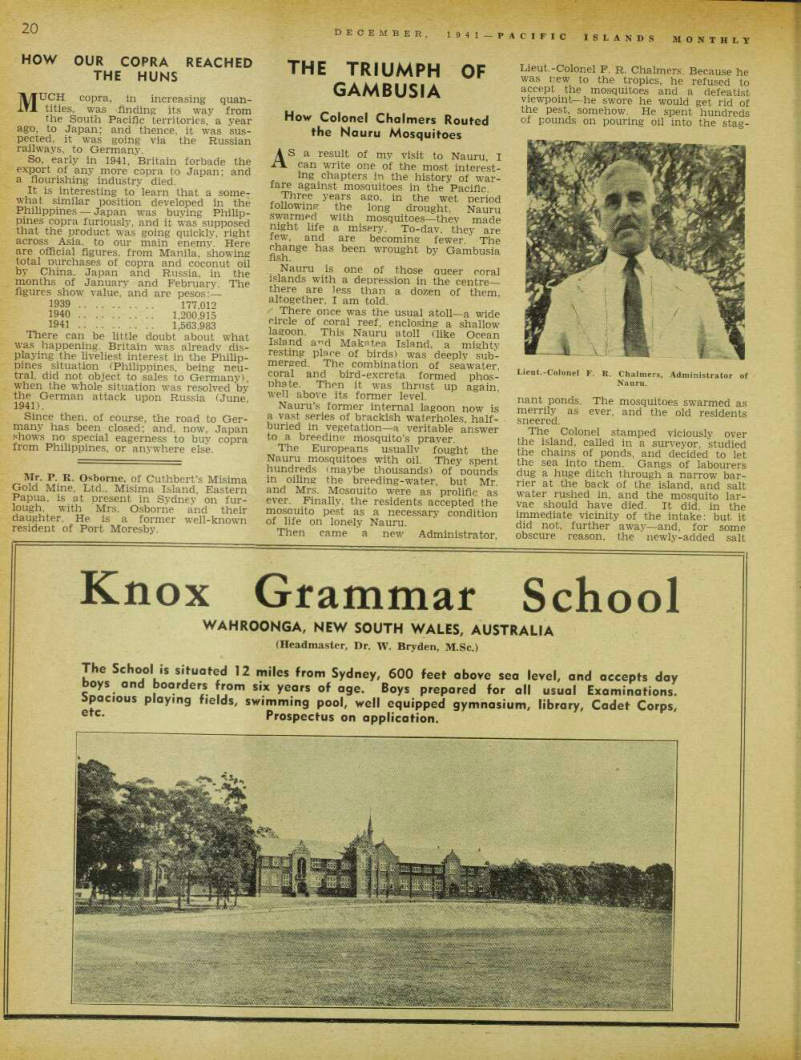
Lieut.-Colonel F. R. Chalmers. Because he was new to the tropics, he refused to accept the mosquitoes and a defeatist viewpoint—he swore he would get rid of the pest, somehow. He spent hundreds of pounds on pouring oil into the stag-
nant ponds. The mosquitoes swarmed as merrily as ever, and the old residents sneered.
The Colonel stamped viciously over the island, called in a surveyor, studied the chains of ponds, and decided to let the sea into them. Gangs of labourers dug a huge ditch through a narrow bar rier at the back of the island, and salt water rushed in, and the mosquito lar vae should have died. It did, in the immediate vicinity of the intake: but it did not, further away—and, for some obscure reason, the newly-added salt
Lieut.-Colonel F. R. Chalmers, Administrator of Nauru.
water quickly disappeared, and the ponds resumed their former level.
Colonel Chalmers himself bitterly named his ditch “Chalmers’ Folly”.
Meanwhile, the Rev. C. L. Welch. LMS missionary, had gone away on a visit to Ocean Island, and places eastward.
“Welch,” said the Administrator, “if you can find some of those Gambusia fish over there, try and bring a few back to Nauru. Perhaps they can live in these blasted ponds.” He had heard of the experiments with Gambusia in the Gilbert and Ellice Colony, carried out by Major C. A. Swinbourne.
Many weeks later, Mr. Welch returned to Nauru. With him, in three earthen ware jars, tenderly cherished, he had 18 Gambusia.
Administrator and missionary tended those tiny fish as if they were precious orchids. They called in Chedwin, a native police pensioner, and made him Director of Fisheries, or something. The three of them fed the fish, and coddled them, and encouraged cohabitation and multiplication; and in a few weeks they were releasing jar-fulls of them in the ponds.
The Administrator declares that the result had to be seen, to be believed.
Ponds, which had been almost stiff with mosquito larvae, in a few months showed only clear water, through which darted countless thousands of tiny Gambusia. The pest was beaten.
“Talk about your rabbits and guinea pigs,” said Colonel Chalmers. “When it comes to a rapid natural increase, I’ll back my Gambusia against anything on earth! Let it be known that if anyone wants Gambusia, I can supply ’em, in hundreds or in millions!”
I walked beside those ponds in the evening, under heavy foliage. I saw the waters teeming with little fish, but I did not meet a single mosquito. They now go singly, where once they screamed in thousands.
Nauru’s 1,700 natives have their vil lages scattered over the pleasant island, mostly near the ponds. The change in their living and health conditions, as a result of the new control over the mos quito pest, can be imagined.
R. W. R.
Private J. D. McClymont, elder son of Captain D. McClymont (harbourmaster at Apia, Western Samoa) and Mrs. Mc- Clymont, who is serving overseas with the NZ Forces, has been promoted to sergeant. He joined up the day war was declared and took part in the Greece and Crete campaigns.
Mr. and Mrs. W. G. (“Bill”) Royal, of New Guinea, are at present in Sydney on holidays. Mr. Royal, who was one of the original discoverers of the rich Morobe goldfield, has been mining in Wewak Dis trict in recent years, with some success.
Before going across to the mainland, 20 years ago, he had an engineering business in Rabaul.
One of the ponds, or lakes, in the interior of Nauru.