Alternatives To Copra
pp. 11-54 · Read in the full issue
Philippines Coconut Corporation Experts Show How New Industries May be Based on Coconut Palm.
(Article written before outbreak of War with Japan) ... ONE of the most interesting developments in the history of the coconut-growing industry has taken place in the Philippines.
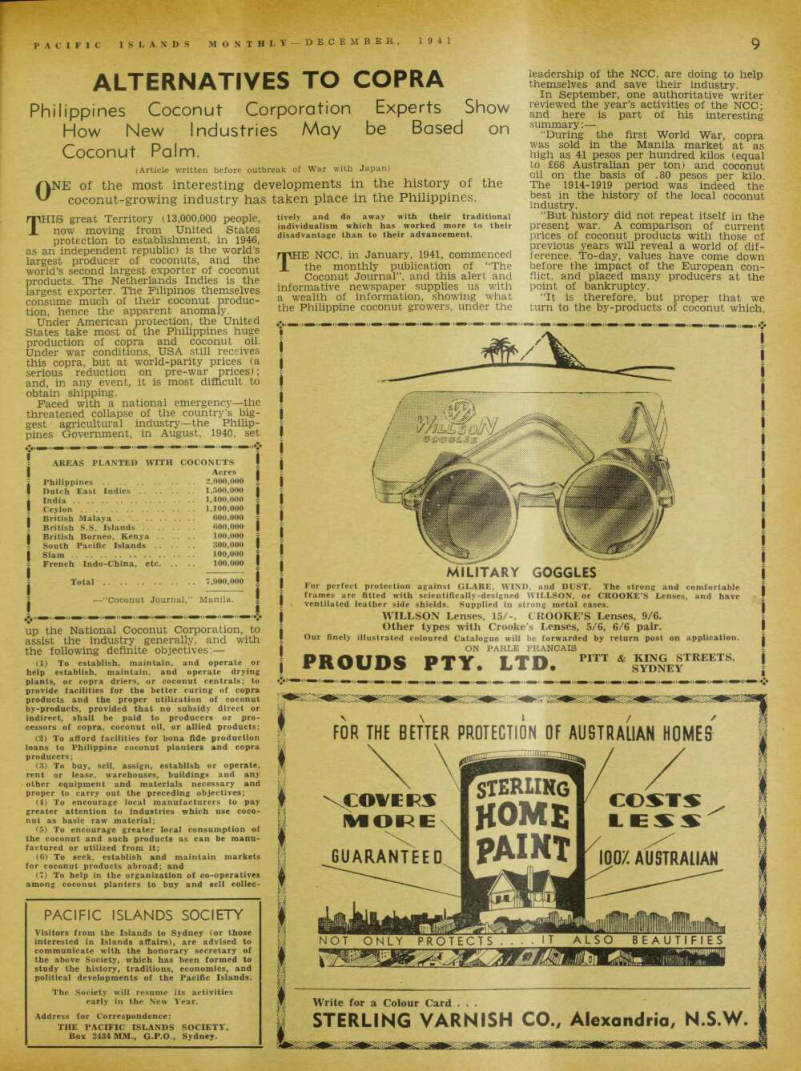
rIS great Territory (13,000,000 people, now moving from United States protection to establishment, in 1946, as an independent republic) is the world’s largest producer of coconuts, and the world’s second largest exporter of coconut products. The Netherlands Indies is the largest exporter. The Filipinos themselves consume much of their coconut produc tion, hence the apparent anomaly.
Under American protection, the United States take most of the Philippines huge production of copra and coconut oil.
Under war conditions, USA still receives this copra, but at world-parity prices (a serious reduction on pre-war prices); and, in any event, it is most difficult to obtain shipping.
Faced with a national emergency—the threatened collapse of the country’s big gest agricultural industry—the Philip pines Government, in August, 1940, set
up the National Coconut Corporation, to assist the industry generally, and with
the following definite objectives:—
(1) To establish, maintain, and operate or help establish, maintain, and operate drying plants, or copra driers, or coconut centrals; to provide facilities for the better curing of copra products and the proper utilization of coconut by-products, provided that no subsidy direct or indirect, shall be paid to producers or pro cessors of copra, coconut oil, or allied products; (2) To afford facilities for bona fide production loans to Philippine coconut planters and copra producers; (3) To buy, sell, assign, establish or operate, rent or lease, warehouses, buildings and any other equipment and materials necessary and proper to carry out the preceding objectives; (4) To encourage local manufacturers to pay greater attention to industries which use coco nut as basic raw material; (5) To encourage greater local consumption of the coconut and such products as can be manu factured or utilized from It; (6) To seek, establish and maintain markets for coconut products abroad; and (7) To help in the organization of co-operatives among coconut planters to buy and sell collec
lively and do away with their traditional individualism which has worked more to their disadvantage than to their advancement. rE NCC, in January, 1941, commenced the monthly publication of “The Coconut Journal”, and this alert and informative newspaper supplies us with a wealth of information, showing what the Philippine coconut growers, under the
leadership of the NCC, are doing to help themselves and save their industry.
In September, one authoritative writer reviewed the year’s activities of the NCC; and here is part of his interesting summary:— “During the first World War, copra was sold in the Manila market at as high as 41 pesos per hundred kilos (equal to £66 Australian per ton) and coconut oil on the basis of .80 pesos per kilo.
The 1914-1919 period was indeed the best in the history of the local coconut industry.
“But history did not repeat itself in the present war. A comparison of current prices of coconut products with those cf previous years will reveal a world of dif ference. To-day, values have come down before the impact of the European con flict, and placed many producers at the point of bankruptcy.
“It is therefore, but proper that we turn to the by-products of coconut which,
properly industrialized, can displace such costly importations as gasoline, crude oil, kerosene, mineral carbon, paints, sacks, and other articles.
“To form a nucleus of an enormous body of skilled workers in the industriali
zation of the coconut raw materials, the National Coconut Corporation has set up a number of schools, notably the one in Sariaya, for the teaching of home in dustries all over the country, to train men and women in the skill necessary to turn cut the standardized products which the corporation plans to manu facture out of the coconut raw materials.
These schools will teach the following:— Better method of making copra—improved dry ing process; Methods of making soap in the home—Nacoco sosa (a Manila preparation), mixed with an equal amount of coconut oil, produces a good soap by means of a process which a five-year old can master in one demonstration; Production of good lard and butter from the coconut meat juice; Weaving of hats from strips of processed coconut leaves; Making from coconut leaves braids to be ex ported to the United States for manufacture into various articles; Preparation of coconut dishes—home-cooking department of the schools dedicated to the en couragement and introduction of coconut dishes in our daily diet; Preparation of coconut charcoal for gas masks, a national defence item, with possibilities of profitable exportation; Preparation of a wood preservative from coconut shell —the NCC technicians got a hint from the fact that coconut shells are never attacked by termites and forthwith developed a process for extracting a preservative for wood from the coconut shell; Manufacture of coir from the coconut husk— the long fibres for the making of door mats, brushes, brooms, and similar articles; Manufacture of a panelling material from the “shorts” of coir fibre, mixed with cement and asbestos, the product having been proven as fire-proof, sturdy, durable, and capable of com peting with the commercial wall board used in house construction; Preparation of coconut shell charcoal for motor fuel—the NCC technicians have developed a device by which charcoal is converted into gas and runs motors. The charcoal costs only .02 pesos a kilo and 45 kilos, costing .90 pesos are all that is necessary to run a motor truck
from Manila to Sariaya, a trip which normally costs from 4.80 pesos to 5.00 pesos in gasoline (Note: A pesos is worth 3/3] Australian, a kilo is 2Vz lb.) Manufacture of sugar and rice bags from coir to replace the jute bags, which are difficult to get these days, because of the war pre occupation of India and the disruption of mari time transportation; and Production of margarine and other edible products from copra. ‘‘ A U the products to be turned out by £°. me ind ustries and the plants of the NCC are to be standardized, so they can be marketed in quantities, whether locally or abroad, without any difficulty arising from variation in specifications.
Developing these home industries, based on the coconut, the NCC expects to increase the total employment of the population in gainful work, and at the same time augment the total wealth producing activity of the country.
“The self-sufficiency motif in the NCC’s rehabilitation of the coconut industry is dramatized by the NCC’s own use of coconut oil, coconut shell as charcoal and raw shell for motor fuel in all its plants, instead of imported crude oil, gasoline kerosene or coal.”
Co-Operative Societies
IN the following article we summarise some of the outstanding material which has been published in the Coconut Journal”, which may be regarded of interest to coconut planters, generally It was announced in January, 1941, that the Philippines Government proposed to organise coconut-growers and their em ployees into producers’ co-operative socie ties; to assist Filipino retailers to compete with foreign retailers on at least equal terms; and to lend all possible assistance to individuals to organise consumers into co-operative societies. At the same time, steps were being taken to organise schools of instruction throughout the Territory where Filipinos might be trained in al
ternative and extended uses of the coconut.
The NCC announced that it would ac cept, in its bonded warehouses, through out the Group, any coora that might be delivered there, provided that the copra was in the standard specifications of from 6 per cent, to 7 per cent, moisture, and less than 1 per cent, fatty acid. A loan based on 70 per cent, of the actual market value of the copra at the time or delivery would be made to the growers, bearing 6 per cent, interest p.a. Similar financial accommodation was being ar ranged for all by-products of the coconut, such as fibre, coconut shell, oil, etc.
Coir And Charcoal
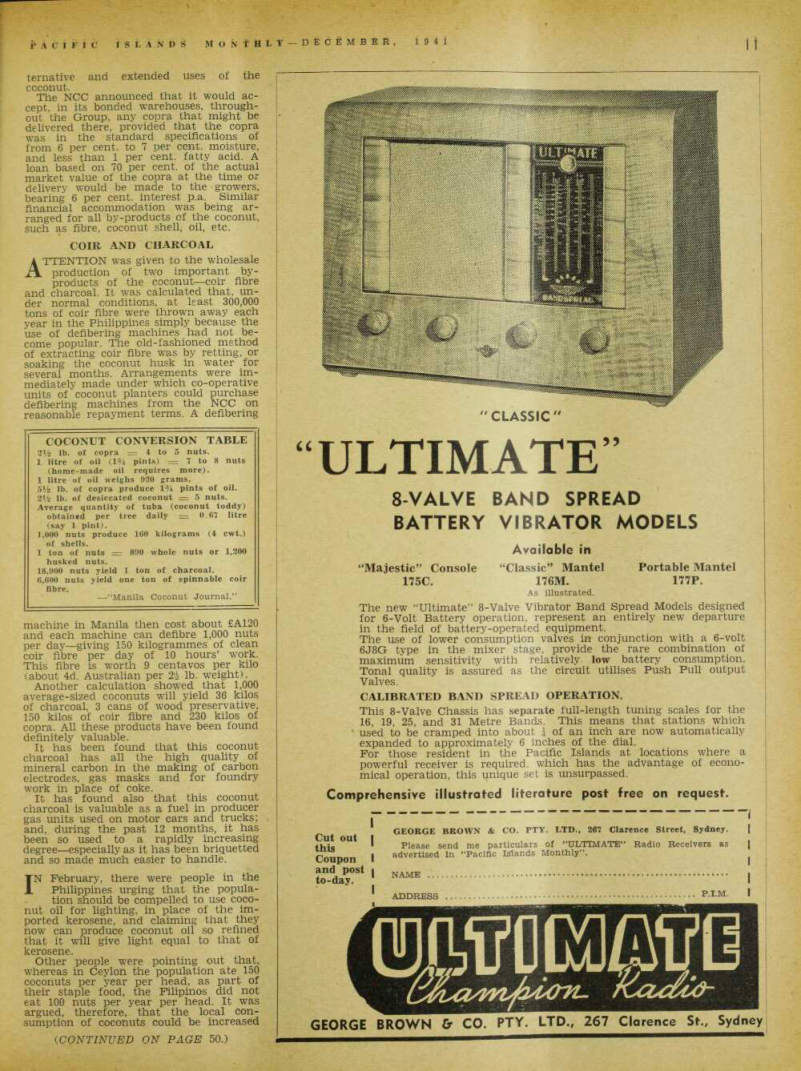
ATTENTION was given to the wholesale production of two important by products of the coconut —coir fibre and charcoal. It was calculated that, un der normal conditions, at least 300,000 tons of coir fibre were thrown away each year in the Philippines simply because the use of defibering machines had not be come popular. The old-fashioned method of extracting coir fibre was by retting, or soaking the coconut husk in water for several months. Arrangements were im mediately made under which co-operative units of coconut planters could purchase defibering machines from the NCC on reasonable repayment terms. A defibering
machine in Manila then cost about £AI2O and each machine can defibre 1,000 nuts per day—giving 150 kilogrammes of clean coir fibre per day of 10 hours’ work.
This fibre is worth 9 centavos per kilo (about 4d. Australian per 2k lb. weight).
Another calculation showed that 1,000 average-sized coconuts will yield 36 kilos of charcoal, 3 cans of wood preservative, 150 kilos of coir fibre and 230 kilos of copra. All these products have been found definitely valuable.
It has been found that this coconut charcoal has all the high quality of mineral carbon in the making of carbon electrodes, gas masks and for foundry work in place of coke.
It has found also that this coconut charcoal is valuable as a fuel in producer gas units used on motor cars and trucks; and, during the past 12 months, it has been so used to a rapidly increasing degree—especially as it has been briquetted and so made much easier to handle.
IN February, there were people in the Philippines urging that the popula tion should be compelled to use coco nut oil for lighting, in place of the im ported kerosene, and claiming that they now can produce coconut oil so refined that it will give light equal to that of kerosene.
Other people were pointing out that, whereas in Ceylon the population ate 150 coconuts per year per head, as part of their staple food, the Filipinos did not eat 100 nuts per year per head. It was argued, therefore, that the local con sumption of coconuts could be increased
(Continued On Page 50.)
by about 50 per cent., thus cutting out considerable food importation.
Co-Operative Plant Units
ARTICLES in favour of establishing co operative machinery units among coconut growers have appeared in practically every issue of the journal. It is claimed that coconut growers can help themselves if they co-operate in estab lishing plants for drying copra, and thus producing a higher grade; by organising agencies for selling their own copra; by purchasing plant for the extraction of oil from copra; by establishing mills for the production of desiccated coconut; by es tablishing plants for productions made from the edible oil of the coconut; and by an organisation for buying goods in ex change for copra and other coconut products.
As in the case in all countries, co operative enterprises can be described most convincingly in theory, but they rarely work out well in practice, and this appears to be the case in the Philippines There has been much talk of co-operative societies, but little indication that this movement has developed strongly.
Products Of The Coconut
IT was announced early in 1941 that the NCC school was being attended by 150 students, who were receiving tuition in how to make the best economic use of the coconut and it was further an nounced that everything the school could produce was being sold immediately—in fact, the demand was greater than the supply. The products of the school in cluded the following articles—all made from the coconut: Asbestos tiles, bags, baskets, braid, brushes, carpets, charcoal, coconut shell novelties, coconut oil, con fectionery, doormats, hats, helmets, in sulating board, rope, rugs, sacks, slippers, soaps, wood preservatives, wooden shoes, and yarn from coir fibre.
Medicinal Value
IN the March issue, Dr. Leon, physician and scientist, described the medicinal uses of some of the products of the coconut palm. He said that fresh coconut milk can be a substitute for animal milk.
“It has an advantage over the animal milk, for it has a mild laxative effect and as such is ideal food or drink for persons suffering from high blood pressure and constipation. It contains vitamins A, C, D and E, and calcium and phosphorus, which are necessary for the maintenance of re sistance, nutrition and normal functioning of the body. It is useful to nursing
mothers and TB patients especially, be cause of the vitamins C and D, and the happy combination of calcium and phos phorus. ... It should be taken with sugar, and the amount to meet the individual’s requirements should be calculated, for there are people who are easily affected by its laxative effect. When a stronger laxative effect is desired a bigger amount can be taken. . . . Another important pro perty of coconut milk is its anti-sterility effect. This Is attributed to its vitamin E content.”
The doctor says that the meat of the young coconut has almost the same nutri tive value as coconut milk. Like the coco nut milk, it is good for nursing mothers.
TB patients, and anaemic and debilitated individuals, and growing children. It can be taken alone or mixed with sugar or milk.
The doctor makes a distinction between coconut milk and coconut water. Coconut milk apparently is the thick white liquid produced by squeezing certain portions of the coconut meat. Coconut water is the clear liquid found in young coconuts.
He says that coconut water is good for kidney trouble, because of its deuretic properties for increased urination. Coconut water contains a fair amount of vitamins C and D. It is a good drink for TB pa tients, convalescents, peonle afflicted with febrile diseases and nursing mothers. The doctor says that the spongy meat of the young coconut is a nutritious food con taining carbo-hydrate, fats and vitamins A. B, C and D.
The core of the coconut tree is astrin gent and styptic, and hence is useful in hemorrhagic conditions, and it is also anti-diarrheic. It must be given in the form of infusion or decoction to the patient. In simple diarrhoea cases the core of the coconut tree may be given as food, or part of the diet by boiling it in water with a little salt, the whole to be taken by the patient, including the cooked core. This also furnishes good nutrition and it contains carbo-hydrates, proteins, fats, minerals and vitamins.
The soft shell of the young coconut is anti-diarrheic and anti-hemorrhagic. It may be given internally by eating it raw, or applying it locally after it has been triturated.
The powder of the old dry shell of a matured coconut, made by scraping it with a knife, is a valuable powder for wounds and ulcers. Besides, it stimulates the growth of tissues and hastens the healing process. It can be mixed with iodoform powder in dressing deep wounds and ulcers. It is also a good deodorant.
Production Of Sacks
BY July, 1941, the NCC had created a country - wide organisation under which spinning wheels were being distributed all over the Philippine Group and a large number of teachers and de monstrators were out, showing the people how to devote their full or their spare time to spinning yarn from coconut coir, weaving such yarn into sackcloth, and if possible, making finished sacks out of the cloth.
It was reported that so many people had taken up this new industry of spin ning and producing sacks from coconut fibre that the two centres established to
manufacture coir were being hard put to it to supply the demand for coir, while the available factories able to make spinning wheels were similarly overwhelmed with orders. The NCC has not only created this organisation, but has fixed a daily
quota, showing the number of sacks to be produced by a large number of Philip pine centres. The quota is based on a total production of 10,000 sacks per day.
One section of the NCC is studying the problem of considerably increasing the
quantity of live stock raised on coconut plantations. Attention is being given to cattle, goats and sheep.
In the August journal, a scientist, Mr.
Lava, examined the food value of the coconut, and said that, “while coconut milk is not cow milk, preliminary experi ments have shown that by proper adjust ment, coconut milk may be made as nutritious as cow milk. Furthermore, coco nut milk may have other desirable physio logical properties”. He says also: “A flour can be produced from the coconut cake, by-product of coconut oil, that has more crude fibre and proteins than wheat flour but less soluble carbo-hydrates. Mixed with wheat flour, it produces good bread cake and confectionery. By substituting coconut flour for wheat flour to the extent of 20 per cent., a substantial importation of wheat flour may be avoided.”
A leading electrical engineer describes the great and hitherto unsuspected value of the carbon from coconut shell in sup plying essential parts (electrolodes, etc) for flashlight batteries, telephone bat teries, radio batteries, motor accessories, graphite, etc. It appears that, in this direction, an important industry already has been established in Manila^.
Space forbids the summarising of any more of this interesting material. In the last issue of “Coconut Journal” to hand (October, 1941) one notices the following significant headings to articles: “Coir Spinning and the Production of Sand Bags”; “The Sninning Wheel a Symbol of Personal Freedom”: “Flour Substitutes from Coconut”: “The Progess of the NCC Campaign for New Copra Driers”.
It would appear that the South Pacific has something important to learn from the Philippines in regard to the reor ganisation and stabilisation of the coconut industry.