War Comes To The Pacific
pp. 7-8 · Read in the full issue
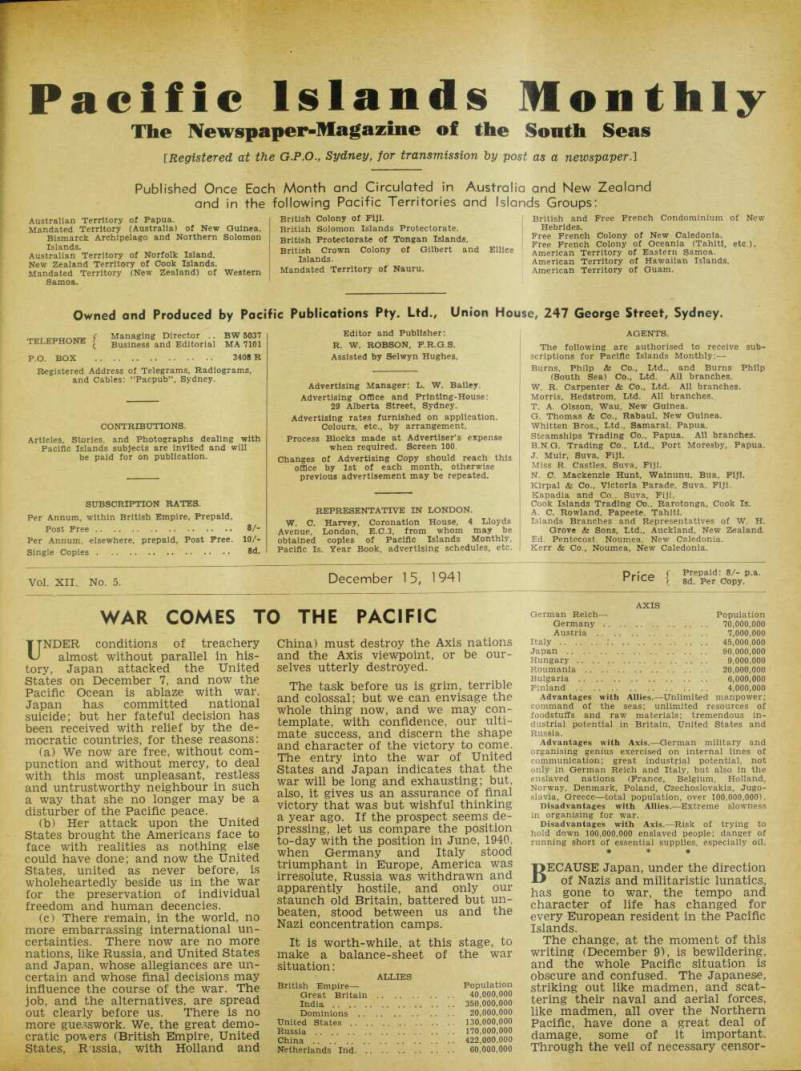
UNDER conditions of treachery almost without parallel in his tory, Japan attacked the United States on December 7, and now the Pacific Ocean is ablaze with war.
Japan has committed national suicide; but her fateful decision has been received with relief by the de mocratic countries, for these reasons: (a) We now are free, without com punction and without mercy, to deal with this most unpleasant, restless and untrustworthy neighbour in such a way that she no longer may be a disturber of the Pacific peace. (b) Her attack upon the United States brought the Americans face to face with realities as nothing else could have done; and now the United States, united as never before, is wholeheartedly beside us in the war for the preservation of individual freedom and human decencies. (c) There remain, in the world, no more embarrassing international un certainties. There now are no more nations, like Russia, and United States and Japan, whose allegiances are un certain and whose final decisions may influence the course of the war. The job, and the alternatives, are spread out clearly before us. There is no more guesswork. We, the great demo cratic powers (British Empire, United States, Russia, with Holland and
China) must destroy the Axis nations and the Axis viewpoint, or be our selves utterly destroyed.
The task before us is grim, terrible and colossal; but we can envisage the whole thing now, and we may con template, with confidence, our ulti mate success, and discern the shape and character of the victory to come.
The entry into the war of United States and Japan indicates that the war will be long and exhausting; but, also, it gives us an assurance of final victory that was but wishful thinking a year ago. If the prospect seems de pressing, let us compare the position to-day with the position in June, 1940, when Germany and Italy stood triumphant in Europe, America was irresolute, Russia was withdrawn and apparently hostile, and only our staunch old Britain, battered but un beaten, stood between us and the Nazi concentration camps.
It is worth-while, at this stage, to make a balance-sheet of the war situation:
Allies
British Empire— Population Great Britain 40,000,000 India 350,000,000 Dominions 20,000,000 United States 130,000,000 Russia 170,000,000 China 422,000,000 Netherlands Ind 60,000,000
Axis
German Reich — Population Germany 70,000,000 Austria 7,000,000 Italy : 45,000,000 Japan 90,000,000 Hungary 9,000,000 Roumania 20,000,000 Bulgaria 6,000,000 Finland 4,000,000 Advantages with Allies. —Unlimited manpower; command of the seas; unlimited resources of foodstuffs and raw materials; tremendous in dustrial potential in Britain, United States and Russia.
Advantages with Axis.—German military and organising genius exercised on internal lines of communication; great industrial potential, not only in German Reich and Italy, but also in the enslaved nations (Prance, Belgium. Holland, Norway, Denmark, Poland, Czechoslovakia, Jugo slavia, Greece—total population, over 100,000,000).
Disadvantages with Allies. —Extreme slowness in organising for war.
Disadvantages with Axis. —Risk of trying to hold down 100,000,000 enslaved people; danger of running short of essential supplies, especially oil. * * * BECAUSE Japan, under the direction of Nazis and militaristic lunatics, has gone to war, the tempo and character of life has changed for every European resident in the Pacific Islands.
The change, at the moment of this
writing (December 9), is bewildering,
and the whole Pacific situation is obscure and confused. The Japanese, striking out like madmen, and scat tering their naval and aerial forces, like madmen, all over the Northern Pacific, have done a great deal of damage, some of it important.
Through the veil of necessary censor
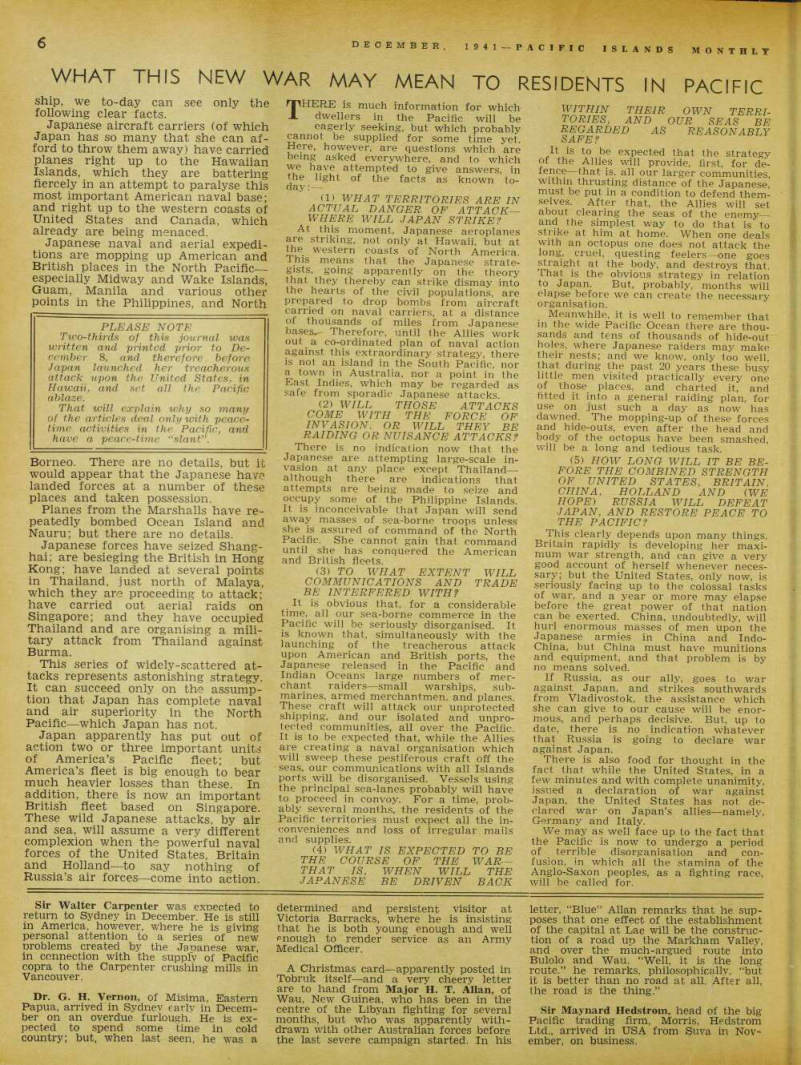
ship, we to-day can see only the following clear facts.
Japanese aircraft carriers (of which Japan has so many that she can af ford to throw them away) have carried planes right up to the Hawaiian Islands, which they are battering fiercely in an attempt to paralyse this most important American naval base; and right up to the western coasts of United States and Canada, which already are being menaced.
Japanese naval and aerial expedi tions are mopping up American and British places in the North Pacific— especially Midway and Wake Islands, Guam, Manila and various other points in the Philippines, and North
Borneo. There are no details, but it would appear that the Japanese have landed forces at a number of these places and taken possession.
Planes from the Marshalls have re peatedly bombed Ocean Island and Nauru; but there are no details.
Japanese forces have seized Shang hai; are besieging the British in Hong Kong; have landed at several points in Thailand, just north of Malaya, which they are proceeding to attack; have carried out aerial raids on Singapore; and they have occupied Thailand and are organising a mili tary attack from Thailand against Burma.
This series of widely-scattered at tacks represents astonishing strategy.
It can succeed only on the assump tion that Japan has complete naval and air superiority in the North Pacific—which Japan has not.
Japan apparently has put out of action two or three important units of America’s Pacific fleet; but America’s fleet is big enough to bear much heavier losses than these. In addition, there is now an important British fleet based on Singapore.
These wild Japanese attacks, by air and sea, will assume a very different complexion when the powerful naval forces of the United States, Britain and Holland—to say nothing of Russia’s air forces—come into action.
Sir Walter Carpenter was expected to return to Sydney in December. He is still in America, however, where he is giving personal attention to a series of new problems created by the Japanese war, in connection with the supply of Pacific copra to the Carpenter crushing mills in Vancouver.
Dr. G. H. Vernon, of Misima, Eastern Papua, arrived in Sydney early in Decem ber on an overdue furlough. He is ex pected to spend some time in cold country; but, when last seen, he was a
determined and persistent visitor at Victoria Barracks, where he is insisting that he is both young enough and well enough to render service as an Army Medical Officer.
A Christmas card —apparently posted in Tobruk itself —and a very cheery letter are to hand from Major H. T. Allan, of Wau, New Guinea, who has been in the centre of the Libyan fighting for several months, but who was apparently with drawn with other Australian forces before the last severe campaign started. In his
letter, “Blue” Allan remarks that he sup poses that one effect of the establishment of the capital at Lae will be the construc tion of a road up the Markham Valley, and over the much-argued route into Bulolo and Wau. “Well, it is the long route,” he remarks, philosophically, “but it is better than no road at all. After all, the road is the thing.”
Sir Maynard Hedstrom, head of the big Pacific trading firm, Morris, Hedstrom Ltd., arrived in USA from Suva in Nov ember, on business.