“Savages in Serge”
pp. 56-57 · Read in the full issue
Tribute to Royal Papuan Constabulary
ONE of the finest feats of colonial administration in the British Empire has been the bloodless pacification of more than 250,000 primitive Papuan natives.
In this vast country, there still are many natives who have never seen a European and who still live under Stone Age conditions; but gradually they are being brought under control and prepared for the impact of modern civilisation.
The Papuans themselves, as members of the Royal Armed Constabulary (formerly known as the Native Armed Constabulary) are playing no small part in this work of pacification.
This little force of native police has done splendid work in maintaining law and order among its own people during the past 50 years and, in that time, has built up a reputation and record equal to any other similar body in the world.
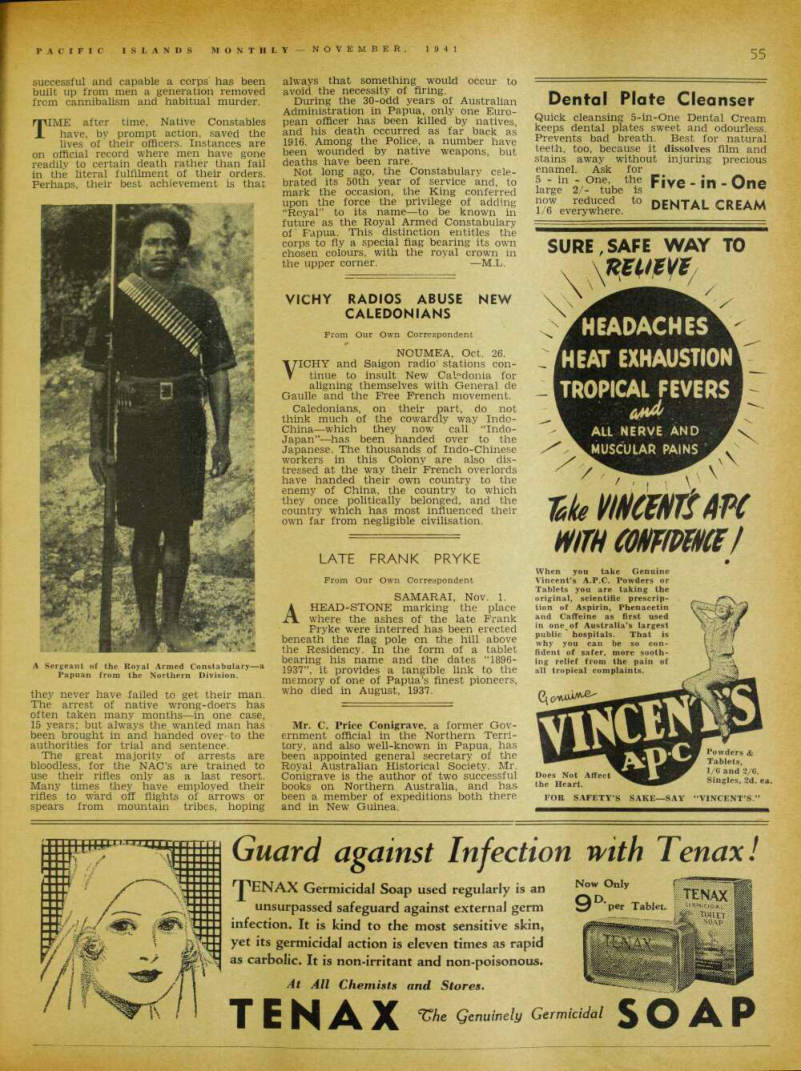
The Constabulary have been dubbed “savages in serge”, but they are a hardy and vigorous body of men, muscular and well set up. On patrol, with their packs and rifles, they cut picturesque figures as they swing along, in their uniform of navy and red.
THE Native Armed Constabulary was instituted in 1889 bv Sir William Macgregor. Through the Fiji Gov ernment, he recruited 12 Solomon Islanders and 2 Fijian NCO’s, from the Fiji Police Force and, with them, formed the nucleus of the Service. Later, the force was expanded with Papuan natives, eight being recruited in the first year.
These new recruits did very well and their number was rdpidly increased.
When the Solomon Islanders and Fijians completed their three-year term of service, it was decided not to replace them. A few were re-engaged, but all other vacancies were filled by Papuans.
Within a few years, the Service became wholly Papuan in character.
The record of the Constabulary has been consistently good, from the time of its inauguration until the present day.
Without it, the pacification of Papua might never have been achieved. True, the force has been well led; but not the most perfect leadership could have suc ceeded in the difficult task without the unquestioning loyalty and the unfailing courage the men have always given their officers.
A good deal of the success of the Constabulary has been due to the careful manner in which recruits have been trained and to the system which in culcates a sense of duty and of loyalty from the outset. It reflects great credit, too, on the native character that so
successful and capable a corps has been built up from men a generation removed from cannibalism and habitual murder.
TIME after time, Native Constables have, by prompt action, saved the lives of their officers. Instances are on official record where men have gone readily to certain death rather than fail in the literal fulfilment of their orders.
Perhaps, their best achievement is that
they never have failed to get their man.
The arrest of native wrong-doers has often taken many months —in one case, 15 years; but always the wanted man has been brought in and handed over-to the authorities for trial and sentence.
The great majority of arrests are bloodless, for the NAC’s are trained to use their rifles only as a last resort.
Many times they have employed their rifles to ward off flights of arrows or spears from mountain tribes, hoping
always that something would occur to avoid the necessity of firing.
During the 30-odd years of Australian Administration in Papua, only one Euro pean officer has been killed by natives, and his death occurred as far back as 1916. Among the Police, a number have been wounded by native weapons, but deaths have been rare.
Not long ago, the Constabulary cele brated its 50th year of service and, to mark the occasion, the King conferred upon the force the privilege of adding “Royal” to its name—to be known in future as the Royal Armed Constabulary of Fapua. This distinction entitles the corps to fly a special flag bearing its own chosen colours, with the royal crown in
the upper corner.
-M.L.
A Sergeant of the Royal Armed Constabulary—a Papuan from the Northern Division.