Escape From The
pp. 45-46 · Read in the full issue
Sea
Mangaia Native's Terrifying Experience
By W.S.B.
A MAN returned from the small island of Mitiaro, in the Southern Cook Group, told the story of how a native of that island, returning in his canoe from a fishing expedition, had safely ac complished the crossing of the reef, only to be plunged suddenly into a hole in which he disappeared. Some small children awaiting him on the beach ran home in fright to acquaint relatives of the disaster.
A party hurried to the spot and peered into the water. For a time nothing was seen, but presently a hand appeared, to be immediately grasped by the watchers,
and the victim, alive but terribly bat tered, was snatched from his prison beneath the jagged coral. He had slipped through into a kind of cave, where he had been fighting desperately for his life in the surging waters.
This story provides a parallel to our own island of Mangaia. Edgar Allan Poe could scarcely have devised a more fan tastic and terrifying adventure.
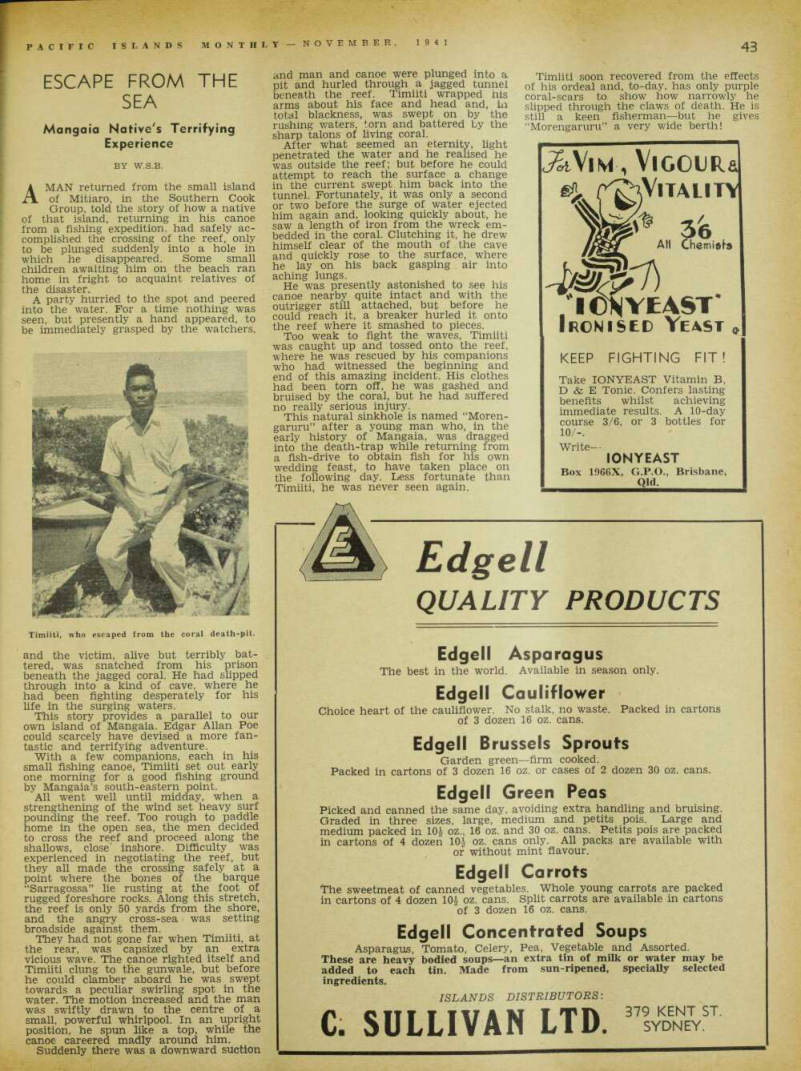
With a few companions, each in his small fishing canoe, Timiiti set out early one morning for a good fishing ground by Mangaia’s south-eastern point.
All went well until midday, when a strengthening of the wind set heavy surf pounding the reef. Too rough to paddle home in the open sea, the men decided to cross the reef and proceed along the shallows, close inshore. Difficulty was experienced in negotiating the reef, but they all made the crossing safely at a point where the bones of the barque “Sarragossa” lie rusting at the foot of rugged foreshore rocks. Along this stretch, the reef is only 50 yards from the shore, and the angry cross-sea was setting broadside against them.
They had not gone far when Timiiti, at the rear, was capsized by an extra vicious wave. The canoe righted itself and Timiiti clung to the gunwale, but before he could clamber aboard he was swept towards a peculiar swirling spot in the water. The motion increased and the man was swiftly drawn to the centre of a small, powerful whirlpool. In an upright position, he spun like a top, while the canoe careered madly around him.
Suddenly there was a downward suction
and man and canoe were plunged into a pit and hurled through a jagged tunnel beneath the reef. Timiiti wrapped his arms about his face and head and, in total blackness, was swept on by the rushing waters, torn and battered by the sharp talons of living coral.
After what seemed an eternity, light penetrated the water and he realised he was outside the reef; but before he could attempt to reach the surface a change in the current swept him back into the tunnel. Fortunately, it was only a second or two before the surge of water ejected him again and, looking quickly about, he saw a length of iron from the wreck em bedded in the coral. Clutching it, he drew himself clear of the mouth of the cave and quickly rose to the surface, where he lay on his back gasping air into aching lungs.
He was presently astonished to see his canoe nearby quite intact and with the outrigger still attached, but before he could reach it, a breaker hurled it onto the reef where it smashed to pieces.
Too weak to fight the waves, Timiiti was caught up and tossed onto the reef, where he was rescued by his companions who had witnessed the beginning and end of this amazing incident. His clothes had been torn off, he was gashed and bruised by the coral, but he had suffered no really serious injury.
This natural sinkhole is named “Moren garuru” after a young man who, in the early history of Mangaia, was dragged into the death-trap while returning from a fish-drive to obtain fish for his own wedding feast, to have taken place on the following day. Less fortunate than Timiiti, he was never seen again.
Timiiti soon recovered from the effects of his ordeal and, to-day, has only purple coral-scars to show how narrowly he slipped through the claws of death. He is still a keen fisherman —but he gives ‘Morengaruru” a very wide berth!
Timiiti, who escaped from the coral death-pit.
Mr. Gordon Farmer, of the Audit De partment of the New Guinea Public Service, arrived in Australia recently to enlist for overseas service. Prior to his departure from the Territory, Mr. Farmer was farewelled at a gathering in Rabaul.
Mrs. Farmer preceded him South a short time ago.
Captain Harry Rochford Hughes, who for nearly 30 years was an officer, then master, of the Pacific Cable Board’s ship “Iris”, died in Auckland in October at the age of 66. During his long service, he gained a high reputation as an ex pert in laying and repairing cables in Central Pacific and NZ waters. When the “Iris” was armed and sent out from Auckland in the last war to search for Count Felix von Luckner, who had es caped from internment on Motuihi Island, Captain Hughes was in command of the shore party at the Kermadec Is lands, where the Germans were recap tured. Later the “Iris” was re-named “Recorder” and passed to the ownership r f Cable and Wireless Ltd. Captain Hughes retired from the sea in 1932.