Fiji Rubber
p. 42 · Read in the full issue
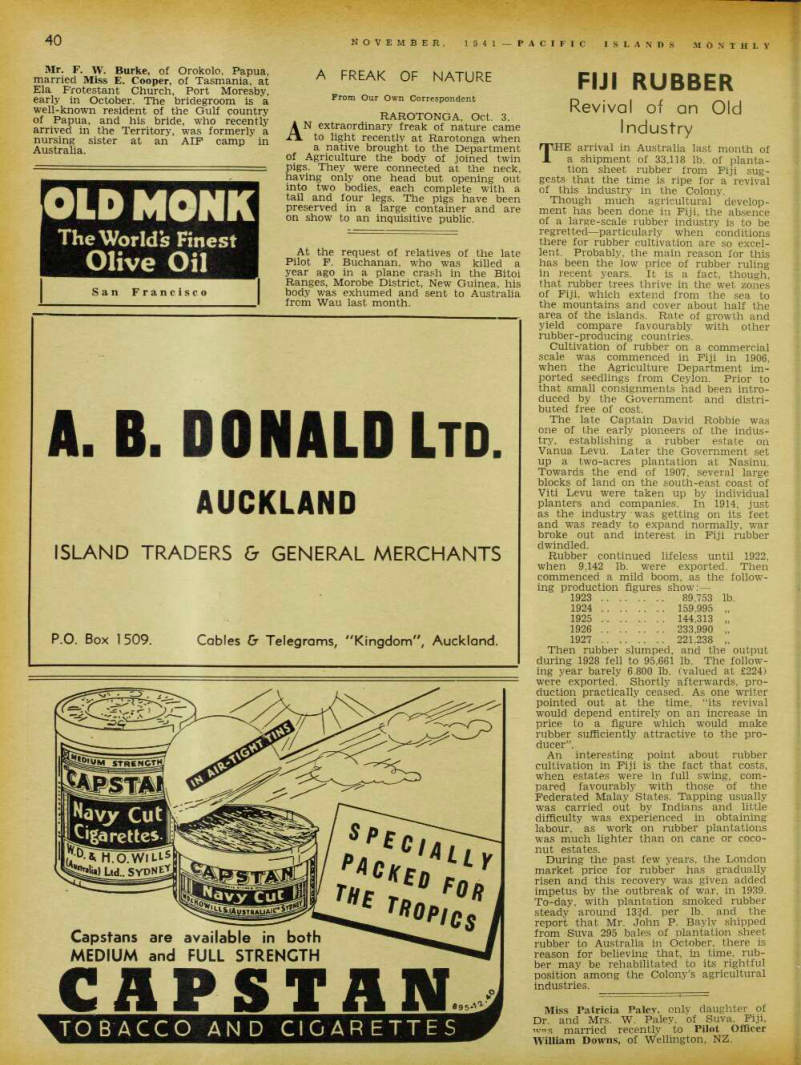
Revival of an Old Industry
THE arrival in Australia last month of a shipment of 33,118 lb. of planta tion sheet rubber from Fiji sug gests that the time is ripe for a revival of this industry in the Colony.
Though much agricultural develop ment has been done in Fiji, the absence of a large-scale rubber industry is to be regretted—particularly when conditions there for rubber cultivation are so excel lent. Probably, the main reason for this has been the low price of rubber ruling in recent years. It is a fact, though, that rubber trees thrive in the wet zones of Fiji, which extend from the sea to the mountains and cover about half the area of the islands. Rate of growth and yield compare favourably with other
rubber-producing countries.
Cultivation of rubber on a commercial scale was commenced in Fiji in 1906, when the Agriculture Department im ported seedlings from Ceylon. Prior to that small consignments had been intro duced by the Government and distri buted free of cost.
The late Captain David Robbie was one of the early pioneers of the indus try, establishing a rubber estate on Vanua Levu. Later the Government set up a two-acres plantation at Nasinu.
Towards the end of 1907, several large blocks of land on the south-east coast of Viti Levu were taken up by individual planters and companies. In 1914, just as the industry was getting on its feet and was ready to expand normally, war broke out and interest in Fiji rubber dwindled.
Rubber continued lifeless until 1922, when 9,142 lb. were exported. Then commenced a mild boom, as the follow ing production figures show:— 1923 89,753 lb. 1924 159,995 „ 1925 144,313 „ 1926 233,990 „ 1927 221,238 „ Then rubber slumped, and the output during 1928 fell to 95,661 lb. The follow ing year barely 6.800 lb. (valued at £224) were exported. Shortly afterwards, pro duction practically ceased. As one writer pointed out at the time, “its revival would depend entirely on an increase in price to a figure which would make rubber sufficiently attractive to the pro ducer”.
An interesting point about rubber cultivation in Fiji is the fact that costs, when estates were in full swing, com pared favourably with those of the Federated Malay States. Tapping usually was carried out by Indians and little difficulty was experienced in obtaining labour, as work on rubber plantations was much lighter than on cane or coco nut estates.
During the past few years, the London market price for rubber has gradually risen and this recovery was given added impetus by the outbreak of war, in 1939.
To-day, with plantation smoked rubber steady around 13|d. per lb. and the report that Mr. John P. Bayly shipped from Suva 295 bales of plantation sheet rubber to Australia in October, there is reason for believing that, in time, rub ber may be rehabilitated to its rightful position among the Colony’s agricultural industries.
Miss Patricia Paley, only daughter of Dr. and Mrs. W. Paley, of Suva, Fiji, was married recently to Pilot Officer William Downs, of Wellington, NZ.