Method of Treatment
pp. 30-31 · Read in the full issue

Ficus Rubber
A NUMBER of New Guinea planters these days have a regular, profitable . source of income from the production ? c^ s ru bber—a “scrap” rubber, dis rubber fr ° m and not aS good aS para Recently, a cocoa planter in Western Samoa, having learned of the NG ficus rubber industry from articles in the “PIM”, sought information on how to tap and cure this “scrap”. It appears that in Samoa, many years ago, ficus trees were inter-planted with cocoa as wind breaks and for shade, but to-day these rubber trees have outgrown their use fulness and, in some cases, have destroyed plantations and handicapped cocoa production on others, . The present method of treating ficus * n New Guinea was evolved by a leading planter of Madang, Mr. V. w. Maxwell; and, in an interview in Sydney, last he courteously supplied the following details to the “PIM”.
TAPPT>jr Avn rninrrTmr
Tapping And Collecting
THIRST, the top side of the ficus tree ao^T?^?'nclie 1 s m V. s t be cut 1R . sharp arSiS? a t distances not IGSS tn.3,n 12 in. &p&rt. Th.o IcitGX (or gUm) will floW from these cuts and run down the trunk, where it coagulates and d r j es on the bark, Thus, obviously, it i S not prudent to work too close to the base of the tree The dried latex is collected a week after the incisions are made. Under no
circumstances should collecting be left more than 9 days as, from this time onwards, deterioration rapidly sets in— the rubber becomes discoloured, tacky and loses elasticity. Care should be taken to see that it is not wound up too tightly Mr. Maxwell estimates that, under super vision, a native can collect uo to 15 lb of “scrap” daily.
The raw “scrap” is now taken to a curing shed to be treated.
The Curing Shed
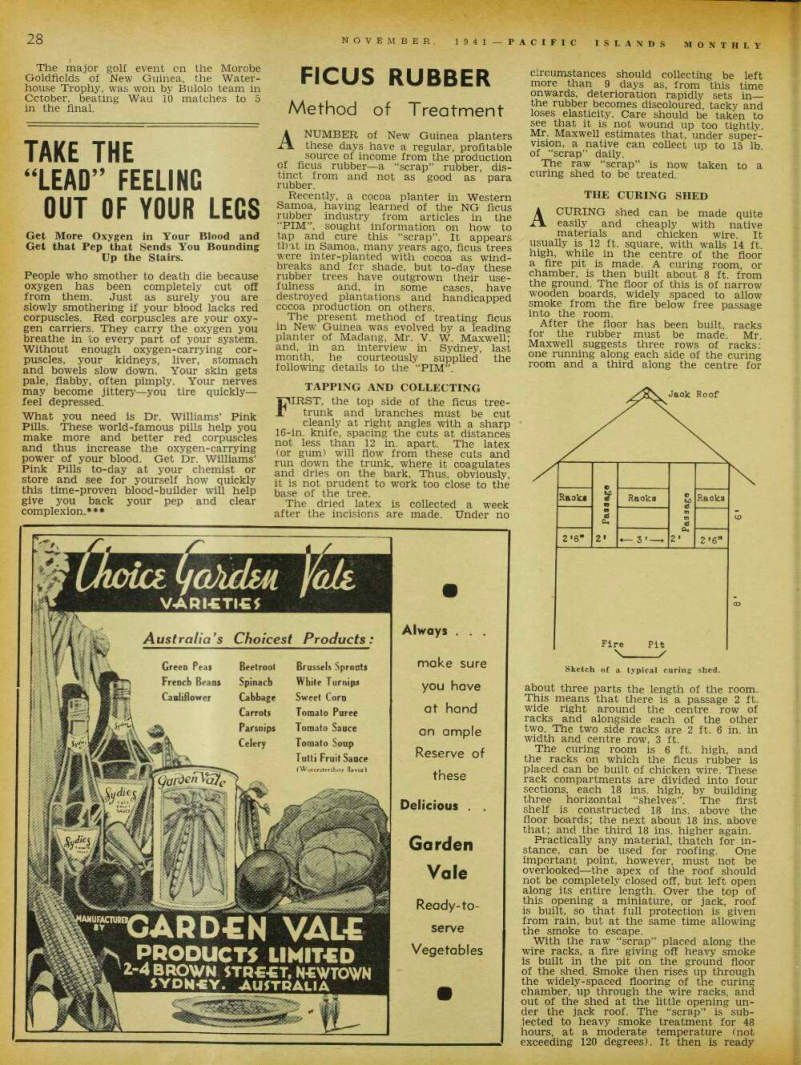
A CURING shed can be made quite easily and cheaply with native materials and chicken wire. It usually is 12 ft. square, with walls 14 ft. high, while in the centre of the floor a fire pit is made. A curing room, or chamber, is then built about 8 ft. from the ground. The floor of this is of narrow wooden boards, widely spaced to allow smoke from the fire below free passage into the room.
After the floor has been built, racks for the rubber must be made. Mr.
Maxwell suggests three rows of racks: one running along each side of the curing room and a third along the centre for
about three parts the length of the room.
This means that there is a passage 2 ft. wide right around the centre row of racks and alongside each of the other two. The two side racks are 2 ft. 6 in. in width and centre row, 3 ft.
The curing room is 6 ft. high, and the racks on which the ficus rubber is placed can be built of chicken wire. These rack compartments are divided into four sections, each 18 ins. high, by building three horizontal “shelves”. The first shelf is constructed 18 ins. above the floor boards; the next about 18 ins. above that; and the third 18 ins. higher again.
Practically any material, thatch for in stance, can be used for roofing. One important point, however, must not be overlooked—the apex of the roof should not be completely closed off, but left open along its entire length. Over the top of this opening a miniature, or jack, roof is built, so that full protection is given from rain, but at the same time allowing the smoke to escape.
With the raw “scrap” placed along the wire racks, a fire giving off heavy smoke is built in the pit on the ground floor of the shed. Smoke then rises up through the widely-spaced flooring of the curing chamber, up through the wire racks, and out of the shed at the little opening un der the jack roof. The “scrap” is sub jected to heavy smoke treatment for 48 hours, at a moderate temperature (not exceeding 120 degrees). It then is ready
Sketch of a typical curing shed.
for the packing centre to be baled and shipped.
100 Lb. Bales Best
RUBBER is freighted by measurement, and in order to reduce shipping space and to facilitate handling, Mr.
Maxwell believes that it should be baled in a hand press. Interior measurements of the box portion of the press should be 24 ins. in length, 12 ins. in breadth, and 16 ins. in depth. This gives a 100 lb. bale of convenient size. To obviate the collection of dust and foreign matter, rubber should be baled as soon as possible after leaving the curing shed. Having been pressed, the ficus bale is dusted with French chalk, covered with an inner wrapping cf unbleached calico and given an outer wrap of hessian.
Mr. Maxwell said that every 5,000 trees require a line of approximately 18 “boys”—ls cutters and collectors, 1 “boss boy”. 1 packer and 1 “fire-boy”. Work should be apportioned as follows: cutting for 6 days, then collecting 8 days. This will produce about 2,800 lb. of “scrap” rubber per month.
Planters in New Guinea receive for their ficus rubber a price very close to the quotation for “scrap” para rubber.