Palmyra
pp. 54-55 · Read in the full issue
PAA's Proposed New Bose
ALTHOUGH it is definite that Suva will be included in Pan American Airways South Pacific air service as from mid-October, there has been no official announcement yet, concerning PAA’s application to the USA Government to use Palmyra Island as a refuelling: base. Presumably, the matter is still under discussion in Washington.
A glance at a map of the Pacific re veals the significance of Suva and Palmyra. At present, Clippers leave San Francisco, call at Canton Island, Nou mea (New Caledonia), and thence fly on to the terminal port. Auckland (NZ). The distances between Honolulu and Canton, and Canton and Noumea necessitate long non-stop flights and this, in turn, means that large quantities of fuel have to be carried at the expense of passengers and freight. If Clippers call at Palmyra and Suva, these two long hops will be
broken up into four smaller trips, enabling larger quantities of freight, etc., to be carried.
A veil of secrecy has been drawn over USA activities on Palmyra during the past year or so, but Mr. Edward H. Bryan, jnr., in a book just published, gives some in teresting information about this little island.
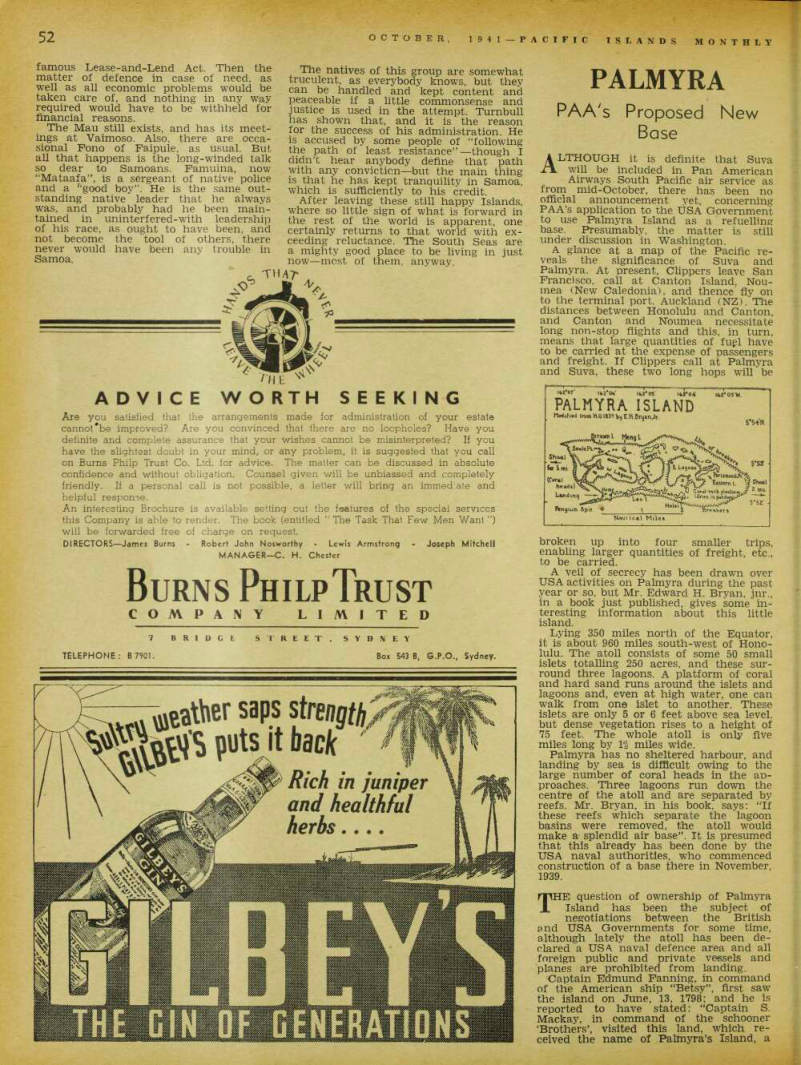
Lying 350 miles north of the Equator, it is about 960 miles south-west of Hono lulu. The atoll consists of some 50 small islets totalling 250 acres, and these sur round three lagoons. A platform of coral and hard sand runs around the islets and lagoons and, even at high water, one can walk from one islet to another. These islets are only 5 or 6 feet above sea level, but dense vegetation rises to a height of 75 feet. The whole atoll is only five miles long by Vh miles wide.
Palmyra has no sheltered harbour, and landing by sea is difficult owing to the large number of coral heads in the ap proaches. Three lagoons run down the centre of the atoll and are separated by reefs. Mr. Bryan, in his book, says: “If these reefs which separate the lagoon basins were removed, the atoll would make a splendid air base”. It is presumed that this already has been done by the USA naval authorities, who commenced construction of a base there in November, 1939.
THE question of ownership of Palmyra Island has been the subject of negotiations between the British and USA Governments for some time, although lately the atoll has been de clared a USA naval defence area and all foreign public and private vessels and planes are prohibited from landing.
Captain Edmund Fanning, in command of the American ship “Betsy”, first saw the island on June, 13. 1798: and he is reported to have stated: “Captain S.
Mackay, in command of the schooner ‘Brothers’, visited this land, which re ceived the name of Palmyra’s Island, a
few years after our discovery of it”.
Actually, the island received its name from the American vessel ‘‘Palmyra” which sought shelter there in November, 1802. It was also known as Samarang Island, from the visit of a ship of that name in 1840.
In 1859, Dr. Gerrit P. Judd landed from the brig “Josephine” and laid claim to Palmyra on behalf on the American Guano Co., for which he was agent.
Washington, apparently, did not recog nise the claim, for the deposits were not worked. Three years later, Captain A.
Bent, under a Royal Commission from King Kamehameha IV, took formal possession of the island for the Hawaiian Government. Bent subsequently sold his rights. Eventually, the island came into the possession of the Pacific Navigation Co., which sent a man and his wife there for a year (1885).
Commander Nichols, of H.M.S. “Cor morant”, formally annexed the island for Great Britain in 1889; but Palmyra was specifically included in the Hawaiian Islands by Act of the USA Congress, approved in 1898. Judge Henry E. Cooper, of Honolulu, purchased certain interests there in 1911; and the following year the cruiser “West Virginia” took formal possession in the name of the United States.
A small party went to the island in 1920 on behalf of the Palmyra Develop ment Co to investigate copra possibilities.
In 1922, Leslie and Ellen Fullard-Leo, of Honolulu, acquired some of Judge Cooper’s claims, the rest of which passed to his heirs when he died.
In 1938, the USA Navy commenced its first surveys of the atoll and a party to begin construction of a base left Honolulu in November, 1939.