Rotuma
p. 44 · Read in the full issue
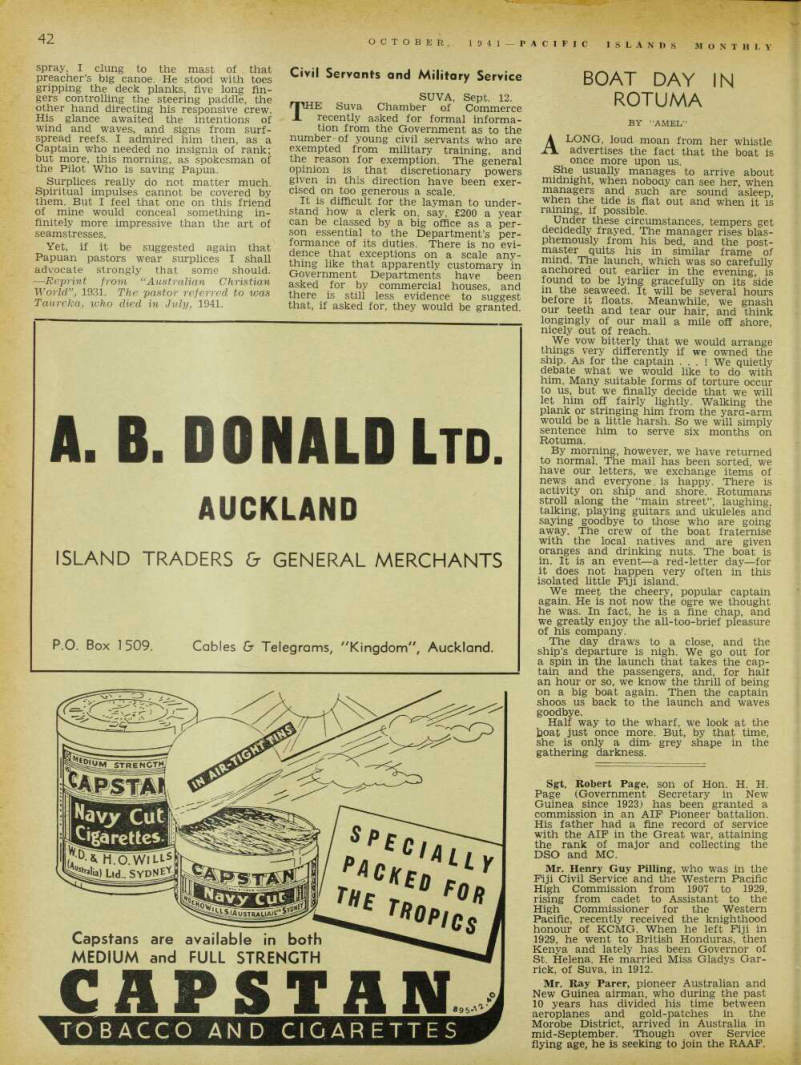
Boat Day In
By “Amel”
ALONG, loud moan from her whistle advertises the fact that the boat is once more upon us.
She usually manages to arrive about midnight, when nobody can see her, when managers and such are sound asleep, when the tide is flat out and when it is raining, if possible.
Under these circumstances, tempers get decidedly frayed. The manager rises blas phemously from his bed, and the post master quits his in similar frame of mind. The launch, which was so carefully anchored out earlier in the evening, is found to be lying gracefully on its side in the seaweed. It will be several hours before it floats. Meanwhile, we gnash our teeth and tear our hair, and think longingly of our mail a mile off shore, nicely out of reach.
We vow bitterly that we would arrange things very differently if we owned the ship. As for the captain . . . ! We quietly debate what we would like to do with him. Many suitable forms of torture occur to us, but we finally decide that we will let him off fairly lightly. Walking the plank or stringing him from the yard-arm would be a little harsh. So we will simply sentence him to serve six months on Rotuma.
By morning, however, we have returned to normal. The mail has been sorted, we have our letters, we exchange items of news and everyone is happy. There is activity on ship and shore. Rotumans stroll along the “main street”, laughing, talking, playing guitars and ukuleles and saying goodbye to those who are going away. The crew of the boat fraternise with the local natives and are given oranges and drinking nuts. The boat is in. It is an event—a red-letter day—for it does not happen very often in this isolated little Fiji island.
We meet the cheery, popular captain again. He is not now the ogre we thought he was. In fact, he is a fine chap, and we greatly enjoy the all-too-brief pleasure of his company.
The day draws to a close, and the ship’s departure is nigh. We go out for a spin in the launch that takes the cap tain and the passengers, and, for half an hour or so, we know the thrill of being on a big boat again. Then the captain shoos us back to the launch and waves goodbye.
Half way to the wharf, we look at the boat just once more. But, by that time, she is only a dim- grey shape in the gathering darkness.
Sgt. Robert Page, son of Hon. H. H.
Page (Government Secretary in New Guinea since 1923) has been granted a commission in an AIF Pioneer battalion.
His father had a fine record of service with the AIF in the Great war, attaining the rank of major and collecting the DSO and MC.
Mr. Henry Guy Pilling, who was in the Fiji Civil Service and the Western Pacific High Commission from 1907 to 1929, rising from cadet to Assistant to the High Commissioner for the Western Pacific, recently received the knighthood honour of KCMG. When he left Fiji in 1929, he went to British Honduras, then Kenya and lately has been Governor of St. Helena. He married Miss Gladys Gar rick, of Suva, in 1912.
Mr. Ray Parer, pioneer Australian and New Guinea airman, who during the past 10 years has divided his time between aeroplanes and gold-patches in the Morobe District, arrived in Australia in mid-September. Though over Service flying age, he is seeking to join the RAAF.