Ancient Cannon at Was if
p. 42 · Read in the full issue
Was if From "Fort au Prince"?
Letter to the Editor T WAS rather interested in a “PIM”
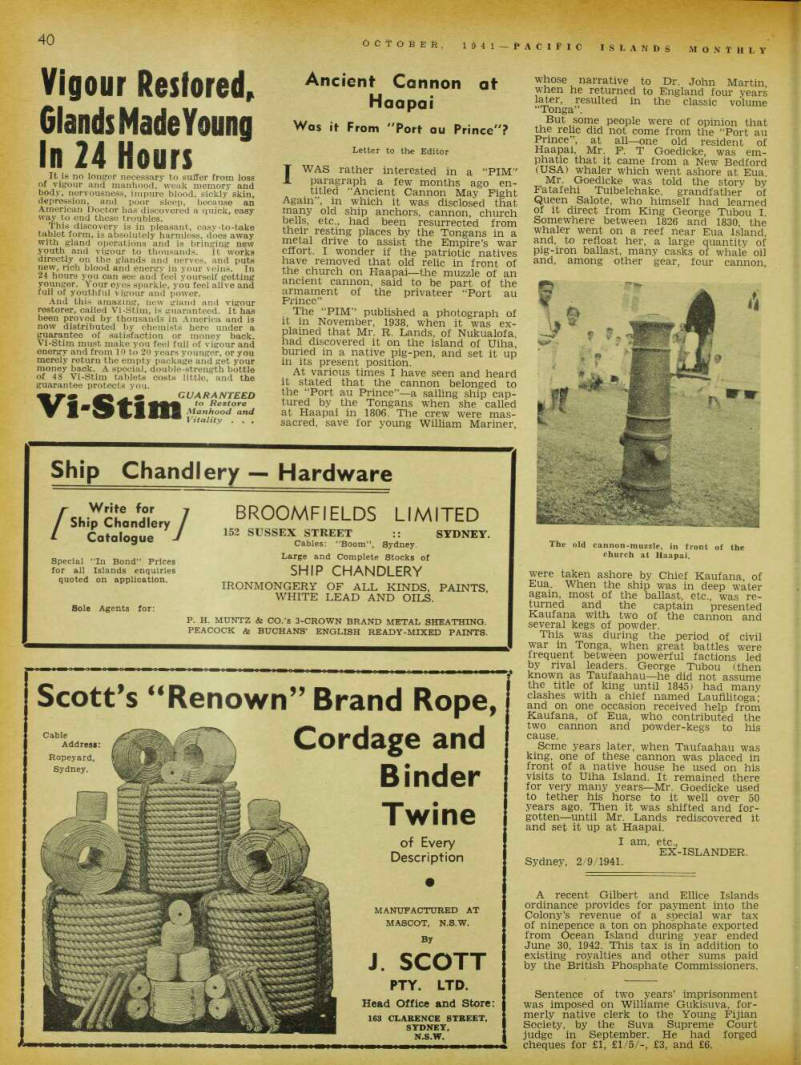
I narnornnh a f DnT A a mon ths ago en- A . Ancient Cannon May Fight Again , in which it was disclosed that many old ship anchors, cannon, church bells pfp T , Pcm , f^Awi their rP-stVno- resuirected from places by the Tongans in a metal drive to assist the Empire’s war effort. I wonder if the patriotic natives have removed that old relic in front of the church on TTnnnch 7 u muzzle of an ancient cannon, said to be part Of the armament of the privateer “Port au PTince”
The “PIM” published a photograph Of it in November iQqa whoVi if nla neH p I S , r .\ Lands, of Nukualofa, i} ac * discovered it on the island of Uiha, buried in a native pig-pen, and set it up in its present position At various times I have seen and heard stated that the cannon belonged to the ‘‘Port au Prince”—a sailing ship cap tured by the Tongans when she called at Haapai in 1806. The crew were mas sacred, save for young William Mariner,
whose narrative to Dr. John Martin, when he returned to England four years res ulted in the classic volume Tonga”.
But some people were of opinion that the relic did not come from the “Port au Prince”, at all—one old resident of Haapai, Mr. P. T Goedicke, was em phatic that it came from a New Bedford (USA) whaler which went ashore at Eua.
Mr. Goedicke was told the story by Fatafehi Tuibelehake, grandfather of Queen Salote, who himself had learned of it direct from King George Tubou I Somewhere between 1826 and 1830, the whaler went on a reef near Eua island, and, to refloat her, a large quantity of pig-iron ballast, many casks of whale oil and, among other gear, four cannon,
were taken ashore by Chief Kaufana, of Eua. When the ship was in deep water again, most of the ballast, etc., was re turned and the captain presented Kaufana with two of the cannon and several kegs of powder.
This was during the period of civil war in Tonga, when great battles were frequent between powerful factions led by rival leaders. George Tubou (then known as Taufaahau—he did not assume the title of king until 1845) had many clashes with a chief named Laufilitoga; and on one occasion received help from Kaufana, of Eua, who contributed the two cannon and powder-kegs to his cause.
Some years later, when Taufaahau was king, one of these cannon was placed in front of a native house he used on his visits to Uiha Island. It remained there for very many years—Mr. Goedicke used to tether his horse to it well over 50 years ago. Then it was shifted and for gotten—until Mr. Lands rediscovered it and set it up at Haapai.
I am, etc.,
Ex-Islander.
Sydney, 2/9/1941.
A recent Gilbert and Ellice Islands ordinance provides for payment into the Colony’s revenue of a soecial war tax of ninepence a ton on phosphate exported from Ocean Island during year ended June 30, 1942. This tax is in addition to existing royalties and other sums paid by the British Phosphate Commissioners.
Sentence of two years’ imprisonment was imposed on Williame Gukisuva, for merly native clerk to the Young Fijian Society, by the Suva Supreme Court judge in September. He had forged cheques for £l, £l/5/-, £3, and £6.
The old cannon-muzzle, in front of the church at Haapai.