tolt
p. 36 · Read in the full issue
Papua Could Grow
Rice
How to Save Ships and Exchange
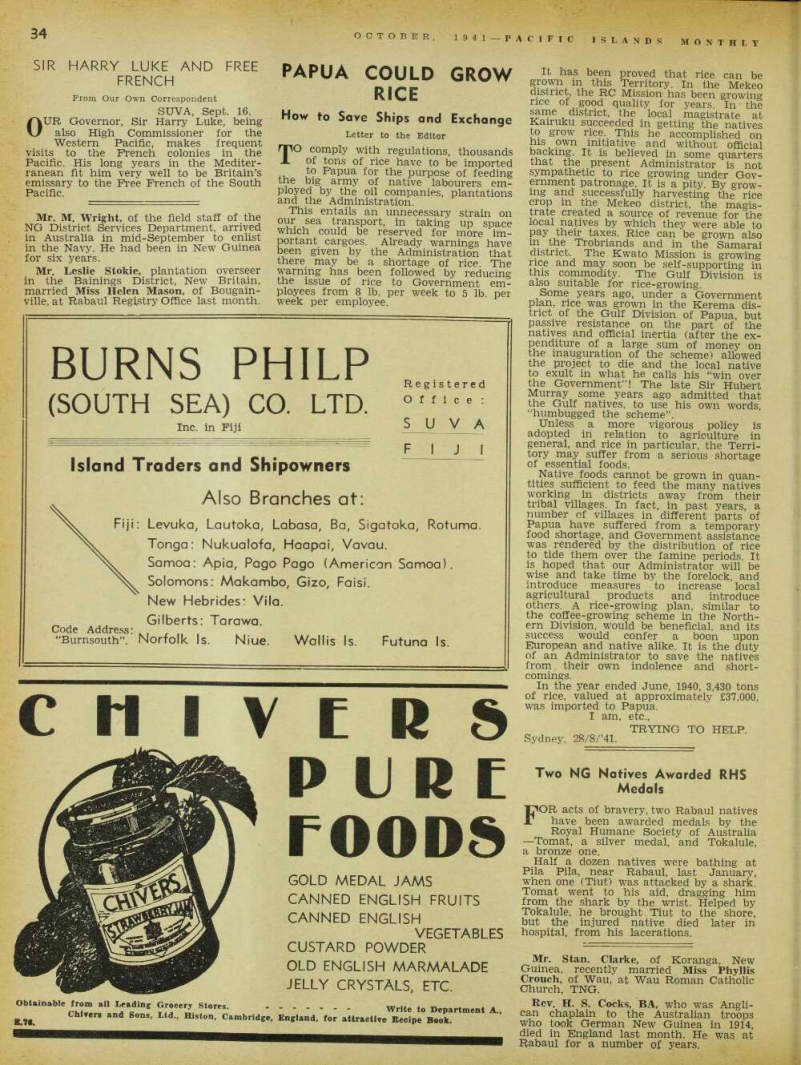
Letter to the Editor , ... , comply with regulations, thousands -*■ of tons of rice have to be imported £9 Papua for the purpose of feeding the big army of native labourers em ployed by the oil companies, plantations and the Administration.
“hfkfn?
which C ould b p e reserved k for more’im nortant raro-np<? AirenHv hil
tolt
there may be a shortage of rice The warning has been followed by reducing the issue of rice to Government em ployees from 8 lb. per week to 5 lb per week per employee.
It has been proved that rice can be grown m this Territory. In the Mekeo district, the RC Mission has been growing nee of good quality for years. In the same district, the local magistrate at Kairuku succeeded in getting the natives to grow rice. This he accomplished on his own initiative and without official backmg. It is believed in some quarters that the present Administrator is not sympathetic to rice growing under Gov ernment patronage. It is a pity. By grow ing and successfully harvesting the rice crop in the Mekeo district, the magis trate created a source of revenue for the local natives by which they were able to pay their taxes. Rice can be grown also m the Trobriands and in the Samarai district. The Kwato Mission is growing rice and may soon be self-supporting in this commodity. The Gulf Division is also suitable for rice-growing.
Some years ago, under a Government plan, rice was grown in the Kerema dis trict of the Gulf Division of Papua, but passive resistance on the part of the natives and official inertia (after the ex penditure of a large sum of money on the inauguration of the scheme) allowed the project to die and the local native to exult in what he calls his “win over the Government”! The late Sir Hubert Murray some years ago admitted that the Gulf natives, to use his own words, “humbugged the scheme”.
Unless a more vigorous policy is adopted in relation to agriculture in general, and rice in particular, the Terri tory may suffer from a serious shortage of essential foods.
Native foods cannot be grown in quan tities sufficient to feed the many natives working in districts away from their tribal villages. In fact, in past years, a number of villages in different parts of Papua have suffered from a temporary food shortage, and Government assistance was rendered by the distribution of rice to tide them over the famine periods. It is hoped that our Administrator will be wise and take time by the forelock, and introduce measures to increase local agricultural products and introduce others. A rice-growing plan, similar to the coffee-growing scheme in the North ern Division, would be beneficial, and its success would confer a boon upon European and native alike. It is the duty of an Administrator to save the natives from their own indolence and short comings.
In the year ended June, 1940, 3,430 tons of rice, valued at approximately £37,000, was imported to Papua.
I am, etc.,
Trying To Help.
Sydney, 28/8/’4l.