A Union of Pacific Territories After the War?
pp. 7-8 · Read in the full issue
IT is far too early, yet, to start speculating about the probable political future associations of the Pacific Territories; but, even now, speculation can be interesting.
Dwellers in the Pacific wonder, natur ally enough, where they are going, and under what flag their future will lie.
The Nazis will be defeated in their plan of world hegemony. The char acter of their defeat will determine the extent to which they, in future, will dominate the Continent of Europe. Neither they, nor their allies, will dictate the political future of Pacific countries.
Probably, after this war, there will be a conference of all the nations, victorious and defeated and non belligerent; but in this conference the dominant voices will be those of a strong, intensively-armed Britain, Russia and United States—three Powers determined that, on this oc casion, something really will be done to abolish from the earth the systems which produce war—and they will have the failures of Versailles and the League of Nations to guide them.
We may expect a genuine effort to retain the League of Nations and make it work. But it will work only if it is fully supported by the United States, and is given teeth. In other
words, there must be always at the disposal of the League of Nations forces powerful enough to curb and cow the dictators and the predatory nations of the future.
A LEAGUE of Nations, or some thing of the kind, may solve some of the Pacific’s political prob lems. Future world opinion, most definitely, will be against territorial aggrandisement. That means that a number of important Pacific Terri tories, now floating around loose—one refers particularly to the Mandated Territories of New Guinea and Western Samoa, the now semi-inde pendent Commonwealth of the Philip pines, the French colonies of New Caledonia, New Hebrides and French Oceania—may not be permitted to follow their natural desire to be per manently attached to one or other gf the Powers, but may be compelled to exercise some form of self-govern ment under League control.
New Guinea and New Hebrides, for example, may wish to become Austra lian territories. But world opinion— and especially American opinion— almost certainly will be against any additions to the already swollen British Empire. If it could be shown that Australia, during her twenty years of Mandate guardianship, had
done anything worth noting in deve loping the natural resources of New Guinea, or in improving the educa tional and living standards of the 750 o qo natives Australia might put up a g OOC i case f or taking over New Guinea permanently and perhaps a I SO f o r bringing New Hebrides and j- hp Solomons under her wins But— -1 * from the establishment of the gold industry, for which official Aus tralia can claim no credit—Australia’s re cord in New Guinea is unimpressive a 20-years period in which Austra lian ex-politicians have been allowed t 0 sit in the “ CUS hy” j 0 b of Adminis trator and twiddle futile thumbs N ’ thplp „ unless some eood
iSaL
under Wlll remam unde Australian control, The position of the Philippines is intriguing. America definitely is committed to giving the group corn plete independence. The country al ready is half-way through the change over; and, in a few years, unless the United States Congress goes into re verse on Philippines’ policy, the Re public of the Philippines will be born, But, already, the open maw of a wait ing Japan has scared the Filipinos, and they have lost all their formei eagerness for independence. They think they would like to stay with America. But America is not en thusiastic. It seems an open-and
shut proposition for League of Nations protection.
EVERYONE is guessing about the future of the French colonies.
One hears, in places, “New Caledonia and New Hebrides to Australia and French Oceania to the United States”.
But, most definitely, that disposition is wanted neither by Australia nor the United States. If France could be quickly restored to her 1939 con dition, all would be simple. But it is doubtful whether even the complete overthrow of Germany in Europe would bring about either a united France or a re-united French Empire.
The stain of Vichy must be wiped out —perhaps in blood—before France again will control an Empire. Mean while, what of New Caledonia and French Oceania, now overwhelmingly anti-Vichy?
MAYBE, this is a time when we might consider the prac ticability of some kind of Pacific Islands Confederation, or Union, to function under the protection of a League of Nations.
Omitting the Philippines, we may note that, south of the Equator, there are (west to east) the terri tories of Papua, New Guinea, Solo mons, New Caledonia, Gilbert and Ellice Colony, Fiji, Tonga, Western and Eastern Samoa, Cook Islands and French Oceania. They are governed from either London, Washington, Canberra, Wellington or (nominally) Paris. Not one territory seems satis fied with its government—almost all complain of non-representation of taxpayers.
The conditions of administration and the problems of government in all of them are almost identical. Yet governmental bureaus in London, Washington, Paris, Wellington and Canberra, knowing little or nothing of tropical islands’ conditions, have been struggling with the problems for decades—and, for the most part, without any consultation one with the other!
Why not a federal authority, estab lished in a central place like Suva, to
protect the interests of all the groups, to encourage their development, to study their problems, to give all of them adequate representation, and to act as a clearing-house for adminis trative data?
If something like that could be established, in the post-war settle ment, a new era surely would dawn in the Pacific Islands.
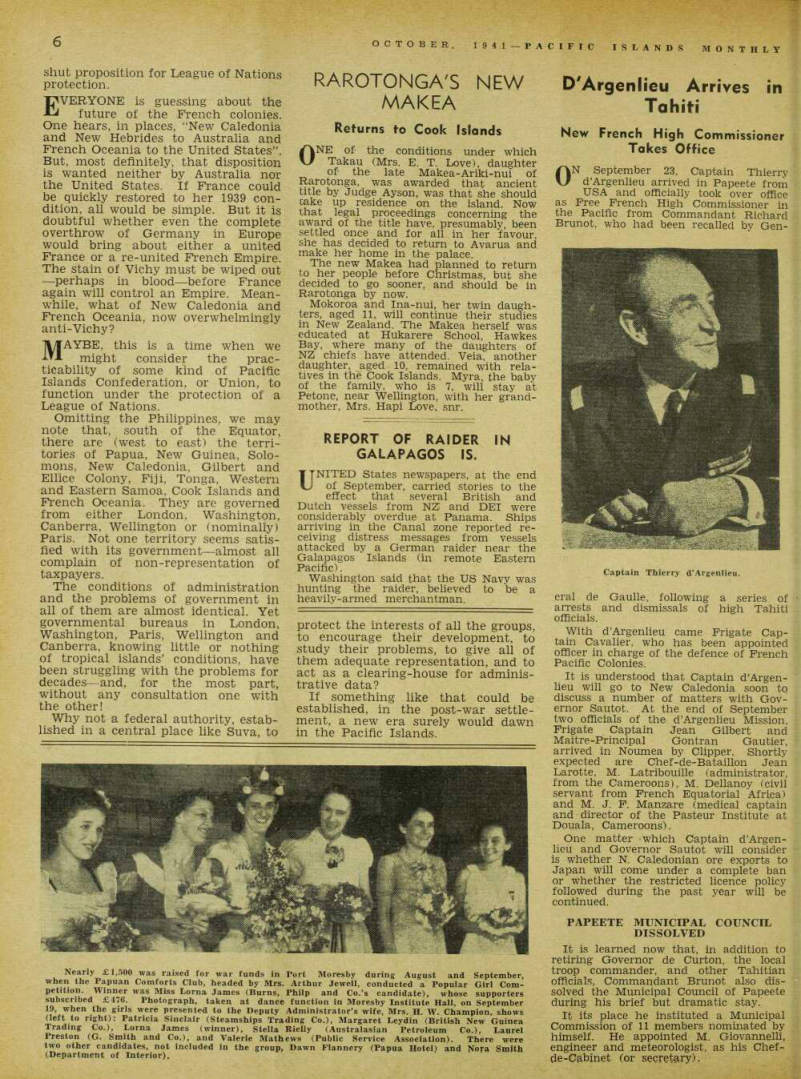
Nearly £1,500 was raised for war funds in Port Moresby during August and September, when the Papuan Comforts Club, headed by Mrs. Arthur Jewell, conducted a Popular Girl Com petition. Winner was Miss Lorna James (Burns, Philp and Co.’s candidate), whose supporters subscribed £476. Photograph, taken at dance function in Moresby Institute Hall, on September 19, when the girls were presented to the Deputy Administrator’s wife, Mrs. H. W. Champion, shows (left to right): Patricia Sinclair (Steamships Trading Co.), Margaret Leydin (British New Guinea Trading Co.), Lorna James (winner), Stella Rielly (Australasian Petroleum Co,), Laurel Preston (G. Smith and Co.), and Valerie Mathews (Public Service Association). There were two other candidates, not included in the group. Dawn Flannery (Papua Hotel) and Nora Smith (Department of Interior).