Native Degeneracy Causes Alarm In
pp. 53-56 · Read in the full issue

New Guinea
Lamentable Effect of Administration's Failure to Produce a Native Control Policy
By R. W. Robson
IF Australia had anything like a normal Government, the Minister respon sible for Pacific Territories adminis tration would be bound to take official notice of the accumulating evidence of deteriorating morale among New Guinea’s “civilised” natives, and to seek the cause and the remedy.
As it is, nothing is likely to happen, until some ugly outbreak among the natives forces officialdom to panic stricken action. By then, much harm will have been done, and remedial mea sures will be correspondingly difficult.
The Australian Government is not normal. At this time of gravest crisis in Imperial affairs, Australia has what is probably the weakest, blindest and most inefficient government in the history of the Commonwealth. That is the price the Australian people must pay for tolerating professionalism in politics and permitting the most selfish interests to dominate Parliaments. The New Guinea Territory, apparently, must suffer along with the mainland of Australia.
FROM one end of the Mandated Ter ritory to the other, thoughtful and far-seeing Europeans are giving warnings of deteriorating native morale, and asking, most urgently, that the Administration formulate a native con trol policy which will take care of pre sent evils and future needs. These evils may be summed up as follows: — 1. Insolence and disobedience among indentured native labourers on mines and plantations; and cheekiness and laziness among house-servants —all being the result of the inability of the employer to administer even minor cor poral punishment. 2. Refusal on the part of a growing number of time-expired labourers to enter into indentures again—they prefer to hang around the towns and accept engagements at a weekly wage, which is higher than the indentured wage. 3. A steadily-growing spirit of hooli ganism among both indentured and un indentured natives, which is seen not only in the cheekier attitude of natives generally, but also in a marked increase in the volume of petty crime—drunken ness, gambling, sodomy, “sing-sing” orgies which often extend over a week end, theft, and so on.
These things are most frequently refer red to at the Morobe end of New Guinea.
But statements published in the “Rabaul Times”, during the past two or three years, indicate similar alarming condi tions in the New Britain district.
Matters came to a head recently when a young woman was brutally murdered in Wau, apparently by a drink-crazed native. The evidence placed before the coroner provided so startling a story of drunken and sexual orgies among native labourers, and of habitual theft, gambling and lack of discipline among native house-servants, that the coroner point edly directed official attention to It.
After that, a committee of Morobe citizens demanded that the Administra tion should protect European residents in the Territory by exercising stricter con trol over natives. But there is, as yet, no indication that either Rabaul or Canberra is going to do anything about it.
The plain fact is that the formulation
of a policy which will really control these now sophisticated natives, and ensure better conditions in the future, calls for a degree of knowledge, experi ence and understanding that apparently is lacking in authoritative quarters in Rabaul, and which cannot be found in Canberra.
MURMURINGS against New Guinea’s native policy (or lack of it) were heard first in the ’twenties; and by 1930 and 1931, when the “PIM” began to publish articles on the subject, complaints were loud and frequent.
Administrators who held office between 1921 and 1932, mostly political appointees, apparently were incapable of formulat ing any policy which called for a cul tured mind, statesmanlike vision and real knowledge of native control.
The late Sir Hubert Murray, watching critically from across the Papuan bor der, more than once expressed to this
writer his alarm at what he saw coming aS reSUlt ° f - compla cent ignorance and inexperience in
SJg r itiV S Melanesians Sir
Hubert, a wise and experienced Pacific
administrator, said that it was an administrative crime that private employ ers, dominated usually by commercial considerations, should be given the responsibility of controlling the transfer of these primitive people from Stone Age to Machine Age conditions.
If Sir Hubert could view the Mandated Territory to-day. he would see, there, justification of his misgivings and his warnings.
There was a ray of hope in 1932, when wise, hard-working, far-seeing Thomas Griffiths became Administrator. He applied himself at once to the formula tion of a native control policy; and in 1933 I saw the scope of his wisdom in two things—in “flash” native law-break ers sweating in the gaol-yards under pack-drill (and so learning that cala boose was something more than a well provisioned holiday resort), and in the General’s close and frequent consulta tions with the old-established missions, to which he turned naturally and pro perly for help and guidance in control ling the present generation of natives, and educating those of the future.
BUT Thomas Griffiths lasted less .than two years. To the dismay of those of us who had found inspiration and hope in his New Guinea work, he suddenly retired. He never has uttered one word against Canberra: but there is no doubt at all that Canberra’s petty officialdom drove him out.
Griffiths knew what New Guinea wanted, and he was determined to sup plv that need. He was no ornamental place-holder and salary-grabber. To him, residence in Rabaul was a discom fort and a sacrifice—but he endured both, in the belief that he was doing an Imperial job.
When Canberra nagged and niggled, and interfered with everything that it
could not understand, Thomas Griffiths said politely that he would not carry on, and he went back happily to his home and family in Melbourne.
In 1934, there came to the Adminis tratorship Brig.-General W. R. McNicoll subsequently knighted. He had been awarded high honours in the 1914-18 war; he had been head of a country Presbyterian Ladies’ College from 1921 to 1931; and he had had three years in Parliament; but of tropical administra tion he had had not one minute’s prac tical experience. His appointment was regarded as a political one, and it was— and still is—deeply resented by the pub lic services of Australia’s tropical terri tories. That has not made for a spirit of co-operation.
THE condition of native affairs was by no means good in 1934; since then, it has deteriorated steadily. The Administrator has made one or two sin cere but fumbling attempts to do some thing about it. But the remedy—and, above all, the formulation of a policy for the guidance of the administrative ser vice and the direction of future adminis trations—calls for a firm hand, informed by real knowledge, experience and under standing of native affairs. And the events of 1934-41 have shown, with lamentable clarity, that those qualities are not to be found in Rabaul.
It now has become an ugly problem and an appalling job, this native posi tion in New Guinea. It has been too long neglected, and it is difficult now to suggest how it should be dealt with.
Certainly, an inquirer should first investigate the causes of the deteriora tion of native morale. He probably would find that the trouble became rapidly worse as more Australians, un accustomed to handling native labour, entered the goldfields area. They did
not realise that these natives were in a condition of change—bewildered folk caught between the primitive and the
sophisticated.
Many natives were exasperatingly stupid; but many also were sensitive and intelligent, and capable of being turned, by sympathetic treatment, into law abiding citizens and loyal helpers of the Europeans. By far too many employers they were just “a bunch of coons”, to be driven to labour like cattle. There were good employers—but there were too many bad employers.
How many of those tough miners from Australia, driving their lines of boys in the sodden gorges of the Bulolo, realised that, to the natives, they were tne repre sentatives of a race of white gods? How many recognised their obligation to help these poor creatures over the wobbly, puzzling bridge between Stone Age (the villages whicn they had just leit) and Machine Age (the life which they would know in the future)?
Some did, but they were not many. In far too many instances, the native labourers were not only exploited, but were allowed to appreciate the fact that they were exploited. They realised that their employer, so far from being a white god, was merely a hard bargainer in the labour market. In some cases, they found themselves, under white mans law, virtually the chattels of a short tempered, hard-drinking, filthy-mouthed, fornicating gentleman, whose main ambi tion was to feed and snore in his hut, while his “niggers” worked his claim.
This kind of employer usually doled out a minimum of food and supplies. The labourers were primitive—but not so primitive that they could not recognise and resent the brutality of their treat ment.
ISAW things on the Morobe goldfield in 1932 which made me sick on the stomach. I was certain that those conditions would lead to serious trouble —and I said so, emphatically, to Sir Hubert Murray, in Port Moresby, on my Way back. A new Administrator, Gen eral Griffiths, had just taken charge, so I published nothing.
At that time, in private letters, I expressed the opinion that if any wan dering writer got into the Morobe end of New Guinea, and saw what was being done with native labour, he would write a book comparable with “Red Rubber”, that startling expose of what pre-war Belgium was doing in the Congo. But I kept quiet, in the hope that Australia presently would properly take hold of her responsibilities to New Guinea natives, and make of her Mandate administration as creditable a job as she had done in Papua.
Griffiths departed, and McNicoll came, and again I hoped that native affairs would be placed under decisive orderli ness and control. But nothing much has been done —the dreadful policy of laissez faire lies like Matupi dust over everything.
MEANWHILE, year by year, step by
step, the primitive natives of New Guinea, being under no kind of moral or educational check, have emu lated the worst traits of their white masters, and have become cunning, de ceitful, covetous and vice-ridden.
Is it realised in complacent Canberra, for instance, that for over ten years there have been at least 10,000 inden tured labourers jammed together in crude barracks on the Morobe goldfield, without any organised means of recrea tion, without educational facilities, with out women, and with very little in the way of moral education or control?
Of course, these are not the same 10,000 labourers. There is a constant coming and going, as time-expired men are replaced.
And what becomes of men who do not sign on again? They go back to their villages, taking with them a knowledge of the ways of white men—and, unfor tunately, of the ways of white women, for there have been of harlots and semi harlots quite a few on the Morobe field —sufficient to undermine and perhaps destroy European prestige.
This is no idle suggestion. Long ago, far-sighted people pointed out, to the • PIM”, the inevitable result of sending thousands of sophisticated boys back each year to their primitive villages; and the “PIM” emphasised the danger.
But na one displayed any interest. It takes more than “newspaper hooey” to lift bureaucrats in comfortable jobs out of their pleasant routine.
THE foregoing, of course, deals only with the Morobe angle of a Terri tory-wide problem, and indicates only some of the causes.
The whole problem requires considera tion by a committee of experts, who would study cause, effect and remedy.
For the personnel of the committee one need go no farther than the Executive and Legislative Councils of New Guinea.
There are men there thoroughly capable
of recognising, presenting and solving New Guinea’s native problem, and for mulating a practical policy. Messrs. E.
Taylor and R. Melrose, heads of the Native Affairs Department, are officers of outstanding ability—the present con dition of native affairs in New Guinea is not their fault—although, unhappily, it is their responsibility.
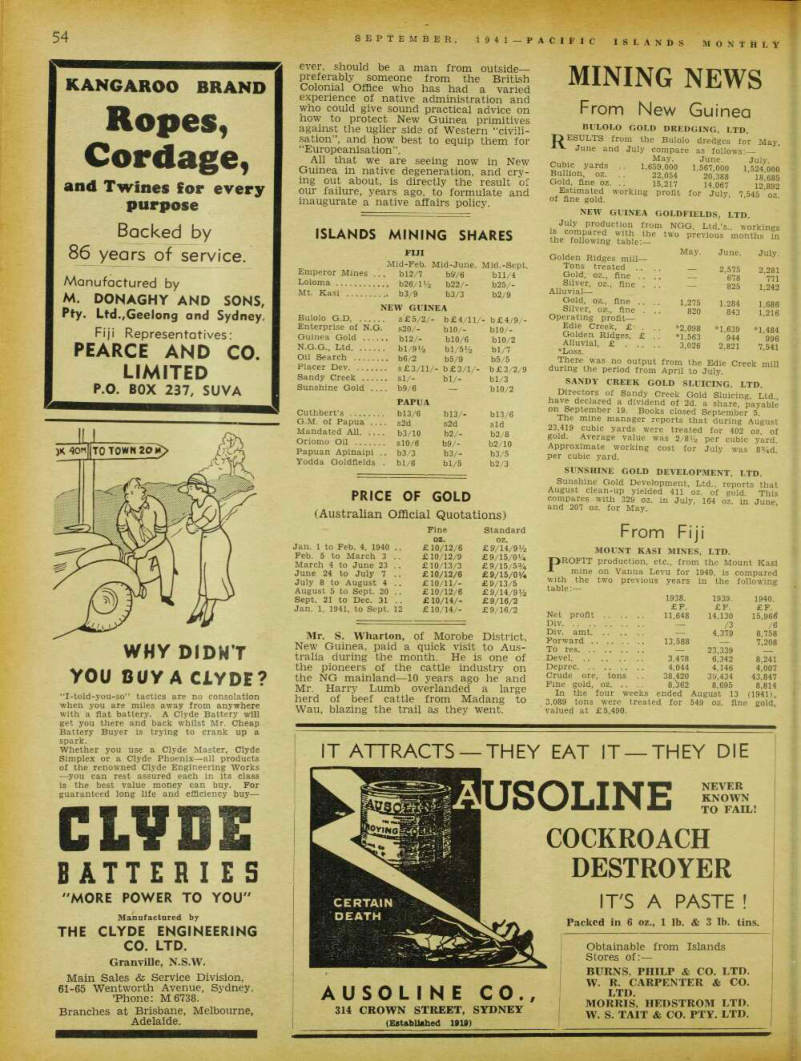
The head of such a committee, how
ever, should be a man from outside— preferably someone from the British Colonial Office who has had a varied experience of native administration and who could give sound practical advice on how to protect New Guinea primitives against the uglier side of Western “civili sation”, and how best to equip them for “Europeanisation”.
All that we are seeing now in New Guinea in native degeneration, and cry ing out about, is directly the result of our failure, years ago, to formulate and inaugurate a native affairs policy.