Prospecting on the Fly
pp. 46-47 · Read in the full issue
River, 1875
By R. B. Howard
TN 1875, a party of diggers met in Cook m°™! r S I . eir . cai 4P at v , lslt I;he sea f th6ir g ° M aRd gBt a At th . e some excitement was apparent owing to a report by “German vT a 5 ry and “Nick the Greek” that they , nad se ® n 8 of gold-bearing stone in §. a v?, Ld 4 1 a yillage, some distance up the Fly River, in New Guinea. The 19, •^ eI \ ea serly discussed, and it was d< £s?® d 1 take;a trip to investigate.
names of comprisingX party^so
will call them by the names by which they were generally known.
First, there was “Red Dick”, who held a first mate’s certificate. “Dublin Bob” was an able seaman. The others were Christy, “Talavera Jack”, “The Squeezer” and “Long Dick”.
A suitable lugger was procured, and put in good sea-going order, with the necessary charts, ample fire-arms and food.
Cooktown was left early one morning.
Cape Direction was soon reached, where we dropped anchor in Lloyd Bay. A native abo. boy was recruited to act as pilot.
The next place of call was Somerset, where that grand old pioneer, Frank Jardine, was interviewed. He gave us some useful information about the in tricacies of the Barrier.
At Thursday Island we, replenished our stores and set sail for the Fly River.
After a few days, we reached Daru, where another native boy was recruited to act as interpreter. We called him Goggles.
Soon after, we entered the Fly and passed a village occupied by the Tugeri tribe, reputed to be the most blood thirsty cannibals along the coast.
A day or two later, we came to another village. Here, the people were friendly, but could not give us any information about gold-bearing stone. Subsequently, we called at several villages, but failed to find any evidence of there being gold in the vicinity.
After proceeding many more miles, we came to the junction of a large stream and the Fly. Here we found a large vil lage. The place was deserted, but num bers of human skulls were lying about, some of them still quite fresh—a grue some sight.
In a short time an old man appeared, apparently from nowhere. On being questioned by Goggles, and on being shown a specimen of quartz, he said, pointing to some conical hills in the dis tance, that there was plenty there, and he promised to provide a guide for us the next day.
True to his promise, the guide put in an appearance, accompanied by a num ber of natives, but no women or child
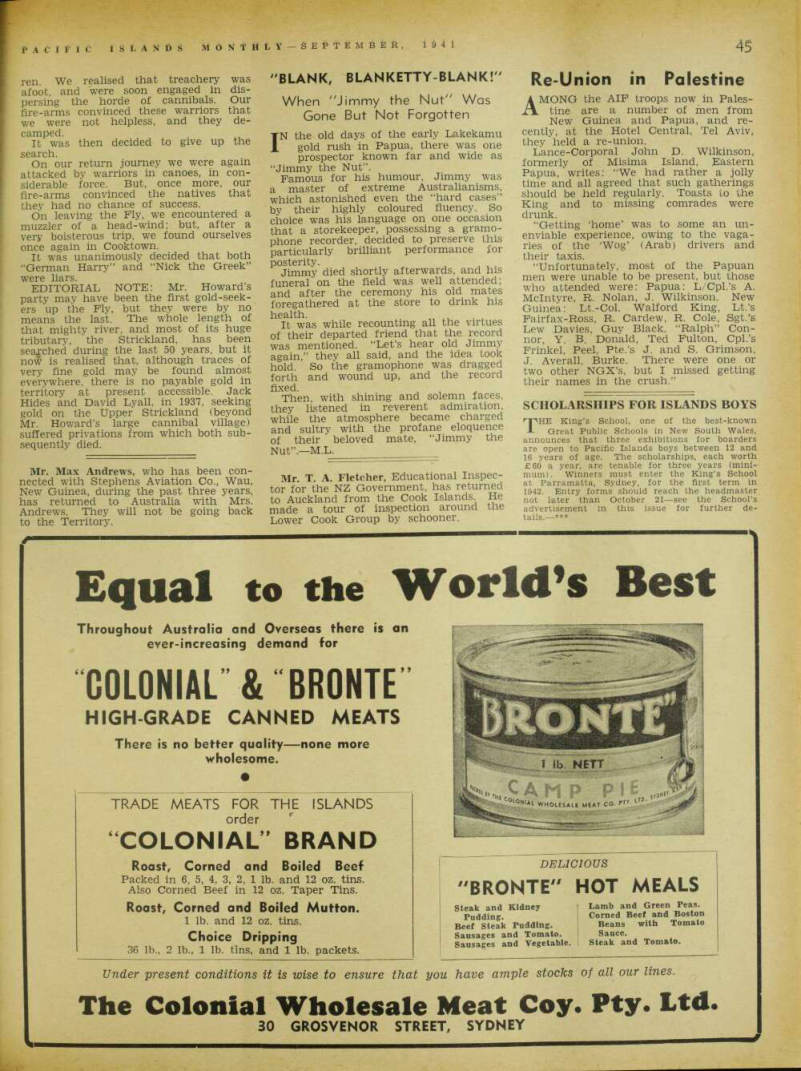
Mr. R. B. Howard, of Navua, Fiji.
ren. We realised that treachery was afoot, and were soon engaged in dispersing the horde of cannibals. Our fire-arms convinced these warriors that we were not helpless, and they decamped.
It was then decided to give up the search.
On our return journey we were again attacked by warriors in canoes, in considerable force. But, once more, our fire-arms convinced the natives that they had no chance of success.
On leaving the Fly, we encountered a muzzier of a head-wind; but, after a very boisterous trip, we found ourselves once again in Cooktown.
It was unanimously decided that both “German Harry” and “Nick the Greek” were liars.
EDITORIAL NOTE: Mr. Howard’s party may have been the first gold-seekers up the Fly, but they were by no means the last. The whole length of that mighty river, and most of its huge tributary, the Strickland, has been searched during the last 50 years, but it nol is realised that, although traces of very line gold may be found almost everywhere there is no payable gold in territory at present accessible. Jack Hides and David Lyall, in !037, seeking gold on the Upper Strickland (beyond Mr. Howard’s large cannibal village) A? prp j nriva firms from which both subsequenuy Qiea. u u u Mr. Max Andrews, who has been connected with Stephens Aviation Co., Wau, New Guinea, during the past three years, has returned to Australia with Mrs.
Andrews. They will not be going back to the Territory.